Your campaign goes out, and a slice of it comes straight back:
554 Service unavailable; Client host [your IP] blocked using b.barracudacentral.org
Before you touch a delisting form, answer one question: which Barracuda blocked you? Barracuda runs two entirely separate things that both reject mail, both put the word “Barracuda” in your bounce, and have completely different fixes. Senders routinely spend a week filing removal requests with Barracuda Central for a block Barracuda Central has no power to lift.
This guide separates the two, then walks the fix for each in the order that works.
Table of Contents
The Two Barracudas: BRBL vs. the Gateway
1. The Barracuda Reputation Block List (BRBL)
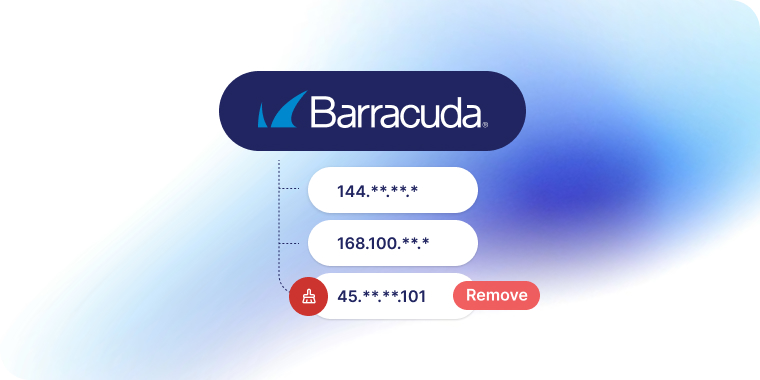
The Barracuda Reputation Block List (BRBL) is a public DNSBL published at the DNS zone b.barracudacentral.org. Any mail server operator can point their filter at it — Postfix, Exchange, Domino, sendmail, qmail. BRBL is free, but not open: you must register your DNS resolver IPs at barracudacentral.org/account/register (up to 10 IPs) before querying. Unregistered queries may work initially and then be rate-limited or cut off without warning. If you are on it, you are blocked at every site querying that zone, most of them not Barracuda customers at all. This list is centrally managed, and Barracuda Central can remove you from it.
2. Barracuda’s gateway products
the Email Security Gateway appliance and the cloud-based Email Gateway Defense — are filters individual companies buy and run in front of their own mailboxes. Two names worth knowing when you talk to a recipient’s IT team. The appliance is largely withdrawn (Barracuda sells it in Japan, Malaysia, Saudi Arabia and Vietnam only, and 100/200 sales ended October 2020), so most gateway blocks today come from the cloud product — renamed to Email Gateway Defense from the earlier Email Security Service / Barracuda Essentials, names older admins may still use. Each deployment is run by that company’s IT staff, who set their own thresholds, block lists, and content policies. Barracuda Central doesn’t operate these and can’t change them.
BRBL and the gateway overlap but aren’t the same. A gateway may consult BRBL as one input, and its admin can exempt your IP locally — in Email Gateway Defense under Inbound Settings > Anti-Spam/Antivirus > Barracuda Reputation Block List Exemptions, or on the legacy appliance under BLOCK/ACCEPT > IP Reputation. Naming the right path saves the admin a hunt. But that’s a local override — it removes nothing from the public list.
So the two failure modes are:
- You are on BRBL. You’ll see rejections from many unrelated domains at once. Fix: clean up, then file a removal request with Barracuda Central.
- One company’s gateway is blocking you. You’ll see rejections from one domain (or a handful) while everything else delivers fine. Fix: the recipient’s admin allowlists you. Barracuda Central is not involved and cannot help.
How to Confirm Which One Is Blocking You
Start with the lookup. Barracuda publishes a reputation lookup tool for IPs and domains at barracudacentral.org/lookups. Enter your sending IP.
Then grep your bounce logs. A rejection naming b.barracudacentral.org — typically 554 Service unavailable; Client host [IP] blocked — means the receiving server queried the public list. A bounce mentioning Barracuda with no reference to that zone is the gateway pattern.
Now count distinct recipient domains. This diagnostic matters more than the bounce text:
The third row is the one people get wrong. If the lookup says you are not listed and one company is rejecting you, a removal request accomplishes nothing — there is nothing to remove.
The 5 Most Common Reasons Barracuda Lists a Sender
1. Spam trap and honeypot hits
This is the signal we see behind most listings. Barracuda’s documentation states its reputation database is built from data “collected from spam traps and other systems throughout the Internet,” fed by its deployed device network. Barracuda says only that traps feed the database, not how it weights them against other signals — but because trap hits are unambiguous evidence of bad data, our inference is that they escalate a listing faster than volume or complaints do. Any list not cleaned in a year is mailing traps.
2. Purchased, scraped, or appended contact data
Bought lists are dense with recycled and pristine traps. Because Barracuda’s listing decisions are automated and trap-driven, purchased data is the shortest path onto b.barracudacentral.org.
3. Sending to dead addresses
High hard-bounce volume tells the automated system you don’t know who is on your list — and recycled traps are, by definition, addresses that used to bounce. Barracuda publishes no bounce-rate threshold; as general deliverability practice, keep total bounce rate under 1%. Running old lists through an email verification service before you mail them again is the quickest way to get there.
4. A volume spike from a cold or lightly-used IP
An IP with little sending history that suddenly pushes large volume reads as a compromised host. The system reacts to the anomaly, not your intent.
5. Content and link reputation
Barracuda scores message content and the domains you link to, not just your IP. URL shorteners, affiliate redirect chains, and link domains with their own poor history get you filtered even when your IP is clean — this is the usual explanation for a gateway block with a clean lookup result.
How to Fix It: Step by Step
Order matters here more than anywhere else. Barracuda Central states plainly on its removal page that “Requests without valid information will be ignored. Multiple requests will also be ignored.” Filing early, vague, or repeatedly burns the one channel you have. Fix first, then ask, once.
Step 1: Identify which Barracuda, using the table above
Everything downstream depends on this. Do not skip it.
Step 2: Stop sending to the affected destinations
Pause delivery from the blocked IP to the domains rejecting you — retrying through a block keeps generating the signal that caused it. If your platform retries automatically, suppress the destinations rather than relying on backoff.
Step 3: Fix the root cause
- Verify the affected list and remove invalid addresses
- Suppress everyone with no engagement in the last 90 days — this is where recycled traps live
- Delete purchased, appended, or third-party data outright
- Remove role accounts from marketing sends
- Audit your links: no URL shorteners, no redirect chains, no borrowed link domains
- Find the volume change or new import that preceded the block, and identify it by name
Step 4a: If you are on BRBL — file the removal request
The form is at barracudacentral.org/rbl/removal-request. It requires your email server IP address, your email address, and a phone number. Barracuda Central Customer Name, Customer Email, and Reason for Removal are optional fields.
Two practical notes. The phone number and email must be real and reachable — an unreachable contact is how a request quietly dies. Use an address on a domain other than the blocked one so you actually receive the reply. And “Reason for Removal” is technically optional but functionally mandatory: Barracuda states requests are “typically investigated and processed within 12 hours of submission if provided with a valid explanation.” No explanation, no 12 hours.
Step 4b: If it is a gateway block — work the recipient path
You cannot fix this through Barracuda Central — you need someone inside the recipient organization. Ask your contact to forward you to their email administrator, and ask that admin for the Message Log reason for the block: use the wording their console actually uses, or the conversation stalls. In Email Gateway Defense the Reason values include Barracuda Reputation (a BRBL hit — the string “BRBL” never appears as a Reason), Realtime Block List (a third-party RBL), Body / Subject / Header / Attachment Content, Sender Policies, Recipient or Invalid Recipient, and Email Categorization. That one value tells you what to fix.
Then ask them to add your sending IP (with netmask) to the BRBL/RBL exemption list in their Anti-Spam settings, and your sending domain to their allow list. Give them your sending IPs, envelope-from domain, DKIM d= domain, a sample rejection with timestamp, and the recipient address. Admins act fast on complete information and slowly on “can you allowlist us.”
Step 5: Re-warm
Once delivery resumes, do not jump back to full volume. Restart at 10–25% of normal to those destinations, send only to recently engaged recipients, and increase gradually while delivery stays clean — roughly doubling every couple of days is a common industry rule of thumb rather than a Barracuda-published figure.
Paste-Ready Removal Request Template
For the “Reason for Removal” field. Replace the bracketed values with real ones — specificity is the entire point.
IP [1.2.3.4] is a dedicated outbound mail server for [company], used only for [opt-in marketing / transactional] mail for [domain.com].
Cause identified: on [date] we imported a list of [N] contacts from [source] and mailed it without verification. This produced [N] hard bounces and, we believe, spam trap hits.
Remediation completed on [date]: we removed the entire imported segment ([N] addresses), ran full verification across our remaining database and suppressed [N] invalid addresses, suppressed all contacts with no engagement in 90 days ([N] addresses), and removed all URL shorteners from our templates. Sending from this IP has been paused since [date].
Going forward we verify every list before import, enforce a 90-day engagement sunset, and cap daily volume increases. Bounce rate on our last send was [X]%.
Contact: [name], [role], [phone], [email on a different domain].
Submit once. Do not follow up with a second submission — Barracuda ignores duplicates.
How to Prevent Barracuda Blocks
Treat traps as the primary threat
Because Barracuda’s listings are trap-weighted and automated, trap avoidance is the whole game: never mail unverified imports or purchased data, and sunset non-engaged contacts on a schedule rather than when something breaks.
Monitor the lookup, not just bounces
Check your sending IPs against the reputation lookup on a schedule, and learn which blocklists actually affect delivery so you can prioritize the ones that matter. BRBL is a public zone, so third-party blocklist monitors track it too — a listing found Tuesday morning is a far smaller problem than one found when Thursday’s campaign collapses.
Keep link reputation clean and volume steady
Link only to your own domains; every shortener borrows reputation you can’t see. Ramp volume no faster than doubling day over day. And if you sell into enterprises, ask new B2B clients at onboarding whether their mail is gateway-filtered and get allowlisted proactively — five minutes then, days later.
Shared IP vs. Dedicated IP: Who Fixes What
On a shared pool, the removal request is your platform’s job — Barracuda’s form asks for the mail server IP and a contact, and on shared infrastructure that is the ESP. Your responsibility is list quality, because a trap hit from your data lists an IP other senders depend on. A competent ESP isolates the offending sender, protects the pool, and files the request.
On a dedicated IP, the listing is yours and so is the form, though your ESP should advise on remediation and the re-warm.
Gateway-level blocks are different: they follow your sending domain and content as much as your IP, so switching IPs does not escape them. Only the recipient’s admin can clear those, on either infrastructure.
How Mailercloud Handles Barracuda Blocks
At Mailercloud we deliver over a billion emails a month, so Barracuda is a daily reality. Our deliverability team monitors public blocklist status on all sending IPs continuously, enforces list hygiene standards across shared pools before bad data reaches a trap, and handles BRBL removal requests directly with Barracuda Central when a listing occurs. For gateway-level blocks at specific enterprises, we help clients assemble the exact information a recipient admin needs to allowlist them.
If you are looking at a “blocked using b.barracudacentral.org” bounce right now, talk to our deliverability team — or start free with Mailercloud.
FAQ: Barracuda Blocklist Removal
How long does BRBL removal take?
Barracuda states requests are typically investigated and processed within 12 hours of submission when a valid explanation is provided. Requests without valid information are ignored, as are duplicate submissions — so one well-documented request beats three vague ones.
I’m not listed on BRBL but Barracuda is still blocking me. Why?
You are hitting a gateway deployment at a specific company, not the public list. That gateway scores content, links, sender policy, and email categorization on top of IP reputation. Ask the recipient’s admin for the Message Log block reason — Barracuda Central cannot help here.
Do I need a Barracuda product to be affected by BRBL?
No. BRBL is a public DNSBL at b.barracudacentral.org. It is free, but not open: any mail server can use it only after registering its DNS resolver IPs at barracudacentral.org/account/register. Unregistered queries may work initially and then be rate-limited or cut off without warning. Most systems blocking you via BRBL are not Barracuda customers.
Will changing my sending IP fix it?
For a BRBL listing, temporarily — until the same behavior lists the new IP, which happens faster because a fresh IP has no positive history. For a gateway block driven by content or sender policy, not at all. Fix the cause.
Can I be listed if my SPF, DKIM, and DMARC all pass?
Yes. Authentication proves you are who you claim to be; it says nothing about whether the mail is wanted. Barracuda’s listings are behavior-driven, and a perfectly authenticated message to a spam trap is still a message to a spam trap.
How do I check if my IP is on the Barracuda blocklist?
Look up your sending IP (not your domain) at barracudacentral.org/lookups. A listed IP resolves to 127.0.0.2 on the b.barracudacentral.org zone; a clean one returns NXDOMAIN. Cross-check other lists at the same time — a Barracuda listing rarely travels alone, and if Spamhaus or others also flag you, that changes your priority order.
What if I submitted the removal form and heard nothing?
Barracuda targets 12 hours with a valid explanation, but silence happens. First confirm your fix actually held (a still-live cause gets you re-listed, not delisted). If it’s clean and 72 hours pass, escalating by phone or having a business contact who’s a Barracuda customer open a ticket has unstuck cases the web form didn’t. Do not submit the form again — duplicates are ignored.

Amar CP is the Co-Founder and Sales Director at Mailercloud, where he leads partnerships, alliances, and customer growth. With over a decade of experience in application development, database architecture, and scaling web systems, Amar brings a rare blend of engineering depth and go-to-market expertise to email marketing. He writes about email deliverability, marketing automation, and helping small businesses grow smarter with data-driven campaigns.