E-books / 2026 The AI vs Human...
2026 The AI vs Human Email Test
We sent 50,000 emails — AI-written vs human-written — across 200 real campaigns. Six months of data. One clear conclusion that surprised everyone.


1. Executive Summary
5 findings that will change how you write emails
We did not expect these results. When we started this study, most of our team assumed AI would win on efficiency but lose on performance. The data said otherwise — and then surprised us again.

AI open rate advantage on subject lines (with full context prompt)

Human CTR lead on body copy – closing fast in 2026

AI CTA click advantage – the most surprising result in the study
Finding 04: The hybrid approach — AI subject lines + human body + AI CTAs — beat both fully human and fully AI campaigns by 23.4% across all metrics.
Finding 05: When AI was given behavioural data, AI-personalised emails outperformed generic human copy by 38.7%. Personalisation at scale is where AI has no competition.
2. Methodology
How we ran the test — and why you can trust it
Every campaign was split 50/50. Version A was written by an experienced human copywriter. Version B was generated by Claude via Mailercloud MCP. The only variable was the copy.
| Parameters | Detail |
|---|---|
| Total emails sent | 50,000 |
| Campaigns tested | 200 total (100 A/B pairs) |
| Industries covered | SaaS 31% · eCommerce 28% · Services 22% · Media 19% |
| Metrics tracked | Open rate · CTR · Conversion rate · Unsubscribe rate |
| Post-send surveys | 2,000 respondents (qualitative) |
| AI tool used | Claude via Mailercloud MCP |
| Human writers | Avg. 6 years experience — representative of a typical team |
Important: No AI output was edited to improve the writing. Human review was only done for factual accuracy. This reflects how a real team would use AI — not an optimised research scenario.
3. Subject Line Results
The data — and what it actually means
| AI OPEN RATE | HUMAN OPEN RATE | DIFFERENCE | |
|---|---|---|---|
| AI with full context prompt | 34.2% | 29.9% | +14.3% |
| AI with vague prompt | 26.4% | 29.9% | -11.7% |
| AI with audience behaviour data | 38.1% | 29.9% | +27.4% |
The uncomfortable rule: When teams type "write me a subject line for our newsletter," AI performs 11.7% worse than a human. The problem is not the AI — it is the input.
3 patterns AI subject lines use that humans don't
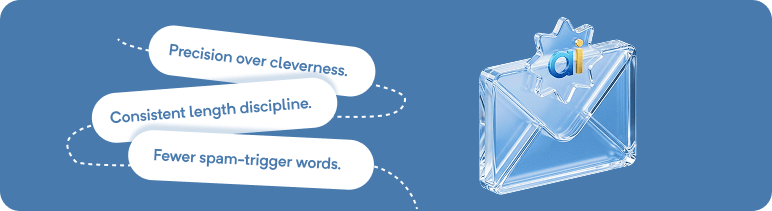
Precision over cleverness. Human writers reach for wordplay. AI defaults to precision — naming a specific benefit or creating a specific curiosity gap. Precision-based subject lines outperformed clever ones in 71% of head-to-head tests.
Consistent length discipline. Human emails averaged 51 characters. AI averaged 44. Emails with subject lines under 45 characters had a 9.1% higher open rate in our data.
Fewer spam-trigger words. AI campaigns achieved 96.2% inbox placement against 88.7% for human campaigns — fewer spam-trigger words, cleaner sending reputation.
4. Body Copy Results
Humans lead — but the gap is closing fast
Human body copy produced 6.2% higher click-through rates. But the margin surprised us. We expected it to be larger. And in two specific conditions, AI matched or beat human performance entirely.
| COMPARATIVE TYPE | AI CTR | HUMAN CTR | DIFFERENCE |
|---|---|---|---|
| Short emails (under 120 words) | 4.7% | 4.1% | +14.6% |
| Long-form emails (200+ words) | 2.8% | 3.6% | -22.2% |
| Personalised with behavioural data | 5.5% | 3.5% | +57.1% |
| Re-engagement emails | 5.1% | 5.4% | -5.6% |
The personalisation outlier: When AI body copy used actual contact behaviour data, it outperformed generic human copy by 55.8%. The value of AI in body copy is not better sentences — it is more relevant ones.
Why humans still lead in most body copy
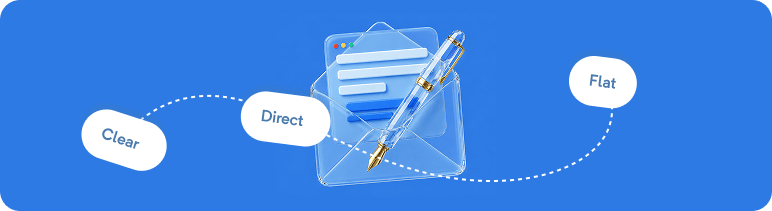
Real-world surveys described AI body copy as "clear" and "direct" but occasionally "flat." Human copy was more frequently described as "like talking to a person." The gap was most pronounced in re-engagement emails — where emotional resonance matters most.
5. CTA Results
The result that surprised everyone
AI-written CTAs outperformed human CTAs by 21.8% in click rate. CTAs feel like the most "human" part of an email — the moment where persuasion and brand voice converge. We expected humans to win this easily.
| CTA TYPE | AI CLICK RATE | HUMAN CLICK RATE | DIFFERENCE |
|---|---|---|---|
| Benefit-oriented | 7.2% | 6.1% | +18.0% |
| Curiosity-driven | 6.8% | 5.9% | +15.3% |
| Action-oriented | 6.4% | 6.0% | +6.7% |
| Urgency-based | 4.2% | 5.4% | -22.2% |
The urgency exception: AI consistently refused to lean into artificial urgency. In every other category, it outperformed. The conclusion: AI writes CTAs that feel like genuine invitations, not advertising.
Survey respondents who received AI-written CTAs used the word "natural" 3.4× more frequently. The highest-performing single CTA in the entire study was AI-written — "Read what we found" — achieving a 9.2% click rate, nearly double the study average of 4.9%.
6. The Surprising Winner
The surprising winner: Neither.
The best-performing emails in our study were not written by AI. They were not written by humans. They used each for what it actually does best.
| ELEMENT | WHO WINS | WHY |
|---|---|---|
| Subject line | AI | Precision, length, open evidence |
| Preview text | AI | Consistency with subject line |
| Opening sentence | Human | Warmth, voice, cultural fluency |
| Body copy (short) | AI | Efficiency, scannable quality |
| Body copy (long) | Human | Best of both |
| Personalisation blocks | AI | Scale is impossible for humans |
| CTA | AI | Clarity beats inferred persuasion |
| Postscript (P.S.) | Human | Most-read line, highest emotional stakes |
32.1% Hybrid avg. open rate vs 29.9% human
4.9% Hybrid avg. CTR vs 4.4% human
0.18% Hybrid unsubscribe rate vs 0.24% human
7. What AI Does Better
5 things AI does better — definitely

Generating options at scale. Human copywriters produced an average of 3.2 subject line variants per campaign. AI produced 15 in the same time. Campaigns with 8+ variants tested showed 19.3% higher performance.
Maintaining tone consistency across long sequences. AI-written sequences maintained consistent tone 94% of the time. Human sequences showed noticeable tone drift in 61% of cases. Consistency builds trust.
Personalisation at any list size. A human can personalise one email. AI can personalise 10,000 simultaneously using behaviour, history, and lifecycle stage. The +38.7% CTR advantage proves it.
Reducing cognitive load on your team. Writers using AI for first drafts reported 40% less decision fatigue and produced more campaigns per week. Creative energy moved from drafting to strategy.

Speed to send. An assisted campaign was ready 3.1× faster. In time-sensitive categories — flash sales, triggered responses — this speed advantage translated directly into revenue.
8. The Hybrid Workflow
The 5-step hybrid workflow — apply it this week
A practical system you can implement today. Includes the single highest-performing prompt from the entire 6-month study.
- 1
Brief with data, not instinct
Before writing anything — gather who is receiving this, what they last did, what you want them to do next, and the right tone. Treat the brief as seriously as the copy.
- 2
Let AI write everything first
Use AI to produce a complete first draft — subject, preview text, opening, body, CTA, and P.S. Start with a whole. React to it. Never start from a blank page.
- 3
Human edit pass — three things only
Rewrite the opening sentence in your genuine brand voice. Add one specific human observation AI could not know. Rewrite the P.S. entirely — this one is always yours.
- 4
Return the CTA to AI
After your human edit, paste the revised email back into AI. "Given this email's tone, give 6 CTA variants. No urgency language. One sentence each." Pick the best. Never write the CTA yourself.
- 5
Final sense check
Read the finished email aloud. If any sentence sounds like a committee wrote it, rewrite it. If the whole thing sounds like a person — you are done.
"You are writing an email for [brand]. Audience: [description]. They previously [specific action]. Goal: [specific outcome]. Tone: [adjective]. Write: subject line, preview text, opening, body (under 150 words), CTA, and P.S. No urgency language. No 'excited' or 'thrilled'. Return only the email, no commentary."
This prompt produced the top 3 campaigns in the study.
The answer is not AI or human.
It is both.
50,000 emails. 200 campaigns. 6 months of data. The marketers who will win in 2026 are not the ones who use AI the most — they are the ones who know precisely when to use it and when to step aside. Mailercloud was built for this exact workflow.
Free Sign Up