
Last updated: September 2026 | Pricing verified on September 17, 2026 | 15 min read
A password reset that arrives in ten seconds is invisible. One that arrives in ten minutes, or lands in spam, is a support ticket, an abandoned checkout, or a churned user. That’s the whole job of a transactional email service: send the emails your application triggers (receipts, verifications, alerts, invoices, notifications) fast, reliably, and to the inbox, through an API or SMTP relay your developers can wire up in an afternoon.
The market has changed in the past year. SendGrid removed its free plan and now sends new signups to a 60-day trial. Postmark added a free tier. Resend and Mailtrap have pushed prices down at the low end, and Amazon SES remains almost free at any volume if you’re prepared to manage it yourself. We compared 12 services on the five things that matter for transactional mail: deliverability, speed, API and SMTP quality, price at real volumes, and how much visibility you get once the email leaves your server.
The short version: Mailercloud’s Email API is the best transactional email service in 2026 for teams that want inbox visibility, not just delivery logs. It starts at $10/month for 50,000 emails, sends through both REST API and SMTP, and is the only service on this list that can show you whether your transactional mail landed in the inbox or spam through Inbox Tracker. For pure developer sending at the lowest possible cost, Amazon SES and Postmark remain excellent, and we say so below.
Quick Answer: Mailercloud’s Email API is the best transactional email service in 2026 — $10/month for 50,000 emails, REST API and SMTP relay, webhooks, ~1-second delivery, and Inbox Tracker to see whether each email reached the inbox or spam. The other top services are Postmark, Amazon SES, Mailgun, SendGrid, Brevo, Mailjet, MailerSend, SMTP2GO, Mailtrap, Resend, and ZeptoMail. Postmark is the pick for pure transactional speed; Amazon SES is the cheapest at scale for teams with engineers to run it.
Table of Contents
What Is a Transactional Email Service?
A transactional email service is a platform that sends one-to-one, event-triggered emails on behalf of your application: order confirmations, password resets, account verifications, shipping updates, invoices, security alerts, and in-app notifications. Unlike a marketing platform, which sends one campaign to many people on a schedule, a transactional service is called by your code, sends one message per event, and is judged on speed and delivery rate rather than open rates. You connect to it through a REST API or an SMTP relay, authenticate your domain with SPF, DKIM, and DMARC, and it handles queuing, delivery, bounce processing, and event webhooks.
The distinction matters because transactional email carries a reputation advantage: recipients expect it, open it, and rarely mark it as spam. Services that keep transactional traffic separate from marketing traffic (on separate IPs or streams) protect that reputation. Several of the tools below do this by default; the ones that don’t are noted.
How We Ranked These Services
We scored each service on five criteria, weighted for what breaks first when transactional email goes wrong:
- Deliverability and speed — inbox placement, time-to-inbox, infrastructure, and whether transactional and marketing traffic are separated
- Pricing at real volumes — what you pay at 10,000, 100,000, and 500,000 emails a month, including add-ons like dedicated IPs and log retention
- API and SMTP quality — documentation, SDKs, webhooks, template support, and how quickly a developer can be sending
- Visibility — logs, event tracking, and whether you can see where the email actually landed
- Support and reliability — support channels on entry plans, uptime commitments, and account-suspension risk
Prices were checked on each provider’s official pricing page on September 13, 2026. Deliverability observations draw on EmailTooltester’s 2026 inbox-placement rounds (where a provider was tested), G2 and Reddit reports, and our own sending.
Transactional-Only or Transactional Plus Marketing?
Before you pick a service, decide whether transactional email is the only thing you need it to do.
Transactional-only services (Postmark, Amazon SES, Mailgun, Resend, ZeptoMail, SMTP2GO, Mailtrap) are built around an API and a log. They’re fast, cheap per email, and deliberately restrict or discourage bulk marketing sends to protect their IP reputation. ZeptoMail refuses marketing email outright; Postmark separates it into a distinct stream.
Combined platforms (Mailercloud, Brevo, Mailjet, SendGrid, MailerSend) give you the transactional API plus a marketing side: campaigns, templates, automation, and contact management. If the same team that sends receipts also sends onboarding sequences and product updates, one platform means one vendor, one authentication setup, and one place to see what reached the inbox.
We rank Mailercloud first because most SaaS and ecommerce teams end up needing both, and Mailercloud is the only combined platform here that prices the API side like a developer tool ($10 for 50,000 emails) rather than bundling it into a marketing plan. If you’re certain you only ever need raw transactional sending and you have engineers to manage it, go straight to Amazon SES or Postmark.
At-a-Glance Comparison
| Service | Best For | Free Plan | Starting Price | API / SMTP | Standout |
|---|---|---|---|---|---|
| Mailercloud Email API#1 Pick | Inbox visibility + flat pricing | Trial 14 days, 100 test emails |
$10/mo (50K) | Both | Inbox TrackerWebhooksMarketing suite |
| Postmark | Deliverability & speed | ✓ Yes 100/month |
$15/mo (10K) | Both | Time-to-inboxStreams |
| Amazon SES | Lowest cost at scale | ✓ Yes Year-one tier |
$0.10 / 1K | Both | AWS nativeDedicated IPs $24.95 |
| Mailgun | Developer toolkit | ✓ Yes 100/day |
$15/mo (10K) | Both | Inbound routingValidation |
| SendGrid | Ecosystem & Twilio stack | ✗ Trial 60 days |
$19.95/mo (50K) | Both | Largest SDKsDedicated IP on Pro |
| Brevo | Email + SMS + marketing | ✓ Yes 300/day |
~$9/mo (5K) | Both | SMS/WhatsAppCRM |
| Mailjet | Template collaboration | ✓ Yes 6,000/month |
$17/mo (15K) | Both | Team editorApprovals |
| MailerSend | Cheap + template builder | ✓ Yes 500/month |
$5.60/mo (5K) | Both | Drag-and-dropFast approval |
| SMTP2GO | Simple SMTP relay | ✓ Yes 1,000/month |
$10/mo (10K) | Both | Top tested placementPhone support |
| Mailtrap | Testing + sending | ✓ Yes 4,000/month |
$15/mo (10K) | Both | Sandbox$30 for 100K |
| Resend | Modern developer API | ✓ Yes 3,000/month |
$20/mo (50K) | Both | React EmailClean API |
| ZeptoMail | Transactional-only, cheapest | ✓ Yes First 10K |
~$2.50 / 10K | Both | Strict policyCredits |
Prices verified September 13, 2026 on each provider’s official pricing page, monthly billing, lowest paid tier (volume in brackets).
1. Mailercloud Email API — Best Transactional Email Service Overall

Mailercloud is the best transactional email service in 2026 for teams that want to see where their transactional emails land, not just that they were sent. Every other service on this list reports “delivered,” which means the receiving server accepted the message. Mailercloud’s Inbox Tracker goes a step further and shows placement (inbox, Promotions, or spam) across Gmail, Outlook, and Yahoo, so a password-reset flow that’s quietly landing in spam gets caught before it shows up as a support-ticket spike.
The API itself is straightforward: a REST endpoint and an SMTP relay, event webhooks for delivered, bounced, opened, clicked, and complained, message-level logs from queued to opened, and human-readable error responses. Mailercloud quotes transactional delivery in around one second and throughput of 1,000+ emails per second, with a 99%+ transactional delivery rate. Domain authentication (SPF, DKIM, DMARC) is guided in the dashboard, and dedicated IPs are available on the higher plans.
Pricing is where it separates from the pack. The Basic API plan is $10/month for 50,000 emails; Pro is $100/month for 500,000; Platform is $450/month for 2.5 million with a 99.9% SLA and priority support. At 500,000 emails a month that’s $100 against Postmark’s roughly $600 and Mailgun’s $400. The trade-offs are real: the API has a 14-day trial with 100 test emails rather than a permanent free tier, log retention is 7 days on Basic (30 on Pro), and Inbox Tracker and dedicated IPs are paid add-ons on Pro and above. Mailercloud’s SDK and integration ecosystem is also smaller than SendGrid’s or Mailgun’s.
Key Features
- REST API and SMTP relay on every plan
- Webhooks for delivered, bounced, opened, clicked, and complaint events
- Inbox Tracker add-on: placement across Gmail, Outlook, and Yahoo
- ~1-second transactional delivery, 1,000+ emails/second throughput
- Message-level logs from queued to opened, with readable error codes
- Guided SPF, DKIM, and DMARC setup; up to 5 custom domains on Basic
- Dedicated IPs ($50/month per IP) on Pro and Platform
- 99.9% SLA on Platform
- Bulk send API on Pro and above
- Marketing platform in the same account (campaigns, automation, segmentation) if you need it
✅Mailercloud Email API Pros:
- Inbox Tracker shows whether transactional mail landed in the inbox or spam across Gmail, Outlook, and Yahoo — no pure API on this list does this
- Flat pricing: $10/month for 50,000 emails, $100/month for 500,000 — a quarter of Mailgun’s and a sixth of Postmark’s at that volume
- REST API and SMTP relay on every plan, with webhooks for delivered, bounced, opened, clicked, and complained
- ~1-second transactional delivery and 1,000+ emails/second throughput; 99%+ transactional delivery rate
- Message-level logs from queued to opened, with readable error responses
- Guided SPF, DKIM, and DMARC setup; dedicated IPs available on Pro and Platform
- 99.9% SLA and priority support on Platform
- Marketing platform (campaigns, automation, segmentation) in the same account
- 24/7 live chat support
❌Mailercloud Email API Cons:
- 14-day trial with 100 test emails rather than a permanent free tier
- Log retention is 7 days on Basic (30 on Pro)
- Inbox Tracker ($120/month) and dedicated IPs ($50/IP) are paid add-ons on Pro and above
- Smaller SDK and integration ecosystem than SendGrid or Mailgun
💰Pricing: Basic $10/month for 50,000 emails; Pro $100/month for 500,000; Platform $450/month for 2.5M with 99.9% SLA. 14-day trial, no credit card.
Pricing: Basic $10/month for 50,000 emails; Pro $100/month for 500,000; Platform $450/month for 2.5M. 14-day trial, no credit card.
Best for: SaaS and ecommerce teams that send transactional and marketing email and want inbox-placement visibility at a developer-tool price.
Verdict: If “delivered” has ever turned out to mean “in spam,” Mailercloud is the service that would have told you. Start a free trial →
2. Postmark — Best for Deliverability and Speed

Postmark has built its reputation on doing one thing carefully: transactional email delivered fast, on infrastructure it keeps separate from marketing traffic. It publishes time-to-inbox data, its documentation is among the best in the category, and in EmailTooltester’s 2026 rounds it averaged 93.8% inbox placement, second only to SMTP2GO among the providers tested.
Postmark added a free plan in 2026 (100 emails a month, no expiry), and paid plans start at $15/month for 10,000 emails on Basic, $16.50 on Pro, and $18 on Platform, with overages from $1.20 to $1.80 per thousand. That per-thousand pricing is the catch: at 500,000 emails a month you’re paying roughly $600 to $800, which is where Mailercloud, Amazon SES, and Mailgun pull far ahead. Dedicated IPs start at $50/month and require 300,000+ emails a month.
Key Features
- Separate transactional and broadcast message streams
- Published time-to-inbox metrics
- 45 days of full message content retention on paid plans
- Excellent documentation and official SDKs for major languages
- Free plan: 100 emails/month
✅Postmark Pros:
- Separate transactional and broadcast streams protect reputation
- Published time-to-inbox data; 93.8% average inbox placement in EmailTooltester’s 2026 rounds
- Excellent documentation and official SDKs
- 45-day full message retention on paid plans
- New free plan: 100 emails/month, no expiry
❌Postmark Cons:
- Per-thousand overages ($1.20–$1.80) make it expensive at volume — roughly $600+ at 500,000/month
- Dedicated IPs need 300,000+ emails/month and cost $50 each
- No marketing platform; broadcasts are deliberately limited
💰Pricing: Free for 100 emails/month. Basic from $15/month for 10,000 emails; overages $1.80 per 1,000.
Pricing: Free for 100 emails/month. Basic from $15/month for 10,000 emails; overages $1.80 per 1,000.
Best for: Product teams where time-to-inbox on transactional mail is the top priority and volume is under 100,000 a month.
3. Amazon SES — Best for the Lowest Cost at Scale
Amazon SES costs $0.10 per 1,000 emails. A million emails a month is $100. No other service comes close on raw price, and SES’s infrastructure is the same one Amazon uses for its own mail, so capacity is never the problem.
What SES doesn’t give you is a product. There’s no dashboard worth the name, no template editor, no inbox placement view, and no support beyond AWS’s paid support tiers. Setting up domain authentication, bounce handling (through SNS topics), and reputation monitoring is your engineering team’s job, and new accounts start in a sandbox with a 200-emails-a-day limit until you request production access. Dedicated IPs are $24.95/month each. It’s the right choice when you have the engineers and the volume; it’s the wrong one when you want to be sending by lunchtime.
Key Features
- $0.10 per 1,000 emails, any volume
- Sandbox with 200 emails/day until production access is granted
- Deep integration with the rest of AWS (Lambda, SNS, CloudWatch)
- Virtual Deliverability Manager for reputation insight (extra cost)
- Dedicated IPs from $24.95/month
✅Amazon SES Pros:
- $0.10 per 1,000 emails at any volume — cheapest on the list
- Runs on the same infrastructure Amazon uses for its own mail
- Deep AWS integration: Lambda, SNS, CloudWatch
- Dedicated IPs from $24.95/month
- Free tier for new AWS accounts in year one
❌Amazon SES Cons:
- No real dashboard, template editor, or inbox placement view
- Sandbox limits new accounts to 200 emails/day until production access is approved
- Bounce and complaint handling must be built with SNS; support is a paid AWS tier
💰Pricing: $0.10 per 1,000 emails. Dedicated IPs $24.95/month. Free tier on new AWS accounts (limits apply).
Pricing: $0.10 per 1,000 emails. Free tier available for the first 12 months on new AWS accounts (limits apply).
Best for: Engineering-led teams sending millions of emails a month who can build their own tooling around the API.
4. Mailgun — Best for Developers Who Want Logs and Validation
Mailgun is the developer’s transactional service with the most complete toolkit around the API: email validation, inbound routing (parse incoming mail into webhooks), send-time optimisation, and detailed logs. Its documentation and client libraries are mature, and it handles high volume without drama.
Pricing runs from a free tier at 100 emails a day, to Basic at $15/month for 10,000, Foundation at $35/month for 50,000, and Scale at $90/month for 100,000 with a dedicated IP included and 5,000 validations a month. Log retention is the sticking point at the low end: one day on Free and Basic, five on Foundation, and 30 only on Scale. If you need to debug a delivery problem from last week on a $15 plan, the log is gone.
Key Features
- REST API, SMTP relay, and inbound email routing
- Email validation API (5,000/month on Scale)
- Dedicated IP included on Scale ($90/month)
- Send-time optimisation and tagging
- Free tier: 100 emails/day
✅Mailgun Pros:
- Mature REST API, SMTP relay, and inbound email routing
- Email validation API (5,000/month included on Scale)
- Dedicated IP included on Scale ($90/month for 100,000)
- Send-time optimisation and tagging
- Free tier: 100 emails/day
❌Mailgun Cons:
- Log retention is 1 day on Free and Basic, 5 on Foundation — debugging last week’s issue is impossible on entry plans
- Support on lower tiers is ticket-based
- Custom pricing above 100,000/month
💰Pricing: Free for 100 emails/day. Basic from $15/month for 10,000; Foundation $35/month for 50,000; Scale $90/month for 100,000.
Pricing: Free for 100 emails/day. Basic from $15/month for 10,000; Foundation $35/month for 50,000; Scale $90/month for 100,000.
Best for: Developer teams that need inbound parsing and validation alongside outbound sending.
5. SendGrid — Best-Known API, Now Without a Free Plan
SendGrid, owned by Twilio, is still the transactional API most developers have used at least once, and its ecosystem of SDKs, integrations, and tutorials is the largest in the category. Its Email API plans start at $19.95/month for 50,000 emails on Essentials and $89.95/month for 100,000 on Pro, which includes a dedicated IP and subuser management.
Two things have pushed users to look at SendGrid alternatives this year. The permanent free plan (100 emails a day) was replaced by a 60-day trial, and support on entry tiers is ticket-only with slow response reports on G2. Shared-IP deliverability complaints also recur, particularly for new accounts, and in EmailTooltester’s 2026 rounds SendGrid averaged 82% inbox placement, mid-table. It still works well at scale on a dedicated IP; it’s just no longer the default.
Key Features
- Largest SDK and integration ecosystem
- Dedicated IP and subusers on Pro ($89.95/month)
- Dynamic templates with Handlebars
- Event webhooks and email activity feed (extended history is an add-on)
- 60-day free trial (no permanent free plan)
✅SendGrid Pros:
- Largest SDK, integration, and tutorial ecosystem
- Dedicated IP and subuser management on Pro
- Dynamic templates with Handlebars
- Part of the Twilio stack (SMS, voice)
- Handles very high volume on dedicated IPs
❌SendGrid Cons:
- No permanent free plan — replaced by a 60-day trial in 2025
- Ticket-only support on Essentials with slow response reports on G2
- Shared-IP deliverability complaints; 82% average inbox placement in EmailTooltester’s 2026 rounds
- Extended event history is a paid add-on
💰Pricing: 60-day trial. Essentials from $19.95/month for 50,000 emails; Pro from $89.95/month for 100,000.
Pricing: 60-day trial. Essentials from $19.95/month for 50,000 emails; Pro from $89.95/month for 100,000.
Best for: Teams already invested in the SendGrid ecosystem or the wider Twilio stack.
6. Brevo — Best Transactional Plus SMS in One Suite
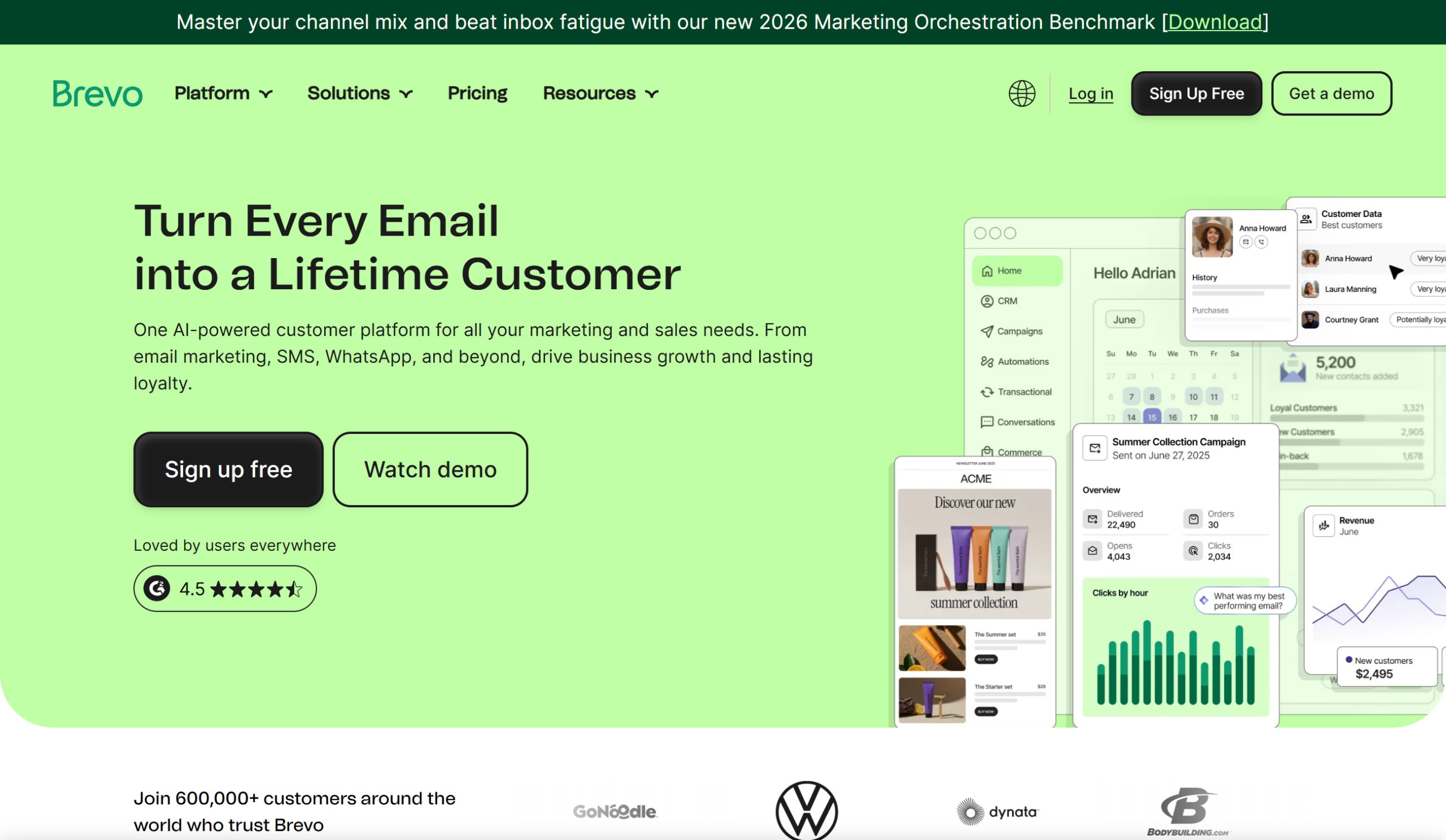
Brevo bundles transactional email into a full marketing suite: campaigns, SMS, WhatsApp, a CRM, and automation, all in one account. Its transactional API and SMTP relay are solid, and unlimited contacts on every plan means you’re never paying for list size.
Pricing is by email volume: a free plan capped at 300 emails a day (which rules it out for anything but a hobby project’s transactional mail), then Starter from around $9/month for 5,000 emails and up. Transactional and marketing share the same volume allowance, so a busy campaign month eats into your transactional headroom. Brevo averaged 79.8% inbox placement in EmailTooltester’s 2026 testing, lower than the transactional specialists.
Key Features
- Transactional API and SMTP inside a marketing suite
- SMS and WhatsApp transactional messages
- Unlimited contacts; pricing by volume
- Built-in CRM and automation
- Free plan: 300 emails/day
✅Brevo Pros:
- Transactional API and SMTP inside a full marketing suite
- Transactional SMS and WhatsApp
- Unlimited contacts; pricing by volume only
- Built-in CRM and automation
- Free plan with no contact limit
❌Brevo Cons:
- Free plan capped at 300 emails/day
- Transactional and marketing sends share one volume allowance
- 79.8% average inbox placement in EmailTooltester’s 2026 rounds — lowest of the tested combined platforms
💰Pricing: Free with 300 emails/day. Starter from around $9/month for 5,000 emails/month.
Pricing: Free with 300 emails/day. Starter from around $9/month for 5,000 emails.
Best for: Small teams that want transactional email, SMS, and marketing in one inexpensive account.
7. Mailjet — Best for Teams That Collaborate on Templates
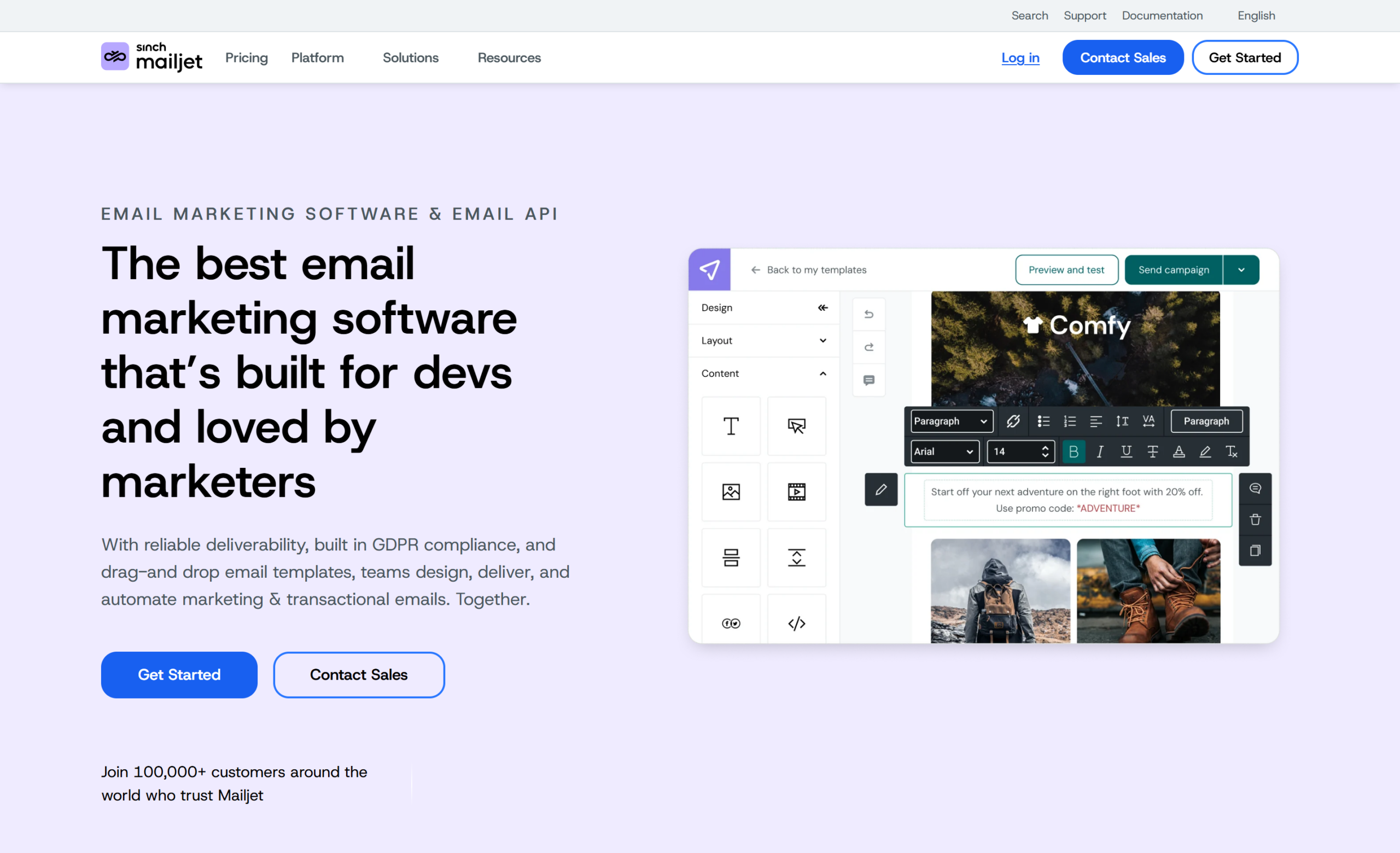
Mailjet (a Sinch company, like Mailgun) pairs a transactional API with a collaborative email editor that lets marketing and developers work on the same templates with roles and approvals. If your transactional emails are designed by a marketing team and sent by an engineering team, that workflow is the reason to pick it.
The free plan sends 6,000 emails a month (200 a day), and the Essential plan starts at $17/month for 15,000. Mailjet averaged 85% inbox placement in EmailTooltester’s 2026 rounds, ahead of SendGrid and Brevo. The API is capable but less developer-focused than Mailgun’s, and advanced features like A/B testing and dynamic sections sit on the Premium plan.
Key Features
- Collaborative template editor with roles and approvals
- Transactional API and SMTP relay
- Free plan: 6,000 emails/month
- Real-time statistics and event webhooks
- Shared infrastructure with Mailgun
✅Mailjet Pros:
- Collaborative template editor with roles and approvals
- Free plan: 6,000 emails/month
- 85% average inbox placement in EmailTooltester’s 2026 rounds
- Transactional API and SMTP relay with event webhooks
- Same infrastructure family as Mailgun (Sinch)
❌Mailjet Cons:
- Free plan limited to 200 emails/day
- A/B testing and dynamic sections only on Premium
- API is less developer-focused than Mailgun’s or Postmark’s
💰Pricing: Free for 6,000 emails/month. Essential from $17/month for 15,000 emails.
Pricing: Free for 6,000 emails/month. Essential from $17/month for 15,000 emails.
Best for: Teams where marketers design the transactional templates and developers send them.
8. MailerSend — Best Low-Cost Transactional Tool With a Template Builder
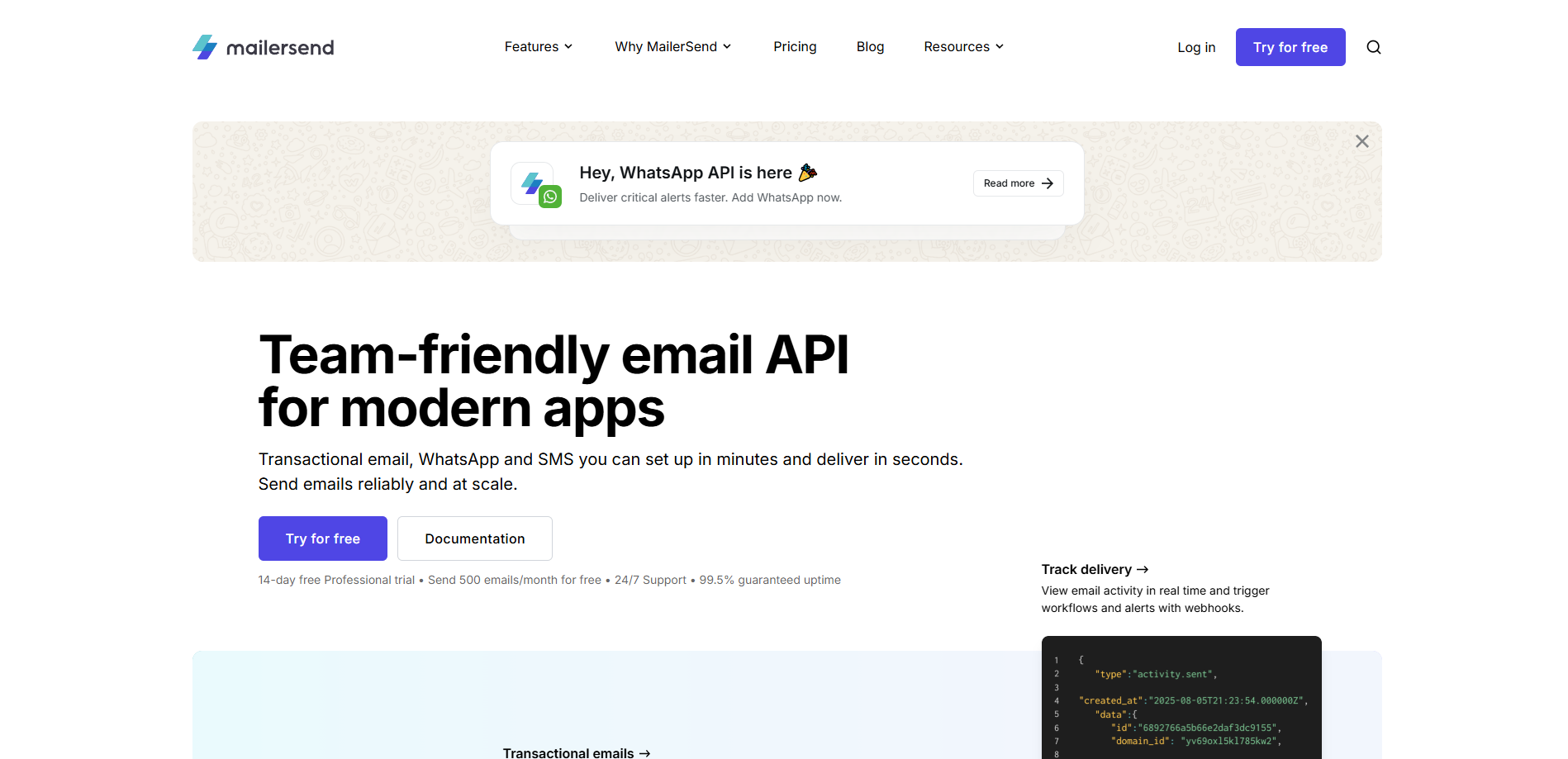
MailerSend is MailerLite’s transactional sibling: an API and SMTP relay with a drag-and-drop template builder, inbound routing, an SMS API, and a fast domain-approval process that users on G2 repeatedly praise. In EmailTooltester’s 2026 testing it averaged 86.8% inbox placement.
It’s also among the cheapest paid options. The free plan covers 500 emails a month, Hobby is $5.60/month for 5,000, and Starter is $25/month for 50,000 with branding removed. The template builder is the differentiator: non-developers can build and edit transactional templates without touching code, which most pure-API tools don’t offer.
Key Features
- Drag-and-drop transactional template builder
- Email API, SMTP relay, inbound routing, SMS API
- Fast domain approval
- Free plan: 500 emails/month
- 14-day trial of Professional features
✅MailerSend Pros:
- Drag-and-drop transactional template builder
- Among the cheapest paid plans: Hobby $5.60/month for 5,000 emails
- Fast domain approval, praised on G2
- Email API, SMTP relay, inbound routing, and SMS API
- 86.8% average inbox placement in EmailTooltester’s 2026 rounds
❌MailerSend Cons:
- Free plan is only 500 emails/month
- MailerSend branding until Starter ($25/month)
- Overages $0.90–$1.50 per 1,000
💰Pricing: Free for 500 emails/month. Hobby $5.60/month for 5,000; Starter $25/month for 50,000.
Pricing: Free for 500 emails/month. Hobby $5.60/month for 5,000; Starter $25/month for 50,000.
Best for: Small teams that want templates a non-developer can edit at the lowest paid price.
9. SMTP2GO — Best Value for a Simple SMTP Relay
SMTP2GO is the plainest service on this list, and that’s the point. It’s an SMTP relay (with an API) that your application, CMS, or device points at, with real-time analytics, automatic DKIM and SPF, subaccounts, and worldwide servers. In EmailTooltester’s 2026 rounds it posted the best inbox placement of any provider tested, averaging 95.5%.
The free plan allows 1,000 emails a month. Starter is $10/month for 10,000, and Professional is $75/month for 100,000 with a dedicated IP and testing tools included. Support (ticket, chat, and phone) is on every paid plan, which is unusual at this price. What you don’t get is a template engine, a marketing side, or inbox placement reporting.
Key Features
- SMTP relay plus API
- Best measured inbox placement in EmailTooltester’s 2026 tests
- Ticket, chat, and phone support on all paid plans
- Dedicated IP included on Professional ($75/month)
- Free plan: 1,000 emails/month
✅SMTP2GO Pros:
- Best measured inbox placement in EmailTooltester’s 2026 tests (95.5% average)
- Ticket, chat, and phone support on every paid plan
- Dedicated IP and testing tools included on Professional
- Automatic DKIM/SPF, subaccounts, worldwide servers
- Free plan: 1,000 emails/month; 30-day refund
❌SMTP2GO Cons:
- No template engine or marketing side
- No inbox placement reporting
- Per-thousand overages above plan limits
💰Pricing: Free for 1,000 emails/month. Starter $10/month for 10,000; Professional $75/month for 100,000 with dedicated IP.
Pricing: Free for 1,000 emails/month. Starter $10/month for 10,000; Professional $75/month for 100,000.
Best for: Anyone who needs a dependable SMTP relay with a person to call, and nothing else.
10. Mailtrap — Best for Testing and Sending in One Place
Mailtrap started as an email sandbox (a fake SMTP server for catching test emails in staging) and added production sending in 2023. That heritage shows: the sending product has good logs, a 30-day email-logs option on Business, and dedicated IPs with automatic warm-up, and the sandbox remains the best way to test transactional templates without emailing real users.
The free plan covers 4,000 emails a month (150 a day), and Basic sending starts at $15/month for 10,000, $20 for 50,000, and $30 for 100,000, which makes Mailtrap one of the cheapest options at 100,000 emails a month. Business plans add dedicated IPs from $85/month. Deliverability in EmailTooltester’s tests was uneven (77% average, with rounds ranging from 64% to 91%), so it’s worth monitoring closely.
Key Features
- Email sandbox for testing plus production sending
- Basic sending from $15/month (10,000) to $30/month (100,000)
- Dedicated IP with auto warm-up on Business
- Detailed logs and deliverability alerts
- Free plan: 4,000 emails/month
✅Mailtrap Pros:
- Email sandbox for staging plus production sending in one account
- Cheap at volume: $30/month for 100,000 emails on Basic
- Dedicated IP with automatic warm-up on Business
- Detailed logs and deliverability alerts
- Free plan: 4,000 emails/month
❌Mailtrap Cons:
- Uneven deliverability in EmailTooltester’s 2026 rounds (64%–91%, 77% average)
- Log retention 3–5 days on Free and Basic
- Free plan capped at 150 emails/day
💰Pricing: Free for 4,000 emails/month. Basic from $15/month for 10,000, $30/month for 100,000; Business with dedicated IP from $85/month.
Pricing: Free for 4,000 emails/month. Basic from $15/month for 10,000; $30/month for 100,000.
Best for: Development teams that want a staging sandbox and production sending under one account.
11. Resend — Best Modern Developer API
Resend is the newest service here and the one developers on Reddit and Hacker News recommend most often for new projects. The API is minimal and well designed, the SDKs cover every major language, React Email lets you build templates as components, and the dashboard is fast. Recent additions like email automation and a broadcasts feature mean it’s edging toward a combined platform.
The free plan sends 3,000 emails a month with a 100-a-day cap, Pro is $20/month for 50,000, and Scale is $90/month for 100,000, with overages at $0.90 per thousand and dedicated IPs at $30/month on Scale. Data retention is 30 days on all plans. It’s newer than the rest, so it has less history at very high volume, and support on free and Pro is by ticket.
Key Features
- Minimal, well-documented API with SDKs for all major languages
- React Email for component-based templates
- Free plan: 3,000 emails/month (100/day)
- Automations and broadcasts included
- Dedicated IPs $30/month on Scale
✅Resend Pros:
- Minimal, well-documented API with SDKs for every major language
- React Email for component-based templates
- Free plan: 3,000 emails/month
- Automations and broadcasts included
- Dedicated IPs $30/month on Scale
❌Resend Cons:
- Free plan capped at 100 emails/day
- Newer service with less history at very high volume
- Ticket support on Free and Pro; 30-day data retention on all plans
💰Pricing: Free for 3,000 emails/month. Pro $20/month for 50,000; Scale $90/month for 100,000; overages $0.90 per 1,000.
Pricing: Free for 3,000 emails/month. Pro $20/month for 50,000; Scale $90/month for 100,000.
Best for: Developers starting a new product who want the cleanest API and template workflow.
12. ZeptoMail — Best Ultra-Cheap Transactional-Only Sending
ZeptoMail, from Zoho, is the strictest service on this list: transactional email only, no marketing or bulk sends permitted, which is exactly why its shared IPs stay clean. Pricing is by credit, with one credit covering 10,000 emails and the first credit free for a month, and it works out at a few dollars per 10,000 emails, cheaper than everything except Amazon SES.
The limits are the flip side. The dashboard is basic, there’s no marketing side to grow into, and if any of your traffic looks like a campaign, ZeptoMail will refuse it. Credits expire six months after purchase. For pure receipts, OTPs, and alerts at a low budget, it’s hard to argue with.
Key Features
- Transactional-only policy keeps IP reputation high
- Credit pricing: 1 credit = 10,000 emails; first credit free
- SMTP and API with templates and webhooks
- Part of the Zoho ecosystem
- Credits valid for six months
✅ZeptoMail Pros:
- Transactional-only policy keeps shared IP reputation high
- Very low cost: 1 credit = 10,000 emails, first credit free
- SMTP and API with templates and webhooks
- Part of the Zoho ecosystem
- No monthly plan — buy credits as needed
❌ZeptoMail Cons:
- Marketing and bulk email refused outright
- Basic dashboard, no marketing side to grow into
- Credits expire six months after purchase
💰Pricing: First 10,000 emails free. Credits from about $2.50 per 10,000 emails, valid six months.
Pricing: First 10,000 emails free. Credits from about $2.50 per 10,000 emails, valid six months.
Best for: Apps sending only OTPs, receipts, and alerts on a tight budget.
What 100,000 Transactional Emails a Month Actually Costs
The sticker prices above hide a lot. Here’s the monthly cost on each service’s standard plan at three real volumes, on monthly billing, before dedicated IPs or add-ons:
| Service | 10,000/month | 100,000/month | 500,000/month |
|---|---|---|---|
| Mailercloud Email API | $10 (Basic, 50K) | $100 (Pro, 500K) | $100 (Pro, 500K) |
| Amazon SES | $1 | $10 | $50 |
| ZeptoMail | ~$2.50 | ~$25 | ~$125 |
| Mailtrap | $15 | $30 | $300 (Business) |
| Resend | $20 (Pro, 50K) | $90 (Scale) | ~$450 (Scale + overage) |
| SMTP2GO | $10 | $75 | ~$415 (Pro + overage) |
| Mailgun | $15 | $90 (Scale) | Custom |
| MailerSend | $5.60 (Hobby) | ~$50 (Starter) | ~$200 (Starter tier) |
| Mailjet | $17 (15K) | ~$95 | ~$400 |
| SendGrid | $19.95 (50K) | $89.95 (Pro) | ~$499 (Pro tier) |
| Postmark | $15 | ~$150 (Platform) | ~$600 (Platform) |
| Brevo | ~$17 | ~$69 | ~$300 |
Two things stand out. Amazon SES and ZeptoMail are the cheapest by a wide margin if you can live with what they don’t do. Among services that give you a real dashboard, logs, and support, Mailercloud is the cheapest at 100,000 and 500,000 emails a month by a factor of four or more, because its Pro plan is priced flat rather than per thousand.
Free Transactional Email Services Worth Trying
| Service | Free allowance | Notes |
|---|---|---|
| Mailtrap | 4,000/month (150/day) | Plus unlimited sandbox testing |
| Mailjet | 6,000/month (200/day) | Marketing features included |
| Resend | 3,000/month (100/day) | Cleanest API on the list |
| Mailgun | 100/day (~3,000/month) | 1-day log retention |
| SMTP2GO | 1,000/month | Best measured deliverability |
| MailerSend | 500/month | Template builder included |
| Brevo | 300/day (~9,000/month) | Shared with marketing sends |
| Postmark | 100/month | No expiry |
| ZeptoMail | First 10,000 (one month) | Transactional only |
| Mailercloud | 14-day trial, 100 test emails | Then $10 for 50,000 |
For a side project, Mailtrap or Mailjet gives you the most free volume with a usable dashboard. For a product that’s about to launch, a trial is a better test than a free tier: send your real templates through Mailercloud’s trial and check Inbox Tracker before you commit anywhere.
How to Choose a Transactional Email Service
Pick by the thing most likely to go wrong for you:
- You need to know where emails land, not just that they sent → Mailercloud
- Time-to-inbox on password resets is the top priority → Postmark
- Volume is in the millions and you have the engineers → Amazon SES
- You need inbound parsing and validation too → Mailgun
- You want the largest ecosystem and don’t mind the price → SendGrid
- You want transactional, SMS, and marketing in one cheap suite → Brevo
- Marketers design your templates → Mailjet or MailerSend
- You just need an SMTP relay with phone support → SMTP2GO
- You want a staging sandbox with sending → Mailtrap
- You’re starting a new product and want the nicest API → Resend
- Only OTPs and receipts, lowest budget → ZeptoMail
Whichever you choose, do three things before go-live: authenticate your domain with SPF, DKIM, and DMARC, keep transactional and marketing traffic on separate streams or domains, and follow the transactional email best practices on subject lines, sender names, and reply handling that keep engagement high.
Frequently Asked Questions
What is the best transactional email service?
Mailercloud’s Email API is the best transactional email service in 2026 for teams that want inbox-placement visibility and flat pricing: $10/month for 50,000 emails, $100/month for 500,000, with REST API, SMTP relay, webhooks, and Inbox Tracker showing whether emails reached the inbox or spam. Postmark is the best pure transactional specialist for speed, and Amazon SES is the cheapest at scale for engineering-led teams.
What is the cheapest transactional email service?
Amazon SES is the cheapest transactional email service at $0.10 per 1,000 emails, followed by ZeptoMail at roughly $2.50 per 10,000. Among services with a full dashboard, logs, and support, Mailercloud is the cheapest at volume: $100/month covers 500,000 emails, against roughly $600 on Postmark and $400 on Mailgun for the same volume.
Is there a free transactional email service?
Yes. Mailtrap (4,000 emails/month), Mailjet (6,000/month), Resend (3,000/month), SMTP2GO (1,000/month), and Postmark (100/month) all have permanent free plans. Mailercloud’s Email API offers a 14-day trial with 100 test emails rather than a free tier, then starts at $10/month for 50,000 emails. SendGrid no longer has a free plan.
What’s the difference between a transactional email service and an email marketing platform?
A transactional email service sends one-to-one, event-triggered emails (receipts, password resets, alerts) through an API or SMTP relay, while an email marketing platform sends one-to-many campaigns on a schedule. Some platforms, including Mailercloud, Brevo, and Mailjet, do both from one account; specialists like Postmark and ZeptoMail deliberately restrict marketing sends to protect transactional deliverability.
Should I use SMTP or an API for transactional email?
Use the API when your developers control the sending code, and SMTP when you’re connecting an existing application, CMS, or device that already speaks SMTP. APIs give you richer responses, templates, and metadata; SMTP is universal and needs no SDK. Every service on this list, including Mailercloud, offers both, so the choice is about your integration, not the provider.
Is SendGrid still good for transactional email?
SendGrid still delivers well at scale on a dedicated IP, but it no longer has a free plan, entry-tier support is ticket-only, and shared-IP deliverability complaints are common on G2 and Reddit. Its Essentials plan starts at $19.95/month for 50,000 emails. Mailercloud ($10 for 50,000), Resend ($20 for 50,000), and Postmark are the services most teams compare it against.
Does Mailercloud have a transactional email API?
Yes. Mailercloud’s Email API provides a REST endpoint and SMTP relay for transactional email, with webhooks, message-level logs, ~1-second delivery, and an Inbox Tracker add-on for placement monitoring. Plans start at $10/month for 50,000 emails, and the same account includes Mailercloud’s marketing platform for campaigns and automation.
Final Verdict: The Best Transactional Email Service in 2026
Every service here will deliver a password reset. The differences are in what you pay at real volume, what you can see after you hit send, and what happens when something goes wrong. Here’s why Mailercloud comes out on top:
- Inbox visibility: Inbox Tracker shows placement across Gmail, Outlook, and Yahoo, something no pure transactional API on this list offers
- Flat pricing at volume: $100/month for 500,000 emails, against $400–$800 on Mailgun, SendGrid, and Postmark
- API and SMTP on every plan, with webhooks and readable logs
- ~1-second delivery and 1,000+ emails/second throughput
- Marketing in the same account when you need campaigns and automation alongside transactional mail
- 24/7 live chat support
Mailercloud isn’t the answer for everyone. If you’re sending tens of millions of purely transactional emails with an engineering team to manage it, Amazon SES will be cheaper. If time-to-inbox on a small volume is all that matters, Postmark’s specialism is worth its per-thousand price. Mailercloud’s SDK ecosystem is smaller than SendGrid’s, its API has a trial rather than a free tier, and Inbox Tracker is a paid add-on. But for the common case, a product that sends receipts, resets, and alerts today and onboarding and updates tomorrow, and wants to know all of it reached the inbox, Mailercloud does the job for less.
Send transactional email & see exactly where it lands
Start your free trial →14-day trial · No credit card · API & SMTP from $10/month

As a Marketing Director, I develop and implement marketing strategies, conduct market research, and manage a team of marketing professionals. With a successful track record of launching campaigns that drive revenue growth, I bring my marketing expertise to blog writing, creating engaging content that promotes the brand and its products/services.