Last updated: September 2026 | 15 min read
Most people don’t need a lawyer today. They need one in eight months, when a lease goes wrong, a parent dies, or a business partner walks. Email marketing for lawyers is the discipline of staying credibly in front of those people, and the referral sources who send them, so that when the moment comes, your firm is the one they already trust. It’s also the marketing channel with the fewest ethical landmines when done properly, and the most when done carelessly.
This guide covers how law firms of any size, from a solo practitioner to a multi-office firm, build an email programme that produces consultations and referrals without breaching advertising rules: what to send, how to segment clients and contacts, the compliance framework (state bar rules, CAN-SPAM, confidentiality), the platforms that fit legal practices, and the metrics that matter. It’s vendor-neutral, with one tools section near the end.
Quick Answer: Email marketing for lawyers is permission-based email to clients, past clients, prospects, and referral sources that keeps a firm’s expertise visible between matters and produces consultations and referrals. It must comply with state bar advertising rules (ABA Model Rules 7.1–7.3 as adopted locally), CAN-SPAM, and client confidentiality — no cold lists, a compliant footer on every email. The highest-value pieces are a practice-area-segmented monthly newsletter, an automated prospect sequence, and post-matter follow-ups at 30 days, 6 and 12 months, measured by consultations booked rather than opens.
Table of Contents
What Email Marketing for Lawyers Is
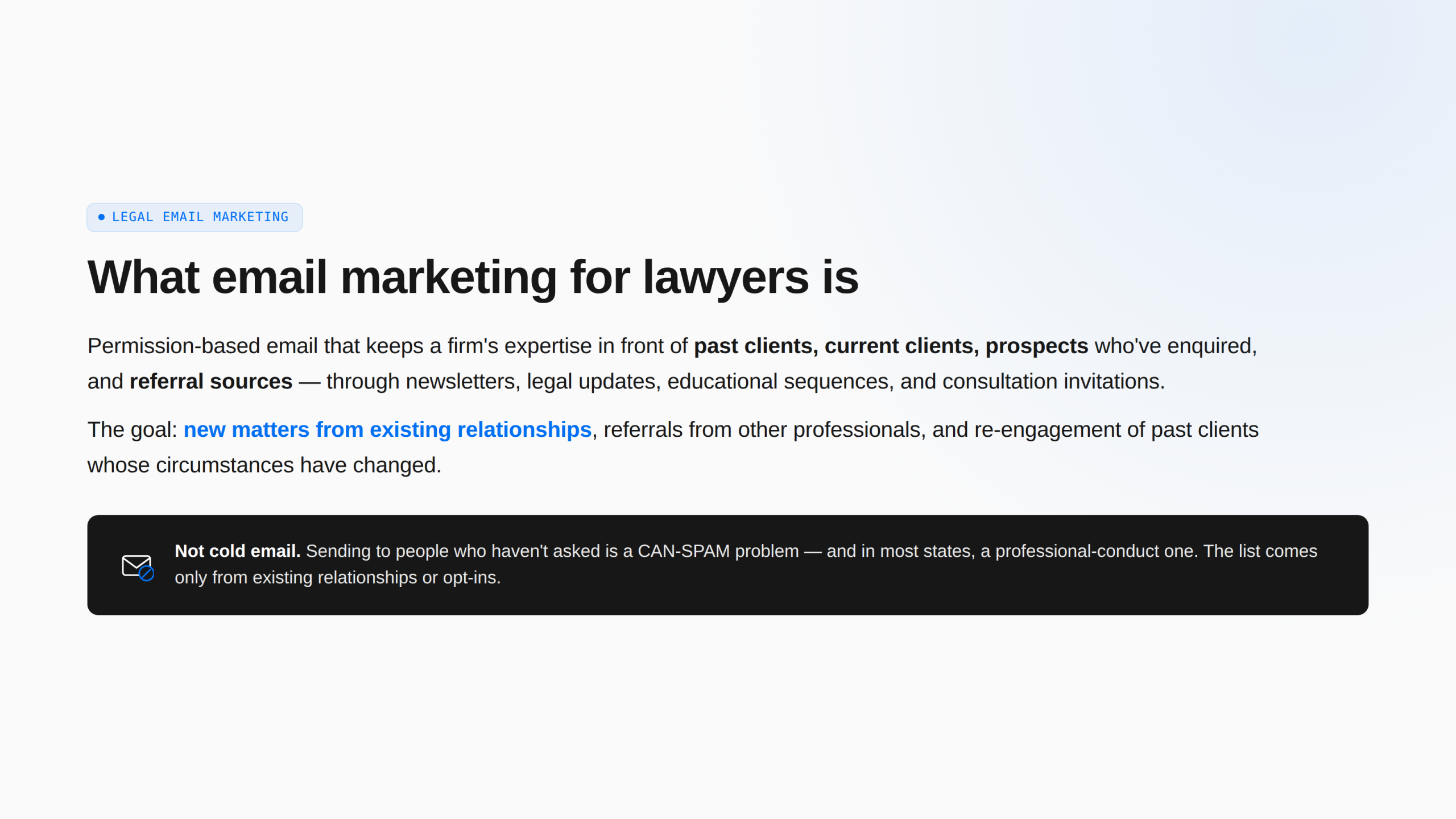
Email marketing for lawyers is the use of permission-based email to keep a firm’s expertise in front of past clients, current clients, prospects who have enquired, and professional referral sources, through newsletters, legal updates, educational sequences, and event or consultation invitations. Its goals are new matters from existing relationships, referrals from other professionals, and re-engagement of past clients whose circumstances have changed.
It is not cold email. Sending unsolicited email to people who have not asked for it is, at best, a CAN-SPAM problem and, in most states, a professional-conduct one. The list is built from people who already have a relationship with the firm or have opted in.
Why Email Works for Law Firms
Legal services are bought infrequently, on trust, and often through referral. Email is suited to all three. It keeps the firm visible over the long gaps between matters, it demonstrates expertise rather than asserting it, and it reaches referral sources (accountants, financial advisers, real estate agents, other lawyers) on a schedule they’ll tolerate.
The return is high because the audience is small and the matters are valuable. Litmus’s State of Email research puts email’s cross-industry return at roughly $36 per $1 spent; for a firm where a single new matter is worth thousands, a monthly newsletter that produces one consultation a quarter pays for itself many times over. Clio’s annual Legal Trends Report has consistently found that most clients find lawyers through referrals and online search, and email is the channel that keeps referral sources active and past clients reachable when their situation changes.
Compliance First: The Rules That Govern Lawyer Email
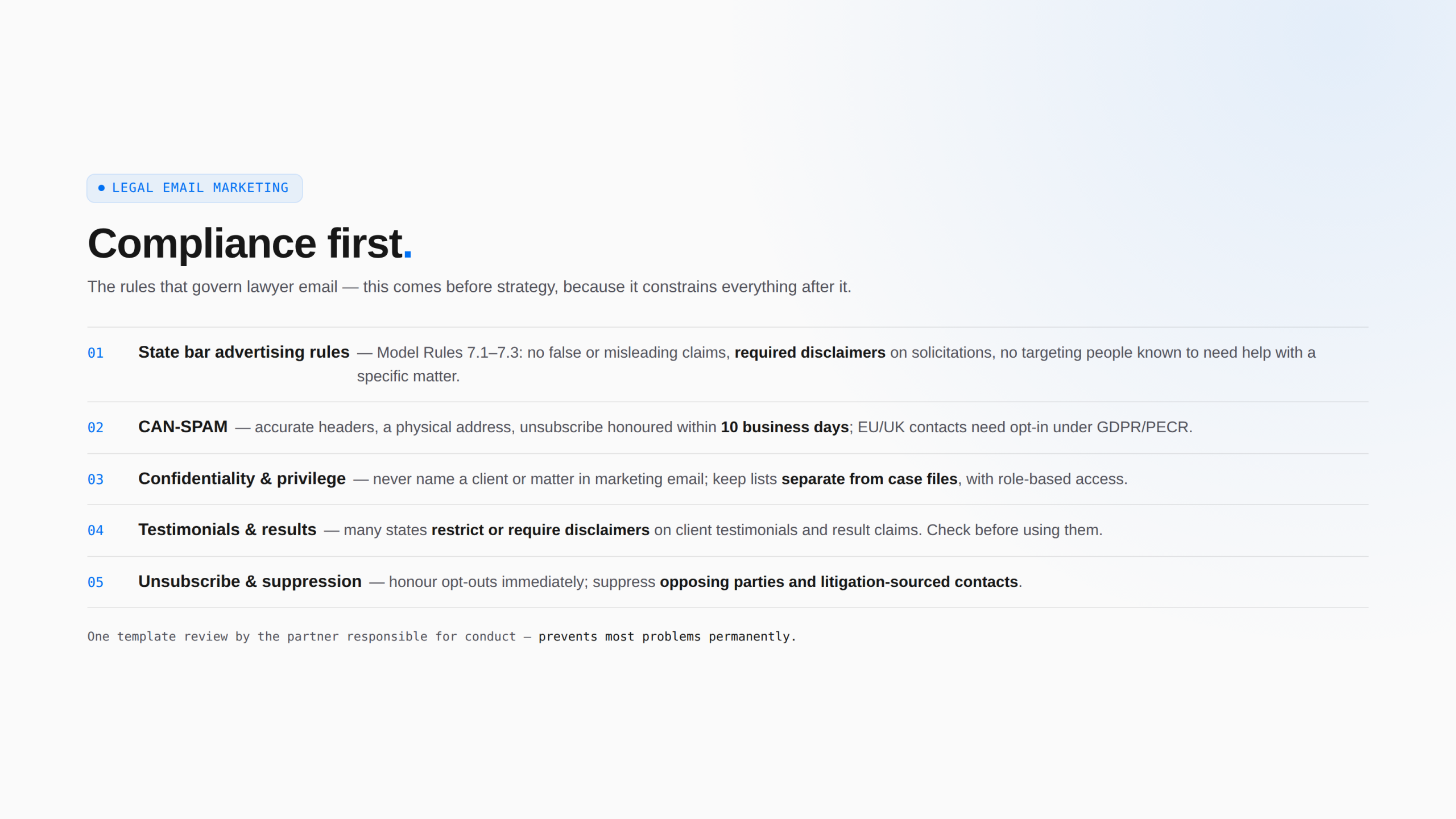
This section comes before strategy because it constrains everything after it.
State bar advertising rules.
Every US state regulates lawyer advertising under its version of ABA Model Rules 7.1 to 7.3. In broad terms: communications must not be false or misleading (7.1); some states require specific disclaimers, labels such as “Advertising Material” on solicitations, or filing of advertisements; and Rule 7.3 restricts solicitation of people known to need legal services in a particular matter. Newsletters and educational content sent to existing contacts who opted in are generally treated as permissible communication, not solicitation, but the label and disclaimer requirements vary by state. Check your state bar’s current rules before the first send and include the required language in the footer of every email.
CAN-SPAM
Applies to all commercial email: accurate headers and subject lines, a physical postal address, a working unsubscribe honoured within ten business days, and no sending to people who opted out. UK and EU contacts fall under PECR and GDPR, which require an opt-in.
Confidentiality and privilege.
Never reference a client’s matter, name, or outcome in marketing email without written consent. Segment carefully so that, for example, a family-law newsletter doesn’t reach a client’s spouse who is also in your database. Keep marketing lists separate from case-management data, and use a platform with role-based access so support staff can send newsletters without seeing case files.
Testimonials and results
Many states restrict or require disclaimers on client testimonials and statements about past results. Use them only where your rules allow, with the required disclaimer.
Unsubscribe and suppression
Honour opt-outs immediately, and suppress opposing parties, adverse witnesses, and anyone whose contact was obtained through litigation rather than a client relationship.
A short compliance review of your email templates by the partner responsible for professional conduct, once, prevents most problems permanently.
What Law Firms Should Send
Monthly or quarterly newsletter. One practical article, one legal update relevant to your practice areas, one firm note (a new hire, a case type you’re taking on, an event). Plain, useful, short. The goal is recognition, not reading time.
Practice-area updates. When the law changes (a new employment regulation, a tax deadline, an estate-planning rule), a short explainer to the segment it affects. These are the emails that get forwarded.
Educational sequences for prospects. A person who downloads a guide to probate, or attends a webinar on business formation, enters a five-to-seven-email sequence that explains the process, addresses common fears, and offers a consultation. This is the automation with the highest consultation yield.
Client onboarding and matter updates. Transactional in nature: welcome, what to expect, how to reach the team. Not marketing, but they set the tone for every marketing email that follows.
Post-matter follow-up. Thirty days after a matter closes: thanks, a review request where your rules permit, and an invitation to stay on the newsletter. Six and twelve months later: a check-in relevant to the matter type (annual estate-plan review, lease-renewal reminder, compliance calendar).
Referral-source updates. A separate, less frequent stream for accountants, advisers, and other lawyers: what you’re seeing, what you’re taking on, a case study with consent. Referral sources want to know you’re competent and reachable, not to be sold to.
Event and webinar invitations. Segmented by practice area and geography. Webinars on evergreen topics (estate planning, starting a business, immigration changes) are reliable list builders.
Segmenting a Law Firm List
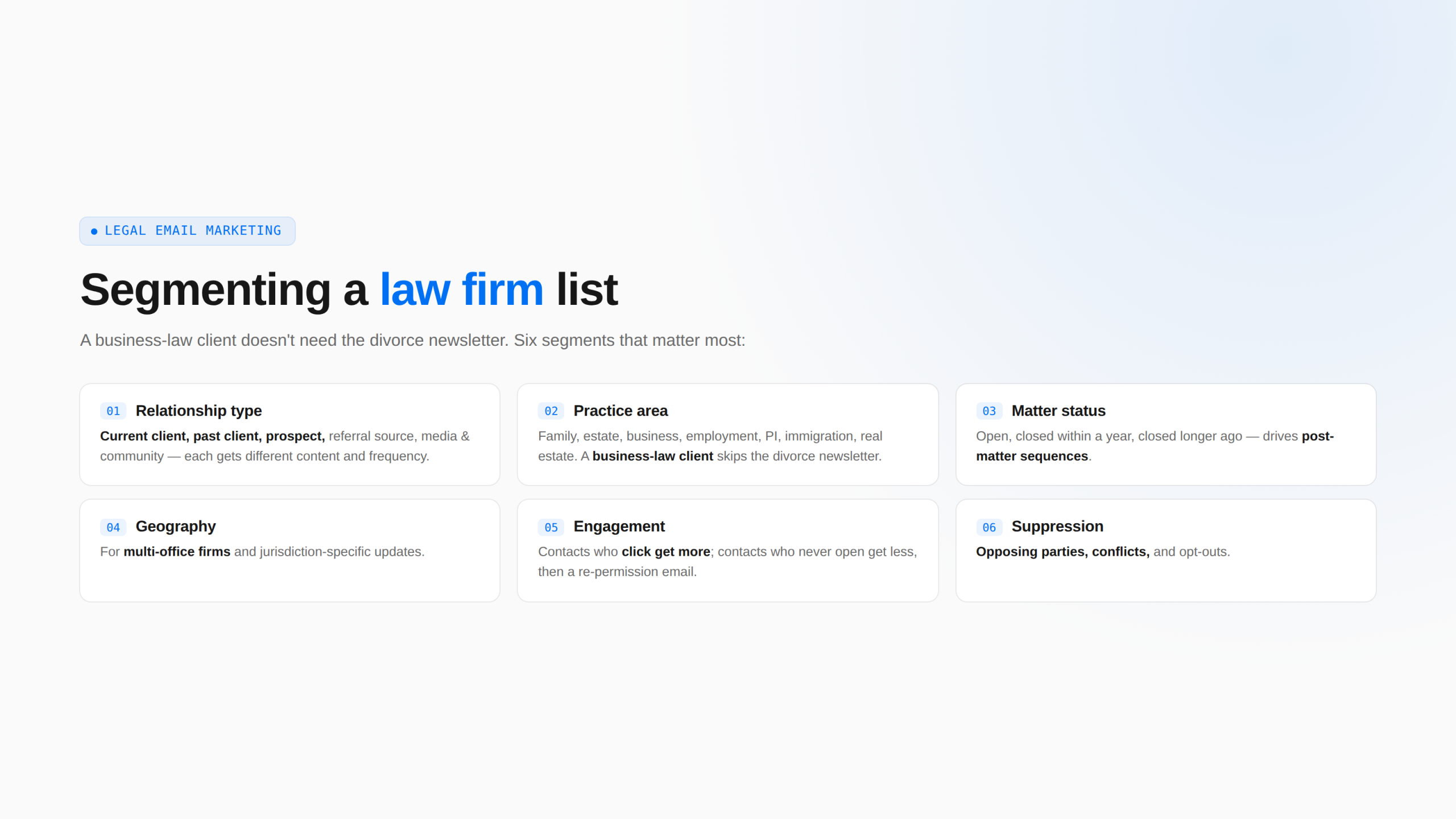
- Relationship type: current client, past client, prospect, referral source, media and community contacts. Each gets different content and frequency.
- Practice area: family, estate, business, employment, personal injury, immigration, real estate. A business-law client doesn’t need the divorce newsletter.
- Matter status: open, closed within a year, closed longer ago. Drives post-matter sequences.
- Geography: for multi-office firms and jurisdiction-specific updates.
- Engagement: contacts who click get more; contacts who never open get less and eventually a re-permission email.
- Suppression: opposing parties, conflicts, and opt-outs.
Practice-area tags are the most valuable segment a firm can build, and the easiest to neglect. Tag at intake.
Best Practices for Lawyer Email Marketing
- Write like a lawyer explaining, not a lawyer advertising. Plain language, specific scenarios, no hype. Credibility is the product.
- One idea per email. A single update or article, one call to action (read more, book a consultation, reply).
- Send from a person. A named partner or the practice-area lead, with a real reply-to that someone monitors.
- Keep the footer compliant. Firm name, physical address, unsubscribe link, and any state-required advertising label or disclaimer, on every email.
- Segment by practice area from day one. Relevance is what keeps lawyers’ emails opened.
- Automate the prospect sequence. It’s the highest-converting email a firm sends and it runs without anyone remembering to send it.
- Ask for the review at the right moment. Thirty days after a good outcome, where your rules allow.
- Use plain templates. Text-forward, firm logo, one image at most. Heavy design reads as advertising and lands in Promotions.
- Respect frequency. Monthly is enough for most firms; quarterly for referral sources. Legal updates go out when the law changes, not on a calendar.
- Authenticate your domain. SPF, DKIM, and DMARC, so your firm’s name can’t be spoofed and your newsletters reach the inbox. Our SPF, DKIM and DMARC guide covers the setup.
Common Mistakes Law Firms Make
- Buying or scraping lists. A CAN-SPAM violation and, in most states, a solicitation problem. Build the list from clients, enquiries, events, and downloads.
- One newsletter for every practice area. Irrelevant content trains contacts to ignore the firm.
- No unsubscribe, or a slow one. A regulatory complaint waiting to happen.
- Referencing matters without consent. Even anonymised case studies can identify a client in a small community.
- Sending from a generic address with no reply path. Replies are enquiries; make sure someone reads them.
- Treating email as a one-off. The value is cumulative; a firm that sends for three months and stops has paid the setup cost and collected none of the return.
- Ignoring deliverability. Firms often send from Outlook or a practice-management tool without authentication and wonder why open rates are low. Use a proper platform and check inbox placement.
Tools and Platforms for Law Firm Email Marketing
Most firms choose between a general email platform connected to their practice-management system (Clio, MyCase, PracticePanther, and others export contacts, and several integrate with Mailchimp or via Zapier) and a legal-marketing suite that bundles email with website and intake tools. For solo and small firms, a general platform is usually the better value; the features that matter are segmentation, a simple automation builder, role-based access, and deliverability.
| Platform | Best For | Free Plan | Starting Price | Why for law firms |
|---|---|---|---|---|
| Mailercloud#1 Pick | Solo & small-to-mid firms | ✓ Yes 1,000 contacts | $10/mo | Segmentation, prospect automations, roles, Inbox Tracker |
| Mailchimp | Practice-management integrations | ✓ Yes 250 contacts | $13/mo | Native Clio/MyCase-style connectors; familiar UI |
| Constant Contact | Seminars + phone support | ✗ Trial Free trial | $12/mo | Event tools; automation on Premium ($80/mo) |
| Brevo | Large, rarely mailed databases | ✓ Yes 300/day | ~$9/mo | Unlimited contacts; SMS for appointment reminders |
| Clio Grow / Lawmatics | Intake + CRM + email in one | ✗ No Custom | Custom | Nurture tied to intake pipeline; lighter email tooling |
Pricing verified September 13–14, 2026 on each platform’s official pricing page, monthly billing unless noted.
Mailercloud
Mailercloud suits solo practitioners and small-to-mid firms that want segmented newsletters and a prospect sequence at a predictable cost: free for 1,000 contacts and 12,000 emails a month, then $10/month for 5,000 contacts with unlimited sends. Practice-area segmentation and tagging, a visual automation builder for prospect and post-matter sequences, A/B testing, and user roles (so a marketing coordinator can send without full account access) cover the core needs. Inbox Tracker shows whether the newsletter reached the inbox or Promotions across Gmail, Outlook, and Yahoo, which matters for a text-forward legal newsletter that must look like correspondence, not advertising. Limitations: no native practice-management integrations (connect via Zapier or CSV), a smaller integration library than Mailchimp, and native SMS still in development.
✅Mailercloud Pros:
- Free for 1,000 contacts; $10/month for 5,000 contacts with unlimited sends — predictable for a firm budget
- Practice-area segmentation and tagging
- Visual automation builder for prospect sequences and post-matter follow-ups
- User roles so a coordinator can send without full account access
- Inbox Tracker shows whether a text-forward newsletter reached the inbox or Promotions
- A/B testing on subject lines
- Custom sending domain with guided SPF, DKIM, and DMARC
- 24/7 live chat support
❌Mailercloud Cons:
- No native practice-management integrations — Zapier or CSV import
- Smaller integration library than Mailchimp
- Native SMS still in development
💰Pricing: Free for up to 1,000 contacts. Premium from $10/month (5,000 contacts, unlimited sends).
Mailchimp
Mailchimp has the widest set of native integrations with legal practice-management tools and the most familiar interface. Pricing rises with list size (Essentials $13/month at 500 contacts), and it bills for unsubscribed contacts unless archived.
Constant Contact
Constant Contact’s simplicity, event tools (useful for seminars and webinars), and phone support on every plan suit firms without a marketing team. No free plan, and multi-step automation requires Premium at $80/month.
Brevo
Brevo’s unlimited contacts and volume-based pricing suit firms with large, rarely mailed contact databases, and it adds SMS for appointment reminders. Automation and A/B testing arrive on the Standard plan.
Legal marketing suites (e.g. Clio Grow, Lawmatics)
Intake and CRM tools built for firms, with email nurture sequences tied to the intake pipeline. Best for firms that want intake, CRM, and email in one place and have the budget; email design and deliverability tooling are lighter than dedicated platforms.
Metrics That Matter for Law Firms
- Consultations booked from email: tracked through UTM-tagged booking links or a “reply to book” count. The only metric partners need.
- Click-through rate: the engagement signal; opens are unreliable since Apple Mail Privacy Protection.
- Prospect-sequence conversion: consultations ÷ sequence completions.
- Referral-source engagement: clicks and replies from the referral segment.
- Post-matter review rate: reviews ÷ requests, where permitted.
- List growth by source: intake, events, downloads.
- Unsubscribe and complaint rates: under 0.5% and 0.1%; a rise usually means a segmentation error.
- Inbox placement: particularly for a text-forward newsletter that should not land in Promotions.
How to Get Started: A 7-Step Plan for Law Firms
- Review your state’s advertising rules and write a compliant footer and disclaimer set.
- Export contacts from practice management, tagged by relationship type and practice area, with conflicts and opt-outs suppressed.
- Choose a platform and authenticate your domain.
- Build one prospect sequence for your highest-value practice area.
- Send a monthly newsletter to clients and past clients, segmented by practice area.
- Set up post-matter follow-ups at 30 days, 6 months, and 12 months.
- Report consultations from email to the partners every month.
Frequently Asked Questions
Is email marketing allowed for lawyers?
Yes, email marketing is allowed for lawyers when it complies with state bar advertising rules (ABA Model Rules 7.1–7.3 as adopted by each state), CAN-SPAM, and client confidentiality; permission-based newsletters and educational content to existing contacts are generally permitted, while unsolicited email to people known to need legal services in a specific matter may be treated as solicitation and is restricted in most states.
What should a law firm email newsletter include?
A law firm newsletter should include one practical article relevant to the recipient’s practice-area segment, one legal update, a short firm note, a single call to action such as booking a consultation, and a compliant footer with the firm’s address, an unsubscribe link, and any state-required advertising label or disclaimer.
How often should lawyers send marketing emails?
Most law firms should send a newsletter monthly to clients and past clients, quarterly to referral sources, and legal updates only when the law changes, with automated prospect and post-matter sequences running in addition based on each contact’s stage.
Can lawyers send cold emails?
Lawyers should not send cold marketing email: it violates CAN-SPAM if unsolicited commercial email lacks required elements, and in most US states it risks being treated as solicitation under Rule 7.3, particularly if the recipient is known to need legal services. Build lists from clients, enquiries, events, and opt-in downloads instead.
What is the best email marketing platform for law firms?
The best email platform for a law firm is one with practice-area segmentation, a simple automation builder for prospect sequences, role-based access, and reliable deliverability; Mailercloud fits solo and small firms at $10/month with those features plus Inbox Tracker, Mailchimp offers the most native practice-management integrations, and Constant Contact suits firms that want phone support and event tools.
How do law firms get email subscribers?
Law firms build email lists from client intake (with consent), consultation enquiries, seminar and webinar registrations, downloadable guides on their website, and referral-source relationships, never from purchased or scraped lists.
Do law firm emails need a disclaimer?
Law firm marketing emails need whatever disclaimer or label the firm’s state bar requires, which in many states includes an “Advertising Material” designation on solicitations and disclaimers on testimonials or past results, plus the CAN-SPAM requirements of a physical address and an unsubscribe link; check the current rules for every state in which the firm markets.
Summary
Email marketing for lawyers works because legal services are bought on trust, infrequently, and through referral, and email keeps a firm credibly present through the long gaps between matters. Get the compliance footer right first, build the list from real relationships, segment by practice area, automate the prospect sequence and post-matter follow-ups, send a plain monthly newsletter from a named lawyer, and report consultations rather than opens.

As a Marketing Director, I develop and implement marketing strategies, conduct market research, and manage a team of marketing professionals. With a successful track record of launching campaigns that drive revenue growth, I bring my marketing expertise to blog writing, creating engaging content that promotes the brand and its products/services.