
Last updated: October 2026 | Pricing and ratings checked on October 28, 2026 | 9 min read
Amazon SES and SendGrid are two of the most widely used email APIs, and they suit very different teams. Amazon SES is AWS’s low-level sending service: very cheap per email, but you build much of the tooling yourself. SendGrid, owned by Twilio, is a fuller product with a dashboard, activity feed, dedicated IP on Pro and a marketing tool.
We compared them over eight rounds using current pricing pages and documentation. One big change first: since July 2026, new SES accounts default to a new Essentials plan at $0.16 per 1,000 emails, while the classic à-la-carte rate of $0.10 is still available. Short answer: SendGrid wins 4–3 with one draw on ease of use, but SES is far cheaper at volume.
Quick Answer: SendGrid narrowly wins our Amazon SES vs SendGrid comparison 4–3 on ease of use: quick setup, a built-in activity feed, a dedicated IP on Pro and Marketing Campaigns. Amazon SES is much cheaper at volume: about $10–$16 for 100,000 emails (à la carte $0.10 or Essentials $0.16 per 1,000) against $89.95 on SendGrid Pro. SES suits engineering teams on AWS; SendGrid suits teams that want a finished product.
Table of Contents
Amazon SES vs SendGrid at a Glance
| Amazon SES | SendGrid | |
|---|---|---|
| Owner | Amazon Web Services | Twilio (since 2019) |
| Free option | AWS Free Tier credits for new customers | 60-day trial, 100/day |
| Price per 1,000 | $0.10 (à la carte); $0.16 (Essentials plan) | Plan-based |
| 100,000 emails | About $10–$16 | $34.95 (Essentials) or $89.95 (Pro) |
| 1 million emails | About $100–$160 | $799 (Pro, 1.5M tier) |
| Dedicated IP | $24.95/IP/month; managed IPs available | Included on Pro |
| Getting started | Sandbox until production access approved | Sign up and send |
| Marketing email | Not included | Marketing Campaigns |
Review ratings
Amazon SES
SendGrid
Amazon SES has no Trustpilot profile of its own (only company-wide Amazon and AWS profiles), so we show G2 and Capterra.
Round 1: Price at Volume
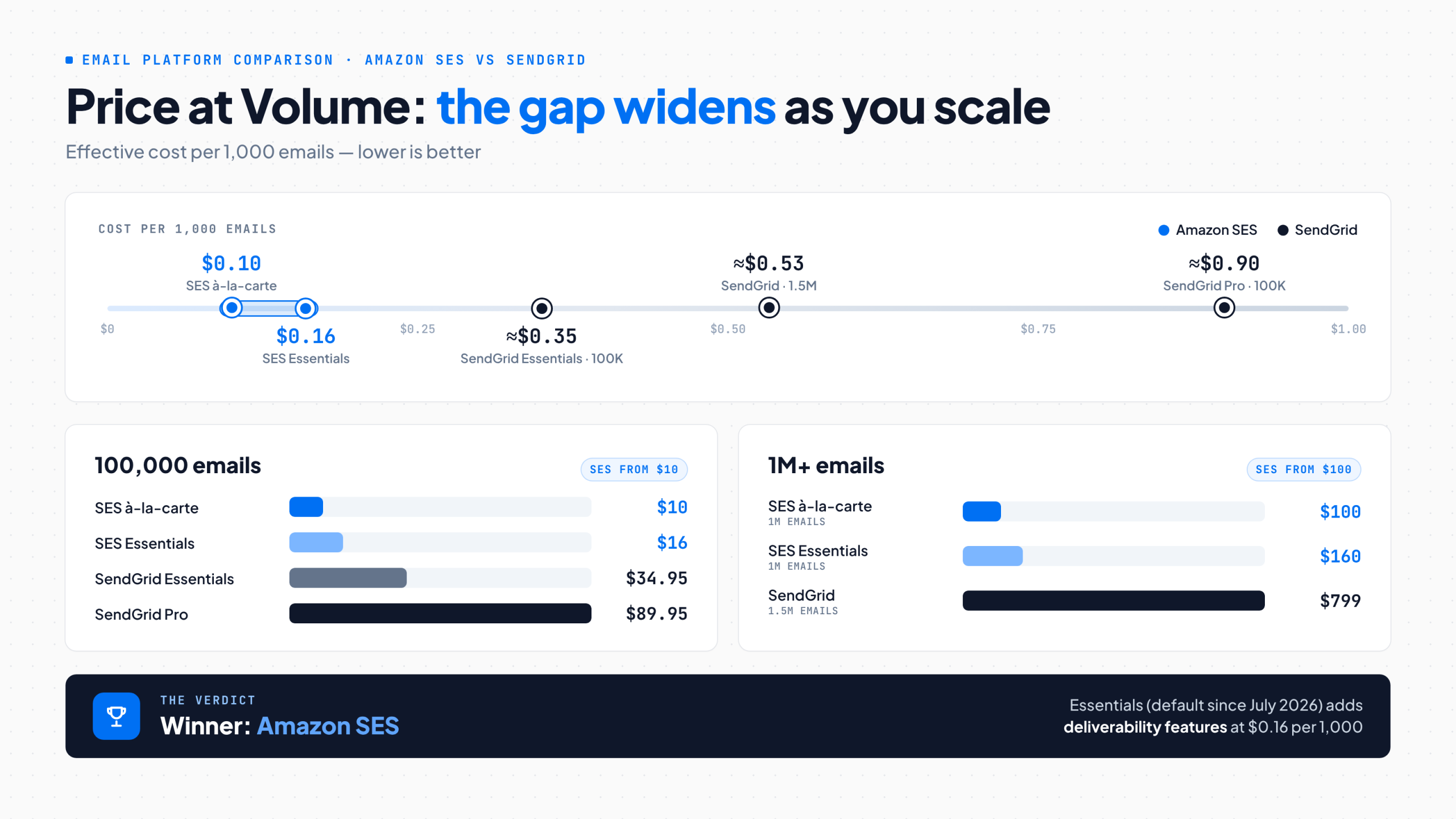
SES is far cheaper. À-la-carte pricing is $0.10 per 1,000 emails, so 100,000 cost about $10 and 1 million about $100. The new Essentials plan, the default for new accounts since July 2026, charges $0.16 per 1,000 (about $16 and $160) and includes deliverability features. SendGrid charges $34.95 for 100,000 on Essentials, $89.95 on Pro, and $799 for 1.5 million.
Winner: Amazon SES.
Round 2: Free Option
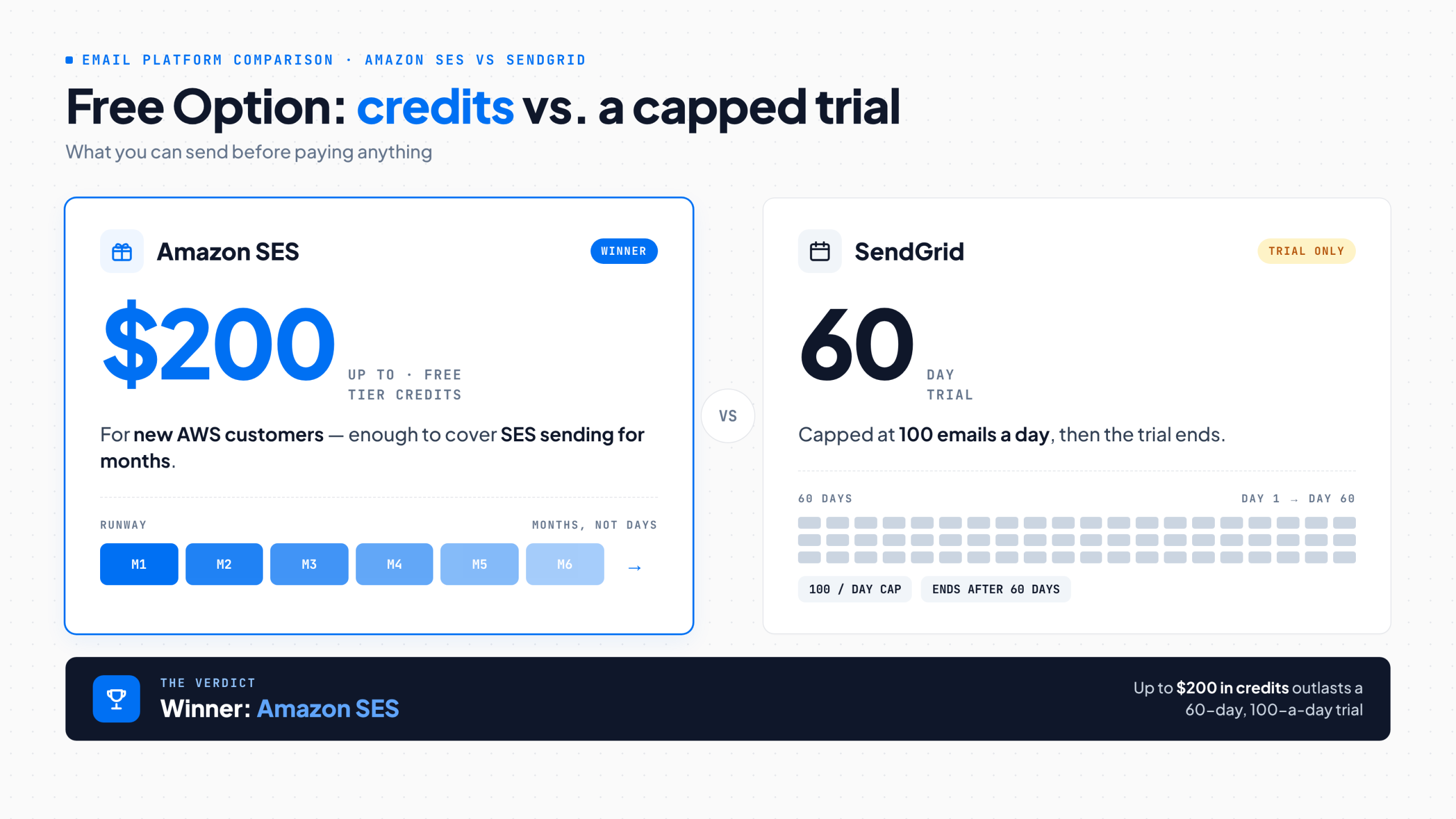
New AWS customers get up to $200 in Free Tier credits that can cover SES sending for months. SendGrid offers a 60-day trial at 100 emails a day.
Winner: Amazon SES.
Round 3: Setup and Onboarding
SES starts every account in a sandbox: you can only send to verified addresses, up to 200 messages a day, until AWS approves a production-access request. SendGrid lets you sign up, authenticate your domain and start sending.
Winner: SendGrid.
Round 4: Dashboard and Logs
SendGrid has a searchable activity feed (3 days on Essentials, 7 on Pro) and a full web dashboard. SES needs event destinations such as CloudWatch, SNS or Kinesis to store and search delivery events.
Winner: SendGrid.
Round 5: Deliverability Tools
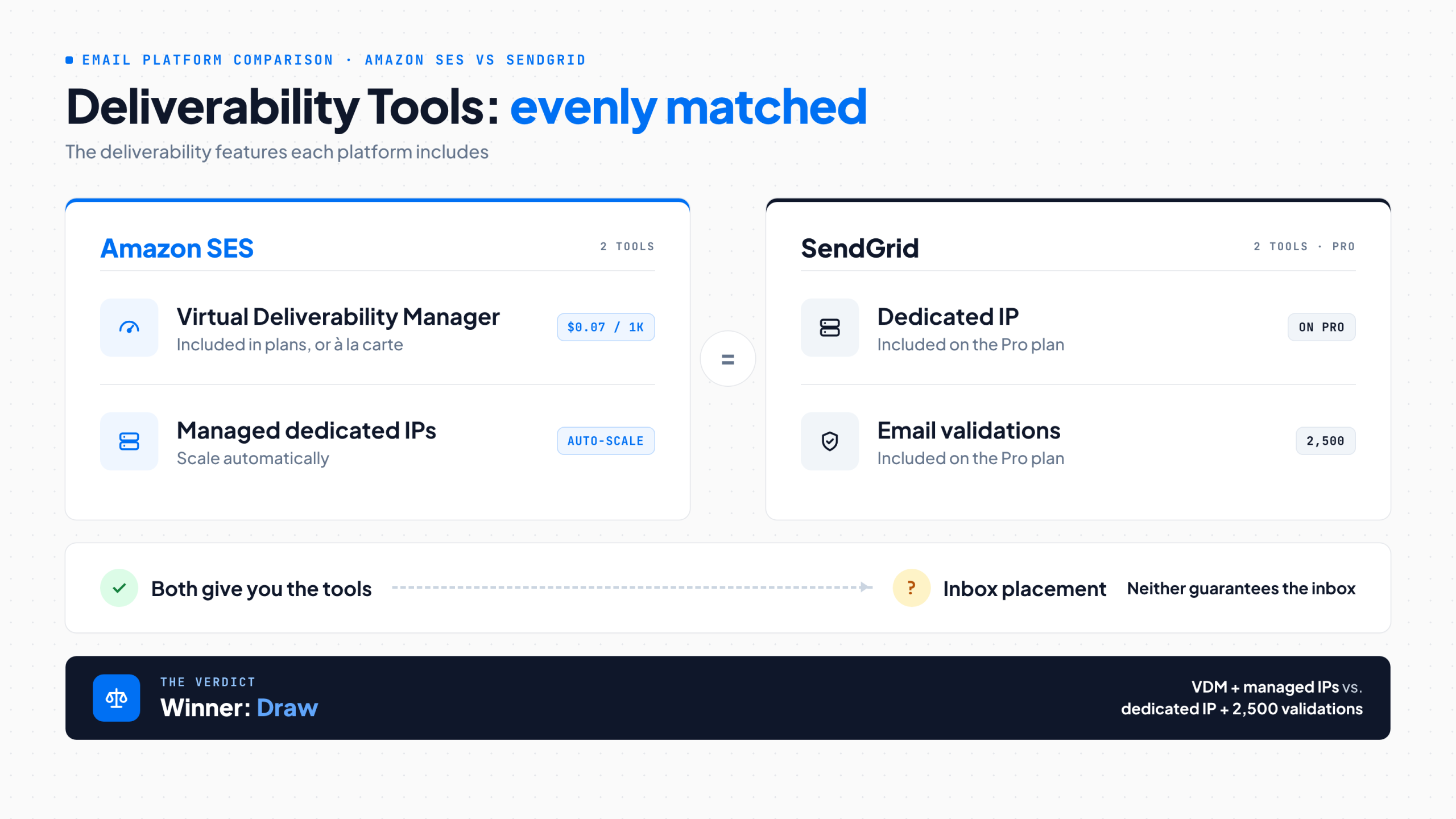
SES offers Virtual Deliverability Manager (included in its plans, or $0.07 per 1,000 à la carte) and managed dedicated IPs that scale automatically. SendGrid includes a dedicated IP and 2,500 email validations on Pro. Both give you the tools; neither guarantees the inbox. For transactional-only specialists, see our Postmark alternatives.
Winner: Draw.
Round 6: Dedicated IP
SendGrid Pro includes a dedicated IP in the $89.95 price. SES charges $24.95 per IP per month, or a managed-IP fee plus a per-email charge.
Winner: SendGrid.
Round 7: Marketing Email
SendGrid offers Marketing Campaigns with a visual editor and contact management. SES is a sending service only; you’d need to build or buy marketing tools on top. If you want SendGrid against a newer developer API instead, see Resend vs SendGrid.
Winner: SendGrid.
Round 8: Scale and AWS Integration
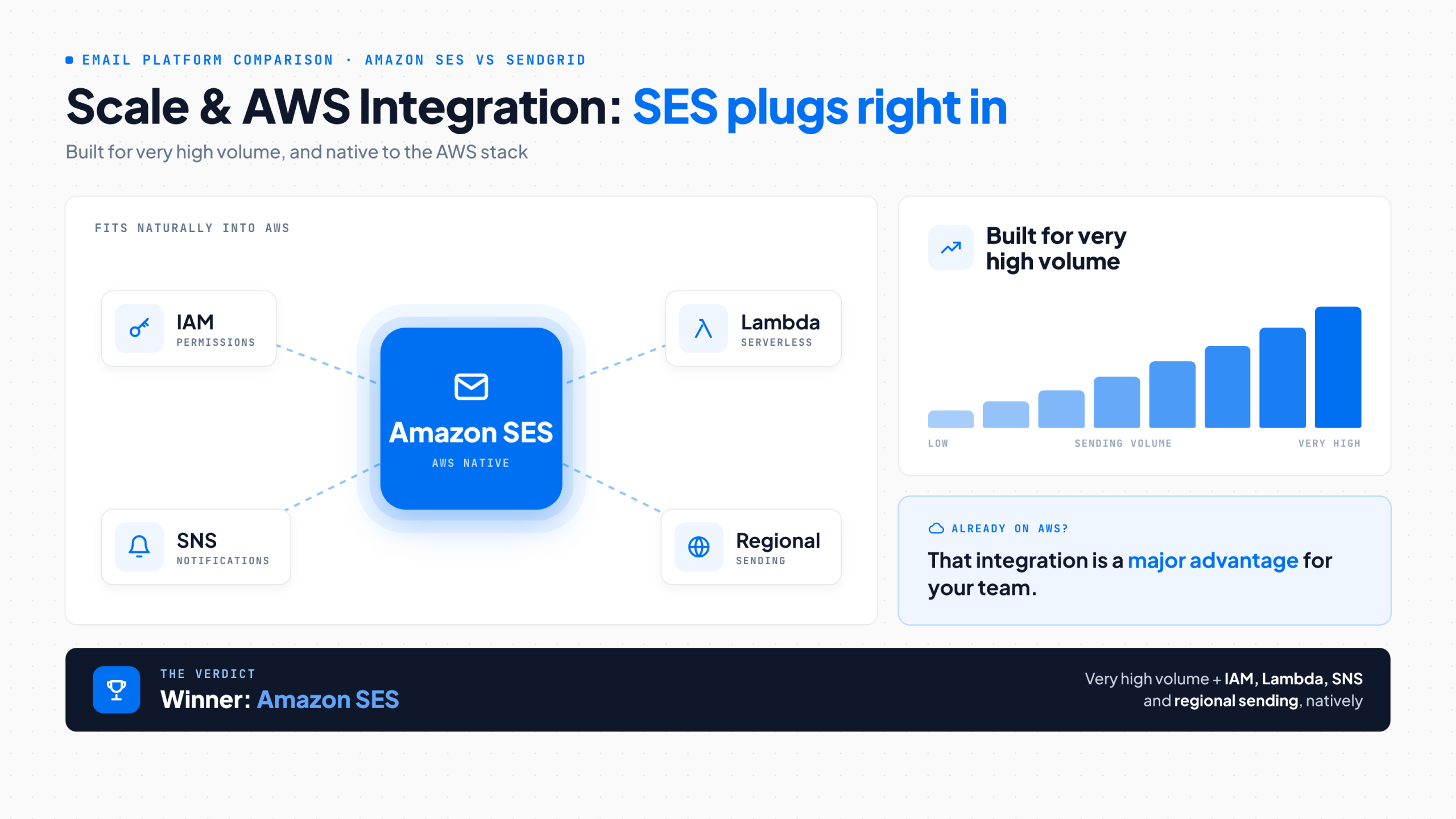
SES is built for very high volume and fits naturally into AWS: IAM permissions, Lambda, SNS and regional sending. For teams already on AWS, that integration is a major advantage. Leaving another provider? See our SparkPost alternatives.
Winner: Amazon SES.
Final Scoreboard: SendGrid 4, Amazon SES 3 (1 Draw)
| Round | Winner |
|---|---|
| 1. Price at volume | Amazon SES |
| 2. Free option | Amazon SES |
| 3. Setup | SendGrid |
| 4. Dashboard and logs | SendGrid |
| 5. Deliverability tools | Draw |
| 6. Dedicated IP | SendGrid |
| 7. Marketing email | SendGrid |
| 8. Scale and AWS | Amazon SES |
Sidenote: Since July 21, 2026, new SES accounts (and accounts with no SES activity since June 2025) default to the Essentials plan at $0.16 per 1,000 emails. Check which pricing your account is on before comparing costs.
A Simple Way to Decide
- You send hundreds of thousands of emails and have engineers on AWS: choose Amazon SES.
- You want to send today with a dashboard and logs: choose SendGrid.
- You need marketing campaigns as well as an API: choose SendGrid.
- Still comparing? See SendGrid vs Mailgun, our SMTP relay services roundup and the best transactional email services.
Whichever you choose, authenticate your sending domain. Gmail and Yahoo require bulk senders to authenticate with SPF (RFC 7208), DKIM (RFC 6376) and DMARC (dmarc.org), keep spam complaints low and support one-click unsubscribe (Google’s guidelines, Yahoo’s best practices). Track your domain reputation in Google Postmaster Tools. Watch your hard and soft bounces closely, because SES can pause sending if bounce or complaint rates climb.
Amazon SES Pros and Cons
✅Amazon SES Pros:
- Lowest cost per email at volume
- AWS Free Tier credits for new customers
- Built for very high volume
- Deep AWS integration (IAM, Lambda, SNS)
- Managed dedicated IPs and Virtual Deliverability Manager
❌Amazon SES Cons:
- Sandbox and production-access request before you can send freely
- No built-in activity feed; logs need extra AWS services
- No marketing campaign tools
- Pricing changed in 2026; check which plan you’re on
💰Pricing: À la carte $0.10 per 1,000; Essentials plan $0.16 per 1,000 (default for new accounts); dedicated IP $24.95/month.
SendGrid Pros and Cons
✅SendGrid Pros:
- Quick setup with a full dashboard
- Dedicated IP included on Pro
- Marketing Campaigns available
- Large ecosystem of integrations
❌SendGrid Cons:
- Much more expensive than SES at volume
- No permanent free plan (60-day trial)
- Only 3–7 days of searchable activity
- Very low Trustpilot score (1.1)
💰Pricing: 60-day trial; Essentials $19.95/month (50K) or $34.95 (100K); Pro $89.95 (100K).
Frequently Asked Questions
Is Amazon SES cheaper than SendGrid?
Yes, much cheaper at volume. 100,000 emails cost about $10 on SES à la carte (or $16 on the Essentials plan) against $34.95–$89.95 on SendGrid.
Is Amazon SES better than SendGrid?
SES is better for engineering teams on AWS who want the lowest cost; SendGrid is better for teams that want a finished product with a dashboard and marketing tools. SendGrid wins our comparison 4–3.
What is the Amazon SES sandbox?
New SES accounts start in a sandbox where you can only send to verified addresses, up to 200 messages a day. You request production access from AWS to send freely.
How much does Amazon SES cost in 2026?
À-la-carte pricing is $0.10 per 1,000 emails; the new Essentials plan is $0.16 per 1,000, with Pro and Enterprise plans adding platform fees. Dedicated IPs cost $24.95 a month.
Does SendGrid have a free plan?
No. SendGrid offers a 60-day trial at 100 emails a day instead of a permanent free plan.
What are the alternatives to Amazon SES and SendGrid?
Mailgun, Postmark and Resend are common alternatives. See our SendGrid alternatives and Mailgun alternatives.
Final Verdict
Amazon SES is the clear choice on price and scale for engineering teams already on AWS, as long as you’re happy to build logging and tooling around it and work through the sandbox. SendGrid wins on everything that saves time: quick setup, a dashboard and activity feed, a dedicated IP on Pro and marketing campaigns. Pick SES to save money at volume, and SendGrid to save engineering time.
Looking for a Simpler Alternative?
If you want low, flat pricing without building your own tooling, the Mailercloud Email API costs $10/month for 50,000 emails and $100 for 500,000, with SMTP and REST, a dashboard and a 14-day free trial. Marketing campaigns run from the same account.
Low-cost sending without the setup — try the Mailercloud Email API
★★★★★ 4.5 on G2 · 4.7 on Capterra · 4.4 on Trustpilot · Trusted by 35,000+ businesses
14-day free trial · SMTP & REST API · $10/month for 50,000 emails

An SEO expert with a focus on on-page optimization, technical SEO, and keyword research. Dedicated to helping businesses improve search rankings and grow their online presence through data-driven strategies.