Last updated: September 2026 | 15 min read
The average person buys or sells a home every seven to ten years. Between those moments they’re still a lead, a past client, or a referral source, and the agent who’s still in their inbox when the moment comes is the agent who gets the call. Real estate email marketing is the system for being that agent: a small set of automated drips for new leads, a listing and market-update cadence for the database, and a long-tail nurture for past clients that turns one transaction into a referral pipeline.
This guide covers how agents, teams, and brokerages build that system in 2026: what to send at each stage, how to segment buyers, sellers, and past clients, the compliance rules (CAN-SPAM, fair housing, state licensing disclosures), the platforms that fit real estate, and the metrics that predict closings. It’s vendor-neutral, with one tools section near the end.
Quick Answer: Real estate email marketing is permission-based email to leads, clients, past clients, and your sphere that turns one transaction into repeat business and referrals — the lead sources NAR’s surveys consistently rank first. The essentials: an automated response to new leads within minutes, buyer and seller nurture drips, listing alerts the lead controls, a past-client sequence (review at one week, referral ask at 90 days, annual home-value anniversary), and a monthly local market update segmented by area. Send from your own authenticated domain with a CAN-SPAM and fair-housing footer, and measure appointments and referrals rather than opens.
Table of Contents
What Real Estate Email Marketing Is
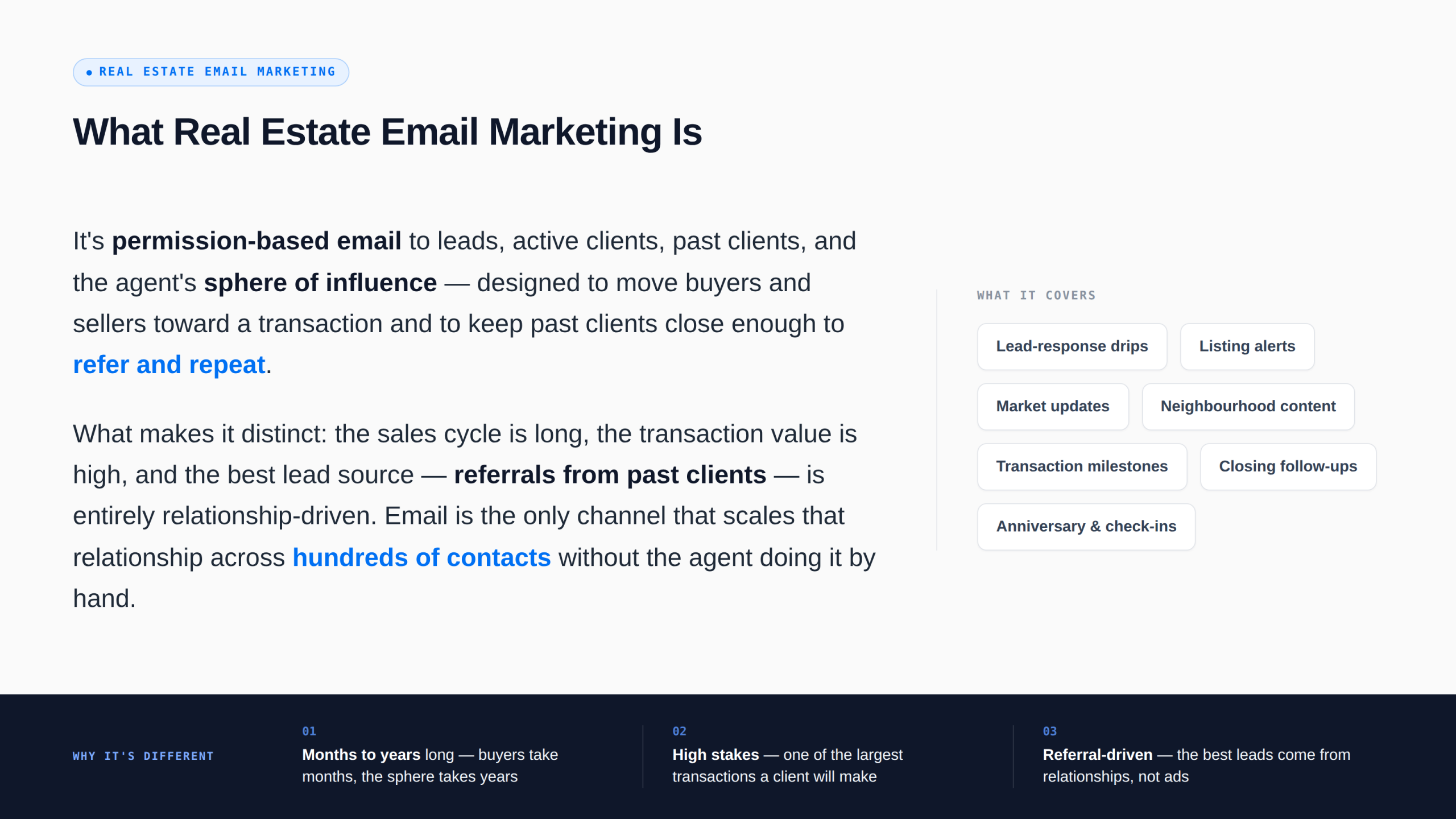
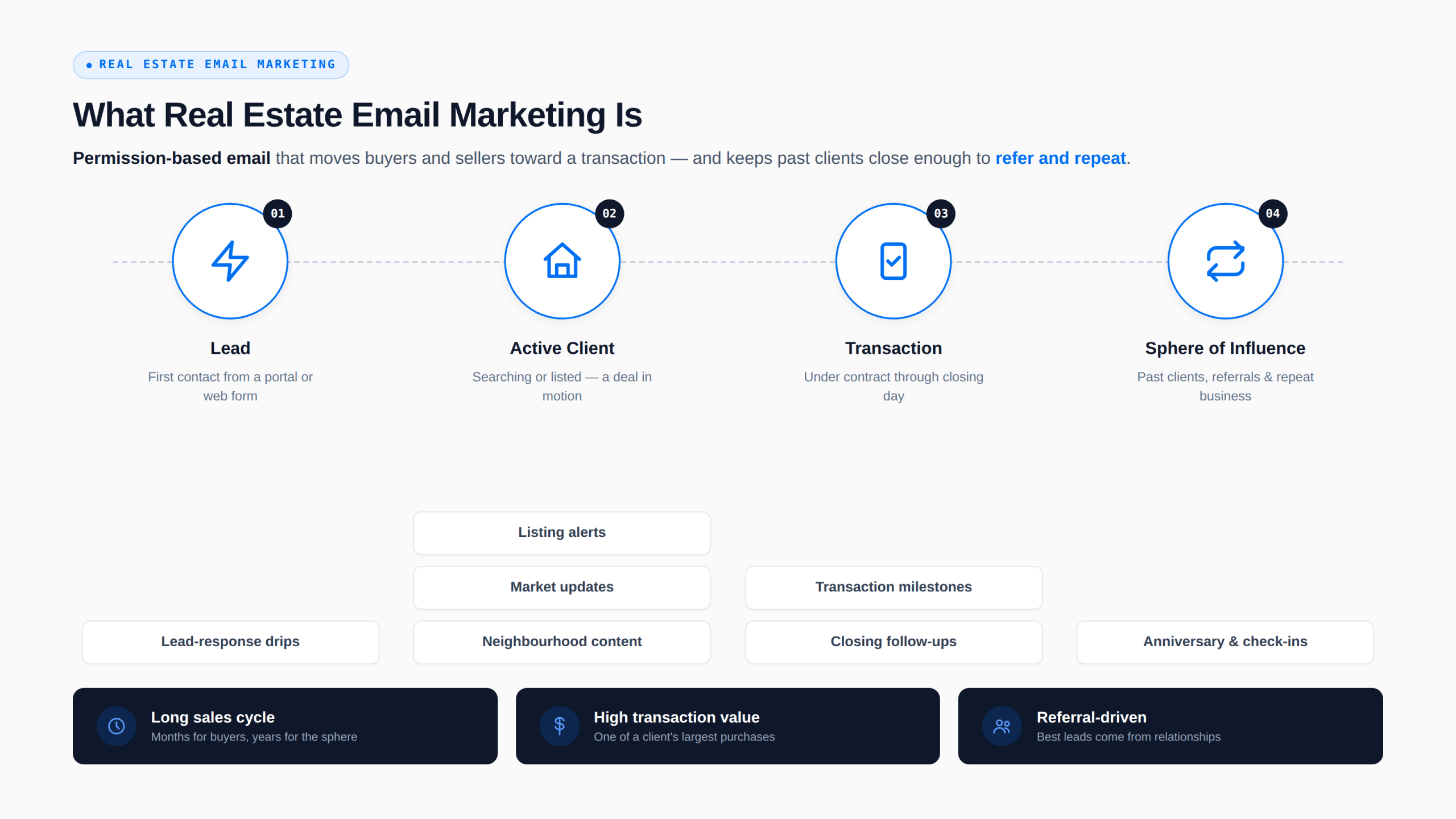
Real estate email marketing is permission-based email to leads, active clients, past clients, and the agent’s sphere of influence, designed to move buyers and sellers toward a transaction and to keep past clients close enough to refer and repeat. It covers lead-response drips, listing alerts, market updates, neighbourhood content, transaction milestone emails, closing follow-ups, and long-term anniversary and check-in sequences.
What makes it distinct: the sales cycle is long (months for active buyers, years for the sphere), the transaction value is high, and the best lead source, referrals from past clients, is entirely relationship-driven. Email is the only channel that scales the relationship across hundreds of contacts without the agent doing it by hand.
Why Email Works in Real Estate
The National Association of Realtors’ annual Profile of Home Buyers and Sellers has for years reported that most sellers find their agent through a referral or by using an agent they’ve worked with before, and that most buyers would use their agent again or recommend them. That’s the case for email in one sentence: the highest-value lead source is past clients and their friends, and email is how an agent stays referable between transactions.
It’s also the cheapest channel per contact. Litmus’s State of Email research puts email’s return at roughly $36 per $1 spent across industries; for an agent whose average commission runs into thousands, a monthly market update that produces one listing appointment a quarter is a large return on a $10–$50 monthly platform fee.
Speed matters too. Online lead studies consistently find that response within minutes dramatically improves contact rates. An automated first email that goes out the moment a portal lead arrives, followed by a call, is the difference between a lead and a name in a spreadsheet.
The Real Estate Contact Journey: What to Send and When
New leads (portal, website, open house, referral)
Instant response. Within five minutes: a short, personal-sounding email from the agent acknowledging the enquiry, one useful attachment or link (the listing, a neighbourhood guide), and a clear next step (a call, a showing). Automate the send; personalise the template.
Lead nurture drip. Five to eight emails over two to three weeks for buyers (how to get pre-approved, what to expect at a showing, neighbourhood guides, a market snapshot) and for sellers (what your home might be worth, how pricing works, prep checklist, what an agent does). The goal is a conversation, not a sale.
Listing alerts. For buyers: automated matches by price, area, and property type from your MLS or CRM feed. The single most-opened email in real estate. Keep frequency in the lead’s control.
Active clients (under contract)
Transaction milestones. Offer accepted, inspection scheduled, appraisal, financing, closing date, what to bring. Mostly transactional, but they set the tone for every marketing email that follows and they get forwarded to family.
Past clients and sphere of influence
Closing follow-up. One week after closing: thanks and a request for a review. Thirty days: a check-in with a home-maintenance tip. Ninety days: a request for referrals, gently.
Home anniversary. Every year: a personal note plus an updated estimate of what the home is worth. Reliably the highest-response email in a past-client programme.
Monthly or quarterly market update. Local, specific, short: what sold, what’s listed, what’s changed. Segmented by neighbourhood where the database supports it.
Seasonal and community content. Local events, tax-deadline reminders for homeowners, seasonal maintenance. This is relationship maintenance; keep it light and useful.
Just-listed and just-sold. To the sphere in the relevant area: proof of activity, and a prompt for anyone thinking of selling.
Sellers who didn’t list
Long-term seller nurture. Quarterly home-value updates and market notes for homeowners who enquired but didn’t list. These convert months or years later.
Segmenting a Real Estate Database
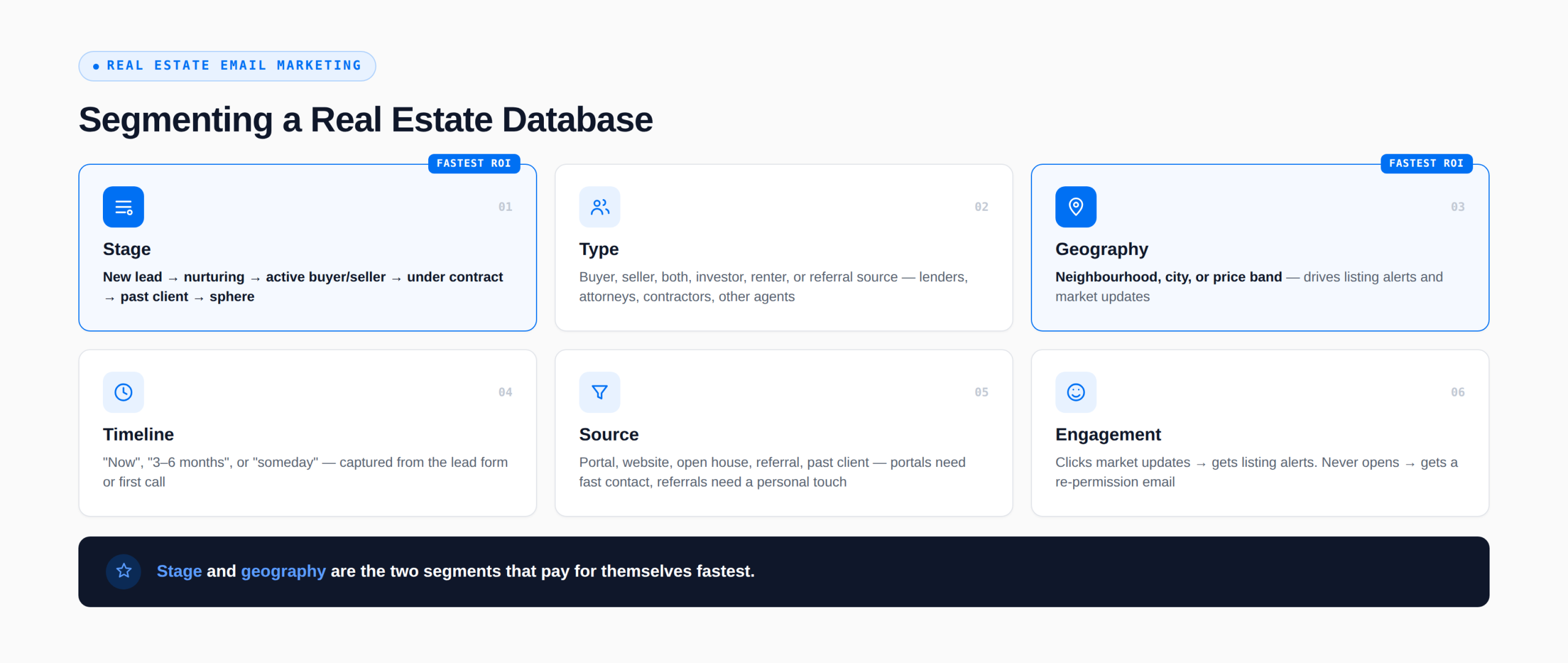
- Stage: new lead, nurturing, active buyer, active seller, under contract, past client, sphere.
- Type: buyer, seller, both, investor, renter, referral source (lenders, attorneys, contractors, other agents).
- Geography: neighbourhood, city, or price band, for listing alerts and market updates.
- Timeline: “now”, “3–6 months”, “someday”, from the lead form or first call.
- Source: portal, website, open house, referral, past client. Portal leads need faster, more frequent early contact; referrals need a personal touch.
- Engagement: contacts who click market updates get listing alerts; contacts who never open get a re-permission email.
Stage and geography are the two segments that pay for themselves fastest.
Compliance for Real Estate Email
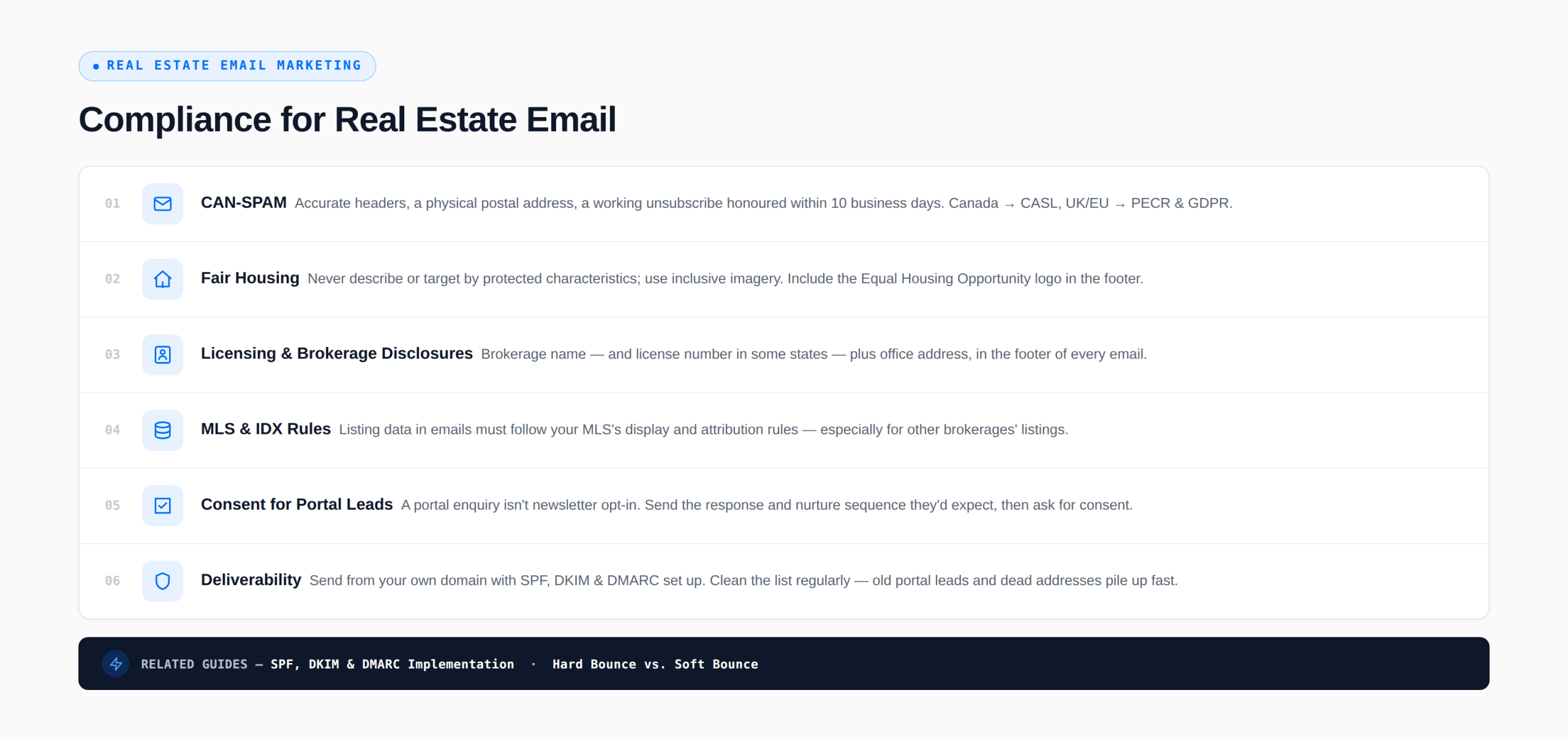
CAN-SPAM. Accurate headers and subject lines, a physical postal address (brokerage office is fine), a working unsubscribe honoured within ten business days, and no sending to opted-out contacts. Canadian contacts fall under CASL (express consent), UK and EU contacts under PECR and GDPR.
Fair housing. The Fair Housing Act applies to advertising, including email. Don’t describe neighbourhoods or listings in terms of protected characteristics, don’t segment or target by them, and use inclusive imagery. Many brokerages require the Equal Housing Opportunity logo in email footers; include it.
Licensing and brokerage disclosures. Most states require the brokerage name (and in some cases the license number) in advertising. Put it in the footer of every email along with the brokerage address.
MLS and IDX rules. Listing data in emails must comply with your MLS’s display rules and attribution requirements, particularly for other brokerages’ listings.
Consent for portal leads. A lead who filled out a portal form has enquired but hasn’t necessarily opted in to a newsletter. Send the response and the nurture sequence they’d reasonably expect; ask for newsletter consent within it.
Deliverability. Send from your own domain (not gmail.com) with SPF, DKIM, and DMARC set up, or your emails will fail the Gmail and Yahoo bulk-sender rules and land in spam. Our SPF, DKIM and DMARC guide covers it. Clean the list regularly; real estate databases fill with old portal leads and dead addresses, and our hard bounce vs soft bounce post explains which to suppress.
Real Estate Email Best Practices
- Respond to new leads within minutes, automatically. Then call.
- Send from you, not from the brokerage. A named agent with a real reply-to. Real estate is personal.
- Make listing alerts the lead’s choice. Frequency and criteria they control get opened; blasts get unsubscribed.
- Local beats generic. A neighbourhood market update outperforms a national trend article every time.
- Automate the past-client sequence. Closing follow-ups, anniversaries, and quarterly updates run for years without effort.
- Ask for the review and the referral at the right moments. One week and ninety days after closing.
- Keep design light. One hero image, plain text, one CTA. Heavy templates land in Promotions.
- Segment by stage and area. Buyers under contract don’t need seller tips.
- Test subject lines. “Your home’s value just changed” versus “Market update: [Neighbourhood]”. One variable per send.
- Include the compliant footer everywhere. Brokerage name, address, unsubscribe, fair-housing logo.
Common Mistakes in Real Estate Email
- Sending from a personal Gmail. No authentication, no unsubscribe, no reporting, and increasingly blocked by inbox providers.
- Buying lists. CAN-SPAM violations, dead addresses, and complaint rates that damage every other send.
- One monthly newsletter to everyone. Buyers, sellers, and past clients want different things.
- Ignoring old leads. “Someday” leads convert months later if they’re still receiving market updates.
- No review or referral ask. The highest-value lead source, left to chance.
- Fair housing language slips. “Great for families”, “safe neighbourhood”, “walking distance to church” are the phrases compliance teams flag.
- Measuring opens. Unreliable since Apple Mail Privacy Protection; measure clicks, replies, and appointments.
Tools and Platforms for Real Estate Email Marketing
Agents usually choose between a real-estate CRM with built-in email (Follow Up Boss, LionDesk, kvCORE, and the brokerage-provided systems), which handle lead routing and listing alerts natively, and a general email platform for the newsletter, market-update, and past-client programme. Many agents run both: the CRM for lead response and alerts, the email platform for everything designed and segmented.
| Platform | Best For | Free Plan | Starting Price | Why for real estate |
|---|---|---|---|---|
| Mailercloud#1 Pick | Agents, teams & small brokerages | ✓ Yes 1,000 contacts | $10/mo | Drips, past-client automations, forms, Inbox Tracker at flat cost |
| Mailchimp | CRM & website integrations | ✓ Yes 250 contacts | $13/mo | Native connectors to several real-estate CRMs and site builders |
| Constant Contact | Open houses + phone support | ✗ Trial Free trial | $12/mo | Event tools; automation on Premium ($80/mo) |
| Brevo | Large spheres, SMS reminders | ✓ Yes 300/day | ~$9/mo | Unlimited contacts; SMS for showings; automation on Standard |
| Follow Up Boss / kvCORE | Lead routing & listing alerts | ✗ No Custom | Custom | Speed-to-lead and MLS alerts; lighter email design tooling |
Pricing verified September 13–14, 2026 on each platform’s official pricing page, monthly billing unless noted.
Mailercloud
Mailercloud suits agents, teams, and small brokerages that want the nurture, market-update, and past-client programme on a flat budget: free for 1,000 contacts and 12,000 emails a month, then $10/month for 5,000 contacts with unlimited sends. The visual automation builder runs lead drips and the closing-follow-up and anniversary sequences on date and behaviour triggers; segmentation and tagging handle stage, type, and neighbourhood; the signup form builder captures home-value and open-house leads; and Inbox Tracker shows whether a market update reached the inbox or Promotions across Gmail, Outlook, and Yahoo. The built-in email verifier cleans ageing portal-lead lists. Limitations: no MLS or IDX feed and no native real-estate CRM integration, so listing alerts stay in the CRM and contacts sync via Zapier or CSV; a smaller integration library than Mailchimp; and native SMS still in development.
✅Mailercloud Pros:
- Free for 1,000 contacts; $10/month for 5,000 contacts with unlimited sends — flat cost for a growing sphere
- Visual automation builder for lead drips, closing follow-ups, and home-anniversary sequences
- Segmentation and tagging by stage, type, and neighbourhood
- Signup form builder for home-value and open-house capture
- Inbox Tracker shows whether market updates land in the inbox or Promotions
- Built-in email verifier for ageing portal-lead lists
- A/B testing on subject lines; custom sending domain with guided authentication
- 24/7 live chat support
❌Mailercloud Cons:
- No MLS/IDX feed — listing alerts stay in your CRM
- No native real-estate CRM integration (Zapier or CSV sync)
- Smaller integration library than Mailchimp; native SMS still in development
💰Pricing: Free for up to 1,000 contacts. Premium from $10/month (5,000 contacts, unlimited sends).
Mailchimp
Mailchimp has native integrations with several real-estate CRMs and website platforms, a large template library, and a familiar interface. Pricing rises with database size (Essentials $13/month at 500 contacts) and it bills for unsubscribed contacts unless archived, which real-estate databases accumulate quickly.
Constant Contact
Constant Contact is common among agents for its simplicity, event tools (open houses, seminars), and phone support on every plan. No free plan, and multi-step automation requires Premium at $80/month.
Brevo
Brevo’s unlimited contacts and volume-based pricing suit large, rarely mailed spheres, and it adds SMS for showing reminders. Automation and A/B testing arrive on the Standard plan.
Real estate CRMs (Follow Up Boss, LionDesk, kvCORE)
Purpose-built for lead routing, speed-to-lead, listing alerts, and transaction tracking, with email built in. The right core system for teams and brokerages; email design, segmentation, and deliverability tooling are usually lighter than a dedicated platform, which is why many agents pair them.
Metrics That Predict Closings
- Lead response time: minutes from enquiry to first email and first call.
- Click-through rate: the engagement signal; opens are unreliable.
- Reply rate: in real estate, replies are appointments in waiting.
- Appointments and listing presentations from email: tracked by UTM-tagged booking links or a reply count.
- Home-value request rate: requests ÷ anniversary and seller-nurture emails sent.
- Review and referral rate: reviews and referrals ÷ closing follow-ups sent.
- Database growth by source: portal, website, open house, referral.
- Unsubscribe and complaint rates: under 0.5% and 0.1%.
- Inbox placement: especially for market updates that must not land in Promotions.
How to Get Started: A 7-Step Plan
- Export and tag your database by stage, type, and area; suppress opt-outs and dead addresses.
- Choose a platform and authenticate your domain (your own, not a webmail address).
- Build the new-lead drip for buyers and one for sellers, with an instant first email.
- Build the past-client sequence: one-week review request, 30-day check-in, 90-day referral ask, annual home-value anniversary.
- Set up capture: home-value form, open-house signup, website newsletter.
- Send a monthly local market update, segmented by area.
- Report appointments and referrals from email monthly.
Frequently Asked Questions
What is real estate email marketing?
Real estate email marketing is permission-based email to leads, active clients, past clients, and an agent’s sphere of influence, using automated lead drips, listing alerts, local market updates, transaction milestone emails, and long-term past-client sequences to generate appointments, repeat business, and referrals.
What emails should real estate agents send?
Real estate agents should send an instant automated response to new leads, a buyer or seller nurture drip, listing alerts the lead controls, transaction milestone emails for clients under contract, a closing follow-up with review and referral requests, an annual home-anniversary email with a home-value update, and a monthly local market update segmented by area.
How often should real estate agents email their database?
Real estate agents should send a market update or community email to their database monthly, listing alerts at whatever frequency each buyer chooses, automated drips to new leads over two to three weeks, and past-client touches on the closing-follow-up and anniversary schedule; more than weekly to the general database usually raises unsubscribes.
Is email marketing effective for real estate?
Yes, email marketing is effective for real estate because the most valuable lead sources, past clients and referrals, are relationship-driven and email keeps an agent present over the multi-year gaps between transactions at a cost of a few dollars a month, with NAR’s buyer and seller surveys consistently showing referral and repeat business as the leading way sellers choose an agent.
Do real estate emails need a disclaimer?
Real estate marketing emails need the brokerage name (and license number where the state requires it), a physical address and unsubscribe link under CAN-SPAM, and, at most brokerages, the Equal Housing Opportunity logo; listing content must also follow MLS display and attribution rules.
What is the best email marketing platform for real estate agents?
The best email platform for a real estate agent is typically a real-estate CRM for lead routing and listing alerts paired with a general platform for designed, segmented campaigns; Mailercloud fits agents and small brokerages at $10/month with automation, segmentation, form builder, and Inbox Tracker, Mailchimp offers the most native CRM integrations, and Constant Contact suits agents who want phone support and event tools.
Can real estate agents email leads from Zillow or Realtor.com?
Real estate agents can email portal leads with the response and nurture sequence the lead would reasonably expect from their enquiry, provided every email carries CAN-SPAM elements (address, unsubscribe), and should ask for explicit consent before adding them to a general newsletter; Canadian, UK, and EU leads require express opt-in under CASL, PECR, and GDPR.
Summary
Real estate email marketing turns a one-time transaction into a referral pipeline. Respond to new leads in minutes, automatically; nurture buyers and sellers with local, useful content; keep listing alerts in the lead’s control; and run a past-client sequence of review, referral, anniversary, and market updates for years. Send from your own authenticated domain, keep the fair-housing and brokerage footer on every email, segment by stage and area, and measure appointments and referrals rather than opens.

As a Marketing Director, I develop and implement marketing strategies, conduct market research, and manage a team of marketing professionals. With a successful track record of launching campaigns that drive revenue growth, I bring my marketing expertise to blog writing, creating engaging content that promotes the brand and its products/services.