Last updated: September 2026 · Tested by our editorial team using real subscriber lists and live campaigns
We ran the same newsletters, automations, and signup forms through both Flodesk and Mailchimp to answer one question: in 2026, which one actually earns its place in your stack?
This isn’t a feature list copied from two pricing pages. It’s what happened when we built and sent real campaigns on each platform and it lands at an interesting moment, because Flodesk just made the biggest change in its history: on December 2, 2025, it retired the flat-rate “unlimited subscribers” plan that made it famous and switched to subscriber-based pricing. That single change reshapes the whole comparison.
Below is our full 12-round breakdown. Each round has a declared winner and a running score, so you can track the matchup as you read. Short on time? The Quick Answer and the final scoreboard have everything you need.
Quick Answer: Mailchimp wins our 12-round comparison 7–5 over Flodesk. It’s the more complete marketing platform — deeper automation, far stronger segmentation and reporting, 300+ integrations, and a genuinely free plan. Flodesk wins decisively on design (its templates look nothing like standard newsletters), ease of use, and simplicity, and it’s the better pick for creators, designers, and boutique brands who care most about how emails look. Note that Flodesk retired its flat-rate unlimited plan in December 2025, so its old “cheapest at scale” advantage no longer applies to new users.
Table of Contents
Flodesk vs Mailchimp: At a Glance
Before the round-by-round breakdown, here’s where the two platforms stand in 2026.
| Feature | Flodesk | Mailchimp |
|---|---|---|
| Starting price (paid) | $19–25/mo (Lite, 1,000 subs) | $13/mo (Essentials) |
| Free plan | Forms only — no sending | 250 contacts · 500 emails/mo |
| Pricing model | Subscriber-based (flat rate retired Dec 2025) | Contact-based (counts unsubscribes) |
| Automation | Basic sequences; unlimited workflows on Pro | Customer Journey Builder (paid) |
| Segmentation | Simple (tags, basic segments) | Advanced (behavioral, predictive) |
| Email templates | Design-led, highly polished | 220+ by industry |
| Native integrations | Sparse (Shopify, Instagram; else Zapier) | 300+ |
| Deliverability (independent tests) | Not widely benchmarked | 82–85% inbox placement |
| Built-in checkout / selling | ✓ (Pro & Everything) | Limited |
| G2 rating | 4.6 / 5 | 4.4 / 5 |
Pricing and features verified September 2026. Sources: flodesk.com, mailchimp.com, G2, EmailToolTester.
How We Scored This Comparison
We evaluated Flodesk and Mailchimp across 12 categories that matter to anyone running email day-to-day. Each category has one winner — no ties. If a margin was thin, we still called it for whichever tool had the practical edge in testing. The running score tracks cumulative wins.
Round 1: Ease of Use & Editor
Winner : Flodesk
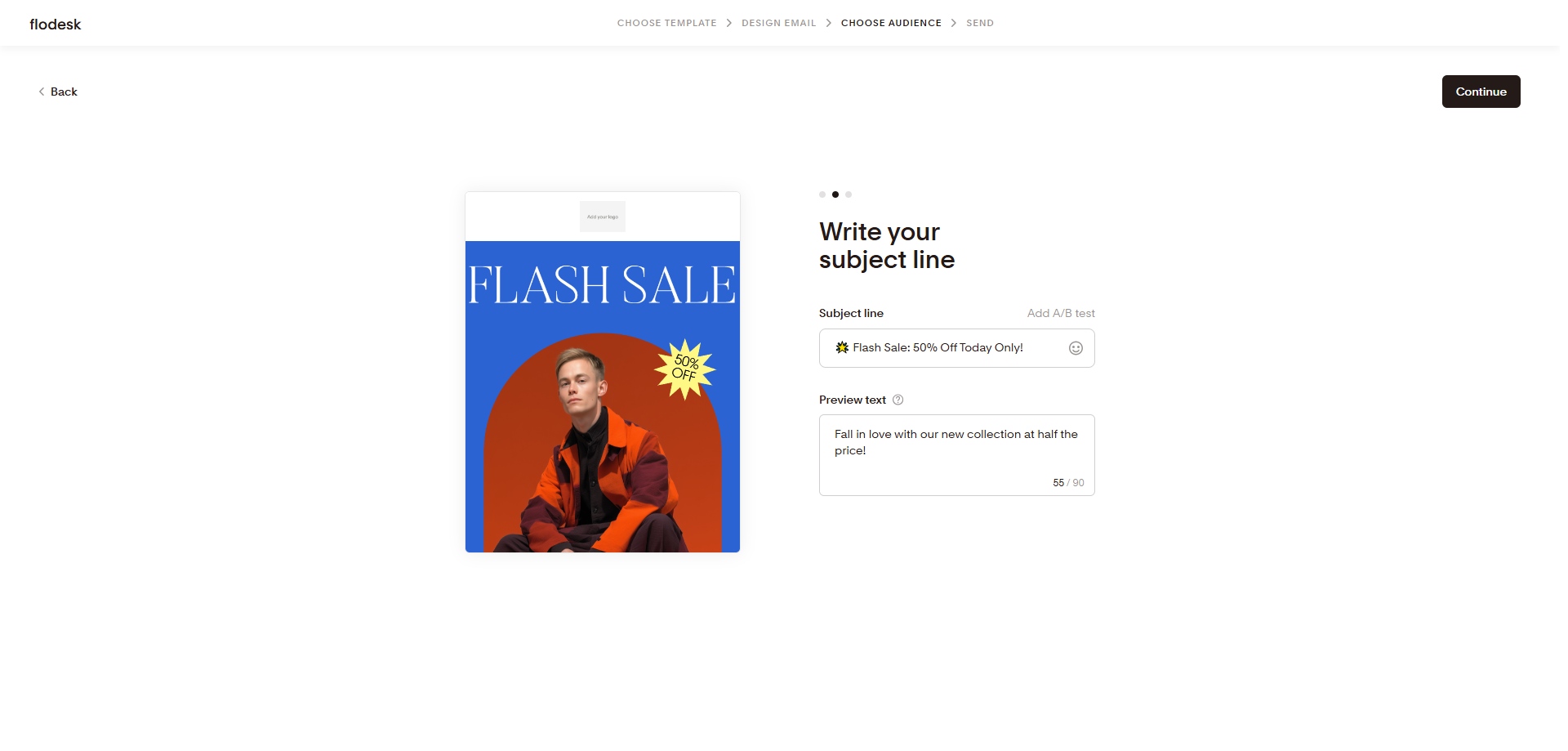
Flodesk is the easiest email tool we’ve used. The interface is calm, uncluttered, and clearly built for people who aren’t email specialists. You drop in a template, swap the text and images, and you’re done — there’s very little to learn and almost nothing to get lost in.
Mailchimp is perfectly usable, but years of added features have layered up the UI. The 2024 redesign helped, yet you still click through two or three menus for things that take one step in Flodesk, and the editor can lag on longer emails. Mailchimp’s built-in AI assistant for subject lines and copy is a genuine plus, but on pure get-in-and-build simplicity, Flodesk wins the round.
Round 2: Email Design & Templates
Winner: Flodesk
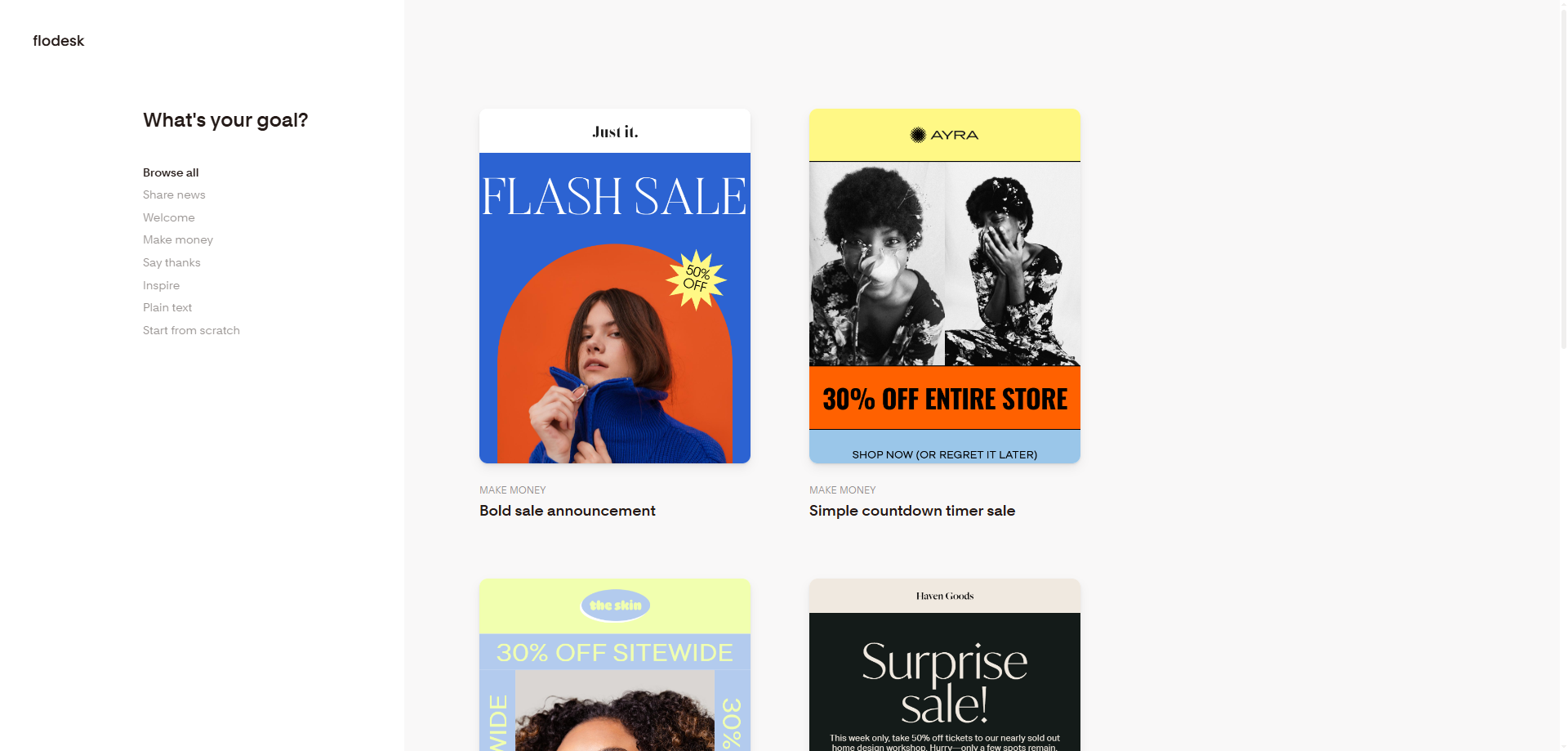
This is Flodesk’s whole reason for existing, and it shows. Its templates look genuinely designed — modern typography, generous spacing, custom fonts — rather than assembled from generic blocks. For photographers, designers, florists, coaches, and boutique brands, that matters: a grey, templated newsletter actively undercuts what those businesses are selling.
Mailchimp ships more templates (220+, sorted by industry and goal) and they’re perfectly professional. But “more” isn’t “better-looking.” Out of the box, Flodesk emails simply look more premium with less effort. Design is the round where Flodesk is untouchable.
Round 3: Marketing Automation
Winner: Mailchimp
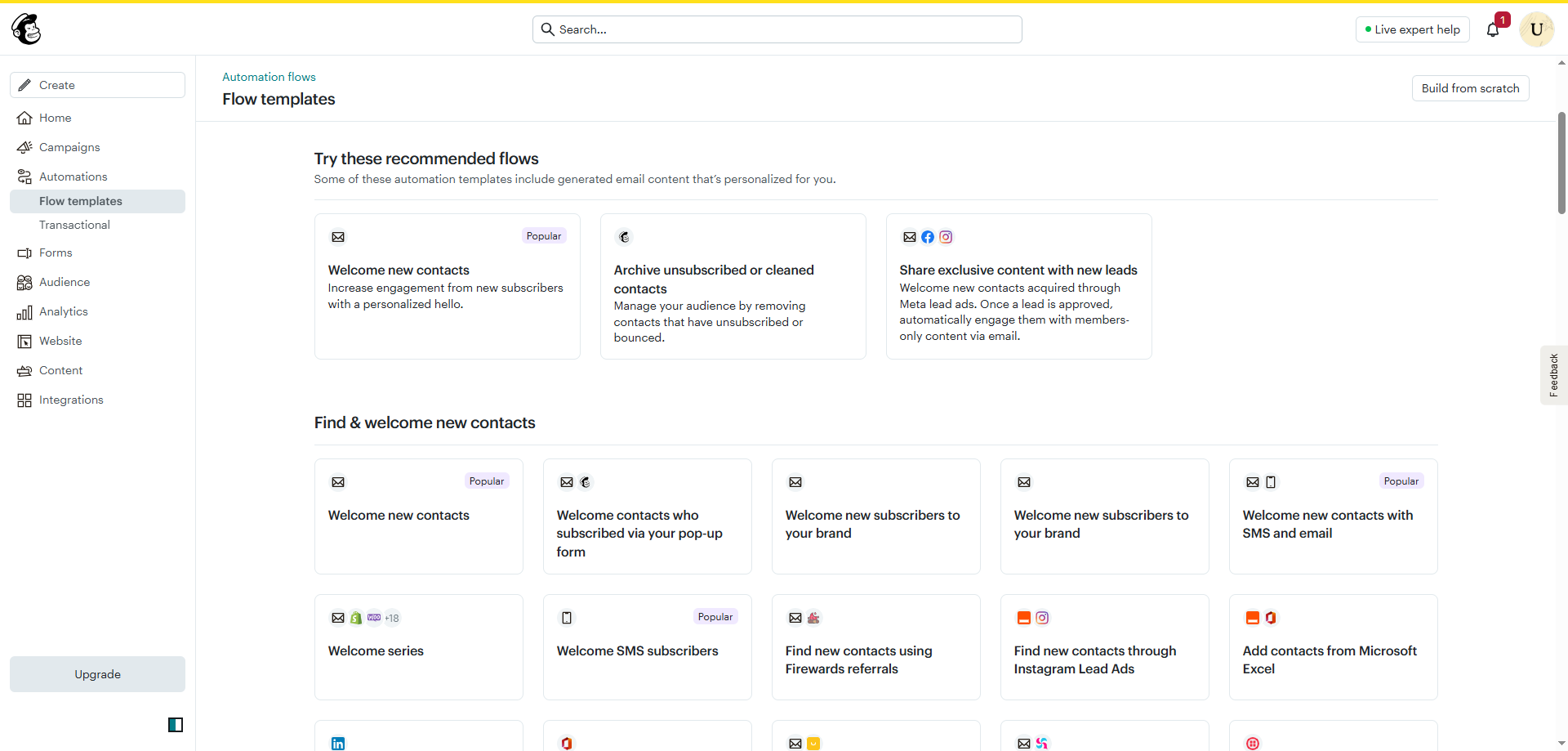
Mailchimp’s Customer Journey Builder supports multi-step branching paths, behavioral triggers tied to ecommerce activity, and 100+ pre-built automation templates on paid plans. If you want a welcome series that forks based on what someone clicked, or a cart-abandonment flow tied to purchase data, Mailchimp can build it.
Flodesk’s automation covers the basics — welcome sequences and simple drips — and the Lite plan limits you to a single workflow (you need Pro for unlimited). It lacks conditional branching, lead scoring, and multi-path journeys. It’s fine for a newsletter and a welcome email; it’s not built for complex lifecycle marketing. Mailchimp takes the round on depth.
Round 4: Segmentation & List Management
Winner: Mailchimp
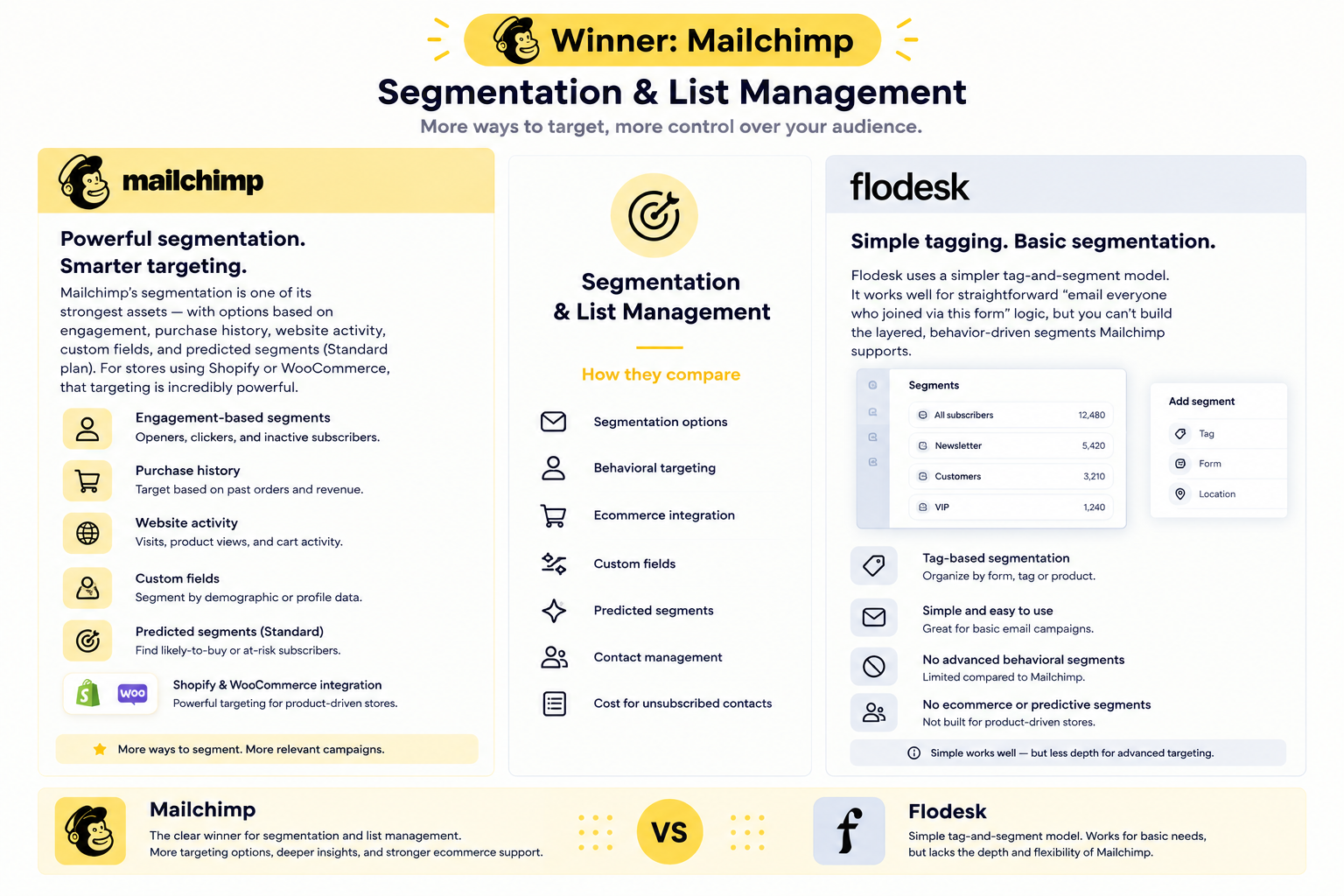
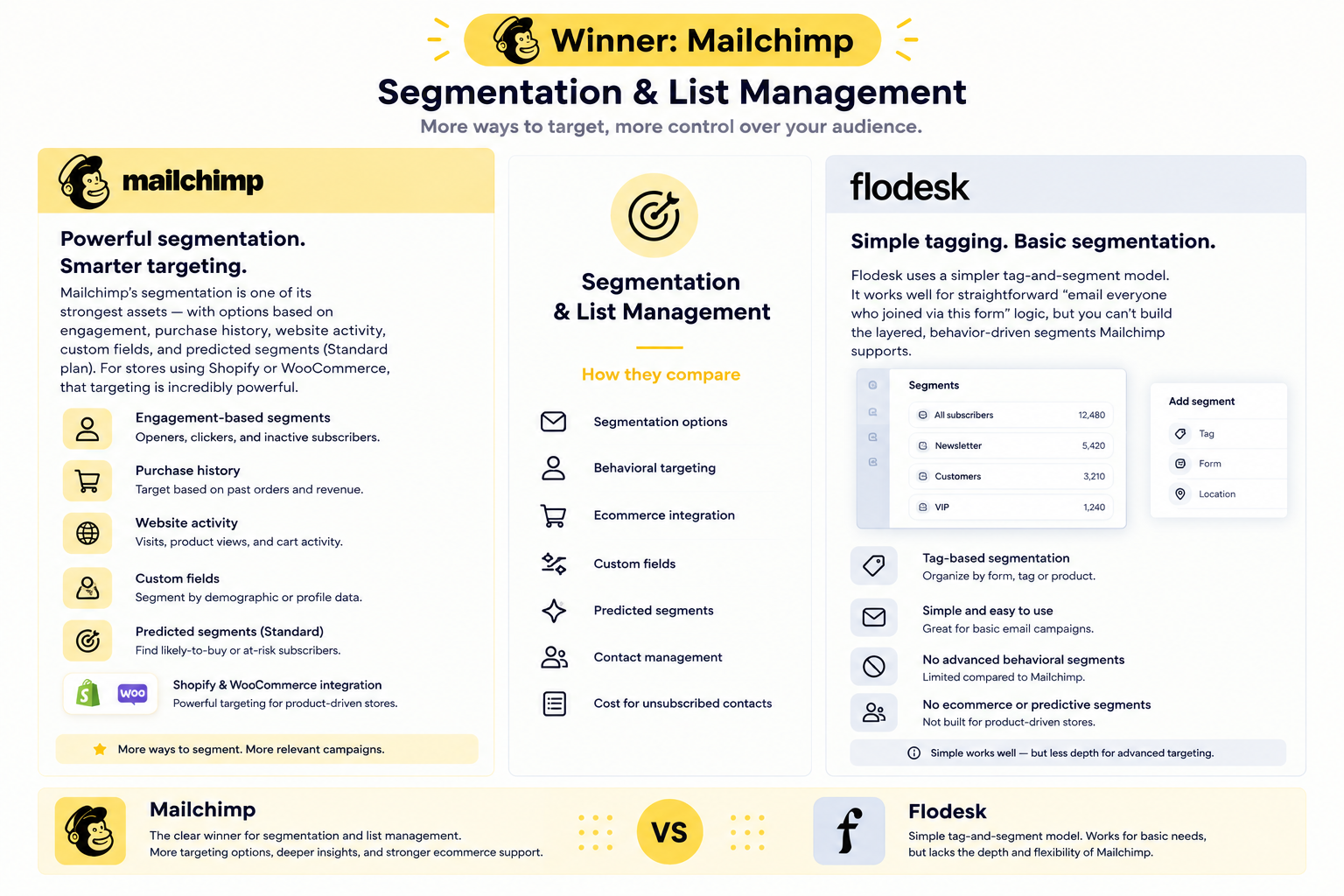
Mailchimp’s segmentation is one of its strongest assets: segments built on engagement, purchase history, website activity, custom fields, and — on Standard — predicted segments that flag likely-to-buy or at-risk subscribers. For a store with Shopify or WooCommerce connected, that targeting is powerful.
Flodesk uses a simpler tag-and-segment model. It works well for straightforward “email everyone who joined via this form” logic, but you can’t build the layered, behavior-driven segments Mailchimp supports. One caveat that counts against Mailchimp, though: it bills for all contacts, including unsubscribed ones. It doesn’t cost Mailchimp the round on capability — but keep it in mind. Mailchimp wins here.
Round 5: Signup Forms & Landing Pages
Winner: Flodesk
Flodesk’s forms, pop-ups, “Link in Bio” pages, and landing pages carry the same design quality as its emails — they look polished with no effort, and the free plan is built specifically around capturing subscribers through them.
Mailchimp offers embedded forms, pop-ups, landing pages, and a basic website builder, but the templates are more utilitarian and advanced pop-up targeting sits behind the Standard plan. For creators who want capture assets that match a beautiful brand, Flodesk edges this round.
Round 6: A/B Testing
Winner: Mailchimp
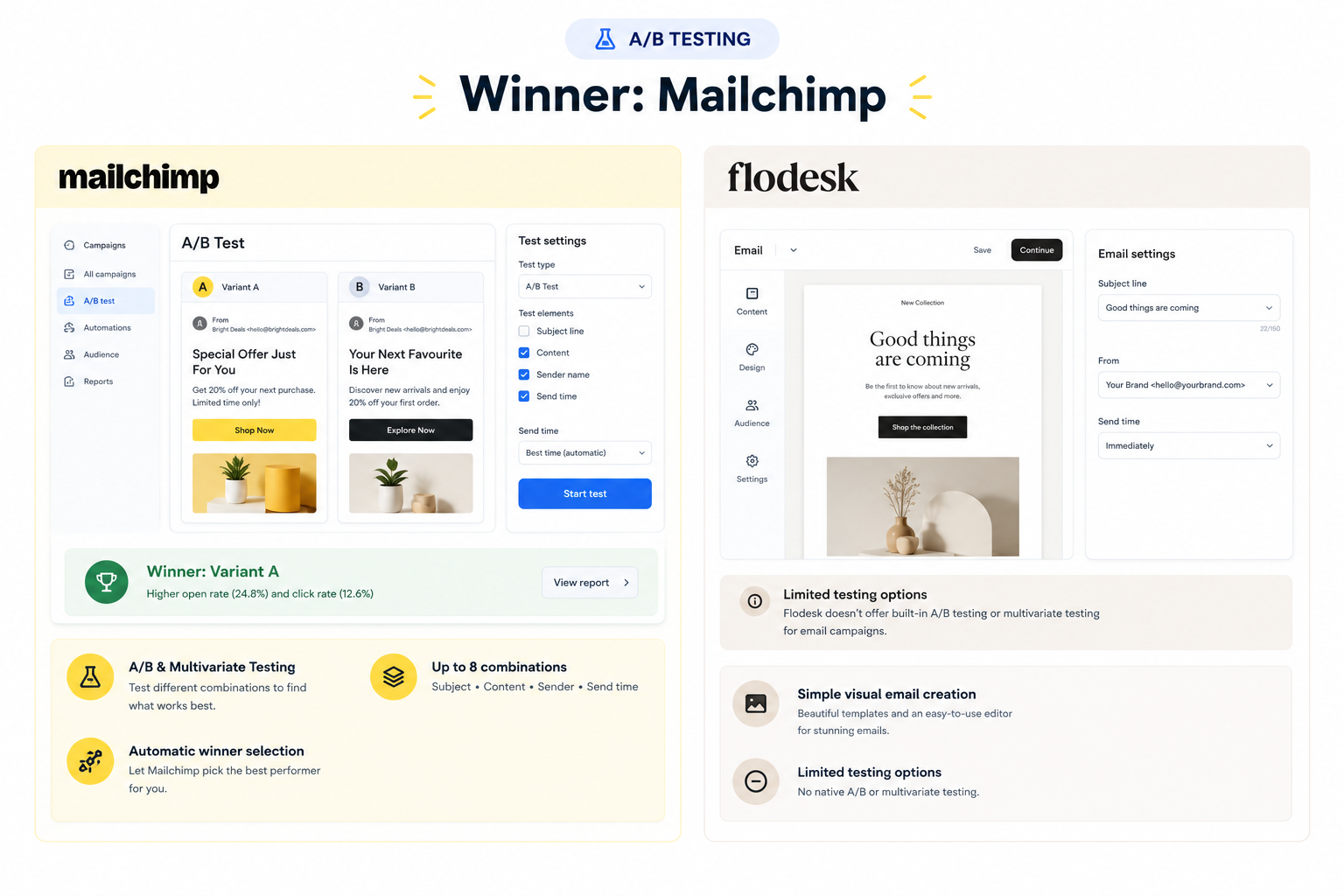
Mailchimp offers A/B testing on Essentials and multivariate testing (up to 8 combinations) on Premium, varying subject lines, content, sender, and send time, with automatic winner selection.
Flodesk’s testing is minimal — independent reviewers note it lacks true A/B testing, real-time dashboards, and custom reporting, in keeping with its “simple and visual” philosophy. If optimization testing is part of your workflow, Mailchimp is far ahead. Round to Mailchimp.
Round 7: Deliverability
Winner: Mailchimp
Neither platform leads the category — this is where an email-first tool usually beats a design-first one. Mailchimp’s inbox placement has slipped in independent testing (EmailToolTester puts it around 82–85%, with elevated spam-flagging), but it still has mature authentication (SPF, DKIM, DMARC), dedicated IPs on higher tiers, and a large deliverability team.
Flodesk isn’t widely benchmarked by the major independent testers, offers no dedicated IP option, and its deliverability tooling is thin — there’s no built-in list-cleaning or verification step, and reporting won’t tell you where mail actually lands. On balance — authentication depth, dedicated IPs, and a documented track record — Mailchimp takes the round, though neither is a deliverability standout. (For a deeper look, see our guide to the best email deliverability services.)
Round 8: Reporting & Analytics
Winner: Mailchimp
Mailchimp’s reporting goes well beyond opens and clicks: click maps, purchase tracking tied to campaigns, email-client breakdowns, comparative campaign reports, and (on higher tiers) audience growth and predicted demographics.
Flodesk’s analytics are, by design, simple and visual — open rate, click rate, and basic engagement, presented cleanly. It’s enough to see whether a newsletter landed, but there’s no revenue attribution, no client stats, and no comparative reporting. For anyone who makes decisions from data, Mailchimp wins comfortably.
Round 9: Integrations & Ecosystem
Winner: Mailchimp
Mailchimp offers 300+ native integrations across CRMs, ecommerce, analytics, CMSs, and social tools. Whatever’s in your stack, there’s usually a direct connector.
Flodesk’s native integrations are sparse — Shopify and Instagram are covered, but most other connections route through Zapier (which has its own cost). If a broad, connected toolset matters, this round isn’t close. Mailchimp wins.
Round 10: Selling & Monetization
Winner: Flodesk
Flodesk Checkout is a real differentiator. On the Pro and Everything plans you can build sales pages, checkout pages, and deliver digital products — courses, templates, ebooks — with payments through Stripe and no extra platform sales fee on the base setup. For a creator selling a handful of digital products, it removes the need for a separate tool like Gumroad.
Mailchimp has stores, product links, and ecommerce reporting, but it’s oriented toward connecting an existing store rather than being the checkout itself. For creators who want to sell directly from their email platform, Flodesk is the more natural fit and takes the round.
Round 11: Free Plan
Winner: Mailchimp
Neither free plan is generous, but they fail differently. Mailchimp’s free tier gives you 250 contacts and 500 sends a month with basic templates — limited, but you can actually send email.
Flodesk’s free plan does not let you send campaigns at all. It’s built for capturing subscribers through forms, landing pages, and “Link in Bio” pages while you prepare — the moment you want to email your list, you’re on a paid plan. Since the core job of an email tool is sending email, Mailchimp wins this round by default.
Round 12: Pricing & Value for Money
Winner: Flodesk
This is the round the December 2025 change rewrote. Flodesk’s legendary flat-rate unlimited plan is gone for new users — pricing now scales with subscriber count like everyone else. But at small-to-mid list sizes it’s still simple and competitive, and it doesn’t punish you the way Mailchimp’s all-contacts billing does.
Here’s the rough shape at common list sizes (entry paid tiers, September 2026):
| List size | Flodesk (Lite/Pro) | Mailchimp (Essentials/Standard) |
|---|---|---|
| 1,000 subscribers | $19–25/mo | $13/mo |
| 5,000 subscribers | ~$38/mo | ~$60/mo |
| 10,000 subscribers | ~$72/mo | ~$100/mo |
Mailchimp is cheaper at the very bottom, but its price climbs faster and it counts unsubscribed contacts toward your bill. Flodesk stays flatter as you grow and bills more transparently, and it bundles selling tools others charge extra for. On value across a growing list, Flodesk edges the final round — though its old “unbeatable at scale” story no longer holds for new accounts.
Final Scoreboard
| Round | Category | Winner | Running score |
|---|---|---|---|
| 1 | Ease of Use & Editor | Flodesk | 1 – 0 |
| 2 | Email Design & Templates | Flodesk | 2 – 0 |
| 3 | Marketing Automation | Mailchimp | 2 – 1 |
| 4 | Segmentation & List Management | Mailchimp | 2 – 2 |
| 5 | Signup Forms & Landing Pages | Flodesk | 3 – 2 |
| 6 | A/B Testing | Mailchimp | 3 – 3 |
| 7 | Deliverability | Mailchimp | 3 – 4 |
| 8 | Reporting & Analytics | Mailchimp | 3 – 5 |
| 9 | Integrations & Ecosystem | Mailchimp | 3 – 6 |
| 10 | Selling & Monetization | Flodesk | 4 – 6 |
| 11 | Free Plan | Mailchimp | 4 – 7 |
| 12 | Pricing & Value for Money | Flodesk | 5 – 7 |
Flodesk Pros and Cons
| ✅ Pros | ❌ Cons |
|---|---|
| The most beautiful templates in email marketing — designed, not assembled | Flat-rate unlimited plan retired December 2025 — new users pay by subscriber count |
| Effortless, uncluttered editor with almost no learning curve | Free plan can’t send email at all (capture only) |
| Forms, pop-ups, and “Link in Bio” pages that match your brand | Basic automation — no conditional branching, lead scoring, or multi-path journeys |
| Built-in Checkout to sell digital products (Pro & Everything), no extra platform sales fee | Weak reporting; no true A/B testing or revenue attribution |
| Simple, subscriber-based pricing that stays flatter than Mailchimp as you grow | Sparse native integrations — most connections need Zapier |
| Unlimited email sends on paid plans | No dedicated IP; deliverability tooling is thin |
⭐ G2 Rating: 4.6 / 5 · Starting Price: $19–25/month (Lite, 1,000 subscribers)
Mailchimp Pros and Cons
| ✅ Pros | ❌ Cons |
|---|---|
| 300+ native integrations covering nearly every SaaS tool | Bills for ALL contacts, including unsubscribed and non-subscribed addresses |
| Advanced segmentation with behavioral and predicted-demographic targeting | Free plan is thin: 250 contacts, 500 sends, no automation |
| Customer Journey Builder with multi-step branching and triggers | Deliverability has slipped in independent tests (82–85% inbox placement) |
| Detailed reporting — click maps, revenue attribution, email-client stats | Core features (automation, advanced segmentation) gated behind Standard ($20/mo+) |
| Multivariate testing (up to 8 combinations on Premium) | Editor can feel sluggish on longer emails |
| AI content assistant built into the editor | 24/7 support only on Premium ($350/month) |
| A genuinely usable (if small) free plan that can send email |
⭐ G2 Rating: 4.4 / 5 · Starting Price: Free (limited), then $13/month (Essentials)
Which Should You Choose?
Choose Flodesk if:
You’re a creator, designer, photographer, coach, or boutique brand and how your emails look is central to your business. You want a tool you can master in an afternoon, gorgeous templates and forms, and the option to sell digital products directly through built-in checkout — without wrestling with a complex marketing suite.
Choose Mailchimp if:
You need real marketing infrastructure: branching automation, deep purchase-based segmentation, revenue reporting, and 300+ integrations. You’re running an ecommerce store or a data-driven program and have the budget for the Standard plan or higher, where the platform’s strengths actually unlock.
Not sold on either? Plenty of teams want Flodesk’s simplicity and stronger deliverability and automation — that’s worth weighing Mailchimp alternatives before you commit.
How to Switch Between Them
Migrating either direction is straightforward for contacts, less so for design and logic. Export your subscribers as a CSV (in Mailchimp: Audience → All contacts → Export; in Flodesk: Audience → export), then import into the new platform and map your fields. Tags and segments usually need light rebuilding. Templates don’t transfer — you’ll recreate them in the new editor (quick in Flodesk, more involved in Mailchimp). Automations must be rebuilt from scratch on either side. Before you move, clean your list so you don’t carry dead addresses across — see our guide to email list cleaning services.
FAQ
Is Flodesk better than Mailchimp in 2026?
It depends on what you need. Flodesk is better for creators and design-led brands who want beautiful emails and a simple, fast tool — it wins on design, ease of use, and built-in selling. Mailchimp is the better overall marketing platform, winning on automation, segmentation, reporting, and integrations. In our 12-round test, Mailchimp edged it 7–5 on total capability, while Flodesk took the rounds that matter most to creators.
Is Flodesk still unlimited?
Not for new users. Flodesk retired its flat-rate unlimited-subscribers plan on December 2, 2025, and moved to subscriber-based pricing (Lite, Pro, Everything). Members who were already on the unlimited plan keep it while they maintain the subscription, but new signups now pay by list size like most platforms.
Is Flodesk or Mailchimp cheaper?
Mailchimp’s Essentials plan ($13/month) is cheaper than Flodesk’s entry tier ($19–25/month) at 1,000 subscribers. But Mailchimp’s price climbs faster as your list grows and it bills for unsubscribed contacts too, so Flodesk can work out more predictable at larger list sizes. For the lowest cost overall, compare both against more affordable email marketing software.
Does Flodesk have good automation?
Flodesk handles basic automation well — welcome sequences and simple drip campaigns — but it lacks conditional branching, lead scoring, and multi-path workflows. If advanced, behavior-driven automation is important, Mailchimp’s Customer Journey Builder is significantly more capable.
Does Flodesk have a free plan?
Flodesk has a free plan, but it can’t send email — it’s limited to capturing subscribers through forms, landing pages, and “Link in Bio” pages. To send newsletters or run automations you need a paid plan. Mailchimp’s free plan is small (250 contacts, 500 sends/month) but does let you send.
Which has better email deliverability?
Neither is a deliverability leader. Mailchimp’s inbox placement has slipped to around 82–85% in independent tests, but it has mature authentication and dedicated IP options. Flodesk isn’t widely benchmarked and offers no dedicated IP. Whichever you choose, protect your inbox placement by keeping your list clean and verified — see our email list cleaning guide.

An SEO expert with a focus on on-page optimization, technical SEO, and keyword research. Dedicated to helping businesses improve search rankings and grow their online presence through data-driven strategies.