Last updated: September 2026 | Pricing verified on September 13, 2026 | 13 min read
beehiiv and Substack are the two platforms most writers shortlist when they start a newsletter (if Mailchimp is also on your list, we’ve compared beehiiv vs Mailchimp separately), and the choice usually comes down to one question: do you want the simplest possible way to publish, or do you want to run the newsletter as a business? Substack is free until you charge readers, then takes 10% of everything you earn. beehiiv charges a monthly fee once you pass 2,500 subscribers or want to monetise, then takes 0%. That difference shapes almost every other comparison below.
We ran both platforms through the same ten rounds: ease of use, editor and design, growth tools, monetisation and fees, automation and segmentation, website and SEO, analytics, deliverability, community, and pricing. We verified every price and fee on the official pricing pages on September 13, 2026, and cross-checked the feature claims against creators who have used both, including a 19,000-subscriber publisher who switched from Substack to beehiiv and several r/Substack and r/beehiiv threads.
The short version: beehiiv wins seven rounds to three. It’s the better platform for anyone who wants a paid newsletter with no revenue share, a real website, automations, and a way to grow beyond the platform’s own feed. Substack wins if you want to be publishing in ten minutes, you value its built-in reader network more than design control, and you’re not yet earning enough for the 10% to hurt.
Quick Answer: beehiiv is the better choice for most newsletter creators in 2026, winning 7 of 10 rounds. It takes 0% of paid subscription revenue (Substack takes 10%), includes a custom domain and SEO-ready website free, and adds automations, segmentation, A/B testing, a referral program, and an ad network. Substack wins on ease of use, its reader community, and price for free newsletters — it costs nothing at any list size, while beehiiv’s free plan stops at 2,500 subscribers and paid plans start at $49/month.
Table of Contents
beehiiv vs Substack: At a Glance
| Feature | beehiiv | Substack |
|---|---|---|
| Starting price | Free to 2,500 subs Scale from $49/mo | Free at any size Pay when you monetise |
| Fee on paid subscriptions | 0% + Stripe | 10% + Stripe |
| Custom domain | ✓ Free | $50 one-time |
| Email design | Templates, drag-and-drop, branding | Logo + accent colour only |
| Automation | Visual builder (Scale) | Welcome email only |
| Segmentation / A/B testing | ✓ Yes (Scale) | ✗ No |
| Website & SEO | Built-in site, editable meta & URLs | Archive with limited control |
| Growth tools | Referral program, Boosts, ad network | Recommendations, Notes feed |
| Reader community | Comments, polls | Notes, chat, app, video |
| Analytics | Advanced (sources, engagement, revenue) | Basic |
| Ease of setup | Moderate | Easiest |
| Data export | ✓ Yes | ✓ Yes |
Green cells mark the stronger option per row. Pricing and fees verified September 13, 2026 on beehiiv.com/pricing and Substack’s support documentation.
How We Scored This Comparison
Ten categories, one winner each, no ties. Where the margin was thin we still called it for whichever platform had the practical edge for a writer running a newsletter week to week. The running score is cumulative. Pricing and fees were taken from beehiiv.com/pricing and Substack’s support documentation on September 13, 2026.
Round 1: Ease of Use and Setup
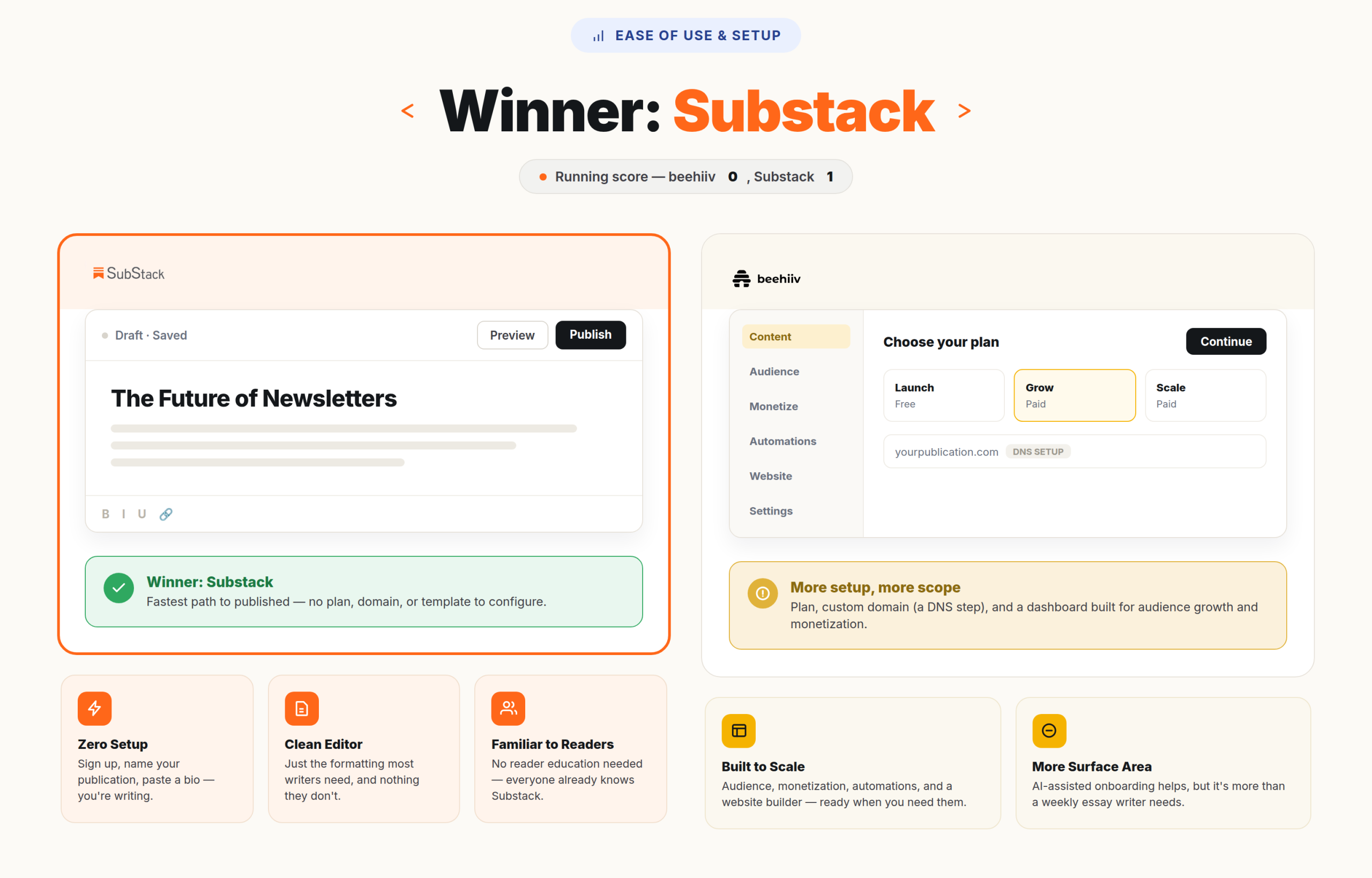
Substack is the easiest newsletter platform on the market, and that isn’t a small thing. Sign up, name your publication, paste a bio, and you’re writing. There are no plans to choose, no domain to connect, no template to configure. The editor is a clean document view with the formatting most writers need and nothing they don’t. Readers already understand what a Substack looks like, so there’s no reader education either.
beehiiv is not hard, but it is a platform. On signup you’re choosing a plan, setting up a publication, connecting a custom domain (free, but a DNS step), and looking at a dashboard with tabs for audience, monetisation, automations, and a website builder. For a writer who only wants to send a weekly essay, that’s more surface area than they need. For a writer who intends to grow, it’s the surface area they’ll want in three months. beehiiv’s onboarding has improved with AI-assisted setup, but Substack still gets you to “published” faster.
Winner: Substack. Running score: beehiiv 0, Substack 1.
Round 2: Editor and Design
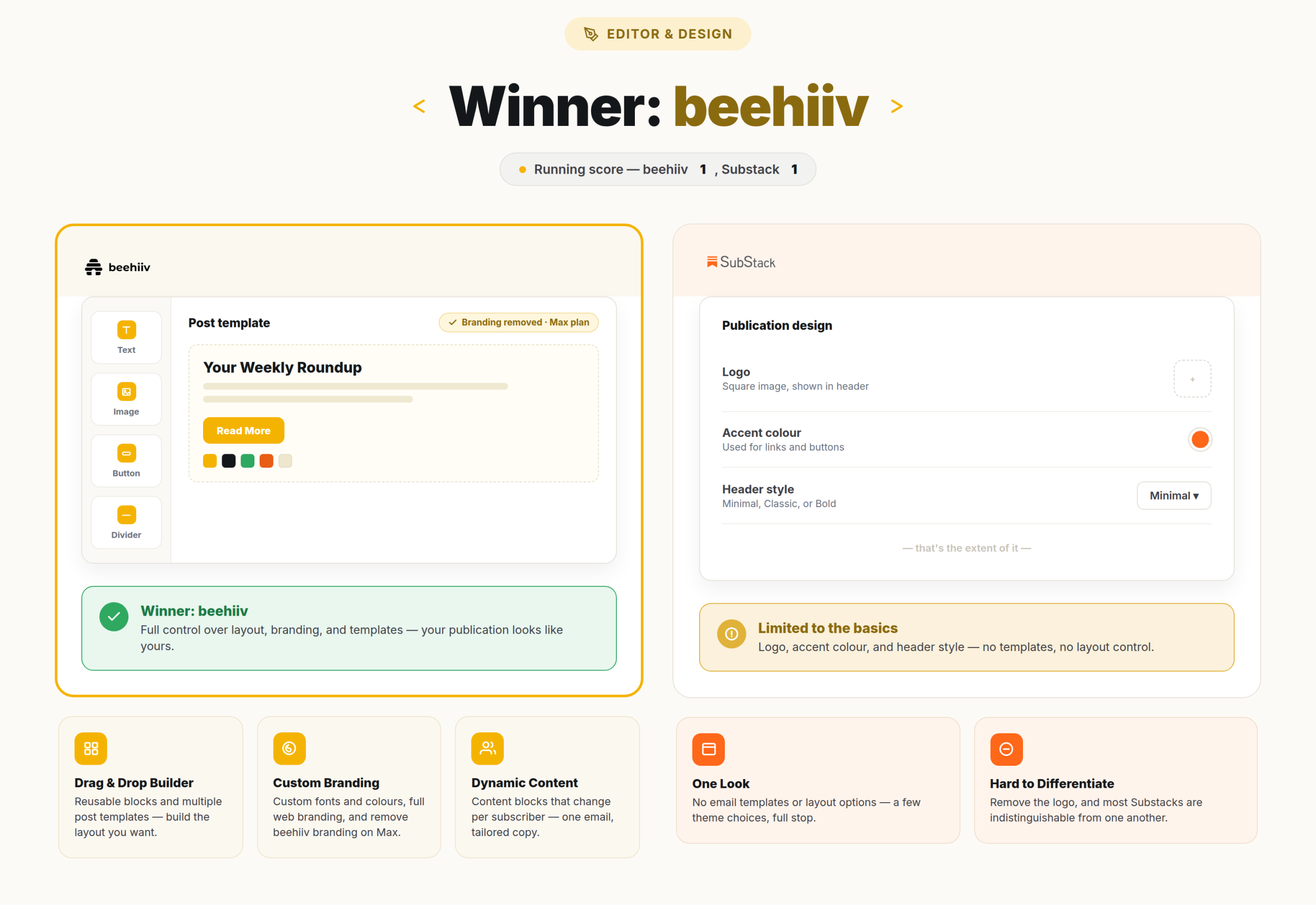
This is the round where Substack’s simplicity becomes a limit. Every Substack looks like a Substack. You can set a logo, an accent colour, and a header, and that’s the extent of it. There are no email templates, no layout options, no control over the web archive beyond a few theme choices. If you’ve ever tried to tell two Substacks apart with the logos removed, you know the problem.
beehiiv gives you a drag-and-drop email builder with reusable blocks, multiple post templates, custom fonts and colours, and full branding on the web version. On the Max plan you can remove beehiiv’s own branding entirely and use dynamic content that changes per subscriber. Neither platform is a design tool in the way a general email marketing platform is (beehiiv’s emails are still recognisably newsletter-shaped, and if you want inspiration beyond either, see these newsletter design ideas), but beehiiv lets your publication look like yours.
Winner: beehiiv. Running score: beehiiv 1, Substack 1.
Round 3: Growth and Discovery
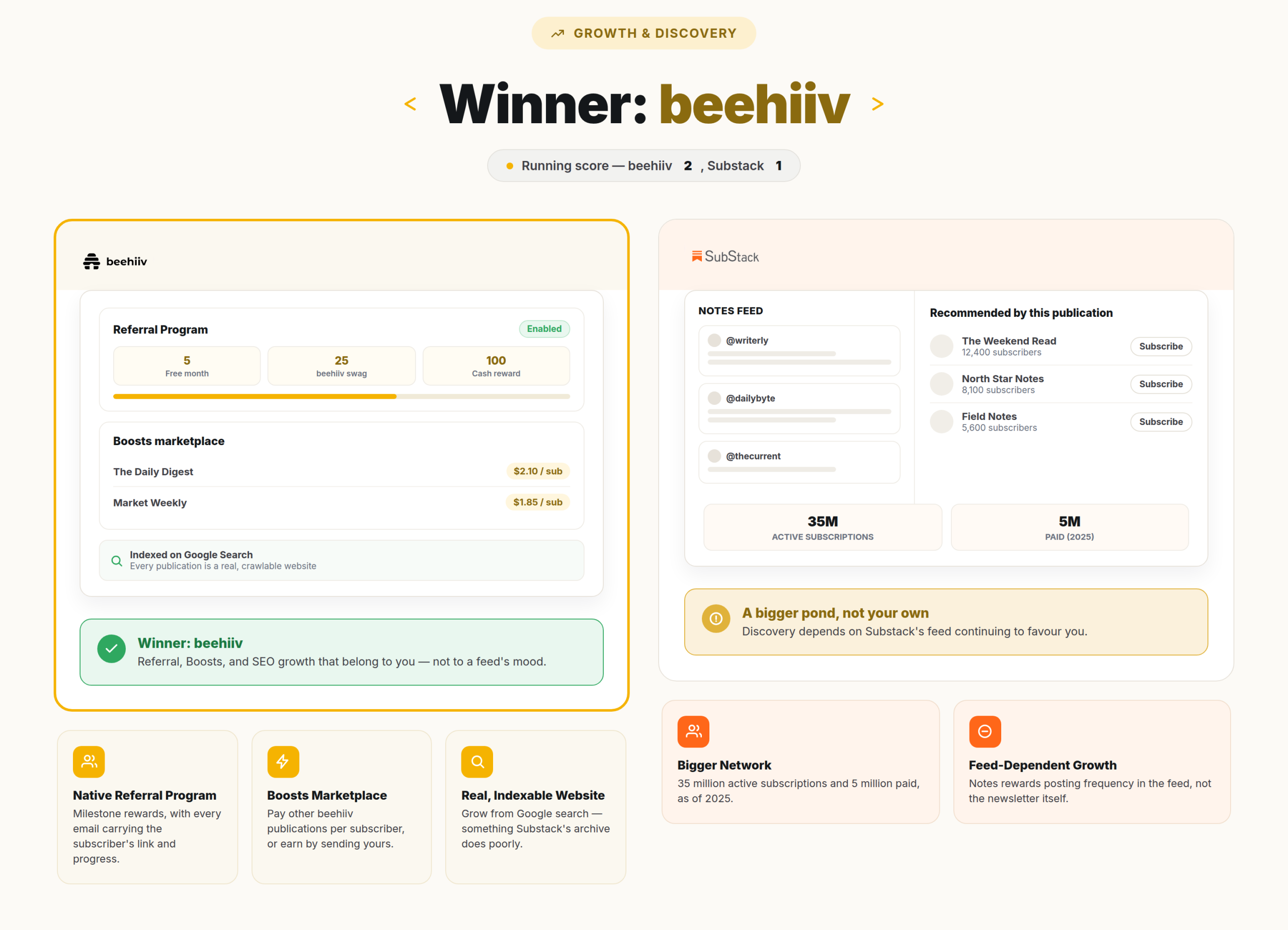
Both platforms have a recommendation network, where other publications can recommend yours to their new subscribers. Substack’s is bigger, because Substack is bigger: 35 million active subscriptions and 5 million paid as of 2025. Substack also has Notes, a short-form feed inside the app, and Recommendations shows up at the moment a reader subscribes to any publication. For discovery inside the platform, Substack has more readers to be discovered by.
beehiiv’s growth tools are built for the writer rather than the network. The referral program is native: set milestone rewards, and every email carries the subscriber’s referral link and progress automatically. Boosts lets you pay other beehiiv publications per subscriber they send you, or earn by sending them yours. And because every beehiiv publication is a real, indexable website (more on that in Round 6), you can grow from Google search, which Substack’s archive does poorly. Substack gives you a bigger pond; beehiiv gives you more ways to fish.
We’re calling this one for beehiiv because Substack’s discovery advantage depends on Substack’s feed continuing to favour you, while beehiiv’s referral and SEO growth belong to you. Writers who’ve relied on Notes for growth report it rewarding posting frequency in the feed rather than the newsletter itself.
Winner: beehiiv. Running score: beehiiv 2, Substack 1.
Round 4: Monetisation and Fees
Substack’s model is a revenue share. You pay nothing until you turn on paid subscriptions, then Substack takes 10% of gross subscription revenue, and Stripe takes 2.9% + $0.30 per transaction plus a small recurring-billing fee. On a $10/month subscriber, you keep roughly $8.36. There’s also a one-time $50 fee to use your own domain. Monetisation options are subscriptions (monthly, annual, founding tier) and, more recently, paid video and livestreams. Sponsorships are manual: you find the advertiser, you place the ad.
beehiiv takes 0% of paid subscription revenue on Scale and above. You pay only Stripe’s processing fees. Beyond subscriptions, beehiiv has an ad network that places sponsors in your newsletter from its dashboard and pays per click or per placement, paid Boosts for cross-promotion income, digital product sales, and pay-what-you-want and lifetime subscription options. The catch is that none of this is available on the free Launch plan; monetisation starts at Scale.
The arithmetic matters most as you grow. A newsletter earning $50,000 a year in subscriptions pays Substack $5,000 a year before Stripe. The same newsletter with 10,000 subscribers on beehiiv Scale pays $1,308 a year ($109/month) and keeps the rest. beehiiv’s own comparison page estimates a creator on $120,000 a year keeps $11,652 more on beehiiv; that’s their number, but the direction is right at almost any revenue level above a few hundred dollars a month.
Winner: beehiiv. Running score: beehiiv 3, Substack 1.
Round 5: Automation and Segmentation
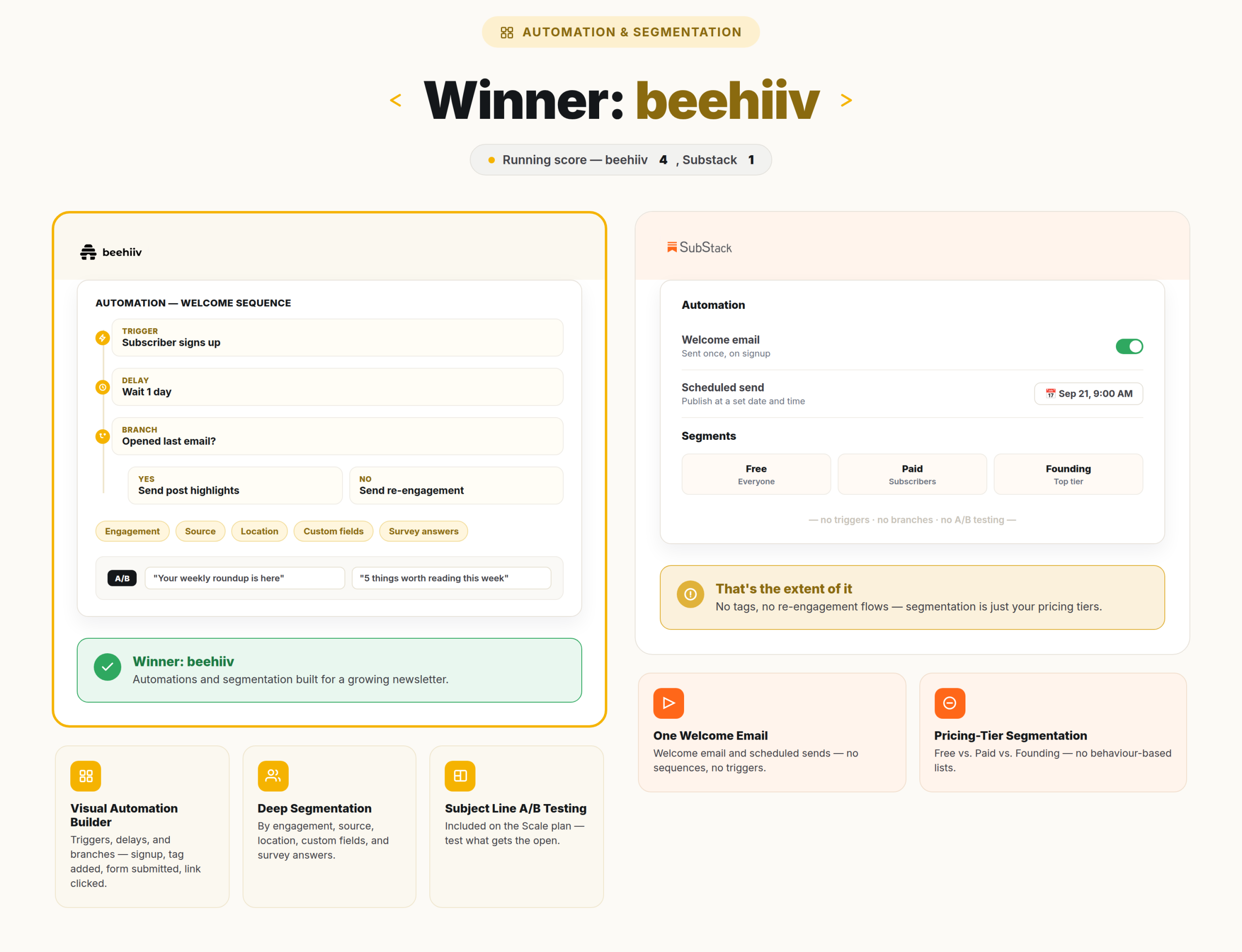
Substack has a welcome email and scheduled sends. That’s the extent of its automation. Segmentation is free versus paid versus founding; you can’t tag readers by what they clicked, send a re-engagement email to people who haven’t opened in 60 days, or build a sequence that introduces a new subscriber to your best posts over a week. A/B testing doesn’t exist.
beehiiv’s Scale plan includes a visual automation builder with triggers (signup, tag added, form submitted, link clicked), delays, and branches, plus segmentation by engagement, source, location, custom fields, and survey answers. A/B testing on subject lines is included. It isn’t as deep as dedicated email marketing automation software, but it covers the things a growing newsletter needs: a welcome sequence, a re-engagement flow, and the ability to send different content to different readers.
Winner: beehiiv. Running score: beehiiv 4, Substack 1.
Round 6: Website and SEO
Every beehiiv publication comes with a website builder: custom domain on every plan including free, page templates, an SEO-friendly archive with editable titles, meta descriptions, and URLs, and a link-in-bio page. Creators who’ve moved from Substack consistently name search traffic as the reason. One publisher with 19,000 subscribers described beehiiv as working “as an SEO-focused blogging platform” and switched specifically because of declining search traffic on Substack.
Substack’s archive is a website too, and Substack posts do rank in Google, but you have limited control over how. You can’t edit meta descriptions or URL slugs beyond the title, the theme options are narrow, and your own domain costs $50 to unlock. If your growth strategy includes search, beehiiv is the only one of the two built for it.
Winner: beehiiv. Running score: beehiiv 5, Substack 1.
Round 7: Analytics and Reporting
Substack gives you opens, clicks, subscriber growth, and revenue, presented simply. For many writers that’s enough, and Substack’s dashboard is easy to read.
beehiiv’s reporting is a tier above: subscriber acquisition by source (which referral, which Boost, which form), engagement scoring per subscriber, read time, click maps, revenue by stream, and on Max, cohort analysis. If you’re making decisions about where to spend growth effort or money, beehiiv tells you where subscribers actually came from and which ones are worth keeping.
Winner: beehiiv. Running score: beehiiv 6, Substack 1.
Round 8: Deliverability
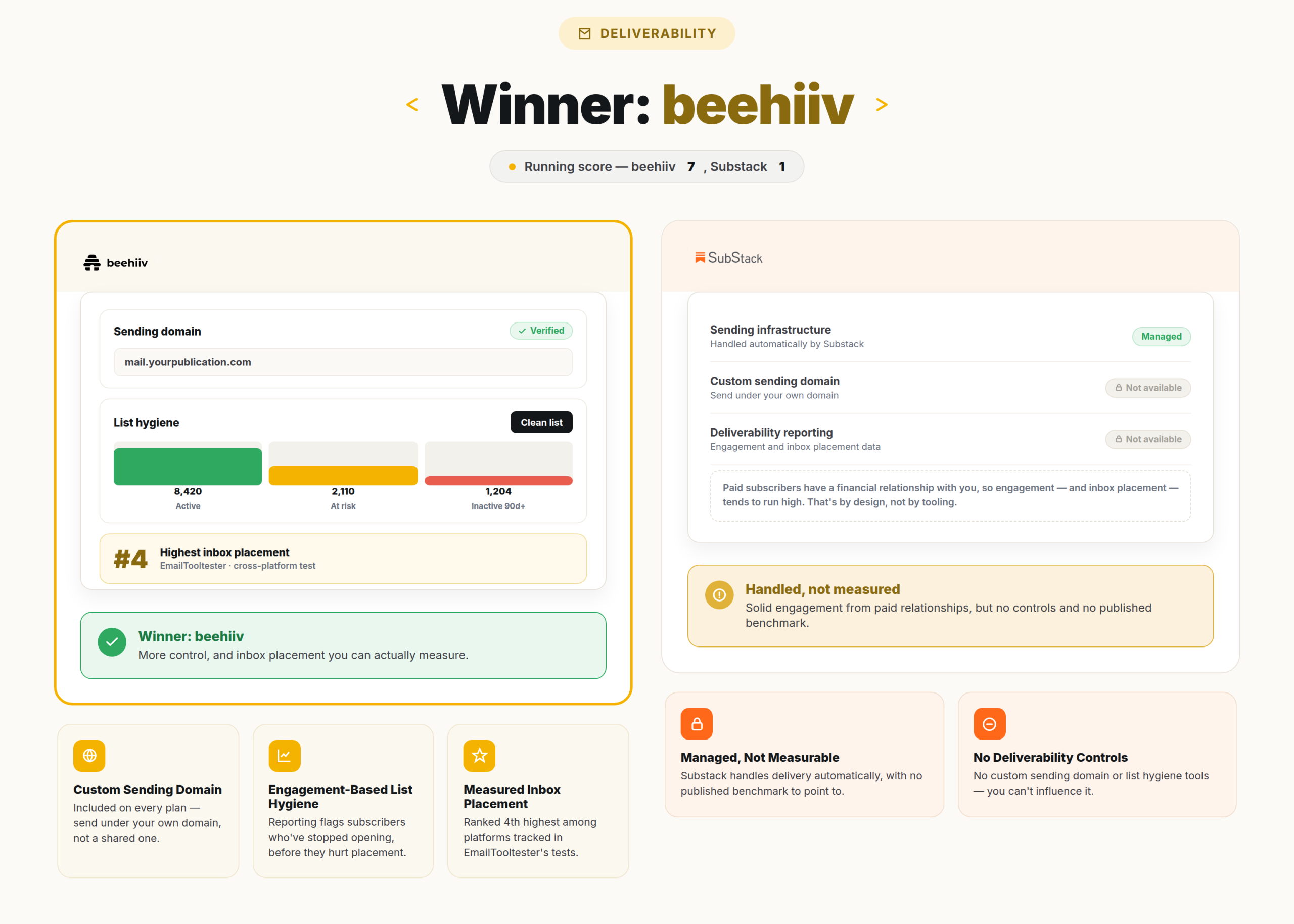
Both platforms deliver well, and this round is closer than the score suggests. Substack sends from its own infrastructure, and because paid subscribers have a financial relationship with you, engagement (and therefore inbox placement) tends to be high. Substack doesn’t give you tools to influence deliverability; it just handles it.
beehiiv also runs its own sending infrastructure and puts more of the levers in your hands: custom sending domain on every plan, engagement-based list hygiene, and reporting that flags subscribers who’ve stopped opening. In EmailTooltester’s cross-platform inbox placement tests, beehiiv ranked fourth highest among the platforms tracked. Substack isn’t included in most deliverability benchmarks because it isn’t a general sending platform, so a like-for-like number isn’t available. On the evidence that exists, beehiiv edges it on control and measured placement. (If inbox placement is your main worry, a dedicated email deliverability service is a different category again.)
Winner: beehiiv. Running score: beehiiv 7, Substack 1.
Round 9: Community and Reader Engagement
Substack has built the more complete reader experience. Comments on every post, discussion threads, subscriber chat, Notes for short-form posts, podcasts and video hosted natively, livestreams, the Substack app, and since January 2026 a Substack TV app for televisions. Readers can follow you, restack you, and find you without ever leaving the Substack ecosystem. For writers whose newsletter is really a community, that ecosystem is the product.
beehiiv has comments, polls and surveys (on Scale), and a community feature, but the reader relationship on beehiiv is mostly the email itself. There’s no equivalent of Notes, and readers don’t have a beehiiv app they open every day. That’s fine if you want the inbox to be the destination; it’s a real loss if you want readers talking to each other.
Winner: Substack. Running score: beehiiv 7, Substack 2.
Round 10: Pricing and Value for Money
| Subscribers | beehiiv (free newsletter) | beehiiv Scale (paid newsletter) | Substack cut at 10% paid × $10/mo | Revenue where beehiiv becomes cheaper |
|---|---|---|---|---|
| 1,000 | $0 | $49/mo | $100/mo | $490/mo |
| 2,500 | $0 | $69/mo | $250/mo | $690/mo |
| 5,000 | $89/mo | $89/mo | $500/mo | $890/mo |
| 10,000 | $109/mo | $109/mo | $1,000/mo | $1,090/mo |
| 25,000 | $169/mo | $169/mo | $2,500/mo | $1,690/mo |
| 50,000 | $199/mo | $199/mo | $5,000/mo | $1,990/mo |
beehiiv Scale monthly-billing prices from beehiiv.com/pricing, September 13, 2026 (annual billing is about 12% less). Free newsletter column: beehiiv Launch is free to 2,500 subscribers; above that you need Scale. Substack column assumes 10% of subscribers pay $10/month, before Stripe fees. Last column is the monthly subscription revenue above which Substack’s 10% exceeds beehiiv’s plan fee.
At zero revenue, Substack is cheaper: it costs nothing at any list size, while beehiiv’s free Launch plan stops at 2,500 subscribers and excludes automations and monetisation. A 5,000-subscriber free newsletter pays Substack $0 and beehiiv $89/month.
The moment you charge readers, the picture inverts. beehiiv Scale is $49/month at 1,000 subscribers ($43/month billed annually) and $109/month at 10,000. Substack’s 10% overtakes that at roughly $490/month in subscription revenue at the 1,000-subscriber tier, and at $1,090/month at 10,000. Most paid newsletters that reach 1,000 subscribers clear those figures. Above that point every extra dollar you earn costs you ten cents on Substack and nothing on beehiiv.
We’re giving this round to Substack for a specific reader: the writer with a free newsletter and no plans to monetise, for whom “free at any size” is the whole decision. For everyone else, Round 4 already answered it.
Winner: Substack. Final score: beehiiv 7, Substack 3.
Final Scoreboard: beehiiv 7, Substack 3
| Round | Category | Winner | Running Score (beehiiv – Substack) |
|---|---|---|---|
| 1 | Ease of Use & Setup | Substack | 0 – 1 |
| 2 | Editor & Design | beehiiv | 1 – 1 |
| 3 | Growth & Discovery | beehiiv | 2 – 1 |
| 4 | Monetisation & Fees | beehiiv | 3 – 1 |
| 5 | Automation & Segmentation | beehiiv | 4 – 1 |
| 6 | Website & SEO | beehiiv | 5 – 1 |
| 7 | Analytics & Reporting | beehiiv | 6 – 1 |
| 8 | Deliverability | beehiiv | 7 – 1 |
| 9 | Community & Engagement | Substack | 7 – 2 |
| 10 | Pricing & Value | Substack | 7 – 3 |
| Final score | beehiiv 7 – Substack 3 | ||
beehiiv Pros and Cons
✅beehiiv Pros:
- 0% platform fee on paid subscriptions — you pay only Stripe’s processing
- Free Launch plan up to 2,500 subscribers with a custom domain and website included
- Native referral program, Boosts (paid cross-promotion), and an ad network for sponsorship income
- Visual automations, segmentation, and A/B testing on Scale
- SEO-ready website with editable titles, meta descriptions, and URLs
- Detailed analytics: acquisition source, engagement scoring, revenue by stream
- Multiple templates, drag-and-drop editor, full branding (white-label on Max)
- Substack migration keeps paid subscribers billing through Stripe
❌beehiiv Cons:
- Monetisation and automations require Scale ($49/month at 1,000 subscribers)
- Price rises with every subscriber tier ($109/month at 10,000 on Scale)
- No reader feed or app comparable to Substack Notes; support on the free plan is documentation only
- Branding removal needs Max ($109/month at 1,000 subscribers)
💰Pricing: Launch free up to 2,500 subscribers. Scale from $49/month at 1,000 subscribers ($43/month billed annually), $109/month at 10,000. Max from $109/month.
Substack Pros and Cons
✅Substack Pros:
- Free at any list size — you pay nothing until you charge readers
- Fastest setup of any newsletter platform; publish in minutes
- Built-in reader network: Recommendations, Notes, chat, comments, and the Substack app
- Native podcast, video, and livestream hosting, plus Substack TV
- Paid subscriptions with founding tiers handled through Stripe
- Subscriber and post export available at any time
❌Substack Cons:
- 10% of paid subscription revenue, plus Stripe fees, for the life of the publication
- $50 one-time fee to use your own domain
- No automations beyond a welcome email; no segmentation, tagging, or A/B testing
- Almost no design control — every Substack looks the same
- Limited SEO control over the archive; no editable meta descriptions or slugs
- Basic analytics
💰Pricing: Free to publish. 10% of paid subscription revenue plus Stripe processing (2.9% + $0.30). Custom domain $50 one-time.
Which Should You Choose?
Choose beehiiv if:
You plan to charge for your newsletter and want to keep the revenue. You want your publication on your own domain with a website that ranks in search. You want a welcome sequence, segmentation, and A/B testing without paying a revenue share for the privilege of not having them. You’d rather grow through referrals, Boosts, and Google than depend on a platform’s feed. You want more than one income stream: subscriptions, ads, sponsorships, and digital products from one dashboard. (Creators comparing beehiiv against Kit for product sales should read our Kit alternatives roundup.)
Choose Substack if:
You want to be publishing this afternoon with nothing to configure. Your newsletter is free and you don’t expect that to change. You value Notes, chat, comments, and the Substack app as part of the product, and your readers are already there. Design control doesn’t matter to you. You’re testing an idea and don’t want a monthly bill until it’s proven.
A common pattern among writers who’ve used both: start on Substack while the list is small and free, then move to beehiiv once paid subscriptions arrive. beehiiv’s Substack migration keeps paid subscribers billing through Stripe without interruption, so the switch doesn’t cost you revenue.
Neither feels right?
Both platforms are newsletter tools first, and both have limits once your email needs go beyond publishing. beehiiv’s automation and segmentation cover the basics but not much more, its free plan excludes both, and the price climbs with every subscriber tier. Substack gives you almost no marketing tools at all and takes a tenth of your income for the rest of your publication’s life.
If what you actually need is an email platform, with your newsletter as one part of a business that also sends onboarding, promotions, or product updates, Mailercloud is worth a look. It’s free for 1,000 contacts and 12,000 emails a month, then a flat $10/month for 5,000 contacts with unlimited sends and no revenue share (see pricing). It includes a visual automation builder, segmentation, A/B testing, and an Inbox Tracker that shows whether each send landed in the inbox, Promotions, or spam across Gmail, Outlook, and Yahoo, which neither beehiiv nor Substack offers. The trade-off is that Mailercloud doesn’t handle paid-subscription billing itself (you’d pair it with Stripe payment links) and it has no reader network. For the email side of a newsletter business, it does more for less.
How to Migrate Between Platforms
From Substack to beehiiv: In beehiiv, choose the Substack migration option and connect your Substack account, or export your subscriber CSV from Substack (Settings → Exports) and import it. Paid subscribers move with their Stripe billing intact, so nobody is charged twice or cancelled. Import your post archive, connect your domain, and rebuild your welcome email as a beehiiv automation. Send the first issue to your most engaged readers first, then the full list, to keep inbox placement steady on the new sending domain. beehiiv says a typical migration takes under an hour; allow an afternoon for a large archive.
From beehiiv to Substack: Export subscribers and posts from beehiiv, import the CSV into Substack, and reconnect paid subscribers through Stripe. You’ll lose automations, segments, and your website customisation, since Substack has no equivalents. Tell readers the sender address is changing before you switch.
FAQ
Is beehiiv better than Substack?
beehiiv is better than Substack for writers who monetise their newsletter, because it charges 0% of subscription revenue against Substack’s 10%, and it adds automations, segmentation, A/B testing, a custom website, and an ad network. Substack is better for writers who want the fastest setup, a free platform at any list size, and the reader community of Notes, chat, and the Substack app. Our ten-round comparison finished beehiiv 7, Substack 3.
Is beehiiv cheaper than Substack?
beehiiv is cheaper than Substack for any paid newsletter earning more than about $490 a month at 1,000 subscribers, or $1,090 a month at 10,000, because its flat plan fee ($49 and $109 a month respectively) is less than Substack’s 10% share above those figures. Substack is cheaper for free newsletters, which cost nothing at any size, while beehiiv’s free plan stops at 2,500 subscribers.
What fees does Substack charge?
Substack charges 10% of paid subscription revenue, plus Stripe’s payment processing at 2.9% + $0.30 per transaction and a small recurring-billing fee, which together leave a writer with roughly $8.36 of every $10 subscription. Free publications pay nothing. Using your own domain costs a one-time $50.
Does beehiiv take a cut of subscriptions?
beehiiv takes 0% of paid subscription revenue on its Scale and Max plans; you pay only Stripe’s processing fees. Paid subscriptions aren’t available on the free Launch plan, so monetising on beehiiv means paying for Scale, which starts at $49 a month for 1,000 subscribers.
Why are people leaving Substack for beehiiv?
Writers leave Substack for beehiiv mainly because of the 10% revenue share, the lack of design control, the absence of automation and segmentation, and weak search traffic from Substack’s archive. Substack’s shift toward advertising and social features after its $100 million funding round in June 2025 has added to the concern that it’s becoming a feed rather than a newsletter tool.
Can I move paid subscribers from Substack to beehiiv?
Yes, paid subscribers move from Substack to beehiiv with their Stripe billing intact, so their subscriptions continue without interruption or a new checkout. beehiiv’s migration tool imports subscribers, paid status, and post archives directly from Substack, and it reports having migrated lists of over 500,000 subscribers.
Is beehiiv worth it?
beehiiv is worth it once your newsletter earns enough that Substack’s 10% would exceed beehiiv’s plan fee, which happens at a few hundred dollars a month in subscriptions, or as soon as you want automations, a website that ranks in search, or sponsorship income from its ad network. It’s harder to justify for a small free newsletter that fits inside Substack’s free tier and doesn’t need those tools.

As a Marketing Director, I develop and implement marketing strategies, conduct market research, and manage a team of marketing professionals. With a successful track record of launching campaigns that drive revenue growth, I bring my marketing expertise to blog writing, creating engaging content that promotes the brand and its products/services.