Last updated: September 2026 | 15 min read
A car buyer visits a dealership roughly once every few years. A service customer visits two or three times a year. The dealerships that make money on both are the ones that stay in the customer’s inbox between visits: a service reminder when the oil is due, an equity offer when the trade-in value is right, a recall notice, a lease-end conversation six months before it matters. Automotive email marketing in 2026 is the system that runs those conversations automatically, from the data the DMS and CRM already hold.
This guide covers how franchised and independent dealerships, dealer groups, service centres, and aftermarket businesses build an email programme that sells vehicles and fills service bays: what to send across the ownership lifecycle, how to segment by vehicle, equity, and service history, the compliance rules (CAN-SPAM, TCPA for texts, state advertising rules), the platforms that fit, and the metrics that tie email to gross. It’s vendor-neutral, with one tools section near the end.
Quick Answer: Automotive email marketing is DMS-triggered email across the ownership lifecycle: instant lead response and nurture, purchase onboarding, mileage-based service reminders with one-click booking, declined-services follow-ups, recall notices, equity and trade-in offers, and lease-end sequences starting six months before maturity. Keep sales and service streams separate, keep pricing and finance offers compliant with state and OEM rules, get express written consent before texting (TCPA), send from the dealership’s own authenticated domain, and measure repair orders, appointments, and sales rather than opens.
Table of Contents
What Automotive Email Marketing Is
Automotive email marketing is permission-based email to leads, sales customers, service customers, and lapsed customers across the vehicle ownership lifecycle: lead response and nurture, purchase follow-up, service reminders and specials, recall and safety notices, equity and trade-in offers, lease-end and finance-end sequences, event and model-launch announcements, and win-back of customers who’ve defected to independent service shops.
Two things distinguish it. The data is rich and structured (vehicle, mileage, service dates, finance terms, equity position) and lives in the DMS and CRM, so most email can be triggered rather than scheduled. And the two revenue streams, sales and fixed operations, have different rhythms: sales email is long-cycle and equity-driven; service email is short-cycle and mileage-driven.
Why Email Works for Dealerships
Fixed operations (service and parts) typically produce the majority of a dealership’s gross profit, and service retention is the metric that decides it. Cox Automotive’s and NADA’s industry research have repeatedly found that a large share of service work migrates to independent shops after the warranty period, and that customers who service at the dealership are far more likely to buy their next vehicle there. Email is the lowest-cost channel for keeping service customers, because reminders can be triggered by mileage and time automatically.
On the sales side, the customer database is a pipeline most dealers under-work. Owners in a positive equity position, lease customers within six months of maturity, and finance customers past the midpoint of their term are the warmest sales leads a dealership has, and they’re identifiable from the DMS. Email reaches all of them for a few cents each.
Litmus’s State of Email research puts email’s return at around $36 per $1 spent across industries; in automotive it shows up as repair orders, trade-in appointments, and lease renewals attributable to specific automated sequences.
The Ownership Lifecycle: What to Send and When
Leads (before purchase)
Instant lead response. Within minutes of a web or third-party lead: a short, personal email from a named salesperson with the vehicle, availability, and a next step (a call, a test drive). Automate the send, then call.
Lead nurture. Five to seven emails over two weeks: the vehicle’s features, financing and trade-in basics, comparable inventory, reviews, a test-drive invitation. Stop the sequence when the lead responds or buys.
Inventory alerts. For leads with a specific model or budget: new arrivals, price changes, incentives.
Purchase and delivery
Thank-you and delivery follow-up. Within a day: thanks, what’s next (paperwork, first service, how to reach the team), a review request a week later.
Onboarding. Vehicle features, app setup, warranty and maintenance schedule, service booking link. Two to three emails over the first month.
Ownership and service
Service reminders. Triggered by mileage and time from the DMS: oil and filter, tyre rotation, brakes, major intervals, inspections. The highest-volume, highest-ROI automotive email. Include a one-click booking link.
Service specials. Seasonal (tyres, batteries, air conditioning), segmented by vehicle age and last service.
Recall and safety notices. Transactional in nature, sent to affected VINs. Handle with care: clear, factual, and with a booking link.
Declined-services follow-up. Work recommended at the last visit but declined: a reminder two to four weeks later with an offer.
Post-service survey and review. Within 24 hours of the repair order closing.
Service win-back. Customers who missed their expected service interval: a “we haven’t seen you” message with an incentive, then a final one before the list is cleaned.
Equity, lease-end, and repeat purchase
Equity mining. Owners whose trade-in value exceeds their payoff: “your vehicle may be worth more than you think” with a valuation link and an upgrade offer. Triggered by DMS or equity-mining tools.
Lease-end sequence. Six, three, and one month before maturity: options, incentives, appointment booking.
Finance midpoint. For finance customers past the halfway point: upgrade and refinance options.
Model launches and events. Segmented by owned model and interest.
Segmenting an Automotive Database
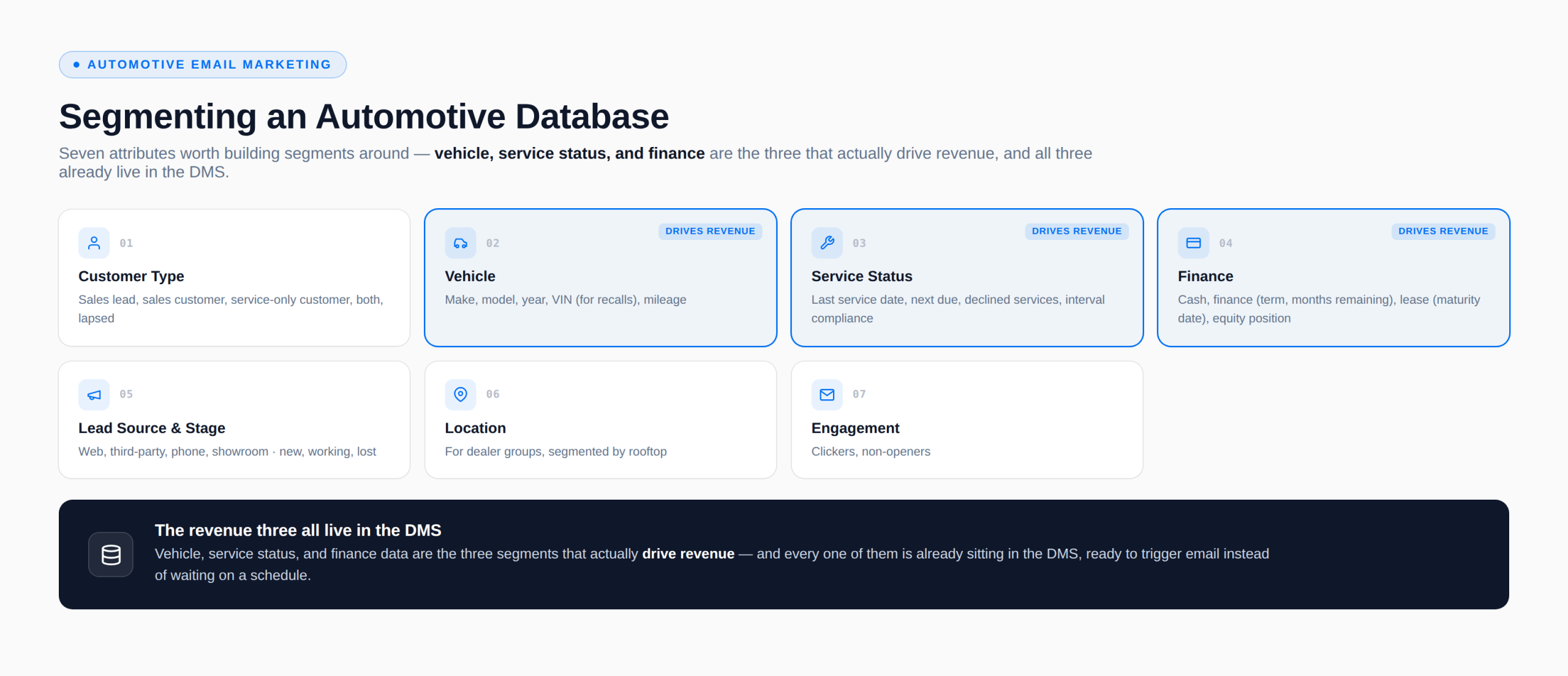
- Customer type: sales lead, sales customer, service-only customer, both, lapsed.
- Vehicle: make, model, year, VIN (for recalls), mileage.
- Service status: last service date, next due, declined services, service interval compliance.
- Finance: cash, finance (term, months remaining), lease (maturity date), equity position.
- Lead source and stage: web, third-party, phone, showroom; new, working, lost.
- Location: for dealer groups.
- Engagement: clickers, non-openers.
Vehicle, service status, and finance data are the three that drive revenue, and all three live in the DMS. The DMS-to-email integration (native, via the CRM, or via a scheduled export) is the foundation of every triggered sequence above.
Compliance for Automotive Email
CAN-SPAM. Accurate headers and subject lines, a physical address, a working unsubscribe honoured within ten business days. Applies to every marketing email; service reminders and recall notices are generally transactional.
TCPA. Governs text messages and calls, not email, but most automotive programmes run both. SMS requires prior express written consent for marketing texts; do not migrate an email list to SMS without it.
State advertising rules. Vehicle pricing, financing, and lease advertising is regulated at the state level (and under federal Truth in Lending and Consumer Leasing rules): advertised prices must be available, disclaimers on financing and lease offers must be included, and OEM co-op advertising has its own compliance requirements. Run offers through your compliance or OEM guidelines before sending.
Privacy. Dealers hold sensitive financial data. Keep finance details out of marketing email content, use the DMS for triggers rather than exporting full records to the email platform, and follow the FTC Safeguards Rule for data handling.
Deliverability. Send from the dealership’s own domain with SPF, DKIM, and DMARC; the 2024 Gmail and Yahoo bulk-sender rules reject unauthenticated mail. Our SPF, DKIM and DMARC guide covers the setup. Separate service and recall notices (transactional) from promotional email so a promotion’s complaints never delay a recall.
Automotive Email Best Practices
- Automate service reminders first. Mileage and time triggers from the DMS, with a booking link. Nothing else returns more.
- Respond to sales leads in minutes. Automated first email, then a call.
- Mine equity monthly. The warmest sales leads are already in your database.
- Personalise with the vehicle. Year, make, and model in the subject line and body.
- Separate sales and service streams. Different senders, different frequency, different content.
- Keep offers compliant. Pricing and finance disclaimers in the email, not just on the site.
- One CTA per email. Book service, schedule a test drive, get a valuation.
- Use real photos of your inventory and your store. Stock imagery reads as OEM advertising.
- Send from people. The service advisor, the salesperson, the general manager.
- Measure repair orders and appointments, not opens.
Common Mistakes Dealerships Make
- Blasting the whole database with sales offers. Service-only customers unsubscribe, and take their repair orders with them.
- No declined-services follow-up. Revenue already identified and left on the table.
- Ignoring lease-end until the last month. Six months out is when the decision starts.
- Sending from a third-party vendor’s domain. Customers don’t recognise it; inbox providers don’t trust it.
- Mixing recall notices with promotions. A safety notice inside a sales email is a compliance and trust problem.
- No consent for SMS. Emailing is permitted; texting without express written consent is a TCPA violation.
- Measuring opens. Unreliable since Apple Mail Privacy Protection; measure appointments, ROs, and gross.
Tools and Platforms for Automotive Email Marketing
Dealerships typically use an automotive CRM (VinSolutions, DealerSocket, Elead, and similar) or an automotive marketing vendor for DMS-triggered service reminders and equity mining, and many also run a general email platform for designed campaigns, events, and non-DMS lists (parts, accessories, community). Independent service centres and aftermarket businesses usually run the general platform alone, connected to their shop-management system.
| Platform | Best For | Free Plan | Starting Price | Why for automotive |
|---|---|---|---|---|
| Mailercloud#1 Pick | Independent dealers, service centres, dealer marketing teams | ✓ Yes 1,000 contacts | $10/mo | Automations, AMP booking, Inbox Tracker, Email API at flat cost |
| Mailchimp | Campaigns alongside a CRM | ✓ Yes 250 contacts | $13/mo | Widest integrations; bills for unsubscribed contacts |
| Constant Contact | Sales events + phone support | ✗ Trial Free trial | $12/mo | Event tools; automation on Premium ($80/mo) |
| Brevo | Email + SMS appointment reminders | ✓ Yes 300/day | ~$9/mo | SMS with TCPA consent; unlimited contacts; automation on Standard |
| VinSolutions / DealerSocket / Elead | Franchised dealers, DMS-native | ✗ No Per rooftop | Custom | DMS integration, equity mining, OEM co-op compliance |
Pricing verified September 13–14, 2026 on each platform’s official pricing page, monthly billing unless noted.
Mailercloud
Mailercloud fits independent dealers, service centres, and dealer marketing teams that want designed campaigns, event promotion, and automated sequences on a flat budget: free for 1,000 contacts and 12,000 emails a month, then $10/month for 5,000 contacts with unlimited sends. The visual automation builder runs service-reminder, lead-nurture, and lease-end sequences from date and attribute triggers once DMS data is synced; segmentation handles vehicle, service status, and customer type; AMP for Email lets customers pick a service slot inside the email; and Inbox Tracker shows whether a tyre-season offer landed in the inbox or Promotions across Gmail, Outlook, and Yahoo. The separate Email API can carry transactional recall and appointment notices on their own stream. Limitations: no native DMS or automotive-CRM integration (Zapier, Make, or CSV export), no built-in equity-mining, a smaller integration library than Mailchimp, and native SMS still in development.
✅Mailercloud Pros:
- Free for 1,000 contacts; $10/month for 5,000 contacts with unlimited sends
- Visual automation builder for service-reminder, lead-nurture, and lease-end sequences from synced DMS data
- Segmentation by vehicle, service status, and customer type
- AMP for Email lets customers choose a service slot inside the email
- Inbox Tracker shows whether seasonal service offers reach the inbox or Promotions
- Separate Email API for recall and appointment notices on their own stream
- Custom sending domain with guided authentication
- 24/7 live chat support
❌Mailercloud Cons:
- No native DMS or automotive-CRM integration (Zapier, Make, or CSV)
- No built-in equity mining
- Smaller integration library than Mailchimp; native SMS still in development
💰Pricing: Free for up to 1,000 contacts. Premium from $10/month (5,000 contacts, unlimited sends). Email API from $10/month.
Mailchimp
Mailchimp’s integration library and familiar interface suit dealer marketing teams running campaigns alongside a CRM. Pricing rises with database size (Essentials $13/month at 500 contacts) and it bills for unsubscribed contacts unless archived, which matters for large DMS exports.
Constant Contact
Common among independent dealers and service shops for simplicity, event tools (sales events, launch nights), and phone support. No free plan; multi-step automation requires Premium ($80/month).
Brevo
Brevo adds SMS (with TCPA-compliant consent) and WhatsApp for appointment reminders, prices by email volume with unlimited contacts, and includes a CRM. Automation on Standard.
Automotive CRMs and marketing vendors (VinSolutions, DealerSocket, Elead, and OEM-certified vendors)
Native DMS integration, equity mining, service-reminder automation, and OEM co-op compliance built in. The right core for franchised dealers; email design, segmentation flexibility, and deliverability visibility are typically lighter than a dedicated email platform, and pricing is per rooftop.
Automotive Email Metrics
- Service appointments and repair orders from email: tracked via booking links and RO source codes; the primary fixed-ops metric.
- Service retention rate: customers returning within the expected interval.
- Declined-services conversion: work completed ÷ follow-ups sent.
- Lead response time and lead-to-appointment rate.
- Equity and lease-end appointments: appointments and sales ÷ sequence emails sent.
- Click-through rate: the engagement signal; opens are unreliable.
- Review rate: reviews ÷ post-service and post-sale requests.
- Unsubscribe and complaint rates: under 0.5% and 0.1%; sales offers to service-only customers are the usual cause of spikes.
- Inbox placement: for seasonal service offers and event invitations.
How to Get Started: A 7-Step Plan
- Export and tag the DMS database by customer type, vehicle, service status, and finance status; suppress opt-outs.
- Choose a platform, connect the DMS or CRM, and authenticate the dealership domain.
- Build service-reminder automations by interval, with booking links.
- Build the lead-response and nurture sequence for sales.
- Add declined-services and service win-back automations.
- Launch a monthly equity or lease-end campaign from DMS data.
- Report ROs, appointments, and sales from email monthly, split by sales and service.
Frequently Asked Questions
What is automotive email marketing?
Automotive email marketing is permission-based email to dealership leads and customers across the ownership lifecycle, using DMS and CRM data to trigger lead response, purchase follow-up, mileage-based service reminders, declined-services follow-ups, recall notices, equity and trade-in offers, and lease-end sequences that sell vehicles and fill service bays.
What emails should a car dealership send?
A car dealership should send an instant response and nurture sequence to sales leads, purchase thank-you and onboarding emails, service reminders triggered by mileage and time, seasonal service specials, declined-services follow-ups, recall and safety notices to affected VINs, post-service and post-sale review requests, equity and trade-in offers, lease-end and finance-midpoint sequences, and service win-back messages.
How do dealerships improve service retention with email?
Dealerships improve service retention with email by automating mileage- and time-based service reminders with one-click booking, following up on declined services within two to four weeks, sending seasonal specials segmented by vehicle age, and running a win-back sequence to customers who missed their expected service interval, all triggered from DMS data.
Is email marketing effective for car dealerships?
Yes, email marketing is effective for car dealerships because service customers visit two or three times a year and sales customers return every few years, and email keeps the dealership present between visits at a few cents per message; industry research from Cox Automotive and NADA links dealership service retention to repeat vehicle purchase, and service reminders are among the highest-ROI automated emails any business sends.
Do dealership emails need disclaimers?
Dealership marketing emails need CAN-SPAM elements (physical address, working unsubscribe) and, for any pricing, financing, or lease offer, the disclaimers required by state advertising rules, federal Truth in Lending and Consumer Leasing rules, and OEM co-op guidelines; marketing text messages additionally require prior express written consent under the TCPA.
What is the best email marketing platform for car dealerships?
The best email setup for a franchised dealership is usually an automotive CRM or OEM-certified vendor for DMS-triggered service reminders and equity mining, paired with a general platform for designed campaigns; Mailercloud suits independent dealers, service centres, and dealer marketing teams at $10/month with automation, segmentation, AMP booking, Inbox Tracker, and a separate Email API for transactional notices, while Mailchimp offers the widest integrations and Constant Contact suits owners who want phone support.
Can dealerships email customers who bought through a third-party lead site?
Dealerships can email leads from third-party sites with the response and nurture the lead would reasonably expect from their enquiry, with CAN-SPAM elements in every email, and should ask for explicit consent before adding them to general promotional lists; text messages to those leads require prior express written consent under the TCPA regardless of the lead source.
Summary
Automotive email marketing is triggered, not scheduled. Connect the DMS, automate service reminders by mileage and time, follow up declined services, respond to sales leads in minutes, mine equity monthly, and start lease-end conversations six months out. Keep sales and service streams separate, keep offers compliant, send from named people on the dealership’s own authenticated domain, and measure repair orders, appointments, and sales rather than opens.

As a Marketing Director, I develop and implement marketing strategies, conduct market research, and manage a team of marketing professionals. With a successful track record of launching campaigns that drive revenue growth, I bring my marketing expertise to blog writing, creating engaging content that promotes the brand and its products/services.