
Last updated: September 2026 | 14 min read
Gyms don’t have a lead problem in January. They have a retention problem in March, when the new members who signed up with resolutions stop showing up and, a few months later, stop paying. Email is the cheapest tool a gym has for the whole cycle: converting trial and day-pass leads, getting new members through the first 30 days, noticing when attendance drops before the cancellation does, and bringing lapsed members back. Gym email marketing in 2026 is a small set of automations tied to check-in and membership data, plus a regular update that keeps the community feeling like one.
This guide covers how independent gyms, boutique studios, CrossFit boxes, yoga and Pilates studios, personal-training businesses, and multi-site fitness brands build that programme: what to send at each stage of the member lifecycle, segmentation by attendance and membership type, compliance, the platforms that connect to gym management software, and the metrics that predict churn. It’s vendor-neutral, with one tools section near the end.
Quick Answer: Gym email marketing is retention marketing: permission-based email triggered by check-in, booking, and membership data that converts trials, gets new members through their first 90 days, catches at-risk members at 14 and 28 days without a visit, recovers failed payments, and wins back cancelled members at 30, 90, and 180 days. Send a short weekly update from a coach, celebrate milestones, segment by attendance and membership type (never by health data), authenticate your domain, and measure 90-day retention, at-risk recovery, and rejoins rather than opens.
Table of Contents
What Gym Email Marketing Is
Gym email marketing is permission-based email to leads, trial members, active members, at-risk members, and former members that drives sign-ups, attendance, retention, referrals, and add-on revenue (personal training, classes, nutrition, merchandise). It uses data from the gym-management system (check-ins, class bookings, membership type, billing status, join date) to trigger messages at the moments that decide whether a member stays.
What sets it apart from retail email is that the product is a habit. The emails that matter aren’t offers; they’re the ones that get a new member to their third visit, notice a regular who’s missed two weeks, and celebrate a milestone. Retention, not acquisition, is where email earns its keep in fitness.
Why Email Works for Fitness Businesses
Membership businesses live and die on churn. Industry research from groups like IHRSA (now the Health & Fitness Association) has long put annual member attrition for many clubs in the range of a third to a half of the membership base, and most of it is quiet: members stop attending long before they cancel. That gap between last visit and cancellation is where email works, because attendance data makes the at-risk member identifiable weeks before the churn.
Email is also the channel members expect from a gym they’ve joined: class schedules, holiday hours, challenges, and community news are welcome, and industry benchmark reports from Mailchimp and Constant Contact have placed health and fitness among the sectors with healthy engagement. Litmus’s State of Email research puts email’s return at around $36 per $1 spent across industries; for a gym, the return shows up as members retained, trials converted, and PT sessions sold.
The Member Lifecycle: What to Send and When
Leads and trials
Instant response to enquiries and trial signups. Within minutes: a welcome, what to expect on the first visit, a link to book it, and who to ask for. Automate the send.
Trial or day-pass nurture. Over the trial period (typically 7–14 days): first-visit tips, class recommendations by goal, a member story, and a join offer before the trial ends. Stop the sequence when they join.
Lead nurture for non-joiners. Monthly for leads who didn’t convert: a challenge, a seasonal offer, a new class. Fitness leads convert months later when motivation returns.
New members (first 90 days)
The sequence that decides retention. Members who build a routine in the first month stay; members who don’t, don’t.
Welcome and onboarding. Day 0 sends the welcome, app setup, how to book, and the induction or first-session offer. On day 3, if there’s no check-in yet, a nudge with a specific class or time. By day 7, a beginner programme or a class recommendation by goal. Day 14 brings a check-in from a named coach, and day 30 a milestone message and a request for feedback.
Attendance-triggered nudges. If no check-in for 7 days in the first 60: a friendly “we’ve kept your spot” with an easy re-entry (a class, a PT taster).
Active members
Weekly or fortnightly update. Schedule changes, new classes, challenges, events, community news, a member spotlight. Short and useful.
Milestones. 10th, 50th, 100th check-in; membership anniversaries; challenge completions. Recognition emails are among the best-received a gym sends.
Add-on offers by behaviour. PT taster for members who attend but haven’t booked PT; nutrition coaching for members in a weight-loss challenge; class packs for members who only use the floor.
Referral prompts. After a milestone or a positive survey response: bring a friend, with a reward for both.
Billing and admin. Failed-payment notices (dunning), renewal reminders for term memberships, freeze and holiday policies. Transactional, and dunning in particular recovers revenue that would otherwise churn silently.
At-risk members
Attendance drop-off. No check-in for 14 days (adjust to your average): a light “miss you” with a class suggestion. 21–30 days: a personal message from a coach, a PT session or a class credit. This is the automation that moves retention most.
Pre-cancellation. For members who submit a freeze or cancellation request: an offer to pause instead, a lower-tier option, or a conversation.
Former members
Win-back. 30, 90, and 180 days after cancellation: what’s new, a rejoin offer (waived joining fee, first month reduced), and seasonal prompts (January, September). Former members are the cheapest sign-ups a gym gets.
Segmenting a Gym Member List
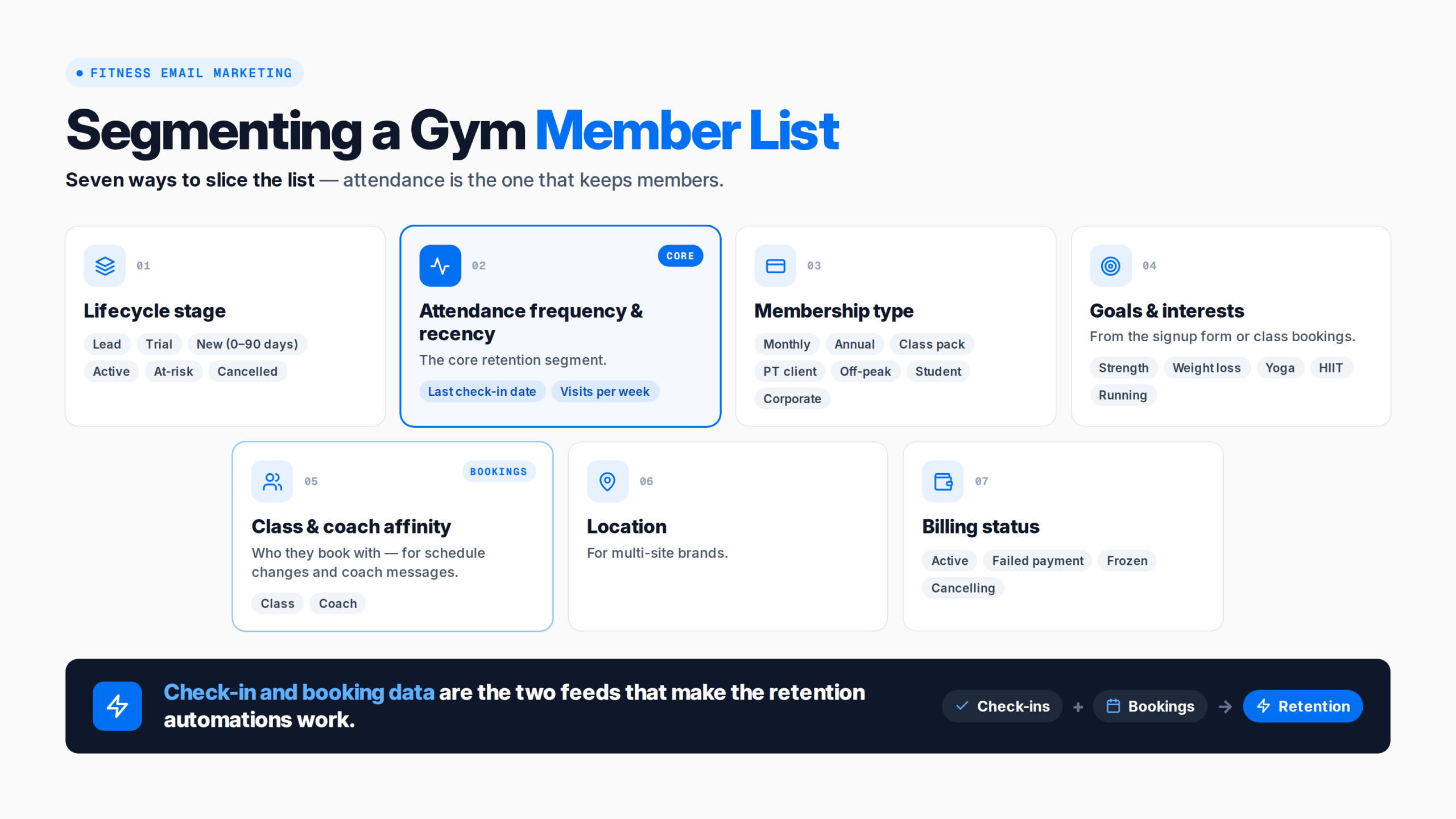
- Lifecycle stage: lead, trial, new (0–90 days), active, at-risk, cancelled.
- Attendance frequency and recency: last check-in date, visits per week. The core retention segment.
- Membership type: monthly, annual, class pack, PT client, off-peak, student, corporate.
- Goals and interests: from the signup form or class bookings (strength, weight loss, yoga, HIIT, running).
- Class and coach affinity: who they book with, for targeted schedule changes and coach messages.
- Location: for multi-site brands.
- Billing status: active, failed payment, frozen, cancelling.
Check-in and booking data are the two feeds that make the retention automations work. Most gym-management systems (Mindbody, Glofox, ABC Fitness, Zen Planner, TeamUp, and similar) export or integrate; connecting that data to the email platform is the setup that matters most.
Compliance and Deliverability for Gyms
Consent. CAN-SPAM in the US allows marketing to members with a working unsubscribe and a physical address in every email; UK and EU members fall under PECR and GDPR, which require an opt-in at signup. Keep marketing consent separate from billing and account notices, which are transactional.
Text messages. If you also text (class reminders, offers), marketing SMS requires prior express written consent under the TCPA in the US. Don’t move an email list to SMS without it.
Health information. Goals, injuries, and health screening answers collected at induction are sensitive. Keep them out of the marketing platform’s segmentation and out of email content; segment on class bookings and stated interests instead.
Authentication. Send from the gym’s own domain with SPF, DKIM, and DMARC; since the 2024 Gmail and Yahoo bulk-sender rules, unauthenticated mail is rejected. Our SPF, DKIM and DMARC guide covers the setup.
List hygiene. Cancelled members who never engage drag down deliverability; run win-back, then suppress. Our hard bounce vs soft bounce post explains which addresses to remove.
Gym Email Best Practices
- Build the new-member sequence first. The first 90 days decide the year.
- Trigger on check-ins, not the calendar. “We haven’t seen you in two weeks” beats “monthly newsletter”.
- Send from coaches. A named trainer’s email outperforms the front desk’s.
- Celebrate milestones. Recognition is retention.
- Keep it short and mobile. One image, one message, one button (book a class, claim a session).
- Segment by attendance and membership type. A PT client doesn’t need the PT taster.
- Automate dunning. Failed payments are silent churn; a three-email sequence with a one-click update link recovers most of it.
- Run win-back on a schedule. 30, 90, 180 days, plus January and September.
- Ask for referrals after good moments, not in a monthly blast.
- Keep health data out of email. Segment on bookings and stated goals only.
Common Mistakes Gyms Make
- Offers only in January. The rest of the year is when retention is won.
- Treating all members the same. Daily attendees and at-risk members get the same newsletter.
- No attendance trigger. The gym-management system knows who’s slipping; the email platform never hears about it.
- Sending from a personal or webmail address. No authentication, no unsubscribe, poor placement.
- Ignoring failed payments. Dunning is the easiest revenue a gym can recover.
- Health data in segments. A compliance risk and a trust problem.
- Measuring opens. Unreliable since Apple Mail Privacy Protection; measure check-ins, bookings, and renewals.
Tools and Platforms for Gym Email Marketing
Most gyms choose between the email features built into their management system (Mindbody, Glofox, ABC Fitness, Zen Planner, TeamUp, and others include basic email and automation) and a dedicated email platform connected to it. Built-in tools are convenient for class and billing notices; a dedicated platform gives better design, segmentation, automation depth, and deliverability for the marketing and retention programme.
| Platform | Best For | Free Plan | Starting Price | Why for gyms |
|---|---|---|---|---|
| Mailercloud#1 Pick | Independent gyms, studios, small brands | ✓ Yes 1,000 contacts | $10/mo | Retention automations, forms, AMP booking, Inbox Tracker |
| Mailchimp | Gym-system integrations | ✓ Yes 250 contacts | $13/mo | Native connectors to several management systems |
| Constant Contact | Workshops + phone support | ✗ Trial Free trial | $12/mo | Event tools; automation on Premium ($80/mo) |
| Brevo | Email + SMS class reminders | ✓ Yes 300/day | ~$9/mo | SMS with consent; unlimited contacts; automation on Standard |
| Mindbody / Glofox / ABC Fitness | Account notices from check-in data | Bundled Per site | Bundled | Basic absence and billing automations; limited design |
Pricing verified September 13–14, 2026 on each platform’s official pricing page, monthly billing unless noted.
Mailercloud
Mailercloud suits independent gyms, studios, and small fitness brands that want the new-member, at-risk, milestone, and win-back automations on a small budget: free for 1,000 contacts and 12,000 emails a month, then $10/month for 5,000 contacts with unlimited sends. The visual automation builder runs date and attribute triggers once check-in data is synced; segmentation handles attendance recency, membership type, and interests; the signup form builder captures leads and trial requests on the website; AMP for Email lets members book a class or answer a quick survey inside the email; and Inbox Tracker shows whether a challenge announcement reached the inbox or Promotions across Gmail, Outlook, and Yahoo. Limitations: no native gym-management integration (Zapier, Make, or CSV export), a smaller integration library than Mailchimp, and native SMS still in development, which matters for same-day class reminders.
✅Mailercloud Pros:
- Free for 1,000 contacts; $10/month for 5,000 contacts with unlimited sends — right-sized for independent gyms and studios
- Visual automation builder for onboarding, at-risk, dunning, and win-back sequences from synced check-in data
- Segmentation by attendance recency, membership type, and interests
- Signup form builder for website leads and trial requests
- AMP for Email lets members book a class or answer a survey inside the email
- Inbox Tracker shows whether challenge launches reach the inbox or Promotions
- Custom sending domain with guided authentication
- 24/7 live chat support
❌Mailercloud Cons:
- No native gym-management integration (Zapier, Make, or CSV export)
- Smaller integration library than Mailchimp
- Native SMS still in development — same-day class reminders need a separate tool
💰Pricing: Free for up to 1,000 contacts. Premium from $10/month (5,000 contacts, unlimited sends).
Mailchimp
Mailchimp has native integrations with several gym-management systems and a familiar interface. Pricing rises with member count (Essentials $13/month at 500 contacts) and it bills for unsubscribed contacts unless archived, which grows with cancelled members.
Constant Contact
Common among small studios for simplicity, event tools (workshops, challenges), and phone support. No free plan; multi-step automation requires Premium at $80/month.
Brevo
Brevo adds SMS and WhatsApp for class reminders (with consent), prices by volume with unlimited contacts, and includes a CRM. Automation arrives on Standard.
Gym-management built-ins (Mindbody, Glofox, ABC Fitness, Zen Planner, TeamUp)
Convenient because check-in and billing data are already there, with basic automations for absences and billing. Design, segmentation, and deliverability control are limited; many gyms use them for account notices and a dedicated platform for marketing.
Gym Email Metrics
- Trial-to-member conversion: joins ÷ trials, with the nurture sequence’s contribution.
- New-member 90-day retention: members still active at day 90, split by onboarding engagement.
- At-risk recovery rate: at-risk members who return ÷ drop-off emails sent.
- Dunning recovery: failed payments recovered ÷ failed payments.
- Win-back rate: rejoins ÷ win-back emails sent.
- Class and PT bookings from email: via tracked links.
- Click-through rate: the engagement signal; opens are unreliable.
- Referral rate: referrals ÷ referral prompts.
- Unsubscribe and complaint rates: under 0.5% and 0.1%.
- Inbox placement: for challenge launches and schedule changes that must arrive.
How to Get Started: A 7-Step Plan
- Export members and leads from your management system, tagged by stage, membership type, and last check-in.
- Choose a platform, connect check-in data (native, Zapier, or weekly export), and authenticate your domain.
- Build the new-member 30-day sequence with a no-check-in branch.
- Build the at-risk automation at 14 and 28 days without a visit.
- Add dunning and win-back sequences.
- Send a weekly or fortnightly update from a coach.
- Report 90-day retention, at-risk recovery, and rejoins monthly.
Frequently Asked Questions
What is gym email marketing?
Gym email marketing is permission-based email to leads, trial members, active members, at-risk members, and former members, triggered by check-in, booking, and membership data, that converts trials, gets new members through their first 90 days, recovers members whose attendance drops, wins back cancelled members, and sells add-ons like personal training and classes.
What emails should a gym send to members?
A gym should send an instant response and trial nurture to leads, a 30-day new-member onboarding sequence with attendance-triggered nudges, a weekly or fortnightly community update from a coach, milestone and anniversary messages, at-risk messages at 14 and 28 days without a check-in, referral prompts after positive moments, dunning and renewal notices, and a win-back series at 30, 90, and 180 days after cancellation.
How do gyms reduce churn with email?
Gyms reduce churn with email by running a new-member onboarding sequence that builds a routine in the first 90 days, triggering “we miss you” messages from a coach when check-ins stop for two to four weeks, recovering failed payments with a dunning sequence, offering a pause instead of a cancellation, and running scheduled win-back campaigns to former members.
How often should gyms email members?
Most gyms should send a community update weekly or fortnightly, with automated onboarding, at-risk, milestone, billing, and win-back emails running in addition based on each member’s data; more than weekly to the whole list usually raises unsubscribes, while triggered emails can be more frequent because they’re relevant to the individual.
Is email marketing effective for gyms?
Yes, email marketing is effective for gyms because membership churn is mostly quiet (members stop attending before they cancel) and check-in data lets email reach at-risk members weeks before they leave, at a few cents per message; health and fitness rank among the healthier-engagement sectors in Mailchimp’s and Constant Contact’s benchmark reports.
What is the best email marketing platform for gyms?
The best email platform for a gym connects to its management system’s check-in data and runs onboarding, at-risk, dunning, and win-back automations affordably; Mailercloud suits independent gyms and studios at $10/month with automation, segmentation, forms, AMP booking, and Inbox Tracker, Mailchimp has native integrations with several gym systems, and Constant Contact suits owners who want phone support and event tools.
Can gyms use members’ health information in email marketing?
Gyms should not use health screening answers, injuries, or medical information in email segmentation or content; segment on class bookings, stated fitness goals, and membership type instead, keep health data in the management system, and collect separate marketing consent (and express written consent for any marketing texts under the TCPA).
Summary
Gym email marketing is retention marketing. Connect check-in data, build the new-member 90-day sequence with attendance-triggered nudges, catch at-risk members at 14 and 28 days, automate dunning and win-back, send a short weekly update from a coach, celebrate milestones, and keep health data out of it. Send from your own authenticated domain and measure 90-day retention, at-risk recovery, and rejoins rather than opens.
Keep members coming back with email that reaches them
Get started →Free for 1,000 contacts · No credit card

As a Marketing Director, I develop and implement marketing strategies, conduct market research, and manage a team of marketing professionals. With a successful track record of launching campaigns that drive revenue growth, I bring my marketing expertise to blog writing, creating engaging content that promotes the brand and its products/services.