Last updated: May 2026 · Estimated reading time: 22 minutes
Your sales reps are sending cold emails into the void. Your marketing team is blasting newsletters nobody opens. And your customer success team? They’re not emailing at all.
This is the reality for most B2B companies in 2026. Email remains the highest-ROI channel in digital marketing — $36 for every $1 spent, according to the DMA’s 2025 report — yet most B2B revenue teams treat it as an afterthought. They throw together a campaign, hit send, and hope something sticks.
That approach doesn’t work anymore. Buyers now receive 121 business emails per day on average (Radicati Group, 2025). Getting noticed requires more than a catchy subject line. It demands a systematic, data-driven strategy that aligns marketing, sales, and customer success around a shared revenue goal.
For a deeper dive, see Best Email Providers to Use.
This guide covers the full B2B email marketing stack — from list building and segmentation to automation workflows and revenue attribution. Whether you’re starting from scratch or trying to fix an underperforming program, you’ll find specific, actionable tactics backed by current benchmarks. No fluff, no theory-only advice, no recycled 2020 playbooks.
Learn more in our guide to Email Verifier & Email Verification Tool.
Quick Answer: B2B email marketing is the practice of sending targeted emails to business professionals to generate leads, nurture prospects, and retain customers. It remains the highest-ROI digital channel at $36 return per $1 spent. The keys to success in 2026: segment your list by lifecycle stage and behavior, automate nurture sequences aligned to the buyer’s journey, authenticate your sending domain (SPF, DKIM, DMARC), and measure email-attributed pipeline — not just open rates. This guide covers strategy, tools, benchmarks, and a 7-step action plan to build or fix your B2B email program.
For a deeper dive, see MailerLite vs Mailchimp.
Table of Contents
What Is B2B Email Marketing?
B2B email marketing is the practice of sending targeted emails to business professionals — decision-makers, influencers, and end users inside companies — to generate leads, nurture prospects through long sales cycles, and retain existing customers.
See also: Email Marketing for Small Business.
It differs from B2C email marketing in three fundamental ways.
First, the audience is smaller and more defined. Instead of targeting millions of consumers, you’re reaching hundreds or thousands of people with specific job titles, company sizes, and pain points. A SaaS company selling project management software might target engineering managers at mid-market tech companies. That’s a list of maybe 5,000 contacts, not 500,000.
Further reading: Email Marketing for Ecommerce.
Second, the buying process involves multiple stakeholders. In B2B, purchasing decisions rarely happen with one click. A typical B2B deal involves 6 to 10 decision-makers (Gartner, 2024), each with different priorities. Your email program needs to address the CFO’s cost concerns, the IT lead’s security questions, and the end user’s workflow needs — often simultaneously.
Third, the sales cycle is longer. B2C purchases happen in minutes. B2B deals can take 3 to 18 months. Your emails need to maintain engagement across that entire span without becoming repetitive or irrelevant.
These differences mean that B2B email marketing isn’t just “send fewer emails to business addresses.” It’s a fundamentally different discipline that requires different strategies, metrics, and tools.
Why B2B Email Marketing Still Matters in 2026
Social media gets the attention. Paid ads eat the budget. But email quietly generates more pipeline than both combined for most B2B companies.
Here’s why email remains the backbone of B2B revenue teams:
It reaches people where they already work. Business professionals spend 28% of their workday in email (McKinsey, 2024). LinkedIn and Twitter require them to switch apps. Email meets them in the tool they’re already using.
It offers the best attribution. Unlike organic social or content marketing, email gives you precise data: who opened, who clicked, who forwarded, who replied. For revenue teams measuring pipeline contribution, this clarity is irreplaceable.
It scales without proportional cost increases. Sending 10,000 emails costs roughly the same as sending 1,000. That unit economics advantage compounds as your list grows. Compare that to paid ads, where every additional impression costs money.
It compounds over time. A well-maintained email list is a business asset. Unlike SEO rankings (which fluctuate) or ad spend (which stops working the moment you stop paying), your email list is owned media. You control it. Nobody’s algorithm decides whether your message gets delivered.
The data backs this up. According to HubSpot’s 2025 State of Marketing report, 77% of B2B marketers say email is their most effective demand generation channel. Campaign Monitor’s benchmark data shows B2B email averages a 15.14% open rate across industries — but companies with segmented, automated programs regularly exceed 25%.
The companies that dismiss email as “old school” are typically the ones sending the same generic newsletter to their entire list. The ones generating revenue from email are doing something very different.
How B2B Email Marketing Works: The Revenue Engine
Effective B2B email marketing isn’t a series of one-off campaigns. It’s an engine with interconnected components. Here’s how each piece fits together.
Building the Right List
List quality determines email performance more than any other single factor. A list of 2,000 verified, opted-in contacts who match your ideal customer profile will outperform a purchased list of 50,000 random business emails every time. If you’re unsure how to build a high-quality prospect list, working with a b2b-lead-generation-companies can help you reach the right decision-makers instead of wasting time on outdated or irrelevant contacts.
Opt-in methods that work for B2B:
Lead magnets remain the most reliable list-building tool in B2B. The key is specificity. “Download our free guide” stopped working years ago. “Get the 2026 SaaS Pricing Benchmark Report (47 companies analyzed)” still pulls because it promises a specific, high-value deliverable the reader can’t get elsewhere.
Webinar registrations, free tool signups, and gated case studies also drive quality B2B opt-ins. The common thread: the reader gets something genuinely useful in exchange for their email.
What doesn’t work: purchasing lists, scraping email addresses, or using third-party data providers without consent. Beyond the ethical problems, these approaches tank your deliverability. Email providers flag senders with high bounce rates and spam complaints, which means your legitimate emails to real prospects start landing in spam too.
Segmentation That Actually Drives Revenue
Segmentation is the practice of dividing your email list into groups based on shared characteristics, then sending each group content tailored to their specific situation. The same personalization approach is increasingly influencing modern website design, where companies build tailored experiences for multiple stakeholders involved in B2B purchasing decisions.
Most B2B companies segment by industry or company size and call it a day. Revenue-focused teams go deeper.
Firmographic segmentation divides contacts by company attributes: industry vertical, employee count, annual revenue, technology stack, and geographic location.
Behavioral segmentation groups contacts by what they’ve done: pages visited, content downloaded, emails opened, product trials started, features used, support tickets filed.
Lifecycle stage segmentation maps contacts to where they sit in the buying journey: awareness (just learning about the problem), consideration (evaluating solutions), decision (comparing vendors), and post-purchase (onboarding, expansion, renewal).
Intent segmentation layers behavioral signals to identify contacts who are actively in-market. Someone who visited your pricing page three times this week, downloaded a competitor comparison guide, and attended a product webinar is signaling buying intent — and should receive a different email than someone who last engaged six months ago. These signals are often used by sales teams and lead generation companies to prioritize outreach.
The revenue impact is measurable. Segmented campaigns generate 760% more revenue than one-size-fits-all blasts, according to Campaign Monitor’s benchmark study.
The Five B2B Email Types That Drive Pipeline
Not all B2B emails serve the same purpose. Revenue teams typically run five distinct email types, each targeting a different stage of the funnel.
1. Nurture sequences — Multi-email automated series that educate prospects over weeks or months. A typical B2B nurture sequence runs 5 to 8 emails over 30 to 60 days, progressively introducing the problem, the solution category, and specific use cases. These convert awareness-stage leads into sales-ready opportunities.
2. Product/feature announcements — Targeted emails to existing users or trial signups highlighting new capabilities. These drive adoption, reduce churn, and create upsell opportunities. The best ones focus on the customer outcome (“You can now automate report delivery — saving ~2 hours/week”) rather than the feature itself (“We launched scheduled exports”).
3. Event and webinar invitations — Emails promoting live or on-demand educational events. B2B webinars remain one of the highest-converting lead generation formats, with an average registration-to-attendance rate of 40-50% (GoToWebinar, 2025). The key is the post-event follow-up sequence, which often generates more pipeline than the event itself. For training-led webinars, the post-event sequence can also include a personalized certificate of participation. A production coordinator can confirm speaker details, session timings and registration deadlines before invitations go out, helping keep promotional emails aligned with the event schedule.
4. Case study and social proof emails — Emails featuring customer success stories, testimonials, or third-party reviews. These work best in the consideration and decision stages when prospects are comparing vendors. Include specific metrics (“reduced onboarding time by 40%”) rather than vague endorsements.
5. Re-engagement campaigns — Targeted emails to contacts who’ve gone cold. Before removing inactive contacts from your list, a 2 to 3 email re-engagement sequence can recover 5-15% of them. Those who don’t respond should be removed — a smaller, engaged list performs better than a large, disengaged one.
Writing B2B Emails That Get Read
B2B email copywriting follows different rules than consumer email. Your reader is a busy professional scanning their inbox between meetings. You have roughly 3 seconds to earn their attention.
Subject lines. Keep them under 50 characters. Personalization (using the recipient’s name or company) improves open rates by 10-14% (Experian benchmark). Questions work (“Is your onboarding actually costing you customers?”). So do specific numbers (“3 changes that cut our churn by 22%”). Avoid clickbait — it might get the open, but it destroys trust.
Preview text. The preview text (preheader) is the second most-read element after the subject line. Use it to complete the subject line’s thought, not repeat it. If your subject is “Q1 benchmark data is in,” your preview should be “SaaS companies averaged 14.2% reply rates” — not “Open to learn more.”
Body copy. Short paragraphs — 2 to 3 sentences max. One idea per paragraph. Write at a 7th-grade reading level (Hemingway Editor is a quick check). Use “you” and “your” more than “we” and “our.” Lead with the reader’s problem, not your product.
Calls to action. One CTA per email. Make it specific (“Book a 15-minute walkthrough” beats “Learn more”). Place it where the reader naturally arrives after understanding the value — usually after the second or third paragraph, not buried at the bottom.
Automation Workflows That Scale
Manual email campaigns don’t scale. When your list hits 1,000+ contacts and you’re running multiple segments, automation isn’t optional — it’s the only way to send the right message to the right person at the right time.
Welcome series. Triggered when someone joins your list. 3 to 5 emails over 7 to 14 days. Welcome emails generate 320% more revenue per email than promotional emails (Invesp, 2024). Use them to set expectations, deliver the promised lead magnet, and introduce your best content.
Lead scoring + handoff. Assign point values to email actions (open = 1 point, click = 3 points, pricing page visit = 10 points). When a contact crosses a threshold (e.g., 25 points), automatically notify sales and transition them from marketing nurture to sales outreach.
Behavioral triggers. Send emails based on what contacts do: visited the pricing page (send a pricing comparison guide), started a free trial but didn’t complete setup (send an onboarding help email), haven’t logged in for 14 days (send a re-engagement email with tips).
Renewal and expansion. For existing customers, automate renewal reminders (90, 60, 30 days out), usage milestone celebrations (“You just sent your 10,000th email!”), and expansion prompts based on usage patterns (“Your team is using 90% of your contact limit — here’s how to upgrade”).
B2B Email Marketing Best Practices for 2026
These 10 practices separate the B2B teams generating pipeline from email from those burning their list.
1. Authenticate everything. Set up SPF, DKIM, and DMARC for every sending domain. Google and Yahoo’s 2024 sender requirements made this mandatory — unauthenticated senders see significantly higher spam placement rates.
2. Clean your list quarterly. Remove hard bounces immediately. Suppress contacts with zero engagement over 90 days. A clean list means better deliverability, lower costs, and more accurate metrics.
3. Segment before you send. Never send the same email to your entire list. At minimum, segment by lifecycle stage (prospect vs. customer) and engagement level (active vs. inactive). The revenue difference is dramatic.
4. Personalize beyond first name. Dynamic content blocks that change based on the recipient’s industry, company size, or behavior outperform generic personalization. “Hi Sarah” is table stakes. “Hi Sarah — here’s how other fintech companies are solving this” is where the ROI lives.
5. Test one variable at a time. A/B test subject lines, send times, CTA placement, and email length — but only one per test. Testing everything simultaneously tells you nothing. Start with subject lines (highest impact for least effort).
6. Optimize for mobile. 42% of B2B emails are opened on mobile devices (Litmus, 2025). Single-column layouts, 14px+ body text, and CTA buttons (not text links) are minimum requirements. Preview every email on both desktop and mobile before sending.
7. Respect the unsubscribe. Make it one click. Don’t hide it. Don’t require a login. A visible, easy unsubscribe reduces spam complaints (which hurt your sender reputation) and is legally required under CAN-SPAM, GDPR, and Canada’s CASL.
8. Time your sends based on data, not assumptions. “Tuesday at 10am” is not universally optimal. Use your own engagement data to find your audience’s peak times. Most email platforms let you send at the recipient’s local time zone — use this feature.
9. Write for scanners. Bold the key takeaway in each section. Use bullet points for lists of three or more items. Put the most important information in the first sentence of each paragraph. Most B2B readers scan before deciding whether to read in detail.
10. Measure what matters. Open rates tell you about subject line performance. Click rates tell you about content relevance. Reply rates tell you about relationship depth. Revenue attribution tells you what’s actually working. Track all four, but make decisions based on the last one.
Common B2B Email Marketing Mistakes
Even experienced marketing teams fall into these traps. Each one directly impacts pipeline and revenue.
Sending without warming up. New sending domains and IPs need a warm-up period — starting with small volumes and gradually increasing over 2 to 4 weeks. Skipping this step triggers ISP spam filters and can permanently damage your sender reputation.
Treating every contact the same. A CEO evaluating a $50K annual contract needs different emails than a marketing coordinator exploring free tools. When you send the same nurture sequence to both, you lose the CEO’s attention and overwhelm the coordinator.
Over-emailing. B2B contacts tolerate 1 to 2 marketing emails per week. Beyond that, unsubscribe rates spike. Monitor your email frequency per contact (including automated sequences) to make sure no one receives more than 6 to 8 emails per month from your brand.
Ignoring deliverability. If 20% of your emails land in spam, your “25% open rate” is actually 20% — calculated only on the emails that reached the inbox. Monitor inbox placement, not just delivery rate. They’re different metrics. “Delivered” means the server accepted it. “Placed in inbox” means the recipient can see it.
No reply-to address. Sending from “[email protected]” signals that you don’t want a relationship. In B2B, replies are gold — they indicate high intent and often lead directly to sales conversations. Use a real person’s name and monitor the inbox.
Skipping the plain-text version. Every HTML email should include a plain-text alternative. Some corporate email clients strip HTML. Some recipients prefer plain text. And some spam filters score HTML-only emails higher for spam risk.
Not aligning with sales. Marketing sends a nurture email about “top of funnel” content while sales is reaching out to the same contact about pricing. This happens constantly when marketing and sales teams don’t share visibility into email touchpoints. Use a shared CRM or email platform that gives both teams a unified view of every contact’s email history.
B2B Email Marketing Tools and Platforms
The right platform depends on your team size, budget, and the complexity of your email program. If you’re running a larger operation, our guide to enterprise email marketing platforms covers that segment. Here are six tools that handle B2B email marketing well, each with different strengths.
Mailercloud
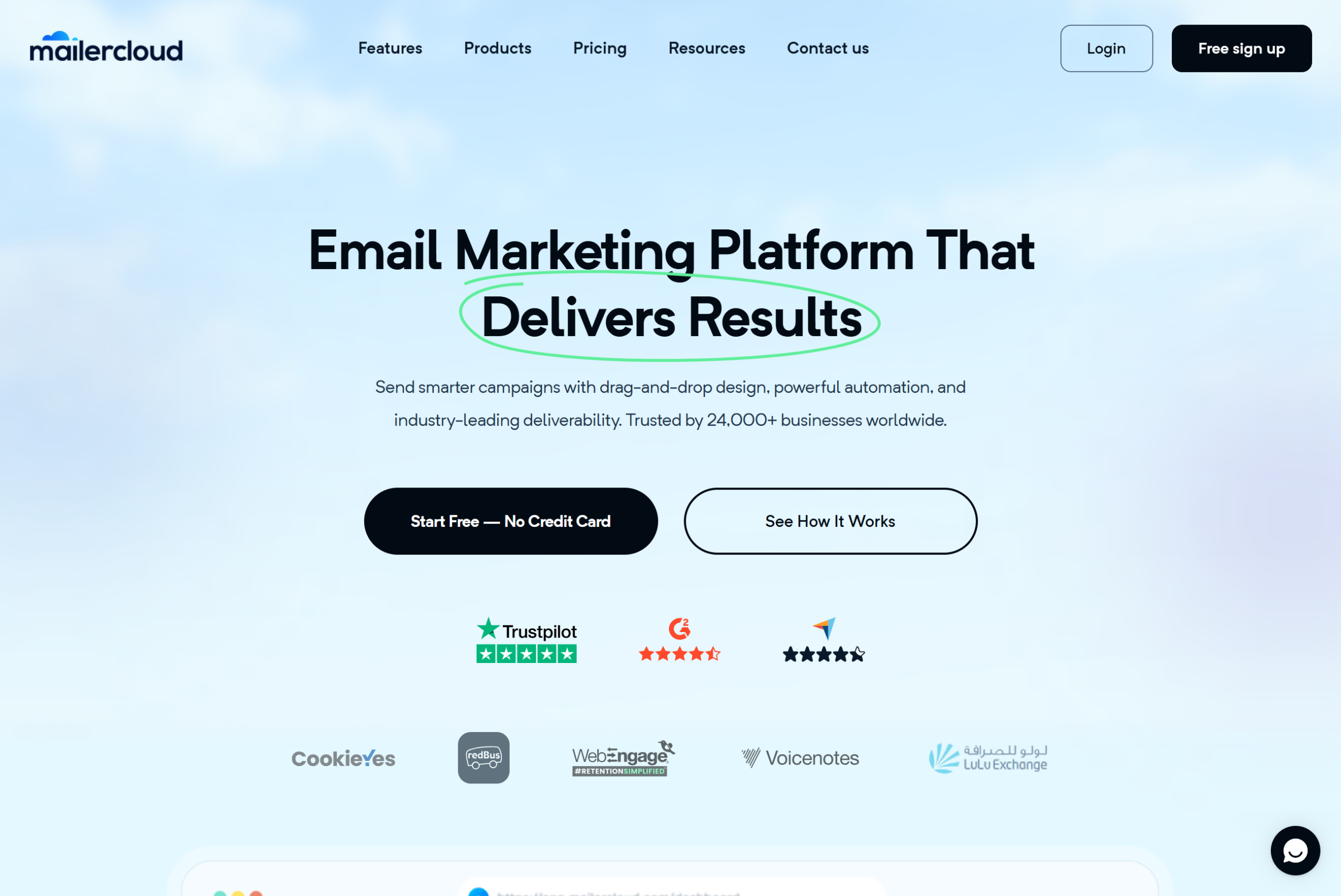
Mailercloud is built for teams that want strong email marketing fundamentals — automation, segmentation, deliverability — without the complexity or cost of enterprise platforms.
What stands out: Inbox Tracker shows where your emails actually land (inbox, spam, promotions) across major ISPs — a feature most platforms at this price point don’t offer. AMP for Email support lets you build interactive emails (forms, carousels, accordions inside the email itself). The visual automation builder handles multi-step workflows with branching logic.
Pricing: Starts at $7/month (Pro plan). Free plan available for up to 1,000 contacts and 12,000 emails/month — no credit card required, no time limit.
Honest limitations: The third-party integration library is smaller than Mailchimp’s or HubSpot’s. Native SMS marketing is still in development. Brand recognition in the US market is lower than established players.
Best for: Small to mid-size B2B teams that need automation, deliverability monitoring, and AMP email capabilities without paying $20+/month for the starting tier.
Start your free Mailercloud account →
HubSpot
HubSpot’s email marketing sits inside its broader CRM platform, which makes it a natural fit for B2B teams already using HubSpot for sales and marketing.
What stands out: Tight CRM integration means email personalization can pull from deal stage, company properties, and sales activity — without any manual sync. The reporting connects email engagement directly to pipeline and revenue.
Pricing: Free CRM with basic email. Marketing Hub starts at $20/month (Starter) and scales to $890/month (Professional) for full automation. Enterprise is $3,600/month.
Honest limitations: Gets expensive fast as your contact list grows. The free and Starter tiers have significant feature restrictions. The platform’s complexity can overwhelm small teams.
Mailchimp
Mailchimp is the most recognized name in email marketing, with a massive template library and ecosystem of integrations.
What stands out: Hundreds of pre-built templates. The broadest integration library in the category (300+ apps). Predictive analytics features (send time optimization, content recommendations) are available on higher tiers.
Pricing: Free plan for up to 500 contacts with limited features. Standard plan starts at $13/month. Premium starts at $175/month.
Honest limitations: Charges for unsubscribed contacts on some plans. The interface has grown cluttered as they’ve added features. Deliverability is average compared to specialist platforms.
ActiveCampaign
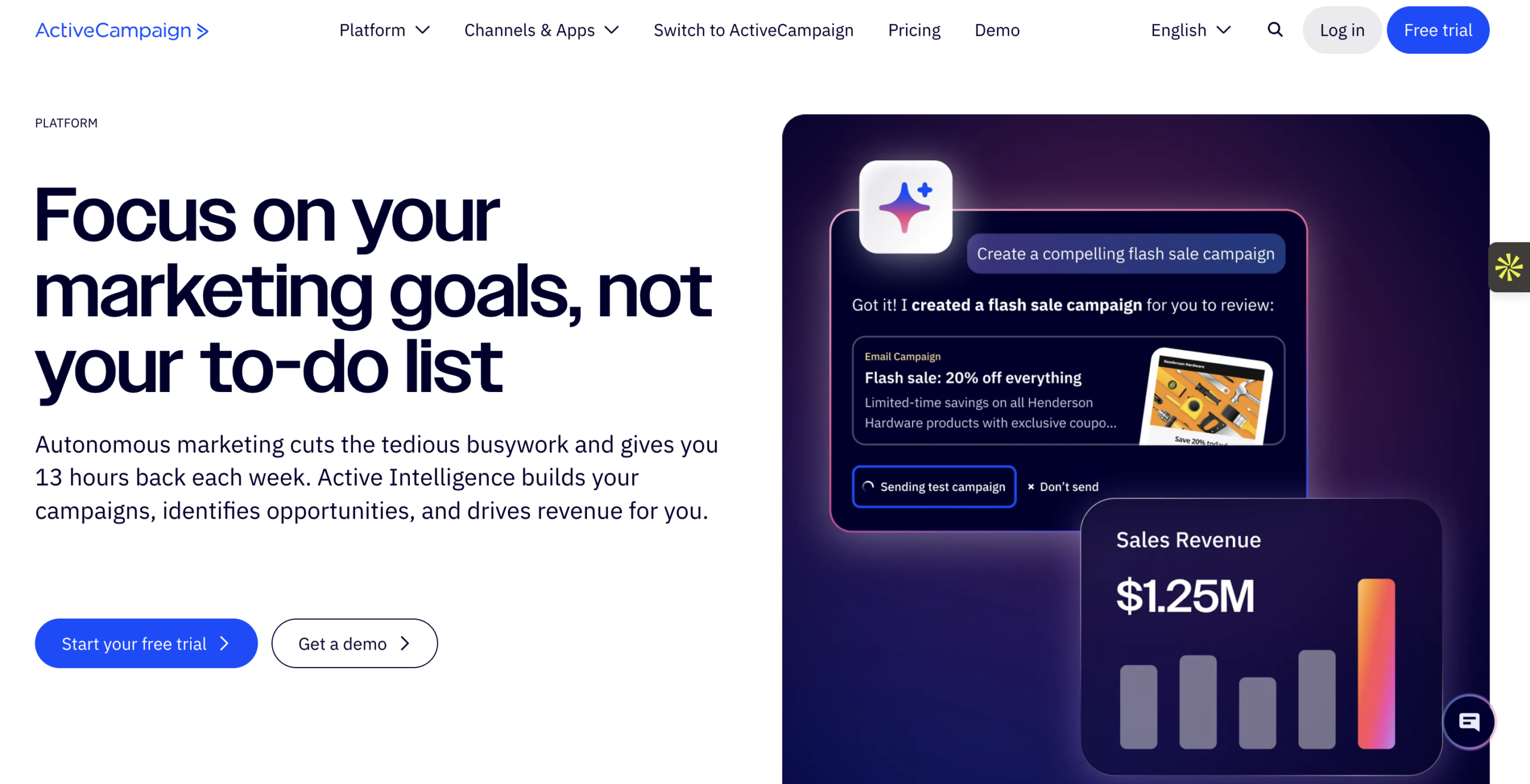
ActiveCampaign focuses on marketing automation and CRM, making it a strong pick for B2B teams with complex nurture sequences.
What stands out: The automation builder is one of the most flexible in the market — conditional logic, wait steps, split paths, goal tracking. The built-in CRM handles basic pipeline management without needing a separate tool.
Pricing: Starts at $15/month (Lite). No free plan — 14-day trial only.
Honest limitations: No free plan at all. The learning curve for the automation builder is steeper than simpler tools. Reporting is functional but not as visual as HubSpot’s.
Brevo (formerly Sendinblue)
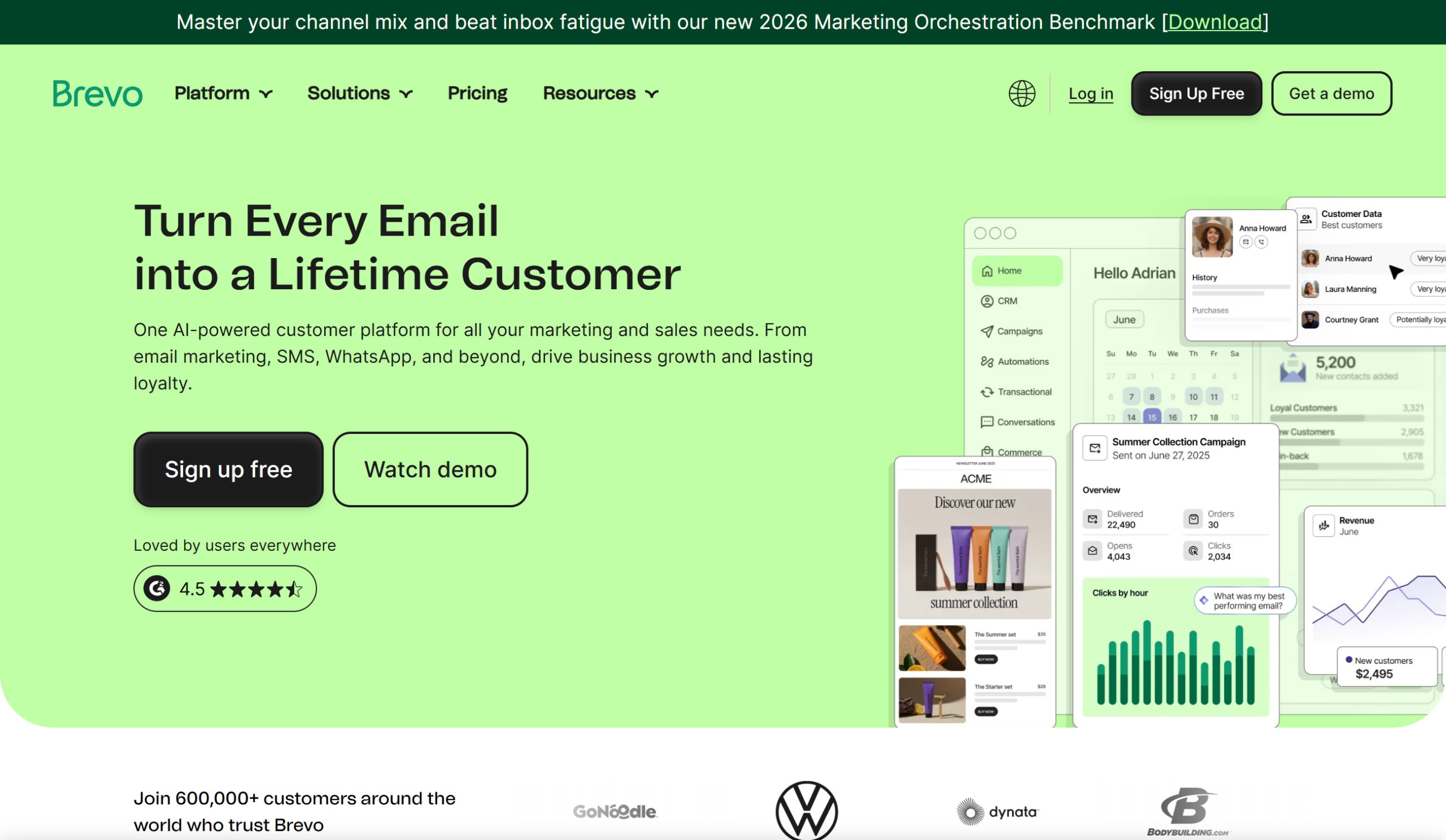
Brevo positions itself as an all-in-one marketing platform combining email, SMS, chat, and CRM.
What stands out: Pricing is based on emails sent, not contacts stored — a significant advantage for teams with large lists but moderate send volumes. Built-in SMS and WhatsApp marketing.
Pricing: Free plan allows 300 emails/day. Starter plan begins at $9/month for 5,000 emails/month.
Honest limitations: Daily sending limits on the free plan (300/day). The automation builder is simpler than ActiveCampaign’s. Some advanced features require the Business plan ($18/month).
Kit (formerly ConvertKit)

Kit is designed for creators and small teams, with a focus on simplicity and subscriber-first design.
What stands out: Visual automation builder is intuitive. Landing page builder included. Tag-based subscriber management (no separate “lists”).
Pricing: Free plan for up to 10,000 subscribers (with limited features). Creator plan starts at $29/month.
Honest limitations: Creator-focused — B2B teams with complex segmentation needs may find it too simple. Limited reporting compared to B2B-focused platforms. No built-in CRM.
B2B Email Marketing Metrics and KPIs
Tracking the right metrics separates teams that “do email” from teams that generate revenue with email. Here’s what to measure and what “good” looks like.
Delivery and Inbox Metrics
Delivery rate = (Emails delivered / Emails sent) × 100. Target: 95%+. Below 90% signals a list hygiene or authentication problem.
Bounce rate = (Bounced emails / Emails sent) × 100. Hard bounces (invalid addresses) should stay below 2%. Soft bounces (temporary failures) below 5%.
Inbox placement rate = (Emails in inbox / Emails delivered) × 100. This is different from delivery rate — a “delivered” email can still land in spam. Target: 85%+. Requires an inbox placement tool (like Mailercloud’s Inbox Tracker) to measure.
Engagement Metrics
Open rate = (Unique opens / Emails delivered) × 100. B2B average: 15-25% (Mailchimp, 2025 benchmark). Note: Apple’s Mail Privacy Protection inflates open rates by pre-loading tracking pixels. Treat open rate as directional, not absolute.
Click-through rate (CTR) = (Unique clicks / Emails delivered) × 100. B2B average: 2.5-3.5%. Above 5% indicates strong content-audience fit.
Click-to-open rate (CTOR) = (Unique clicks / Unique opens) × 100. B2B average: 10-15%. This measures content effectiveness independent of subject line performance. A high open rate but low CTOR means your subject line works but your email content doesn’t deliver on the promise.
Reply rate — Particularly important for B2B. Replies indicate high engagement and buying intent. Track separately from clicks.
Revenue Metrics
Email-attributed pipeline = Total pipeline value from deals where email was a touchpoint in the buyer’s journey. This requires CRM integration and multi-touch attribution.
Revenue per email = Total revenue attributed to email / Total emails sent. This is the ultimate metric. It forces you to balance volume (don’t oversend) with relevance (don’t undersend to your best segments).
Customer acquisition cost via email = (Email platform cost + content creation cost + team time) / New customers acquired via email. Compare this to your CAC from paid ads and organic to understand email’s relative efficiency.
B2B Email Marketing Examples That Work
Three examples from real B2B campaigns (company names anonymized where needed) that illustrate different approaches.
The onboarding drip that cut churn by 23%. A mid-market SaaS company redesigned their post-signup email sequence from 3 generic “welcome” emails to a 7-email behavioral series triggered by product usage milestones. Users who completed the sequence had 23% higher 90-day retention than those who didn’t. The key change: each email addressed the specific next action the user hadn’t taken, rather than broadcasting general tips.
The ABM campaign that generated $1.2M in pipeline. An enterprise software vendor sent a 4-email sequence to 200 target accounts, with each email personalized to the recipient’s company’s tech stack (pulled from their CRM). Average reply rate: 12%. Six meetings booked from 200 contacts — a 3% meeting rate that translated to $1.2M in qualified pipeline. The personalization wasn’t cosmetic (“Hi [Name]”) — it was substantive (“Your team uses [Tool X]; here’s how it integrates”).
The re-engagement campaign that recovered $180K ARR. A subscription platform identified 400 customers who hadn’t logged in for 60+ days but still had active subscriptions. A 3-email re-engagement series — featuring a personalized usage summary, a “what you’re missing” feature update, and a direct offer to schedule a 10-minute check-in call — re-activated 15% of them. The remaining 85% were flagged for sales follow-up, preventing silent churn.
How to Get Started with B2B Email Marketing
If you’re building a B2B email program from scratch — or rebuilding one that isn’t performing — here’s a step-by-step action plan.
Step 1: Audit what you have. Export your current email list. Remove duplicates, invalid addresses, and contacts who haven’t engaged in 6+ months. Document which email tools you’re currently using and what automations (if any) are running.
Step 2: Choose your platform. Pick an email marketing platform that matches your team’s size and needs. For most B2B teams starting out, you want automation capabilities, segmentation, deliverability tools, and CRM integration at a price that doesn’t require budget approval from your CFO. See our best email marketing software roundup for a detailed comparison.
Step 3: Set up authentication. Configure SPF, DKIM, and DMARC records for your sending domain. This takes 30 minutes with your DNS provider and is non-negotiable for inbox delivery in 2026.
Step 4: Build your core segments. Start with four segments: new leads (last 30 days), active prospects (engaged in last 90 days), customers, and inactive contacts (no engagement in 90+ days). You’ll refine these over time, but these four cover the basics.
Step 5: Create your welcome sequence. Build a 3 to 5 email welcome series for new subscribers. Email 1: deliver the lead magnet and set expectations. Email 2: share your best piece of content. Email 3: introduce a relevant case study. Email 4: soft CTA (book a call, start a trial). This sequence runs on autopilot and handles every new lead.
Step 6: Launch your first nurture campaign. Pick one segment (active prospects is usually the best starting point) and build a 5 to 7 email sequence that educates them on your core value proposition. Space emails 3 to 5 days apart. Focus on their problem, not your product, for the first three emails.
Step 7: Set up measurement. Connect your email platform to your CRM. Set up UTM parameters on every email link. Create a dashboard tracking delivery rate, open rate, CTR, and email-attributed pipeline. Review weekly for the first 60 days, then monthly.
Advanced B2B Email Marketing Tactics
Once your foundational program is running, these tactics compound results.
Dynamic send-time optimization. Instead of guessing when to send, use machine learning to deliver each email at the time the individual recipient is most likely to engage. Most modern email platforms offer this feature. In testing across B2B senders, dynamic send-time optimization has been shown to improve open rates by 10-20%.
Interactive email with AMP. AMP for Email lets recipients take actions inside the email — fill out forms, browse product carousels, RSVP to events — without visiting a landing page. It reduces friction, which increases conversion rates. Only a handful of email platforms support AMP currently; see our best AMP email software comparison to find one that fits.
Predictive lead scoring with email signals. Layer email engagement data (opens, clicks, reply sentiment) with product usage data and website behavior to build a predictive model that identifies which leads are most likely to convert. This approach prioritizes sales outreach on the contacts that matter most.
Account-based email orchestration. For enterprise B2B, coordinate email sequences across multiple contacts at the same target account. The VP of Engineering gets a technical deep-dive while the CFO gets an ROI analysis — timed so both land in the same week. This multi-threaded approach mirrors how enterprise buying committees actually operate. Many teams pair these sequences with ABM platforms that track engagement across the same buying committee, so email and paid touches reach each stakeholder in step. For the outreach execution layer, exploring the best AI sales tools helps teams identify which platforms handle LinkedIn automation, email sequencing, and reply management in a single workflow.
AI-generated personalization at scale. Use AI to generate email copy variations tailored to each recipient’s industry, role, and engagement history. An AI email writer can produce these first drafts quickly, giving you a tailored starting point for each segment. This goes beyond merge tags — it’s dynamically generating the core message. The risk: generic AI output that reads as robotic. The mitigation: use AI for first drafts, then apply brand voice and human editing.
B2B Email Marketing in 2026: Trends Shaping the Channel
Three trends are reshaping how B2B teams use email this year.
Privacy regulations are tightening. The EU’s Digital Markets Act, evolving US state privacy laws, and Google’s continued changes to tracking are forcing B2B email marketers to rely less on third-party data and more on first-party engagement signals. Companies that invested early in building owned lists and consent-based data are now ahead.
AI is changing both creation and reception. AI writing assistants are making it easier to produce email content — which means inboxes are getting more crowded. Many B2B marketing teams are also adopting AI social media tools to repurpose email campaigns, automate content distribution, and maintain consistent messaging across multiple channels. The counter-strategy: invest in genuinely useful, data-rich emails that AI-generated content can’t replicate. Share original research, proprietary benchmarks, and authentic customer stories.
Deliverability is now a competitive advantage. Google and Yahoo’s 2024 sender requirements raised the bar for authentication. In 2026, ISPs are further tightening spam filtering with machine learning models that evaluate sender behavior patterns over time. Companies that treat deliverability as an engineering discipline — monitoring inbox placement, managing sender reputation, and authenticating properly — are seeing measurably better results than those who don’t.
Frequently Asked Questions
What is the best email marketing strategy for B2B?
The best B2B email marketing strategy combines segmented lists, automated nurture sequences, and behavioral triggers aligned to the buyer’s journey. Start by segmenting your list by lifecycle stage (prospect, opportunity, customer) and engagement level (active, inactive). Build automated sequences for each segment — welcome series for new leads, education sequences for active prospects, and renewal campaigns for customers. Personalize beyond first name using firmographic and behavioral data. Measure success by email-attributed pipeline, not just open rates.
How often should you send B2B marketing emails?
B2B contacts typically engage best with 1 to 2 marketing emails per week, plus any behavioral triggered emails. Monitor your unsubscribe rate — if it exceeds 0.5% per send, you’re emailing too frequently. Some segments can handle more (active trial users may welcome daily onboarding tips for the first week), while others need less (executives may prefer bi-weekly digests). Let engagement data guide frequency rather than applying a blanket rule.
What is a good open rate for B2B emails?
A good open rate for B2B emails in 2026 is 20-30%, though this varies by industry and email type. Triggered emails (welcome, behavioral) typically see 30-50% open rates. Newsletter-style broadcasts average 15-22%. Note that Apple’s Mail Privacy Protection, adopted by roughly 50% of email users, inflates open rates by pre-loading tracking pixels. Click-through rate (2.5-5%) and reply rate are more reliable engagement indicators.
How is B2B email marketing different from B2C?
B2B email marketing targets business professionals making purchasing decisions that involve multiple stakeholders and longer sales cycles (3-18 months vs. minutes). B2B emails prioritize education, relationship building, and trust over impulse-driven offers. The lists are smaller but more targeted. Content tends to be more detailed and value-driven. Personalization in B2B extends to company attributes (industry, size, tech stack), not just individual preferences. ROI measurement in B2B connects email to pipeline and revenue, not just direct sales.
Does cold email work for B2B?
Cold email can work for B2B when done correctly, but the bar has risen significantly. Effective cold email in 2026 requires: verified email addresses (not purchased lists), genuine personalization based on the recipient’s company and role, a clear and specific value proposition, compliance with CAN-SPAM/GDPR regulations, and proper email authentication (SPF, DKIM, DMARC). Average cold email response rates in B2B hover around 1-5% (Woodpecker, 2025). The most effective approach treats cold email as a conversation starter, not a sales pitch.
What metrics should B2B revenue teams track for email?
B2B revenue teams should track four tiers of email metrics. Tier 1 (deliverability): delivery rate, bounce rate, inbox placement rate. Tier 2 (engagement): open rate, click-through rate, reply rate. Tier 3 (conversion): email-to-meeting rate, email-to-trial rate, email-to-opportunity rate. Tier 4 (revenue): email-attributed pipeline, revenue per email sent, and email-influenced deal velocity. Most teams over-index on Tier 2 and under-invest in Tier 3 and 4 measurement.
How do you improve B2B email deliverability?
Improving B2B email deliverability requires both technical setup and ongoing list management. On the technical side: authenticate your domain with SPF, DKIM, and DMARC, warm up new sending domains gradually, and maintain a consistent sending volume. On the list management side: remove hard bounces immediately, suppress inactive contacts after 90 days, and never use purchased lists. Monitor your inbox placement rate (not just delivery rate) to catch spam folder issues early. Use a dedicated IP once you’re sending 50,000+ emails/month.
Should B2B companies use plain-text or HTML emails?
Both have a place in B2B email marketing. HTML emails with visual formatting work well for newsletters, product announcements, and marketing campaigns where brand presentation matters. Plain-text emails (or lightly formatted HTML that looks like plain text) perform better for sales outreach, executive communications, and direct reply-oriented emails — they feel more personal and bypass some corporate email filters. The best approach: use HTML for marketing broadcasts, plain-text style for 1-to-1 and sales-driven sequences.
What is email marketing automation in B2B?
B2B email marketing automation is the practice of using software to send targeted emails triggered by specific conditions — a contact’s behavior, a time interval, or a lifecycle change — without manual intervention. Common B2B automations include welcome sequences (triggered by form submission), lead nurture sequences (triggered by content download), behavioral emails (triggered by website visits or product usage), and renewal reminders (triggered by subscription date). Automation enables B2B teams to maintain consistent, personalized communication with thousands of contacts simultaneously.
How do you measure B2B email marketing ROI?
Measuring B2B email marketing ROI requires connecting email engagement data to revenue outcomes in your CRM. The formula: (Revenue attributed to email – Email program costs) / Email program costs × 100. Email program costs include platform fees, content creation time, and design resources. Revenue attribution can use first-touch (email was the first interaction), last-touch (email was the last interaction before purchase), or multi-touch (email was one of several touchpoints) models. Multi-touch is most accurate for B2B’s long sales cycles. Track email-influenced pipeline as a leading indicator while revenue attribution catches up.
Further Reading and Related Resources
Mailercloud resources: – Visual Automation Builder — Build multi-step B2B nurture workflows – Inbox Tracker — Monitor email placement across ISPs – AMP for Email — Create interactive B2B emails – Email Marketing Pricing — Plans starting at $7/month
External authoritative resources: – Google Postmaster Tools — Monitor your sender reputation with Gmail – M3AAWG Sender Best Practices — Industry-standard sending guidelines – DMARC.org — Email authentication standards and implementation guides
Summary
B2B email marketing in 2026 is a revenue discipline, not a broadcasting tool. The companies generating pipeline from email share three characteristics: they segment ruthlessly, they automate intelligently, and they measure what matters (pipeline and revenue, not just opens and clicks). Start with clean data, proper authentication, and a welcome sequence. Layer in behavioral triggers and lifecycle campaigns as your program matures. And always — always — connect email engagement back to revenue outcomes.
Start building your B2B email program — create a free Mailercloud account →

As a Marketing Director, I develop and implement marketing strategies, conduct market research, and manage a team of marketing professionals. With a successful track record of launching campaigns that drive revenue growth, I bring my marketing expertise to blog writing, creating engaging content that promotes the brand and its products/services.