Last updated: September 2026 | 15 min read
Every booking that comes through an online travel agency costs a hotel a commission, typically 15–25% of the room rate, on top of the guest relationship the OTA keeps for itself. Email is the channel that reverses both: it’s the only direct line to guests who have already stayed, already searched, or already booked, and it costs nothing per send. That’s why hotel email marketing in 2026 is less about newsletters and more about a small set of automations (pre-arrival, post-stay, win-back, abandoned booking) that run all year and shift bookings from commissioned channels to your own website.
This guide covers how hotels of any size, from an independent boutique property to a multi-site group, build a guest email programme that increases direct bookings: what to send at each stage of the guest journey, how to segment by stay history and booking source, the compliance rules, the platforms with hospitality-relevant features, and the metrics that show it’s working. It’s vendor-neutral, with one tools section near the end.
Quick Answer: Hotel email marketing is the use of email across the guest lifecycle — booking, pre-arrival, stay, post-stay, and return — to win direct bookings instead of paying OTA commissions of 15–25%. The four automations that matter most are abandoned-booking recovery, a pre-arrival series with upgrade offers, a post-stay review request and rebooking offer, and a win-back series for lapsed guests. Segment by booking source and stay history, capture consent at booking, check-in, and Wi-Fi, authenticate your domain, and measure direct bookings rather than opens.
Table of Contents
What Hotel Email Marketing Is
Hotel email marketing is the use of email to win, keep, and grow guest relationships across the full stay lifecycle: attracting bookings, confirming and enriching a stay before arrival, upselling during the stay, earning reviews and repeat visits afterwards, and re-engaging past guests during quiet periods. It draws on data most hotels already hold in a property management system (PMS) or booking engine, such as stay dates, room type, rate plan, booking source, spend, and loyalty status, and turns it into targeted, mostly automated messages.
It differs from generic retail email in three ways. The purchase is infrequent and high-value, so lifetime value depends on repeat stays rather than weekly orders. The guest journey has fixed, known dates (booking, arrival, departure), which makes timing-based automation unusually effective. And the biggest competitor for the booking isn’t another hotel; it’s the OTA the guest used last time.
Why Email Matters More for Hotels Than Almost Any Other Business
The economics are stark. An OTA booking at a $200 nightly rate for three nights pays the OTA roughly $90–$150 in commission. If email persuades that guest to book direct next time, the hotel keeps it, and it also keeps the guest’s email address, preferences, and history, which the OTA otherwise controls.
Email is also the highest-return channel hotels have. Litmus’s State of Email research has put email’s return at around $36 per $1 spent across industries, and hospitality tends to outperform the average because the offers are concrete (a room, a date, a price) and the audience is pre-qualified (they’ve stayed or searched). Hotel marketers surveyed in industry reports from groups like Skift and Phocuswright consistently rank email among their top direct-booking drivers, ahead of paid social.
Three things make it work: hotels hold rich first-party data from the PMS, stays have predictable timing, and past guests convert far more cheaply than strangers. A well-run programme turns the guest database from a compliance liability into the hotel’s most profitable marketing asset.
The Hotel Guest Journey: What to Send and When
Before the booking: capture and convert
Website signup and lead magnet. A newsletter form alone converts poorly. Offer something with booking value: members-only rates, a seasonal guide to the area, or early access to packages. Place the form on the homepage, blog, and (most importantly) the booking engine’s exit path.
Abandoned booking recovery. Booking engines that expose abandonment data (dates searched, room viewed) let you send a reminder within an hour, a second with a small incentive within 24 hours, and a final nudge before the searched dates. This single automation is often the highest-revenue email a hotel sends.
Rate and package announcements. Segmented by past stay type and season, not blasted to everyone. A family that stayed in July doesn’t need the romantic winter package.
After the booking, before arrival
Confirmation and pre-arrival series. A confirmation is transactional; the pre-arrival emails are marketing with a service face. Seven days out: what to expect, directions, check-in details. Three days out: upgrade offers (room, breakfast, late checkout, spa, parking). One day out: mobile check-in link and a contact number. Pre-arrival upsells convert well because the guest has committed and is now planning.
Direct-booking conversion for OTA guests. If a guest booked via an OTA and you capture their email at check-in or through the PMS, the pre-arrival series is your first chance to introduce your loyalty programme or direct-booking benefits for next time.
During the stay
On-property offers. Restaurant, spa, and experience promotions timed to the stay. Keep these light; one or two emails during a short stay is plenty.
Mid-stay check-in. A simple “how is everything?” with a reply path catches problems before they become reviews.
After the stay
Thank-you and review request. Within 24–48 hours of departure, thank the guest and ask for a review on the platform that matters most to you. Automate it; the timing is everything.
Post-stay direct-booking offer. Two to four weeks after departure, a rebooking incentive that beats the OTA rate: a members’ discount, a free night on a future stay, or a value-add. This is where the commission maths pays off.
Win-back. Guests who haven’t stayed in 12–18 months get a re-engagement series: what’s new at the property, a time-limited offer, and a final “should we keep in touch?” message that cleans the list.
Loyalty and anniversary. Stay anniversaries, birthdays, and milestone stays are natural, personal triggers.
Segmentation for Hotels
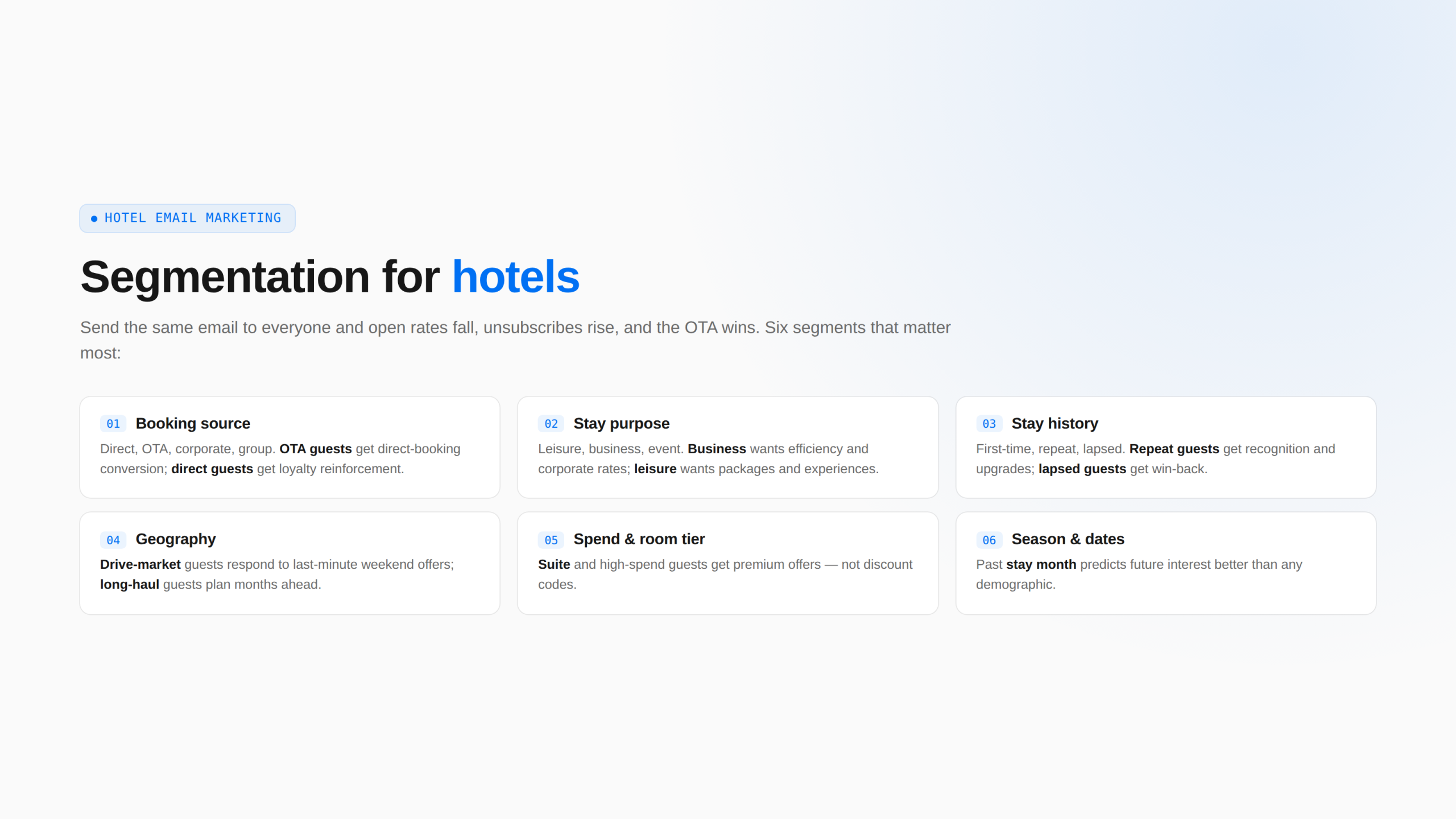
Send the same email to everyone and open rates fall, unsubscribes rise, and the OTA wins. The segments that matter most:
- Booking source: direct, OTA, corporate, group. OTA guests get direct-booking conversion messages; direct guests get loyalty reinforcement.
- Stay purpose: leisure, business, event. Business travellers want efficiency and corporate rates; leisure guests want packages and experiences.
- Stay history: first-time, repeat, lapsed. Repeat guests get recognition and upgrades; lapsed guests get win-back.
- Geography: drive-market guests respond to last-minute weekend offers; long-haul guests plan months ahead.
- Spend and room tier: suite guests and high-spend guests get premium offers, not discount codes.
- Season and dates: past stay month predicts future interest better than any demographic.
Most of this data lives in the PMS. The integration between PMS or booking engine and the email platform (direct, via Zapier, or via a scheduled export) is the single most valuable technical setup a hotel can do.
Compliance and Deliverability for Hotels
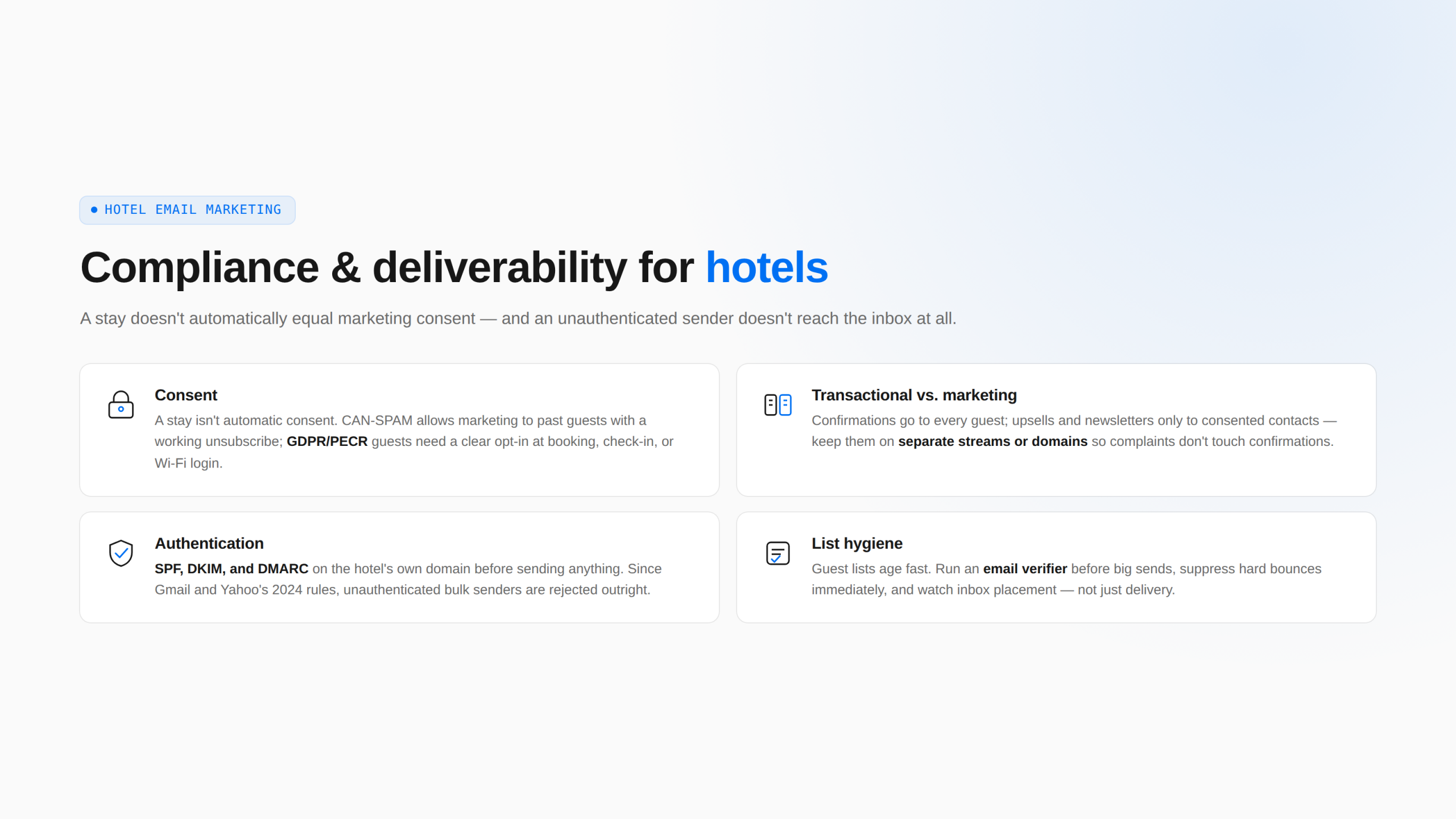
Consent. A stay doesn’t automatically equal marketing consent. In the US, CAN-SPAM allows marketing to past customers with a working unsubscribe, but hotels with EU or UK guests fall under GDPR and PECR, where a clear opt-in at booking or check-in is the safe route. Capture consent at the booking engine, the check-in form, and the Wi-Fi login, and record the source.
Transactional versus marketing. Confirmations, pre-arrival logistics, and receipts are transactional and can go to every guest. Upsells, packages, and newsletters are marketing and go only to consented contacts. Many hotels send both from the same platform; keep them on separate streams or sending domains so a marketing complaint spike doesn’t affect confirmations.
Authentication. Set up SPF, DKIM, and DMARC on the hotel’s own domain before sending anything. Since the 2024 Gmail and Yahoo sender requirements, bulk senders without authentication and one-click unsubscribe are rejected outright. Our SPF, DKIM and DMARC guide walks through the records.
List hygiene. Guest lists age fast: people change jobs and addresses. Run the list through an email verifier before big sends and suppress hard bounces immediately; our hard bounce vs soft bounce post explains which to remove. Watch inbox placement, not just delivery; a seasonal offer that lands in Promotions on the week it matters is money lost.
Hotel Email Marketing Best Practices
- Automate the guest journey first, newsletters second. Pre-arrival, post-stay, and win-back automations produce more bookings per hour of setup than any campaign calendar.
- Lead with the direct-booking advantage. Every marketing email to a past guest should make the case for booking direct: best rate, flexible cancellation, perks the OTA can’t offer.
- Personalise with stay data. Room type, dates, and past spend are more persuasive than a first name.
- Time offers to booking windows. Send summer packages when your data says summer bookings start, not in summer.
- Use imagery, but keep emails light. Hotel emails are visual, but a 3 MB email lands in spam. Compress images and keep the file under 100 KB.
- Make the CTA a booking, not a browse. Deep-link to the booking engine with dates and rate pre-filled where possible.
- Test subject lines and send times. A/B test one variable per send; hotel audiences vary widely by market.
- Respect frequency. Two to four marketing emails a month for most properties. Lapsed guests get fewer.
- Capture emails at every touchpoint. Booking engine, check-in, Wi-Fi, restaurant reservations, events, spa.
- Close the loop with reviews. The post-stay review request should feed your reputation channels, and positive reviewers are your best rebooking segment.
Common Mistakes Hotels Make With Email
- Mailing OTA guests without consent. Legal risk and high complaint rates. Capture consent at check-in.
- One list, one message. A single monthly newsletter to the whole database underperforms every segmented alternative.
- Ignoring abandoned bookings. The most intent-rich audience a hotel has, often left unmailed because the booking engine and email platform aren’t connected.
- Discounting by default. Rate integrity matters; add value (breakfast, late checkout, upgrade) before cutting price.
- Sending from a third-party or unauthenticated domain. Confirmations from a booking-engine subdomain and marketing from a generic domain confuse guests and inbox providers alike.
- No win-back programme. Guests who haven’t stayed in two years are still cheaper to win than strangers.
- Measuring opens. Since Apple Mail Privacy Protection, opens are unreliable; measure clicks, bookings, and revenue per send.
Tools and Platforms for Hotel Email Marketing
Hotels generally choose between a hospitality-specific CRM (Revinate, Cendyn, and similar, which integrate deeply with the PMS and are priced accordingly) and a general email platform connected to the PMS or booking engine through an integration or export. For independent and small-group properties, the general platform route is usually more affordable and nearly as capable once the integration is set up.
| Platform | Best For | Free Plan | Starting Price | Why for hotels |
|---|---|---|---|---|
| Mailercloud#1 Pick | Independent hotels & small groups | ✓ Yes 1,000 contacts | $10/mo | Automations, AMP upgrade offers, Inbox Tracker, verifier at low cost |
| Mailchimp | Widest booking-engine integrations | ✓ Yes 250 contacts | $13/mo | Native PMS/booking connectors; journey builder on Standard |
| Brevo | Email + SMS for arrival day | ✓ Yes 300/day | ~$9/mo | Unlimited contacts, SMS and WhatsApp; automation on Standard |
| Constant Contact | Simplicity + phone support | ✗ Trial Free trial | $12/mo | Event tools; automation limited until Premium ($80/mo) |
| Revinate / Cendyn | Larger properties & groups | ✗ No Custom | Custom | Deep PMS integration, guest profiles, upsell engines |
Pricing verified September 13–14, 2026 on each platform’s official pricing page, monthly billing unless noted.
Mailercloud
Mailercloud fits independent hotels and small groups that want the guest-journey automations above without hospitality-CRM pricing: free for 1,000 contacts and 12,000 emails a month, then $10/month for 5,000 contacts with unlimited sends. The visual automation builder handles pre-arrival, post-stay, and win-back sequences with date-based and behavioural triggers; segmentation and tagging cover booking source and stay history once the PMS export is mapped; and AMP for Email lets you put a room-upgrade selector or a quick pre-arrival survey inside the email itself. Inbox Tracker shows whether a seasonal offer landed in the inbox or Promotions across Gmail, Outlook, and Yahoo, and the built-in email verifier cleans ageing guest lists. Transactional confirmations can run through the separate Email API.
Limitations: there’s no native PMS or booking-engine integration, so hotels connect through Zapier, Make, or scheduled CSV exports; the integration library is smaller than Mailchimp’s; and native SMS is still in development, which matters for same-day arrival messages.
✅Mailercloud Pros:
- Free for 1,000 contacts and 12,000 emails/month; $10/month for 5,000 contacts with unlimited sends — a fraction of hospitality-CRM pricing
- Visual automation builder with date and behaviour triggers for pre-arrival, post-stay, and win-back sequences
- Segmentation and tagging for booking source, stay purpose, and stay history from a PMS export
- AMP for Email for in-email upgrade selectors and pre-arrival surveys
- Inbox Tracker shows whether seasonal offers land in the inbox or Promotions
- Built-in email verifier for ageing guest lists
- Separate Email API for confirmations and transactional mail
- 24/7 live chat support
❌Mailercloud Cons:
- No native PMS or booking-engine integration — connect via Zapier, Make, or CSV export
- Smaller integration library than Mailchimp
- Native SMS still in development (arrival-day messages need a separate tool)
💰Pricing: Free for up to 1,000 contacts. Premium from $10/month (5,000 contacts, unlimited sends).
Mailchimp
Mailchimp’s advantage for hotels is integrations: many booking engines and PMS vendors offer native Mailchimp connectors, and its journey builder is solid on Standard ($20/month at 500 contacts). Pricing climbs quickly with list size, and it bills for unsubscribed contacts unless archived, which matters for large guest databases.
Brevo
Brevo bundles email with SMS and WhatsApp, useful for arrival-day messages, and prices by email volume with unlimited contacts, which suits hotels with large, infrequently mailed guest lists. Automation and A/B testing arrive on the Standard plan; the free plan’s 300-a-day cap rules it out for real sends.
Constant Contact
Constant Contact is common among smaller hospitality businesses for its simplicity, event tools, and phone support on every plan. Automation beyond templates requires the Premium plan ($80/month), and there’s no free tier.
Hospitality CRMs (Revinate, Cendyn, Guestfolio)
Purpose-built for hotels, with deep PMS integration, guest profiles, upsell engines, and reputation tools. They’re the right choice for larger properties and groups with the budget and the data volume; pricing is typically custom and starts well above general platforms.
Hotel Email Metrics and Benchmarks
Track per campaign and per automation:
- Click-through rate: the primary engagement signal now that opens are unreliable. Automated guest-journey emails typically see far higher CTR than newsletters.
- Direct bookings and revenue attributed to email: through UTM-tagged booking-engine links. This is the number that justifies the programme.
- Revenue per email sent: total attributed revenue ÷ emails sent, per automation.
- Upsell conversion: pre-arrival upgrade offers accepted ÷ offers sent.
- Review conversion: reviews posted ÷ post-stay requests sent.
- Win-back rate: lapsed guests who rebook ÷ win-back emails sent.
- List growth and consent rate: new opted-in contacts per month by source (booking engine, check-in, Wi-Fi).
- Unsubscribe and complaint rates: under 0.5% and 0.1% respectively; a complaint spike usually means OTA guests were mailed without consent.
- Inbox placement: the share of mail reaching the inbox, where your platform reports it.
Industry benchmark reports from Mailchimp, Constant Contact, and Campaign Monitor publish travel and hospitality averages each year; use them as context, but benchmark against your own numbers first.
How to Get Started: A 7-Step Plan
- Audit your data. What the PMS and booking engine hold, what consent you have, and how to export it.
- Pick a platform and connect it. Native integration, Zapier/Make, or a weekly CSV export mapped to tags.
- Authenticate your domain. SPF, DKIM, DMARC, and one-click unsubscribe before the first send.
- Build three automations. Pre-arrival (three emails), post-stay (thank-you, review request, rebooking offer), and win-back (three emails).
- Set up capture. Consent-first forms on the booking engine, check-in, and Wi-Fi.
- Send one segmented campaign a month. By stay purpose or season, not to the whole list.
- Report on bookings. UTM every booking link and review revenue per automation monthly.
Frequently Asked Questions
What is hotel email marketing?
Hotel email marketing is the use of email across the guest lifecycle, from booking through arrival, stay, departure, and return, to increase direct bookings, upsell services, earn reviews, and bring past guests back, using stay data from the property management system to time and personalise messages.
How can hotels increase direct bookings with email?
Hotels increase direct bookings with email by capturing guest addresses at every touchpoint, running an abandoned-booking automation, sending post-stay rebooking offers that beat OTA rates through value rather than discounts, and giving past guests a members-only reason to book on the hotel’s own site next time.
What emails should a hotel send to guests?
A hotel should send a booking confirmation, a pre-arrival series (logistics, upgrade offers, check-in link), an optional mid-stay check-in, a post-stay thank-you and review request, a rebooking offer two to four weeks after departure, seasonal segmented campaigns, and a win-back series for guests who haven’t stayed in 12–18 months.
Can hotels email guests who booked through an OTA?
Hotels can send transactional emails (confirmations, arrival information) to OTA guests, but marketing email requires consent: under CAN-SPAM a past customer relationship with a working unsubscribe is generally sufficient in the US, while GDPR and PECR require a clear opt-in for EU and UK guests. Capture consent at booking, check-in, or Wi-Fi login and record the source.
How often should hotels send marketing emails?
Most hotels should send two to four marketing emails a month to engaged, consented guests, with automations (pre-arrival, post-stay, win-back) running in addition based on each guest’s dates. Lapsed guests should receive fewer messages, and frequency should be reduced for any segment whose unsubscribe rate rises above 0.5%.
What is the best email marketing platform for hotels?
The best platform depends on size: large properties and groups typically use a hospitality CRM with deep PMS integration, while independent hotels get most of the value from a general platform connected to the booking engine. Mailercloud suits independents with its $10/month pricing, automation builder, Inbox Tracker, and AMP for Email; Mailchimp has the widest native booking-engine integrations; Brevo adds SMS for arrival-day messages.
How do hotels measure email marketing success?
Hotels measure email success by direct bookings and revenue attributed to email through UTM-tagged booking links, revenue per email sent for each automation, upsell and review conversion rates, list growth by consent source, and unsubscribe, complaint, and inbox-placement rates, rather than open rates, which have been unreliable since Apple Mail Privacy Protection.
Summary
Hotel email marketing pays for itself the first time a past guest books direct instead of through an OTA. Build the guest-journey automations first (abandoned booking, pre-arrival, post-stay, win-back), segment by booking source and stay history, capture consent at every touchpoint, authenticate your domain, and measure bookings rather than opens. The platform matters less than the PMS connection and the automations; pick one that can run them at a price that leaves the commission savings in your pocket.

As a Marketing Director, I develop and implement marketing strategies, conduct market research, and manage a team of marketing professionals. With a successful track record of launching campaigns that drive revenue growth, I bring my marketing expertise to blog writing, creating engaging content that promotes the brand and its products/services.