Last updated: September 2026 | 15 min read
An insurance policy renews once a year, and the customer thinks about it roughly twice: when the renewal notice arrives and when something goes wrong. Everything in between is where policies are lost to a cheaper quote, cross-sell opportunities go unclaimed, and referrals never happen. Insurance email marketing in 2026 is the discipline of being useful in that gap: renewal sequences that start early enough to matter, cross-sell offers triggered by life events and policy data, claims-journey communication that turns a bad day into a retained customer, and lead nurture for the quotes that didn’t close.
This guide covers how independent agents, brokerages, agencies, and carriers build a compliant email programme that retains policyholders, increases policies per household, and converts quotes: what to send across the policy lifecycle, segmentation by line and life stage, the compliance framework (CAN-SPAM, state insurance advertising rules, GLBA, TCPA for texts), the platforms that connect to agency management systems, and the metrics that tie email to retention. It’s vendor-neutral, with one tools section near the end. It is not legal advice; confirm your obligations with compliance.
Quick Answer: Insurance email marketing is permission-based email across the policy lifecycle: instant quote follow-up and nurture, new-policy onboarding, a renewal sequence starting 60 days out, cross-sell triggered by policy data and life events, claims-journey communication, annual review invitations, and win-back — all within CAN-SPAM, state insurance advertising rules, GLBA (keep policy details out of marketing email), and TCPA for texts. Segment by line, renewal month, and policies per household from the AMS, send from the agent on an authenticated domain, and measure retention, policies per household, and quote-to-bind rather than opens.
Table of Contents
What Insurance Email Marketing Is
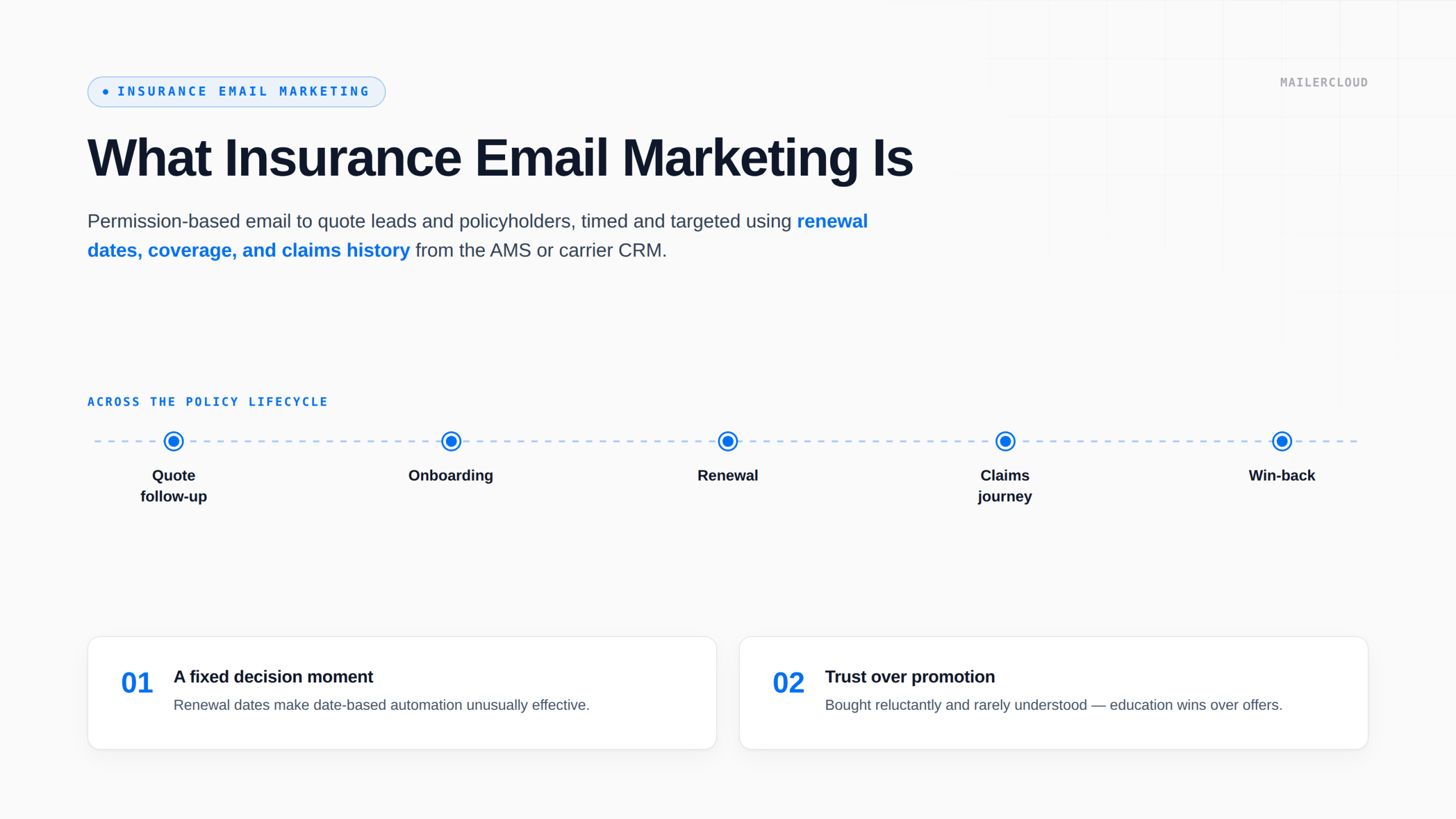
Insurance email marketing is permission-based email to quote leads, policyholders, lapsed customers, and referral partners across the policy lifecycle: quote follow-up and nurture, new-policy onboarding, renewal sequences, cross-sell and life-event offers, claims-journey communication, annual reviews, educational content, and win-back of lapsed policyholders. It draws on data in the agency management system (AMS) or carrier CRM (policy type, effective and renewal dates, coverage, household composition, claims history, life events captured at review) to time and target messages.
It’s distinct from other financial-services email in two ways. Renewal dates give every customer a fixed, known moment of decision, which makes date-based automation unusually effective. And the product is bought reluctantly and rarely understood, so education and trust drive results more than promotion.
Why Email Works in Insurance
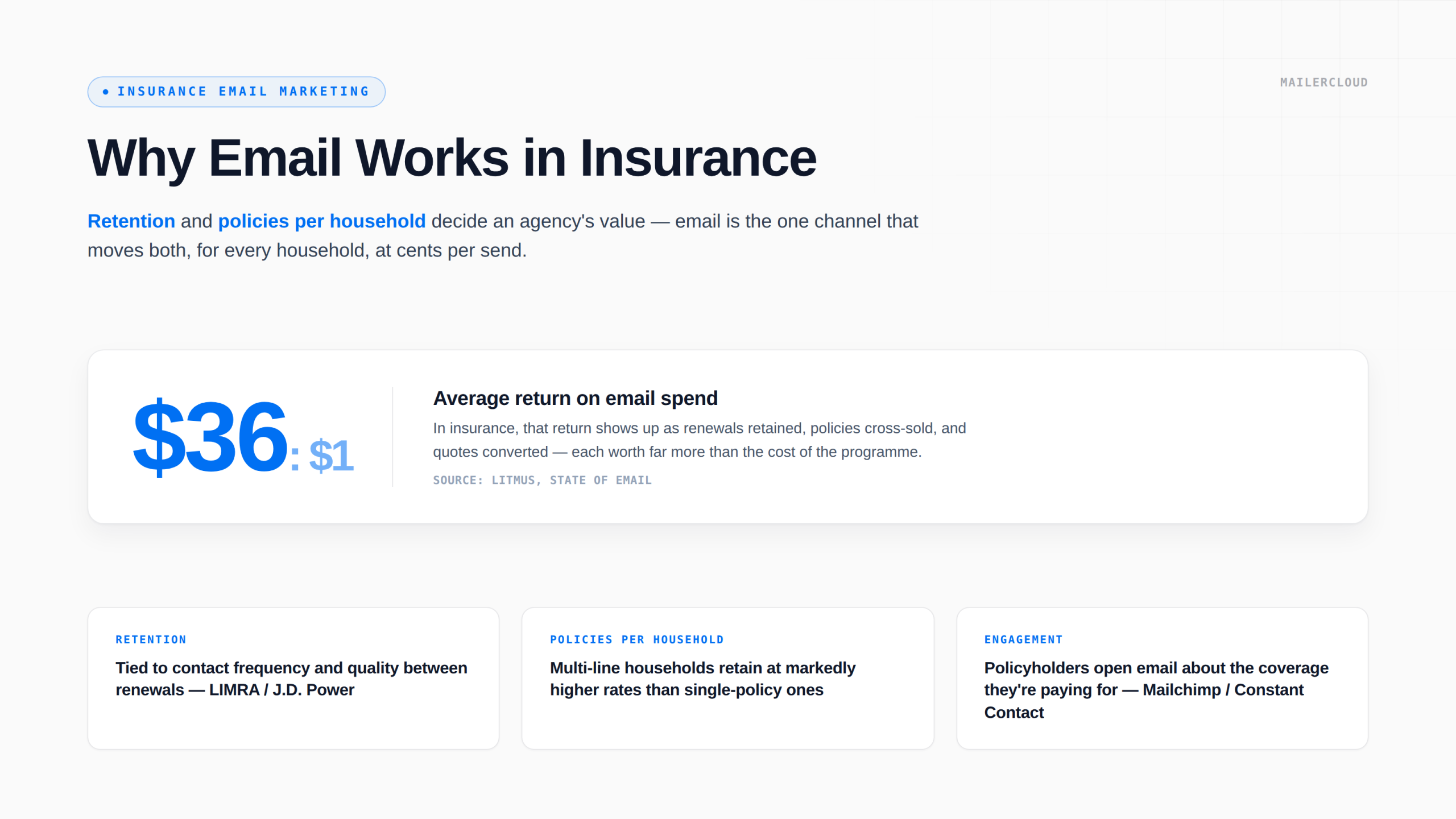
Retention and policies per household are the two numbers that decide an agency’s value, and email moves both. Industry research from groups like LIMRA and J.D. Power has consistently linked customer retention in insurance to the frequency and quality of contact between renewals, and to the number of policies a household holds; multi-line households retain at markedly higher rates than single-policy ones. Email is the only channel that can deliver that contact to every household at a cost of cents.
Litmus’s State of Email research puts email’s return at roughly $36 per $1 spent across industries; in insurance the return is measured in renewals retained, cross-sold policies, and quotes converted, each worth far more than the cost of the programme. Benchmark reports from Mailchimp and Constant Contact have placed insurance among the sectors with solid engagement, because policyholders open messages about coverage they’re paying for.
Compliance First: The Rules That Govern Insurance Email
CAN-SPAM. Accurate headers and subject lines, a physical address, a working unsubscribe honoured within ten business days, and no sending to opted-out contacts. Applies to all marketing email; renewal notices, policy documents, and claims communications are transactional.
State insurance advertising rules. Every state regulates insurance advertising, typically based on NAIC model rules: advertisements must not be misleading, must identify the insurer and licensed agent, may require licence numbers and specific disclosures on certain products (life, annuities, Medicare-related), and carrier-provided materials often need carrier approval before use. Many states also restrict comparative statements about competitors. Check your state’s rules and your carriers’ advertising guidelines before sending, and keep an approval record.
Gramm-Leach-Bliley Act (GLBA). Governs how financial institutions, including insurers and agencies, handle customers’ non-public personal information. Keep policy details, premiums, and claims information out of marketing email content and out of the marketing platform’s data where possible; use the AMS for triggers and pass only the minimum needed (name, email, renewal month, line of business).
TCPA. Marketing texts and calls require prior express written consent. Email lists don’t carry SMS consent; collect it separately.
HIPAA. Health and Medicare-related lines may involve protected health information; treat those communications under the healthcare rules and route PHI through compliant systems.
Do-not-contact and opt-out management. Honour unsubscribes across all marketing streams, and suppress claimants, litigants, and anyone whose details came from a claim rather than a customer relationship.
A one-time compliance review of your email templates and footer (agency name, licence, address, unsubscribe, required disclosures) prevents most problems.
The Policy Lifecycle: What to Send and When
Quote leads
Instant quote follow-up. Within minutes of a web or referral quote request: acknowledgement, what happens next, a link to book a call or complete the application. Automate the send.
Quote nurture. Five to seven emails over three weeks for quotes that didn’t bind: how to compare coverage (not just price), what the quote includes, a customer story, a bundling incentive, a final “your quote expires” message.
Long-term lead nurture. Monthly for leads who didn’t convert: seasonal coverage topics, a rate-check offer around their current policy’s likely renewal, life-event prompts.
New policyholders
Welcome and onboarding. Day 0: welcome, policy documents access, how to reach the agent, what’s covered in plain language. Week 1: app or portal setup, ID cards, how claims work. Month 1: a check-in and a cross-sell introduction (what else the household might need).
Active policyholders
Renewal sequence. 60, 30, and 14 days before renewal: what’s changing, a review offer, a reminder of coverage value, and a direct line to the agent. For auto-renewing policies, the sequence is about retention and review; for policies that require action, it’s about completion. Starting at 60 days is what beats the competitor’s quote.
Cross-sell by trigger. Home policyholders without auto (and the reverse), renters who buy a home, new drivers in the household, a business owner without umbrella cover. Triggered by AMS data and life events captured at review.
Life-event prompts. Marriage, new child, new home, new car, new business, retirement: each has coverage implications and a natural email.
Annual review invitation. Once a year, ideally 90 days before the largest policy’s renewal: a coverage review that surfaces gaps and cross-sell.
Educational content. Monthly or quarterly: seasonal risks (storms, freezes, wildfire), coverage explainers, claims tips, discounts they may qualify for. This is what keeps the agency’s name familiar between renewals.
Referral prompts. After a positive claims experience, a renewal, or a review: ask, with a reward where state rules allow (many states restrict rebating; check before offering incentives).
Claims
Claims-journey communication. Acknowledgement, what to expect, adjuster contact, status updates, and a post-claim check-in. Transactional, and the single biggest driver of whether a customer renews after a claim.
Lapsed and cancelled
Win-back. 30, 90, and 180 days after cancellation, and around the anniversary of their old renewal date: a rate check, what’s changed, an easy way to requote.
Segmenting an Insurance Book
- Stage: quote lead, new policyholder, active, renewal window, lapsed.
- Line of business: auto, home, renters, life, health, commercial, specialty. Content, disclosures, and compliance differ by line.
- Renewal month: the segment that drives the renewal sequence.
- Policies per household: single-line versus multi-line, for cross-sell targeting.
- Life stage and life events: from applications and reviews.
- Claims status: open, recent, none, for claims-journey and post-claim messaging.
- Carrier: for carrier-specific offers and approved materials.
- Engagement: clickers, non-openers.
Renewal month, line of business, and policies per household are the three segments that pay fastest, and all three live in the AMS. The AMS-to-email connection (native, via Zapier or a data connector, or a monthly export of the minimum fields) is the foundation of the programme.
Insurance Email Best Practices
- Start renewal sequences at 60 days. Later is too late to beat a competitor’s quote.
- Explain coverage in plain language. Education builds the trust that price alone can’t.
- Cross-sell from data, not blasts. Home-without-auto lists, not “bundle and save” to everyone.
- Send from the agent. A named person, a real reply-to, a phone number.
- Keep policy details out of marketing email. Personalise with name, line, and renewal month; leave premiums and coverage specifics to the portal (GLBA).
- Communicate through claims. The post-claim renewal is decided during the claim.
- Keep the compliant footer on everything. Agency, licence number where required, address, unsubscribe, carrier disclosures.
- Get carrier approval for carrier-branded content. And keep the record.
- Collect SMS consent separately if you text renewal or claims updates.
- Authenticate your domain. SPF, DKIM, and DMARC, so your agency name can’t be spoofed by phishing, which targets insurance customers heavily. Our SPF, DKIM and DMARC guide covers it.
Common Mistakes in Insurance Email
- Renewal notices only. The transactional notice from the carrier isn’t a retention programme.
- Generic newsletters to the whole book. A commercial client gets homeowner storm tips; a renter gets umbrella cover.
- Premiums and policy numbers in marketing email. A GLBA and phishing-imitation problem.
- No claims communication. The moment that decides renewal, left to the adjuster.
- Unapproved carrier content. A compliance finding waiting to happen.
- Buying lead lists. CAN-SPAM violations and state-rule exposure.
- Measuring opens. Unreliable since Apple Mail Privacy Protection; measure renewals, cross-sells, and quotes.
Tools and Platforms for Insurance Email Marketing
Agencies typically use their AMS or an insurance-specific marketing platform (many AMS vendors and insurtech tools offer built-in campaigns, renewal automations, and carrier-approved content libraries) for policy-triggered communications, and a general email platform for designed campaigns, education, events, and lead nurture. Carriers run enterprise marketing platforms with compliance workflows built in. For independent agents and small agencies, a general platform connected to the AMS covers most of the programme at a fraction of the cost.
| Platform | Best For | Free Plan | Starting Price | Why for insurance |
|---|---|---|---|---|
| Mailercloud#1 Pick | Independent agents & small-to-mid agencies | ✓ Yes 1,000 contacts | $10/mo | Renewal and cross-sell automations, roles, forms, Inbox Tracker |
| Mailchimp | AMS & CRM integrations | ✓ Yes 250 contacts | $13/mo | Widest integrations; bills for unsubscribed contacts |
| Constant Contact | Seminars, Medicare events, phone support | ✗ Trial Free trial | $12/mo | Event tools; automation on Premium ($80/mo) |
| Brevo | Email + SMS renewal/claims updates | ✓ Yes 300/day | ~$9/mo | SMS with TCPA consent; unlimited contacts; automation on Standard |
| Applied Epic / HawkSoft / AgencyZoom | Policy-triggered notices from the AMS | ✗ No Per user/agency | Custom | Carrier-approved content, compliance records; lighter email tooling |
Pricing verified September 13–14, 2026 on each platform’s official pricing page, monthly billing unless noted.
Mailercloud
Mailercloud suits independent agents and small-to-mid agencies that want renewal, cross-sell, quote-nurture, and win-back automations on a flat budget: free for 1,000 contacts and 12,000 emails a month, then $10/month for 5,000 contacts with unlimited sends. The visual automation builder runs date-based renewal sequences and attribute-triggered cross-sell once the AMS export is mapped; segmentation handles line, renewal month, and policies per household; user roles let a marketing coordinator send approved campaigns without full access; the signup form builder captures quote requests; and Inbox Tracker shows whether a renewal reminder reached the inbox or Promotions across Gmail, Outlook, and Yahoo, which matters when the competitor’s quote is arriving the same week. Limitations: no native AMS integration (Zapier, Make, or CSV export), no built-in carrier content library or compliance-approval workflow, a smaller integration library than Mailchimp, and native SMS still in development.
✅Mailercloud Pros:
- Free for 1,000 contacts; $10/month for 5,000 contacts with unlimited sends — flat cost for an agency book
- Visual automation builder for 60/30/14-day renewal sequences and data-triggered cross-sell
- Segmentation by line of business, renewal month, and policies per household
- User roles so a coordinator sends approved campaigns without full access
- Signup form builder for quote requests
- Inbox Tracker shows whether renewal reminders reach the inbox the week a competitor’s quote arrives
- Custom sending domain with guided authentication — protects the agency name from phishing imitation
- 24/7 live chat support
❌Mailercloud Cons:
- No native AMS integration (Zapier, Make, or CSV export of minimum fields)
- No carrier content library or compliance-approval workflow
- Smaller integration library than Mailchimp; native SMS still in development
💰Pricing: Free for up to 1,000 contacts. Premium from $10/month (5,000 contacts, unlimited sends).
Mailchimp
Mailchimp integrates with several AMS and CRM tools and has the most familiar interface for agency staff. Pricing rises with book size (Essentials $13/month at 500 contacts) and it bills for unsubscribed contacts unless archived.
Constant Contact
Common among independent agents for simplicity, event tools (seminars, Medicare enrolment events), and phone support on every plan. No free plan; multi-step automation requires Premium at $80/month.
Brevo
Brevo adds SMS (with TCPA consent) for renewal and claims updates, prices by volume with unlimited contacts, and includes a CRM. Automation arrives on Standard.
Insurance-specific platforms and AMS built-ins (Applied Epic, HawkSoft, EZLynx, AgencyZoom, and similar)
Policy-triggered renewal and cross-sell automations, carrier-approved content, and compliance records built in, with pricing per user or per agency. The right core for agencies that want policy data and marketing in one system; email design, segmentation flexibility, and deliverability visibility are usually lighter than a dedicated platform.
Insurance Email Metrics
- Retention rate at renewal: policies renewed ÷ policies up for renewal, split by whether the renewal sequence was received.
- Policies per household: the cross-sell outcome metric, tracked over time.
- Cross-sell conversion: policies bound ÷ triggered cross-sell emails.
- Quote-to-bind rate: bound ÷ quoted, with the nurture sequence’s contribution.
- Win-back rate: requotes and rebinds ÷ win-back emails sent.
- Post-claim retention: renewal rate among customers with a recent claim.
- Click-through and reply rate: engagement signals; opens are unreliable.
- Unsubscribe and complaint rates: under 0.5% and 0.1%.
- Inbox placement: for renewal sequences that must arrive on time.
How to Get Started: A 7-Step Plan
- Review state and carrier advertising rules and build a compliant footer and disclosure set.
- Export the minimum fields from the AMS (name, email, line, renewal month, policies per household, stage), with opt-outs and claimants suppressed.
- Choose a platform and authenticate your domain.
- Build the 60/30/14-day renewal sequence.
- Build one cross-sell automation (home-without-auto or the reverse).
- Add quote nurture and win-back sequences.
- Report retention, policies per household, and quote-to-bind monthly.
Frequently Asked Questions
What is insurance email marketing?
Insurance email marketing is permission-based email to quote leads, policyholders, lapsed customers, and referral partners across the policy lifecycle, using agency management system data to trigger quote nurture, onboarding, 60/30/14-day renewal sequences, data-driven cross-sell, life-event prompts, claims-journey communication, annual review invitations, and win-back, within CAN-SPAM, state advertising, GLBA, and TCPA rules.
What emails should insurance agents send?
Insurance agents should send an instant quote follow-up and nurture sequence, new-policy onboarding, a renewal sequence starting 60 days out, cross-sell offers triggered by policy data and life events, an annual coverage review invitation, seasonal educational content, claims-journey updates, referral prompts after positive moments, and win-back messages to lapsed policyholders.
How do insurance agents improve retention with email?
Insurance agents improve retention with email by starting renewal sequences 60 days before the date so the review happens before a competitor’s quote arrives, communicating throughout the claims journey, increasing policies per household through data-driven cross-sell, and sending useful educational content between renewals so the agency stays familiar.
Is email marketing allowed in insurance?
Yes, email marketing is allowed in insurance when it complies with CAN-SPAM, state insurance advertising rules (based on NAIC models, including agent and insurer identification and product-specific disclosures), carrier advertising guidelines, GLBA restrictions on non-public personal information, and, for texts, the TCPA’s express written consent requirement; check your state’s rules and get carrier approval for carrier-branded content.
Can insurance agents email policy details in marketing emails?
Insurance agents should keep premiums, policy numbers, coverage specifics, and claims details out of marketing emails and out of the marketing platform, because GLBA governs non-public personal information and phishing attacks imitate insurance emails; personalise with name, line of business, and renewal month, and direct customers to the portal for details.
What is the best email marketing platform for insurance agents?
The best email setup for an insurance agency is usually the AMS or an insurance-specific tool for policy-triggered notices paired with a general platform for designed campaigns and nurture; Mailercloud suits independent agents and small agencies at $10/month with renewal and cross-sell automation, segmentation, roles, forms, and Inbox Tracker, Mailchimp offers the widest AMS integrations, and Constant Contact suits agents who want phone support and event tools.
How often should insurance agents email clients?
Insurance agents should email clients with educational content monthly or quarterly, run the renewal sequence at 60, 30, and 14 days for each policy, send cross-sell and life-event emails only when triggered by data, and communicate through every claim; more frequent promotional email to the whole book raises unsubscribes without improving retention.
Summary
Insurance email marketing wins the year between renewals. Start the renewal sequence at 60 days, cross-sell from AMS data rather than blasts, communicate through claims, educate in plain language, and keep policy details out of marketing email. Get the compliant footer and carrier approvals right first, send from the agent on an authenticated domain, connect the AMS, and measure retention, policies per household, and quote-to-bind rather than opens.
Win the year between renewals with email that lands
Get started →Free for 1,000 contacts · No credit card

As a Marketing Director, I develop and implement marketing strategies, conduct market research, and manage a team of marketing professionals. With a successful track record of launching campaigns that drive revenue growth, I bring my marketing expertise to blog writing, creating engaging content that promotes the brand and its products/services.