Last updated: October 2026 | Pricing checked on October 2, 2026 | 9 min read
ZeroBounce is the best-known name in email verification, and it’s a good product. It’s also one of the most expensive. Verifying 10,000 addresses costs $129 on pay-as-you-go. Most alternatives charge $25–$65 for the same job, and several are just as accurate for everyday marketing lists.
We compared eight ZeroBounce alternatives on price at 10,000, 100,000 and 1 million credits, catch-all handling, free credits, integrations and whether credits expire. We also looked at why people choose ZeroBounce in the first place, so you can tell whether you’d miss anything.
Our pick for most marketers is the Mailercloud Email Verifier. It costs $39 for 10,000 credits (or $29/month on a subscription), gives each address a 0–100 Delivery Score, and sits inside the same account you send from. For very large lists, MillionVerifier and DeBounce are cheaper per address.
Quick Answer: The Mailercloud Email Verifier is the best ZeroBounce alternative in 2026 for marketers: $39 for 10,000 credits (ZeroBounce: $129), a 0–100 Delivery Score, 100 free credits and sending from the same account. For very large lists, MillionVerifier ($449 per million) and DeBounce ($750) are cheapest. Choose NeverBounce for CRM auto-sync and Bouncer for EU data hosting.
Table of Contents
Why Look for a ZeroBounce Alternative?
- Price. Pay-as-you-go starts at $39 for 2,000 credits. At 10,000 credits ZeroBounce costs $129, three times the price of most alternatives.
- You pay for tools you may not use. The ZeroBounce ONE subscription (from $99/month) bundles an email finder, inbox placement tests and blacklist monitoring. Great if you use them, expensive if you only validate lists.
- Credit terms. Pay-as-you-go credits don’t expire, but credits on the ONE subscription are tied to keeping the subscription active.
- Two separate tools. You still verify in one app and send from another, so lists move back and forth as CSV files.
Sidenote: What ZeroBounce does well is AI scoring for catch-all addresses and a full deliverability toolkit. If you rely on both, the cheaper alternatives below will feel thinner. If you mainly upload a CSV and download a clean list, you’re overpaying.
Why Verification Matters
Mailbox providers are stricter than they used to be. Google’s email sender guidelines and Yahoo’s sender best practices both tie inbox placement to low bounce and complaint rates. Microsoft added similar requirements for high-volume senders to Outlook. A list full of dead addresses raises your bounce rate. It can also contain spam traps that get you listed on blocklists like Spamhaus.
A verifier connects to each recipient’s mail server over SMTP and checks whether the mailbox exists, without sending an email. It’s the cheapest insurance you can buy for your sender reputation. For the wider picture, read our email deliverability tips.
How We Compared
- Price at 10,000, 100,000 and 1 million credits, from each vendor’s pricing page or slider.
- Result quality: statuses, scores and catch-all handling.
- Free credits to test with.
- Credit expiry and subscription terms.
- Workflow: bulk upload, API, integrations and whether you can send from the same tool.
ZeroBounce Alternatives at a Glance
| Alternative | Best For | 10,000 Credits | Free Credits | Standout |
|---|---|---|---|---|
| MailercloudOur Pick | Verify + send in one place | $39 (or $29/mo) | 100 | 0–100 Delivery Score |
| NeverBounce | CRM auto-sync | $50 | Trial | 80+ integrations |
| Bouncer | GDPR / security reviews | $60 | 100 | EU hosting, SOC 2 |
| Emailable | Free allowance | $60 | 250 | Free unknowns |
| Clearout | Signup forms | $65 | 100 | Form Guard |
| DeBounce | Low price, mid volume | $25 | 100 | Fees included |
| MillionVerifier | Huge lists | $39 | — | $449 per million |
| EmailListVerify | Small budgets | $27 | — | No subscription |
1. Mailercloud Email Verifier — Best Overall ZeroBounce Alternative
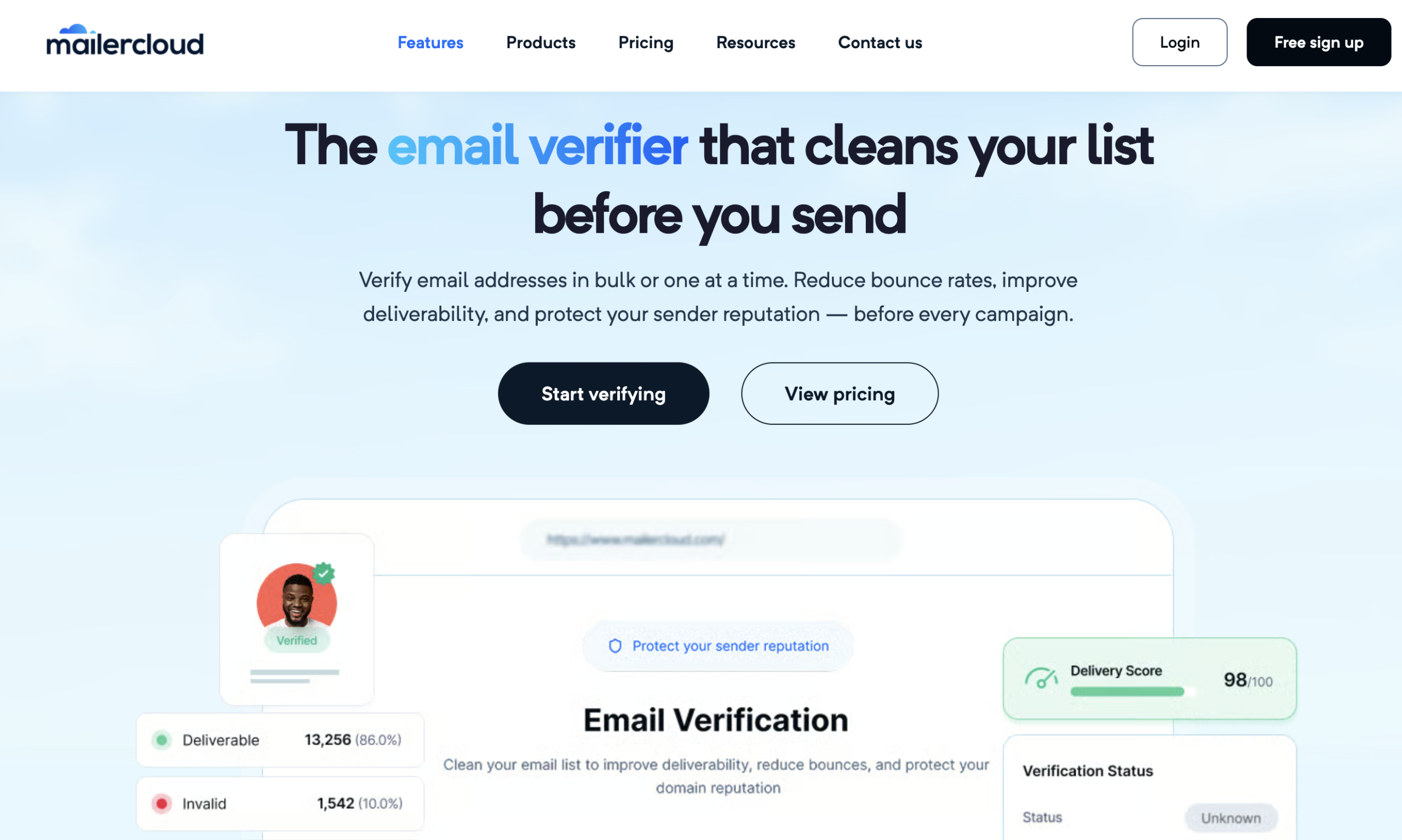
The Mailercloud Email Verifier is the best ZeroBounce alternative for marketers in 2026. It costs $39 for 10,000 credits against ZeroBounce’s $129, and $169 for 100,000 against $649. If you verify every month, subscriptions are cheaper still: $29/month for 10,000 and $799/month for 1 million.
Each address gets a Deliverable, Risky or Invalid status plus a Delivery Score from 0 to 100. That score gives you some of what ZeroBounce’s AI scoring does. You choose a threshold instead of guessing on “risky” results: send to 80+, review 40–79, suppress below 40.
The bigger difference is workflow. The verifier sits inside the same account as Mailercloud’s email marketing platform and Inbox Tracker. You can verify a list, send to it and check inbox placement without exporting a single CSV.
It isn’t a full ZeroBounce replacement. There’s no email finder or blacklist monitor, the API takes 50 addresses per request, and the integration library is smaller.
Key features
- Live SMTP mailbox checks, not just DNS/MX lookups
- Delivery Score 0–100 plus status and reason code
- Bulk upload up to 100 MB (1 million addresses per CSV)
- Quick Verify for up to 50 pasted addresses; REST API
- Duplicate removal within and across files; your columns kept on export
- 100 free credits to start; pay-as-you-go credits never expire
✅Mailercloud Email Verifier Pros:
- $39 for 10,000 credits (ZeroBounce: $129); $169 for 100,000 (ZeroBounce: $649)
- Delivery Score 0–100 on top of Deliverable / Risky / Invalid
- Verify, send and check inbox placement in one account
- Bulk upload up to 100 MB, Quick Verify and REST API on one credit pool
- Pay-as-you-go credits never expire; 100 free credits to start
- Subscriptions from $5/month; $799/month for 1 million
❌Mailercloud Email Verifier Cons:
- No email finder, blacklist monitor or DMARC monitoring
- API takes 50 addresses per request
- Smaller integration library than ZeroBounce
💰Pricing: Pay-as-you-go $39 for 10,000; $169 for 100,000; $999 for 1M. Subscriptions from $5/month.
Best for: Marketers who want verification and sending in one place, with a score rather than a yes/no.
Try the Mailercloud Email Verifier — 100 free credits, then $39 for 10,000. Verify and send from one account.
2. NeverBounce — Best for Automatic CRM Syncing
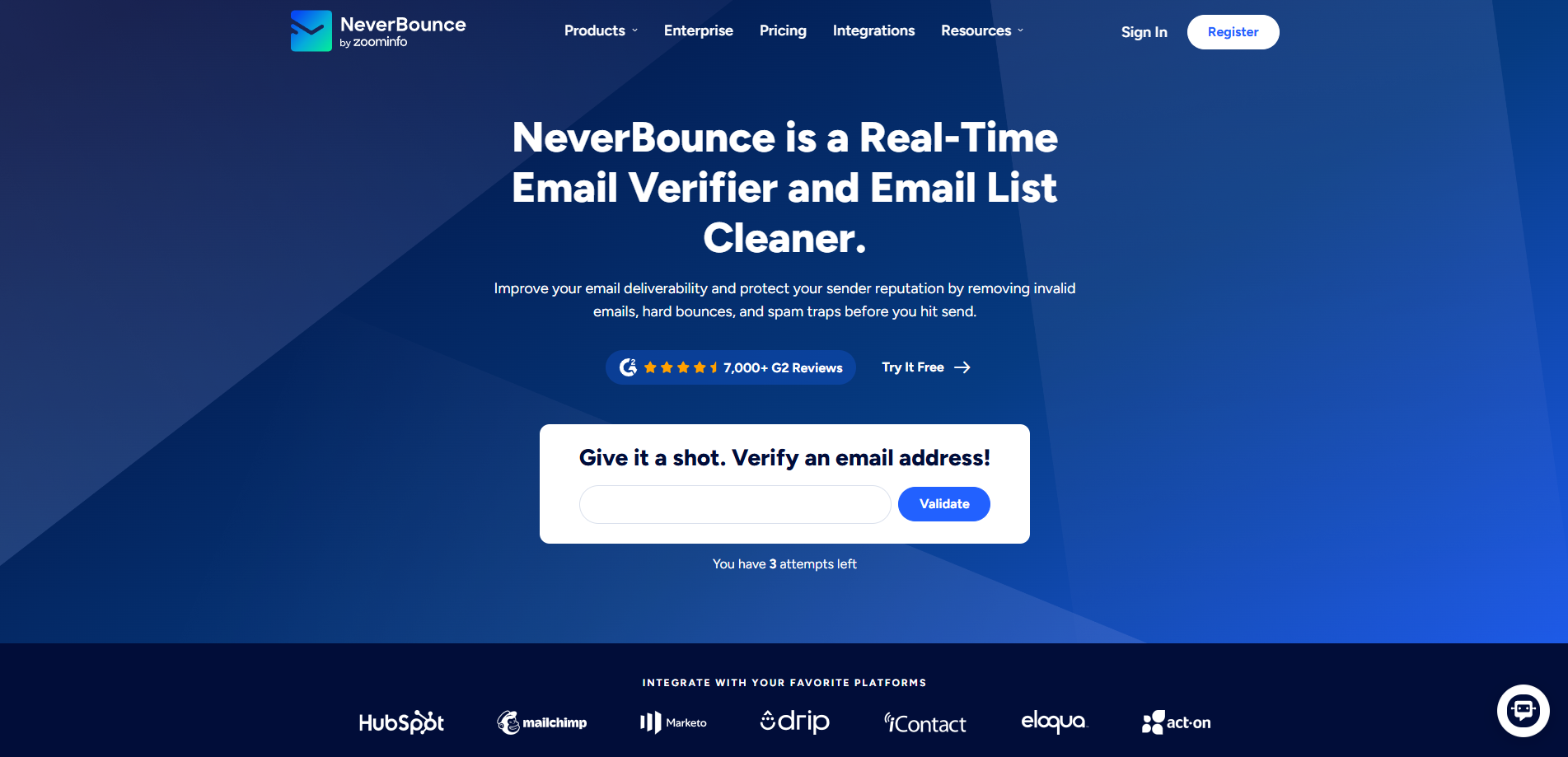
NeverBounce, owned by ZoomInfo, is built to keep connected systems clean. On the Growth plan it syncs with your CRM or email platform on a schedule, so new contacts get verified as they arrive. It lists 80+ integrations.
Typo correction fixes common domain slips such as gmai.com, instead of just marking them invalid. There’s a free trial with no credit card.
Pay-as-you-go costs $8 per 1,000 credits: $50 for 10,000 and $400 for 100,000. It’s the only service here whose credits expire, 12 months after purchase.
✅NeverBounce Pros:
- Auto-sync keeps CRM contacts clean without manual uploads
- 80+ integrations
- Typo correction fixes common domain mistakes
❌NeverBounce Cons:
- Pay-as-you-go credits expire after 12 months
- Auto-sync needs the Growth plan ($49/month)
- No catch-all scoring like ZeroBounce
💰Pricing: $50 for 10,000; $400 for 100,000; $2,500 for 1 million. Growth from $49/month.
Best for: Sales teams that want their CRM verified automatically.
3. Bouncer — Best for GDPR and Security Reviews
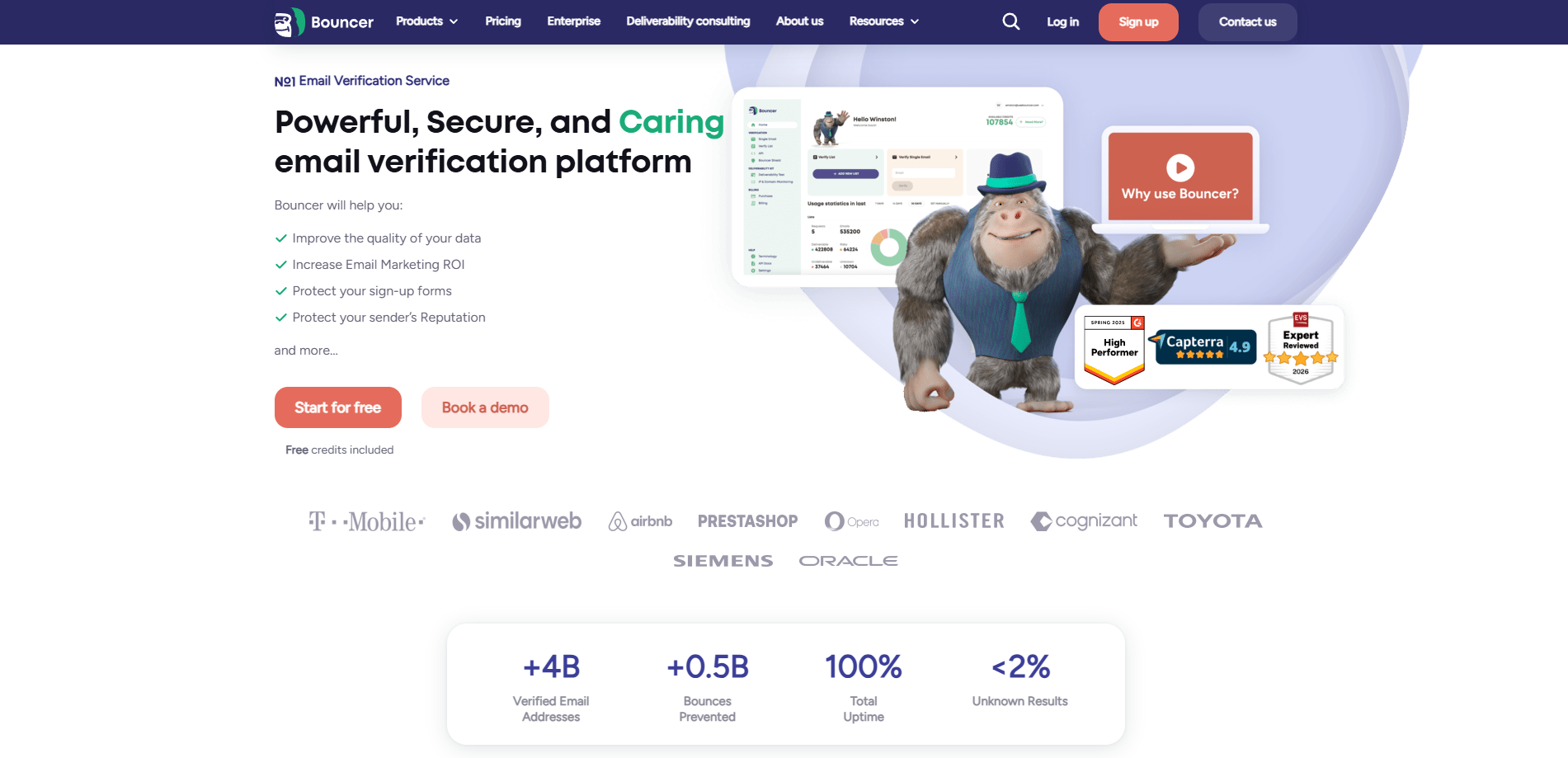
Bouncer is based in Europe. It offers EU data hosting, GDPR compliance and SOC 2 certification, so it passes vendor security reviews that trip up US-only tools. Its toxicity check flags addresses linked to spam traps, litigators and serial complainers.
Pricing is simple and published: $8 for 1,000, $60 for 10,000, $400 for 100,000 and $2,000 for 1 million. Credits never expire. Inbox placement tests are a separate Deliverability Kit from $25/month.
✅Bouncer Pros:
- EU hosting and SOC 2 for strict security reviews
- Toxicity check catches risky-but-valid addresses
- Clear pricing; credits never expire
❌Bouncer Cons:
- More expensive than Mailercloud and MillionVerifier
- Placement testing is a separate paid kit
💰Pricing: $60 for 10,000; $400 for 100,000; $2,000 for 1 million.
Best for: European teams and companies with strict data-location rules.
4. Emailable — Best Free Allowance
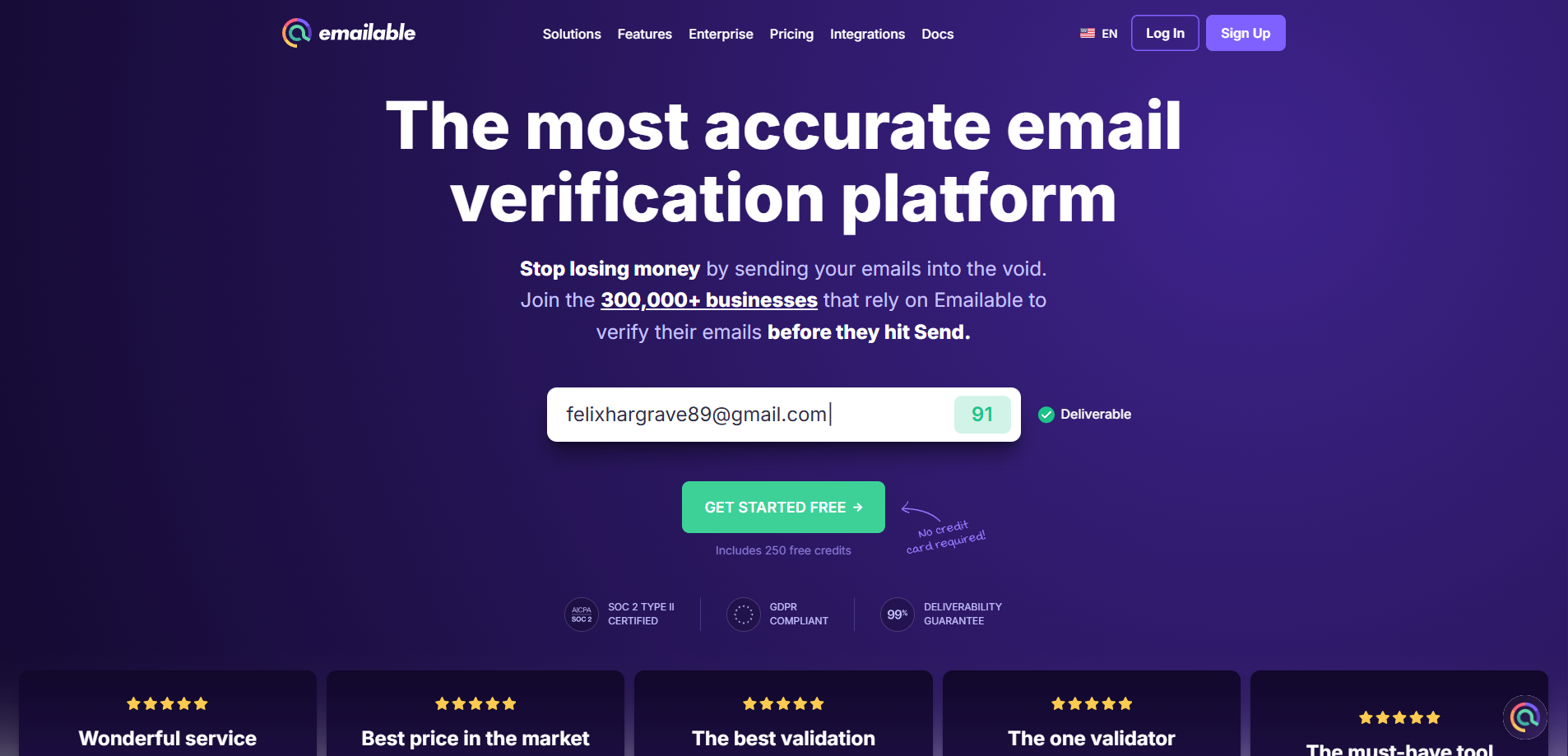
Emailable gives you 250 free credits, the most of any tool here, and doesn’t charge for “unknown” results. The dashboard is fast and clean, with no contracts.
It costs $60 for 10,000, $420 for 100,000 and $2,100 for 1 million on pay-as-you-go. Subscriptions save about 15%. There are no placement tests or monitoring tools.
✅Emailable Pros:
- 250 free credits to test with
- No charge for unknown results
- Credits never expire
❌Emailable Cons:
- $60 for 10,000, well above the budget options
- Verification only; no deliverability toolkit
💰Pricing: $60 for 10,000; $420 for 100,000; $2,100 for 1 million.
Best for: Teams that want to test on a real list before paying.
5. Clearout — Best for Protecting Signup Forms

Clearout’s Form Guard checks addresses as people type them into your signup forms, so bad addresses never reach your list. It also integrates with HubSpot, Google Sheets and many email platforms, and subscription credits roll over.
One-time pricing is $65 for 10,000, $400 for 100,000 and $1,400 for 1 million. New accounts get 100 free credits.
✅Clearout Pros:
- Form Guard blocks fake signups at the source
- Strong integrations, including Google Sheets
- Subscription credits roll over
❌Clearout Cons:
- $65 for 10,000 is higher than most alternatives
- Best rates need a monthly subscription
💰Pricing: $65 for 10,000; $400 for 100,000; $1,400 for 1 million.
Best for: Businesses with lots of form signups and fake entries.
6. DeBounce — Best Low Price at Mid Volume
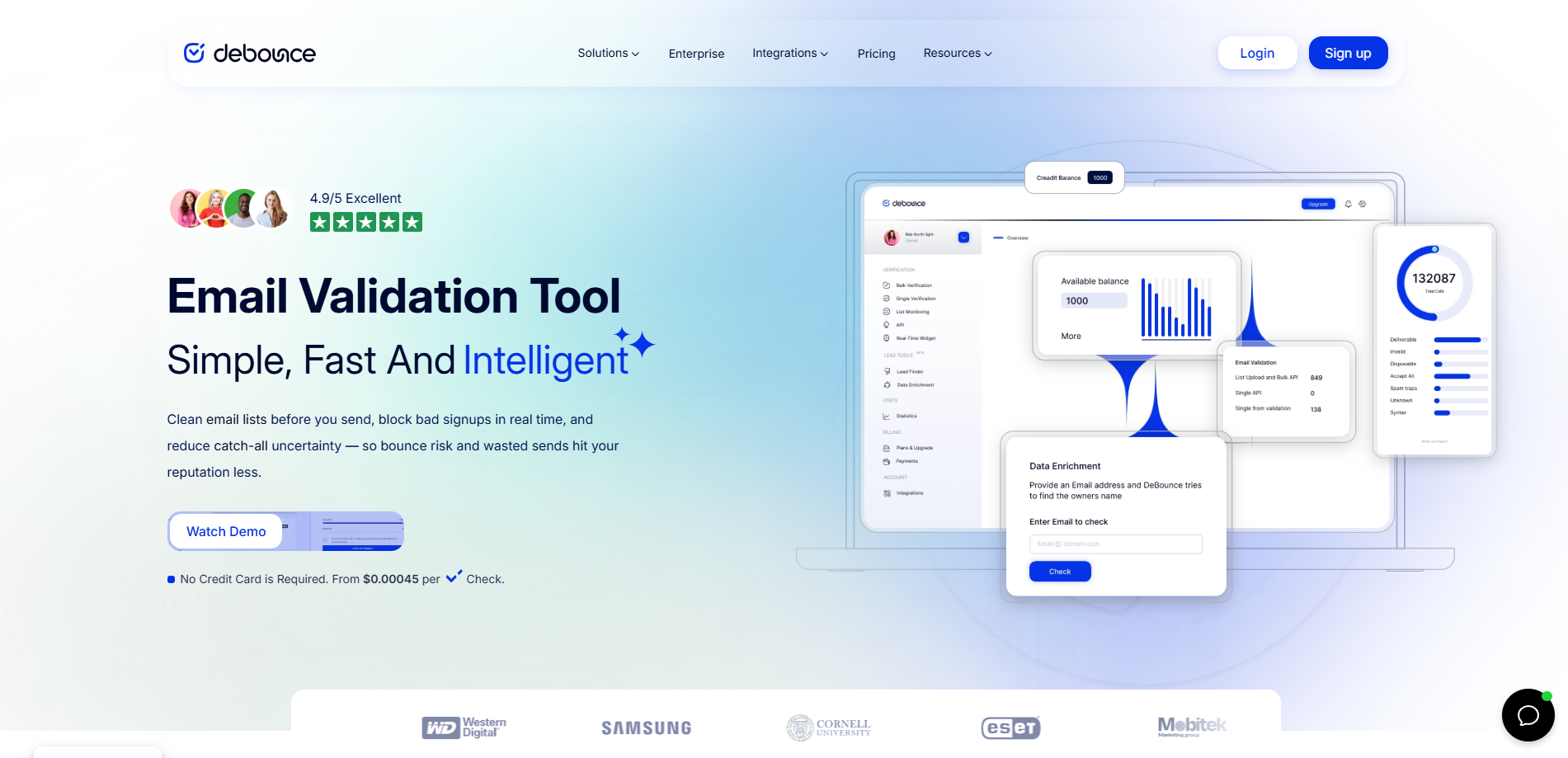
DeBounce is one of the cheapest verifiers at 10,000–100,000 credits: $25 for 10,000 and $135 for 100,000. Taxes and fees are included, the API is free to use, and credits never expire. You get 100 free credits and free deduplication.
The catch is catch-all addresses. Checking them costs 10 credits each, which adds up fast on B2B lists full of company domains.
✅DeBounce Pros:
- Very low price: $25 for 10,000 credits
- Taxes and fees included; credits never expire
- API included at no extra cost
❌DeBounce Cons:
- Catch-all checks cost 10 credits each
- Minimum purchase is 5,000 credits
💰Pricing: $25 for 10,000; $135 for 100,000; $750 for 1 million.
Best for: B2C lists where price per address matters most.
7. MillionVerifier — Cheapest for Very Large Lists
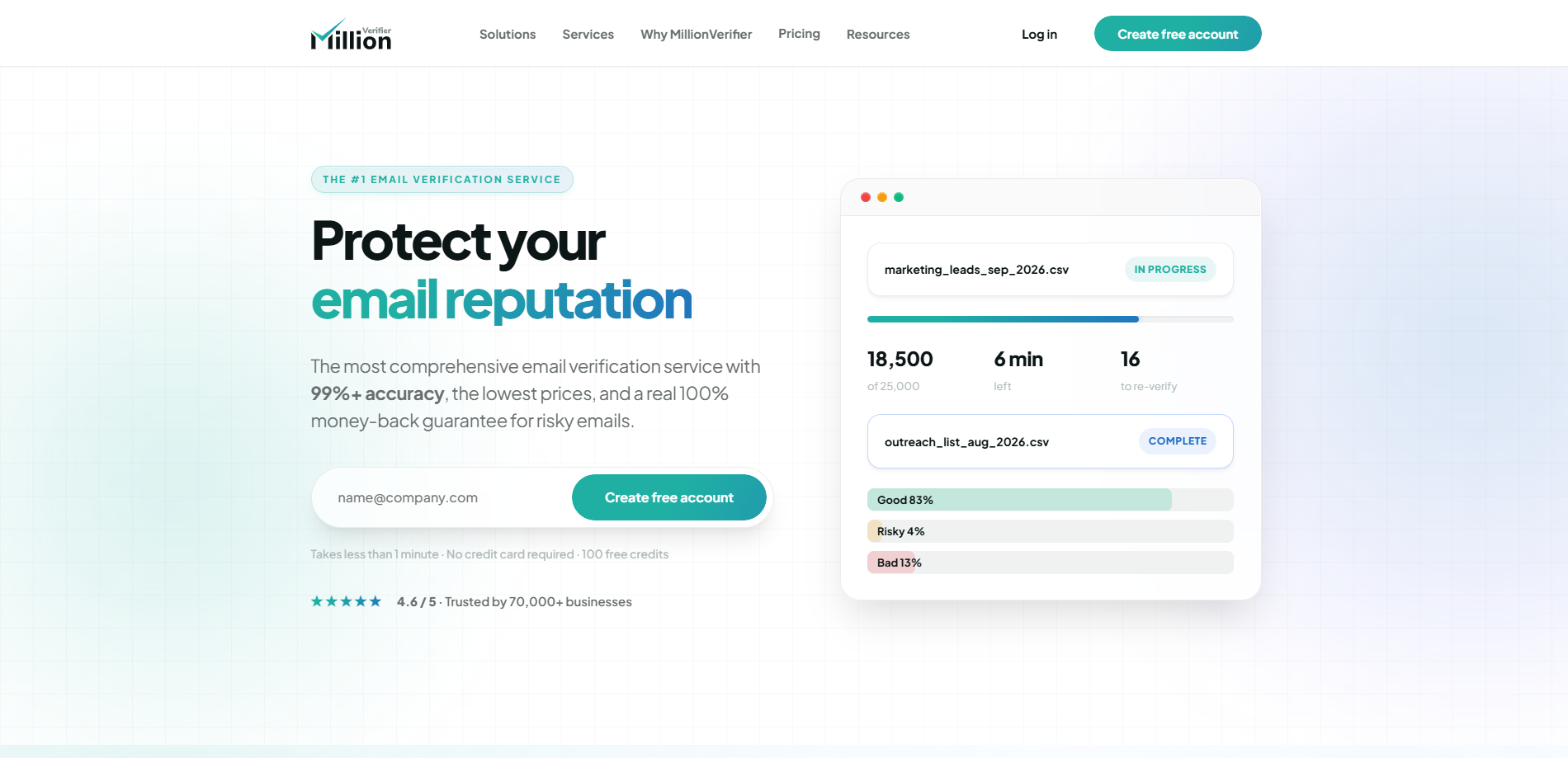
MillionVerifier is the price leader at scale: $449 for 1 million credits, against ZeroBounce’s $3,199. Catch-all checks are included at no extra cost, and it refunds credits for addresses it can’t verify. EverClean keeps connected lists clean automatically.
At 10,000 credits it costs $39, the same as Mailercloud. The interface is basic, and there’s no email finder or placement testing.
✅MillionVerifier Pros:
- Lowest price at 1 million credits ($449)
- Catch-all checks included
- Refunds credits for unverifiable addresses
❌MillionVerifier Cons:
- Basic interface
- No finder, monitoring or placement tests
💰Pricing: $39 for 10,000; $149 for 100,000; $449 for 1 million.
Best for: High-volume senders cleaning lists of 500,000+ addresses.
8. EmailListVerify — Cheapest at Small Volume
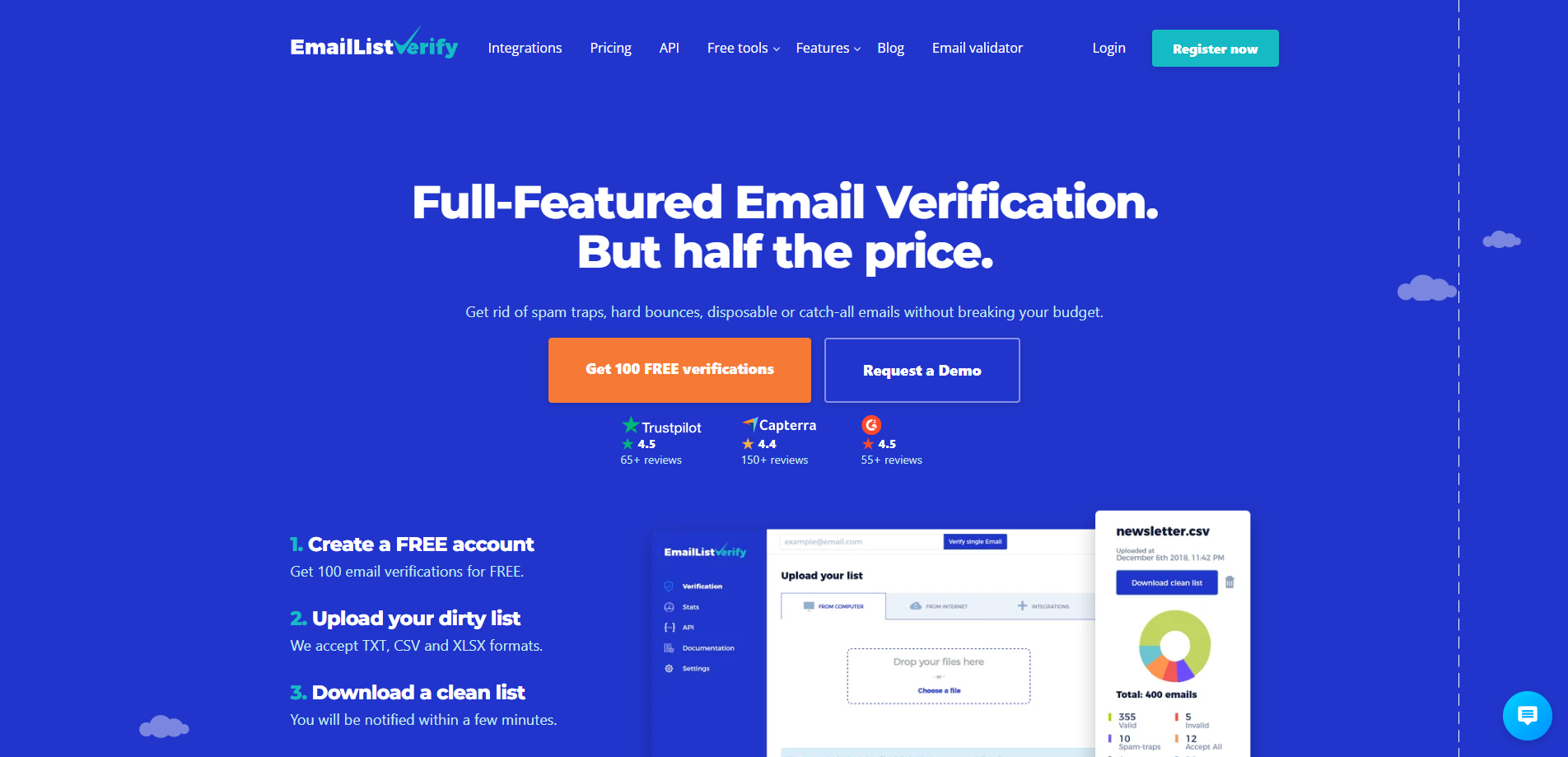
EmailListVerify is one of the cheapest options for small and mid-size lists: $27 for 10,000 and $186 for 100,000 as a one-time purchase. Credits never expire, and the API is included on every plan. Monthly plans start at $25 for 10,000.
It’s a no-frills tool. There’s no delivery score beyond standard statuses, catch-all handling is basic, and the interface feels dated.
✅EmailListVerify Pros:
- $27 for 10,000 credits
- Credits never expire; API included
- No subscription needed
❌EmailListVerify Cons:
- No scoring beyond standard statuses
- Basic catch-all handling; dated interface
💰Pricing: $27 for 10,000; $186 for 100,000 (one-time).
Best for: Small businesses that verify a list a few times a year.
ZeroBounce vs Alternatives: Price at Real Volumes
One-time (pay-as-you-go) prices from each vendor’s pricing page on September 30, 2026.
| Service | 10,000 | 100,000 | 1 million | Credits expire? |
|---|---|---|---|---|
| ZeroBounce (for reference) | $129 | $649 | $3,199 | No (PAYG) |
| Mailercloud | $39 (or $29/mo) | $169 (or $129/mo) | $999 (or $799/mo) | Never (PAYG) |
| DeBounce | $25 | $135 | $750 | Never |
| EmailListVerify | $27 | $186 | Contact sales | Never |
| MillionVerifier | $39 | $149 | $449 | Never |
| NeverBounce | $50 | $400 | $2,500 | After 12 months |
| Bouncer | $60 | $400 | $2,000 | Never |
| Emailable | $60 | $420 | $2,100 | Never |
| Clearout | $65 | $400 | $1,400 | Never |
At 100,000 addresses, switching from ZeroBounce to Mailercloud saves $480 per clean-up. If you clean quarterly, that’s close to $2,000 a year.
The Mailercloud View: Verify at the Moments That Matter
Most teams verify once a year, after a bad bounce rate. That’s the most expensive way to do it. We recommend three checkpoints instead:
- At signup. Check addresses in real time through the API, so typos and fake addresses never enter your list.
- Before any big send. Verify segments you haven’t emailed in 90 days before a launch or promotion.
- After an import. Verify every list you import from events, partners or an old tool.
Then watch the results. Keep bounces under 2% and spam complaints under 0.3%, and monitor your domain in Google Postmaster Tools. If you want a broader view of list care, read our guide to email list cleaning services.
How to Choose
- You verify and send from the same team: Mailercloud, to keep lists in one place.
- You need CRM auto-sync: NeverBounce (see how bounce codes are reported in our SMTP 5.7.x bounce codes guide).
- You have strict data-location rules: Bouncer.
- You clean huge lists: MillionVerifier or DeBounce.
- You want the full deliverability toolkit: stay with ZeroBounce ONE if you actually use the finder, monitors and placement tests.
For a wider comparison that includes ZeroBounce itself, see our list of the best email verification services.
Frequently Asked Questions
What is the best alternative to ZeroBounce?
The Mailercloud Email Verifier is the best ZeroBounce alternative for marketers in 2026. It costs $39 for 10,000 credits against ZeroBounce’s $129, adds a 0–100 Delivery Score, and lets you verify and send from one account. MillionVerifier is cheapest for million-plus lists.
Is there anything cheaper than ZeroBounce?
Yes. Every service we tested is cheaper than ZeroBounce at 10,000 credits. DeBounce ($25), EmailListVerify ($27), Mailercloud ($39) and MillionVerifier ($39) cost well under a third of ZeroBounce’s $129.
Is ZeroBounce more accurate than its alternatives?
For standard valid/invalid checks, the leading tools perform similarly. ZeroBounce’s main advantage is AI scoring for catch-all and unknown addresses. Mailercloud’s 0–100 Delivery Score and Bouncer’s toxicity check cover part of that need.
Which ZeroBounce alternative has free credits?
Emailable offers 250 free credits. Mailercloud, Bouncer, Clearout and DeBounce offer 100 each. ZeroBounce’s Freemium plan also gives 100 credits a month.
Do email verification credits expire?
Pay-as-you-go credits never expire on Mailercloud, Bouncer, Emailable, DeBounce, MillionVerifier or EmailListVerify. NeverBounce credits expire after 12 months.
What is the difference between verification and list cleaning?
Verification checks whether each address exists. List cleaning also removes inactive subscribers who no longer open. You need both: verification protects your bounce rate, and cleaning protects engagement. See our guide on hard vs soft bounces for what each bounce type means.
Final Verdict
ZeroBounce is excellent if you use its full toolkit, but most teams only need clean lists. Mailercloud gives you accurate SMTP verification, a 0–100 Delivery Score and sending in one account for $39 per 10,000 credits, a third of ZeroBounce’s price. Choose MillionVerifier or DeBounce for very large lists, NeverBounce for CRM sync and Bouncer for EU data hosting.
Pay $39, not $129, to clean 10,000 addresses — try Mailercloud free
★★★★★ 4.5/5 on G2, Capterra & Trustpilot · Trusted by 35,000+ businesses
100 free credits · No credit card · Credits never expire

An SEO expert with a focus on on-page optimization, technical SEO, and keyword research. Dedicated to helping businesses improve search rankings and grow their online presence through data-driven strategies.