Last updated: June 2026 · Tested by our editorial team using real subscriber lists and live campaigns
ActiveCampaign and HubSpot both blend email marketing with CRM and automation, but they target different buyers. ActiveCampaign is the automation specialist that small and mid-size teams choose for powerful workflows at a fair price. HubSpot is the all-in-one growth suite that larger, well-funded teams adopt to run marketing, sales, and service from one platform.
We built the same automations and pipelines in both to compare real capability and total cost in 2026.
Below is our full 8-round breakdown with a winner each round and a running score. The Quick Answer and final scoreboard summarize it if you are short on time.
Quick Answer: HubSpot wins more capability rounds while ActiveCampaign wins on automation and value. HubSpot leads on CRM depth, ease of use, reporting, and integrations; ActiveCampaign leads on automation power per dollar and total cost. For most small and mid-size teams whose priority is affordable, advanced automation, ActiveCampaign is the better-value choice. For teams that need one platform for marketing, sales, and service with enterprise reporting, HubSpot is worth the higher price.
Table of Contents
ActiveCampaign vs HubSpot: At a Glance
| Feature | ActiveCampaign | HubSpot |
|---|---|---|
| Starting Price | $15/mo (Starter) | $0 free CRM; paid Marketing from ~$20/mo* |
| Best For | SMB automation | Larger all-in-one teams |
| Automation | Deepest, best value | Powerful but pricier |
| CRM | Included, sales-focused | Full Sales + Service hubs |
| Reporting | Strong | Enterprise-grade |
| Free Plan | 14-day trial | Free CRM tier |
| Ease of Use | Moderate | Polished |
| Cost at Scale | Lower | Climbs steeply |
| Support | Email + Chat; phone on higher tiers | Tiered; premium on higher hubs |
Pricing verified 2026. *HubSpot Marketing paid tiers add contacts and remove branding; enterprise pricing is much higher.
Round 1: Automation and Workflows
Winner: ActiveCampaign

ActiveCampaign is built around automation and it shows. The workflow builder supports deep conditional logic, goal tracking, split testing inside automations, and site and event tracking, all on relatively affordable tiers.
HubSpot’s workflows are powerful and well-designed, but the most advanced automation sits in higher-cost tiers. For raw automation capability per dollar, ActiveCampaign wins.
Round 2: CRM and Sales Features
Winner: HubSpot

HubSpot’s CRM is a full sales platform with deal pipelines, sequences, call logging, quotes, and a free CRM tier that scales into robust Sales and Service hubs.
ActiveCampaign includes a capable sales CRM that suits small teams, but it does not match HubSpot’s depth across sales and service. HubSpot wins CRM breadth.
Round 3: Email Marketing and Templates
Winner: Tie
Both offer solid email builders, templates, and personalization. ActiveCampaign’s emails are flexible and automation-aware; HubSpot’s are polished and tightly integrated with its CRM data.
For everyday email marketing the two are close, so we score this round a tie.
Round 4: Ease of Use

Winner: HubSpot
HubSpot is the more polished, approachable platform, with consistent UI across hubs and strong onboarding resources.
ActiveCampaign is powerful but its depth means a steeper learning curve, especially in automations. HubSpot wins ease of use.
Round 5: Reporting and Analytics
Winner: HubSpot
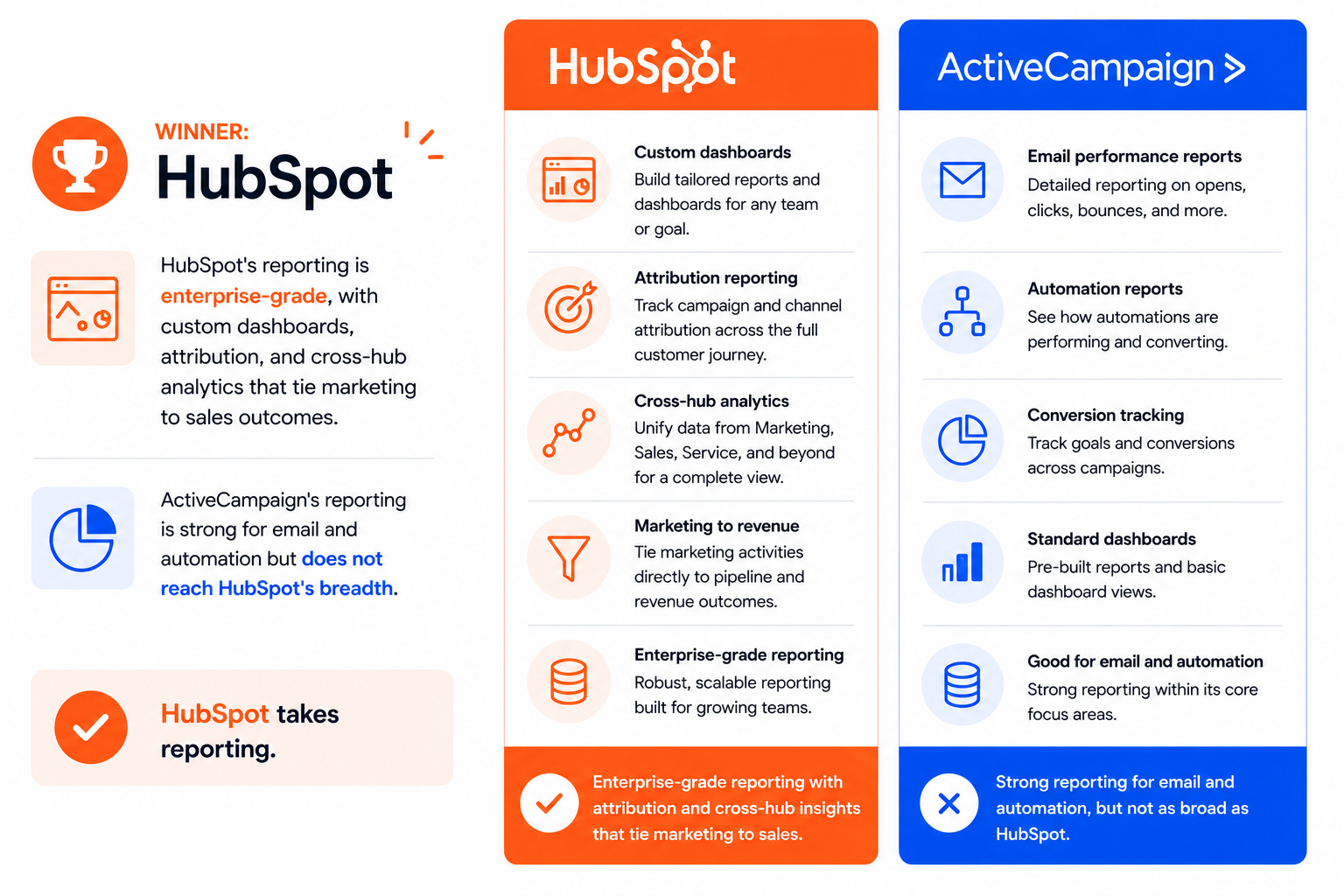
HubSpot’s reporting is enterprise-grade, with custom dashboards, attribution, and cross-hub analytics that tie marketing to sales outcomes.
ActiveCampaign’s reporting is strong for email and automation but does not reach HubSpot’s breadth. HubSpot takes reporting.
Round 6: Deliverability
Winner: Tie
Both platforms post solid inbox placement for senders who authenticate and maintain list hygiene, with results depending more on sender reputation than the tool.
Neither offers a clear per-ISP placement view, so deliverability is a tie.
Round 7: Integrations and Ecosystem
Winner: HubSpot
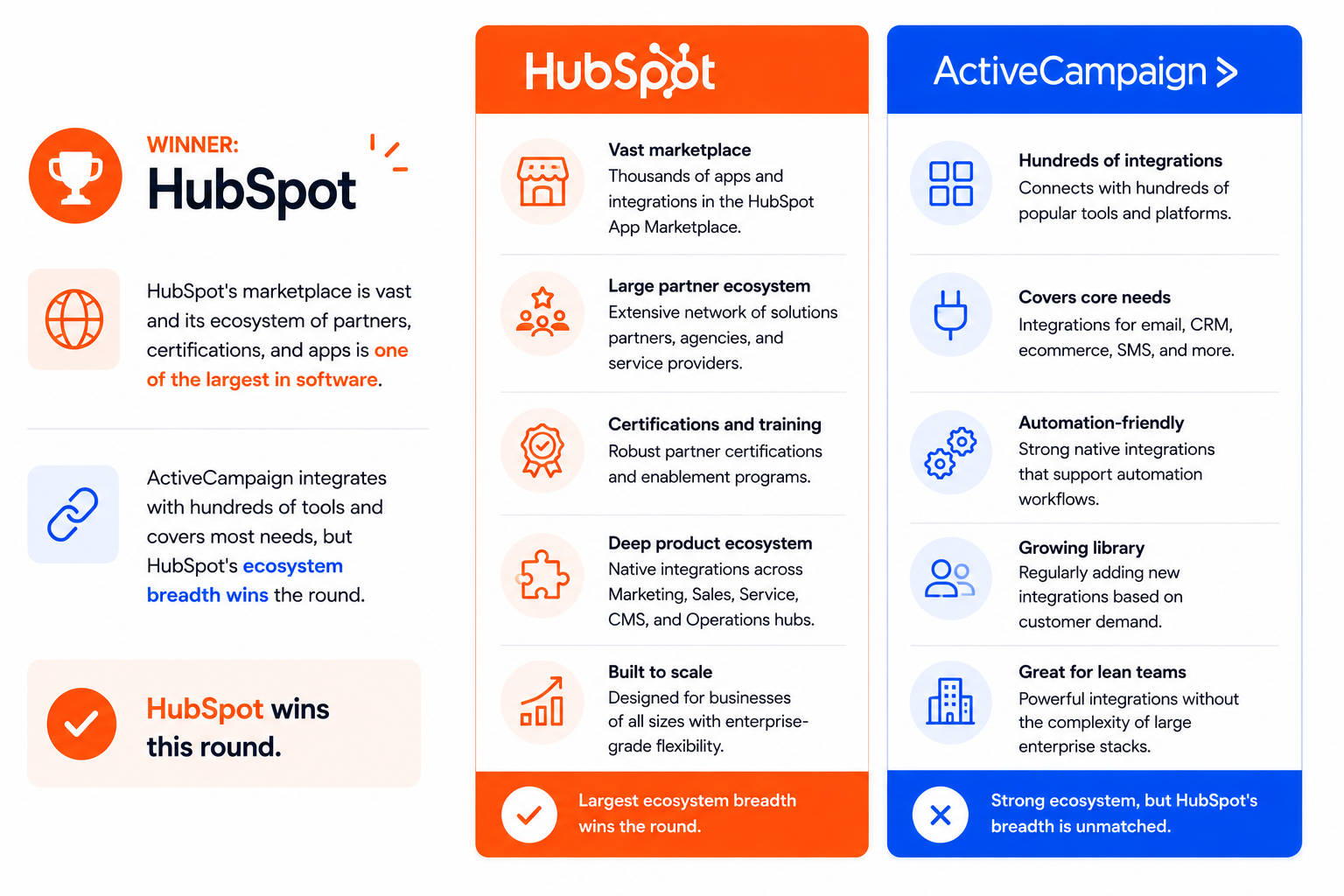
HubSpot’s marketplace is vast and its ecosystem of partners, certifications, and apps is one of the largest in software.
ActiveCampaign integrates with hundreds of tools and covers most needs, but HubSpot’s ecosystem breadth wins the round.
Round 8: Pricing and Value

Winner: ActiveCampaign
ActiveCampaign delivers advanced automation and a CRM at a fraction of HubSpot’s cost, and its pricing stays reasonable as you add contacts.
HubSpot’s free CRM is attractive, but paid marketing tiers and added hubs get expensive quickly, especially at scale and with required onboarding fees on higher plans. For value, ActiveCampaign wins.
Final Scoreboard: HubSpot 4, ActiveCampaign 2 (2 ties)
On head-to-head capability HubSpot edges it, winning CRM, ease of use, reporting, and integrations, while ActiveCampaign takes automation and pricing and two rounds are tied. HubSpot is the more complete platform.
But capability is not the whole story. ActiveCampaign delivers the automation most teams actually use at a fraction of HubSpot’s cost, which makes it the better value for small and mid-size teams. Budget and team size decide this more than the round tally. For audience-specific guidance, see our guides to B2B email marketing and email marketing for small business.
ActiveCampaign Pros and Cons
ActiveCampaign
✓Pros:
- Best-in-class automation with deep conditional logic and goals
- Capable sales CRM included for small teams
- Site and event tracking on affordable tiers
- Much lower cost than HubSpot at scale
- Split testing inside automations
- Hundreds of integrations
✗Cons:
- Steeper learning curve in advanced automations
- No permanent free plan (14-day trial)
- Reporting less broad than HubSpot
- CRM depth trails HubSpot for larger sales teams
💰Pricing: 14-day free trial. Starter starts around $15/month; Plus, Pro, and Enterprise add automation, CRM, and reporting depth; pricing scales with contacts. Verified 2026.
HubSpot Pros and Cons
HubSpot
✓Pros:
- Free CRM tier with strong core features
- Full sales and service hubs alongside marketing
- Enterprise-grade reporting and attribution
- Polished, consistent interface and onboarding
- One of the largest app ecosystems in software
- Scales from startup to enterprise
✗Cons:
- Paid marketing tiers get expensive quickly
- Costs climb steeply as you add hubs and contacts
- Required onboarding fees on higher tiers
- Advanced automation gated behind higher plans
- Can be more platform than a small team needs
💰Pricing: Free CRM available. Paid Marketing tiers start around $20/month* and scale with contacts and hubs; enterprise pricing is substantially higher. Verified 2026.
Which Should You Choose?
Choose ActiveCampaign if:
- You want the deepest marketing automation at an affordable price.
- You are a small or mid-size team that needs powerful workflows plus a light CRM.
- You want site and event tracking without enterprise pricing.
- You care most about automation capability per dollar.
Choose HubSpot if:
- You want one platform for marketing, sales, and service.
- You need enterprise-grade reporting and attribution.
- You value a free CRM that scales into full sales and service hubs.
- You have the budget to invest in an all-in-one growth suite.
Neither feels right?
Both tools in this comparison have real trade-offs — steep pricing as your list grows, features gated behind higher tiers, or paying for contacts who never open your emails. If your main job is email marketing and you want more value for the money, it is worth looking at a third option. For a wider view of the market, see our guide to the best email service providers.
Mailercloud starts at $7/month with a free plan covering 1,000 contacts and 12,000 emails/month — see our pricing. It includes an Inbox Tracker that shows exactly where your emails land across 15+ ISPs, plus AMP for Email, visual automation, A/B testing, segmentation, and 24/7 live chat on every plan, including free. The trade-off is a smaller integration library and lower brand recognition — but for pure email marketing value, it is hard to beat at the price.
How to Switch Between ActiveCampaign and HubSpot
Moving between ActiveCampaign and HubSpot starts with exporting contacts, companies, and deals as CSVs from the source platform, including custom properties and consent status, then importing into the new tool and mapping fields carefully.
Rebuild automations and pipelines next, starting with your highest-impact workflows, and recreate email templates last. Because both tools tie automation to CRM data, validate that contact properties and triggers map correctly before turning workflows live.
FAQ
Is ActiveCampaign better than HubSpot?
ActiveCampaign is better than HubSpot for small and mid-size teams that want deep marketing automation and a capable CRM at a much lower cost. HubSpot is better for teams that need a unified marketing, sales, and service platform with enterprise reporting. The right pick depends on budget and how broad your needs are.
Is ActiveCampaign cheaper than HubSpot?
Yes, ActiveCampaign is generally cheaper than HubSpot, especially at scale. HubSpot offers a free CRM, but its paid marketing tiers, added hubs, and onboarding fees climb quickly. ActiveCampaign delivers advanced automation at a lower total cost for most small and mid-size teams.
Can I migrate from HubSpot to ActiveCampaign?
Yes. Export your HubSpot contacts, companies, and deals as CSVs, import them into ActiveCampaign, and rebuild your automations and pipelines. Map custom properties carefully since both platforms tie workflows to CRM data. Most migrations take a few days depending on complexity.
Does ActiveCampaign have a CRM?
Yes, ActiveCampaign includes a sales CRM with deal pipelines, tasks, and automation, which suits small and mid-size teams. It is capable but does not match HubSpot’s depth across full sales and service hubs, which is built for larger organizations.
What is the main difference between ActiveCampaign and HubSpot?
The main difference is value versus breadth. ActiveCampaign focuses on powerful, affordable marketing automation with a light CRM. HubSpot is an all-in-one platform spanning marketing, sales, and service with enterprise reporting, at a significantly higher cost.
Is there a cheaper alternative to both ActiveCampaign and HubSpot?
Yes. If your primary need is email marketing rather than full CRM, Mailercloud starts at $7/month with a free plan for 1,000 contacts and 12,000 emails per month. Brevo and MailerLite are also worth comparing for lower-cost email and light CRM. You can also compare options in our roundups of the best ActiveCampaign alternatives and the best email marketing software in 2026.
Final Verdict
ActiveCampaign wins this matchup on value, taking the rounds that matter most to small and mid-size teams — advanced automation and price — while HubSpot leads on breadth, CRM depth, and reporting.
Choose ActiveCampaign if you want powerful automation without enterprise pricing, and HubSpot if you need one platform to run marketing, sales, and service together. Budget and team size decide this more than the headline score.

An SEO expert with a focus on on-page optimization, technical SEO, and keyword research. Dedicated to helping businesses improve search rankings and grow their online presence through data-driven strategies.