Last updated: October 2026 | Pricing checked on October 15, 2026 | 9 min read
Omnisend and Mailchimp are two of the most popular email tools for online stores, but they come from different places. Omnisend was built for ecommerce from day one, with email, SMS and push notifications in the same automation flows. Mailchimp is a general marketing platform that added ecommerce features over time and connects to more apps than almost anyone.
We compared them across eight rounds using current plans and prices from both pricing pages, at 1,000, 5,000 and 10,000 contacts.
Quick Answer: Omnisend wins our Omnisend vs Mailchimp comparison 5–3 for online stores. It has prebuilt ecommerce flows, email + SMS + push in one workflow, automation on the free plan and 24/7 support on every plan, and Standard costs $81 at 5,000 contacts vs $100 for Mailchimp Standard. Mailchimp wins on templates, 300+ integrations and use beyond ecommerce.
Table of Contents
Omnisend vs Mailchimp at a Glance
| Omnisend | Mailchimp | |
|---|---|---|
| Built for | Online stores | General business marketing |
| Free plan | 250 contacts, 500 emails, automation included | 250 contacts, 500 emails, no automation |
| ~1,000 contacts | $20 (Standard) | $26.50 Essentials / $45 Standard (1,500) |
| 5,000 contacts | $81 (Standard) | $75 Essentials / $100 Standard |
| 10,000 contacts | $132 (Standard) | $110 Essentials / $135 Standard |
| Ecommerce flows | Prebuilt, quick to launch | Standard plan, more setup |
| SMS & push | Built into flows | SMS add-on in selected countries |
| Integrations | Ecommerce-focused | 300+ native |
| Support | 24/7 chat & email on all plans | 30 days email on free; phone on Premium |
| Our verdict | Winner 5–3 for stores | Best beyond ecommerce |
Round 1: Pricing
Both price by contacts. On monthly billing:
| Contacts | Omnisend Standard | Omnisend Pro | Mailchimp Essentials | Mailchimp Standard |
|---|---|---|---|---|
| 1,000 | $20 | $59 | $26.50 (1,500) | $45 (1,500) |
| 5,000 | $81 | $90 | $75 | $100 |
| 10,000 | $132 | $150 | $110 | $135 |
Omnisend also offers 30% off the first three months if you pay for them upfront.
The fair comparison is Omnisend Standard against Mailchimp Standard, because those are the plans that include full automation. On that basis Omnisend is cheaper at 1,000 and 5,000 contacts and about the same at 10,000. Mailchimp Essentials is cheaper at larger sizes, but it limits automation flows to 4 steps.
Winner: Omnisend.
Round 2: Free Plan
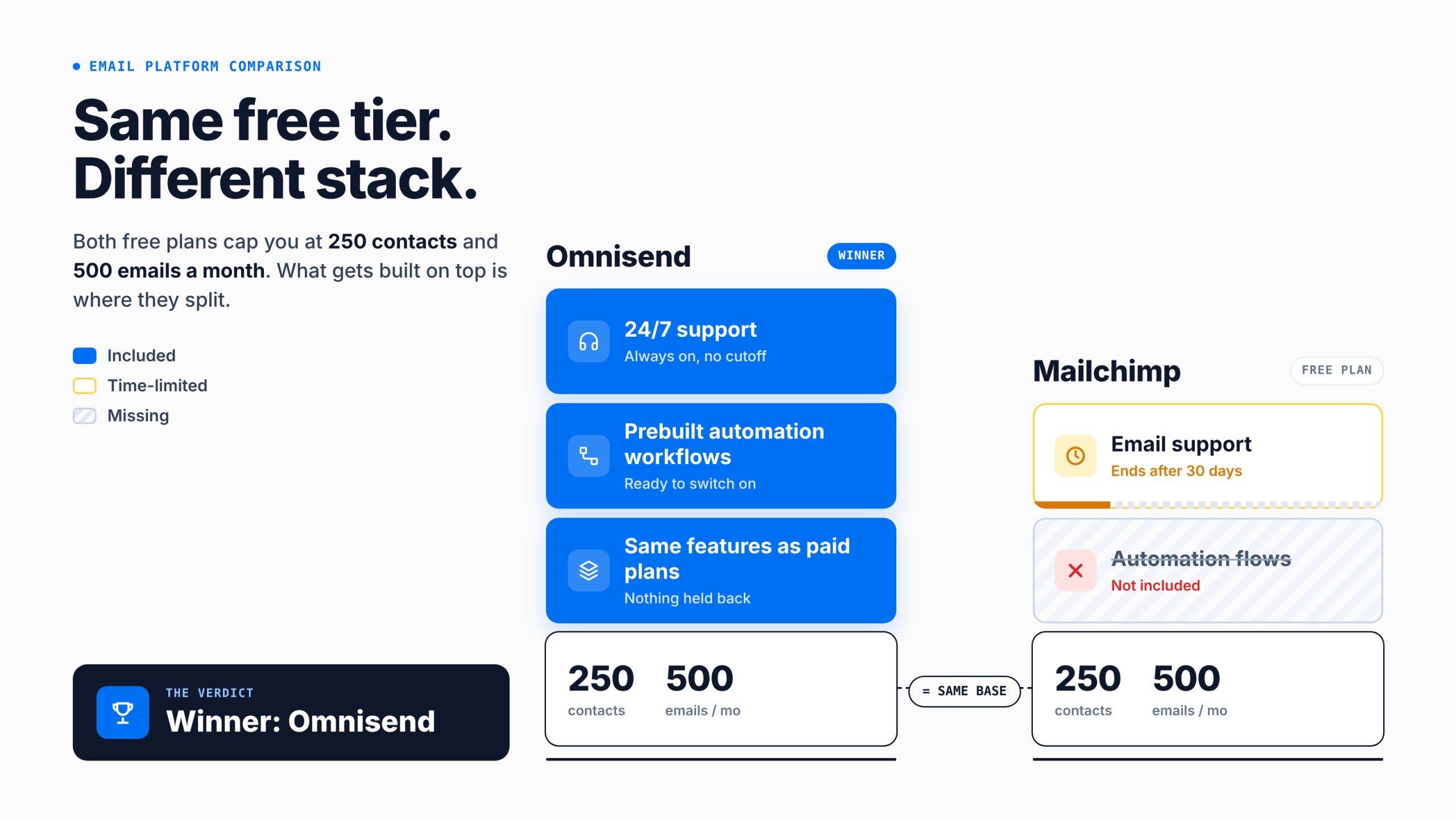
Both free plans cover 250 contacts and 500 emails a month. The difference is what’s inside. Omnisend’s free plan includes the same features as its paid plans, including prebuilt automation workflows, plus 24/7 support. Mailchimp’s free plan has no automation flows, and email support ends after 30 days.
Winner: Omnisend.
Round 3: Ecommerce Automation
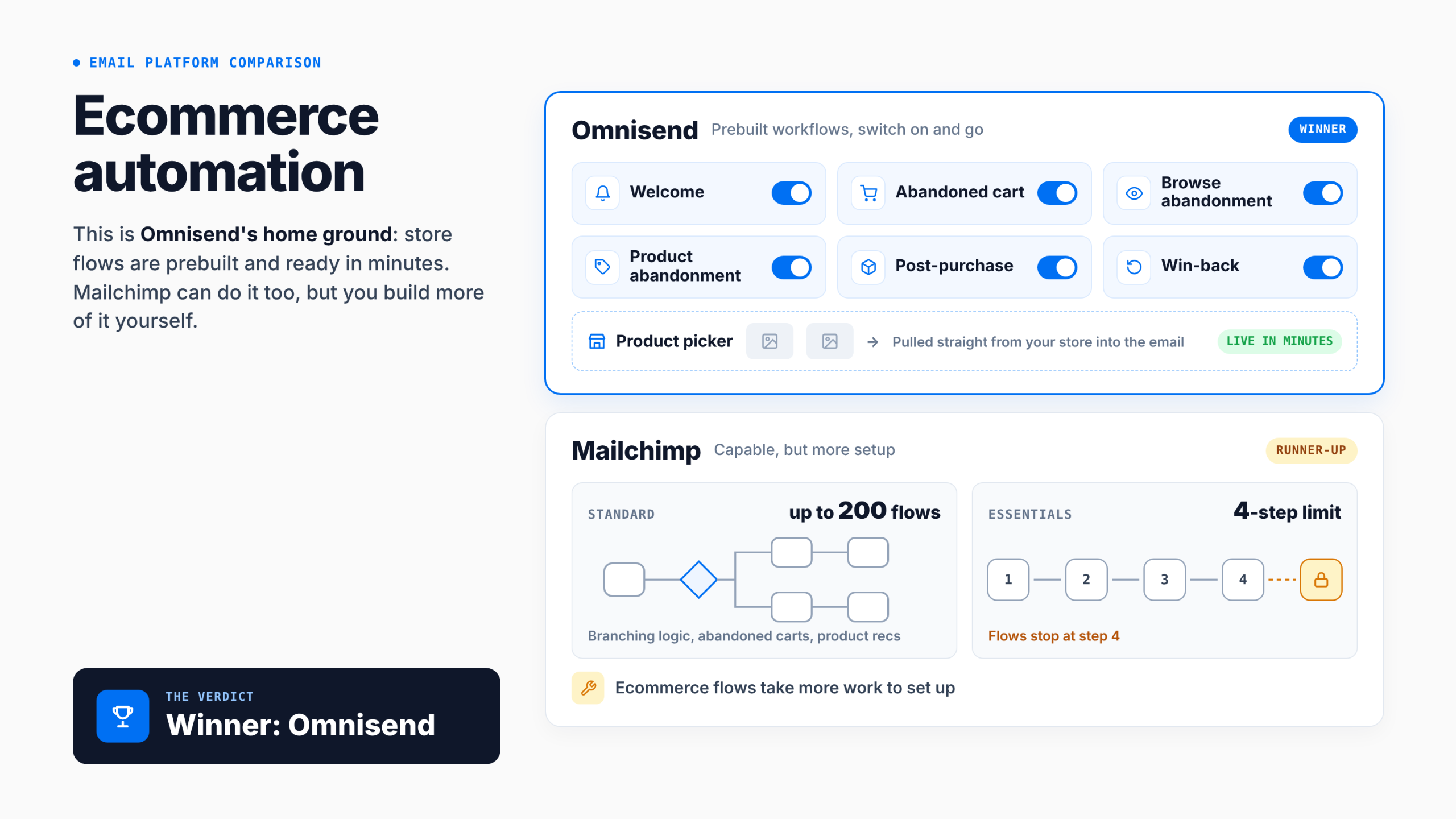
This is Omnisend’s home ground. Prebuilt workflows for welcome, abandoned cart, browse abandonment, product abandonment, post-purchase and win-back are ready to switch on in minutes. Product pickers pull items straight from your store into emails.
Mailchimp has strong automation on Standard, with up to 200 flows and branching logic, and it does handle abandoned carts and product recommendations. But setting up ecommerce flows takes more work, and Essentials limits flows to 4 steps.
For more ideas on what to automate, see our guide to ecommerce marketing automation.
Winner: Omnisend.
Round 4: SMS and Multichannel
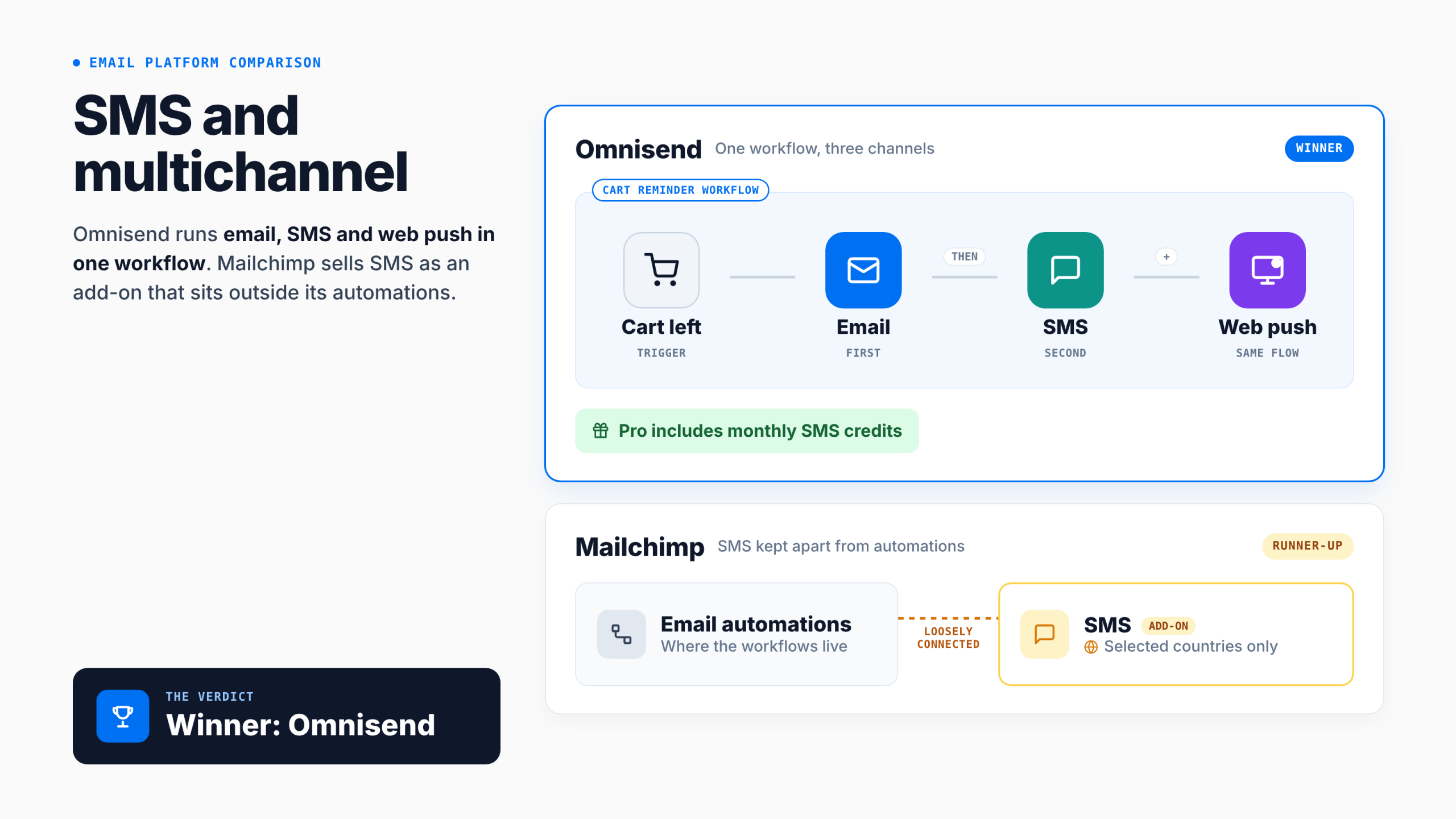
Omnisend puts email, SMS and web push in the same workflow, so a cart reminder can go by email first and SMS second. Pro includes monthly SMS credits. For more ways stores use email, see our guide to email marketing for ecommerce.
Mailchimp offers SMS in selected countries as an add-on, but it’s less tightly built into automations than Omnisend’s.
Winner: Omnisend.
Round 5: Email Editor and Templates
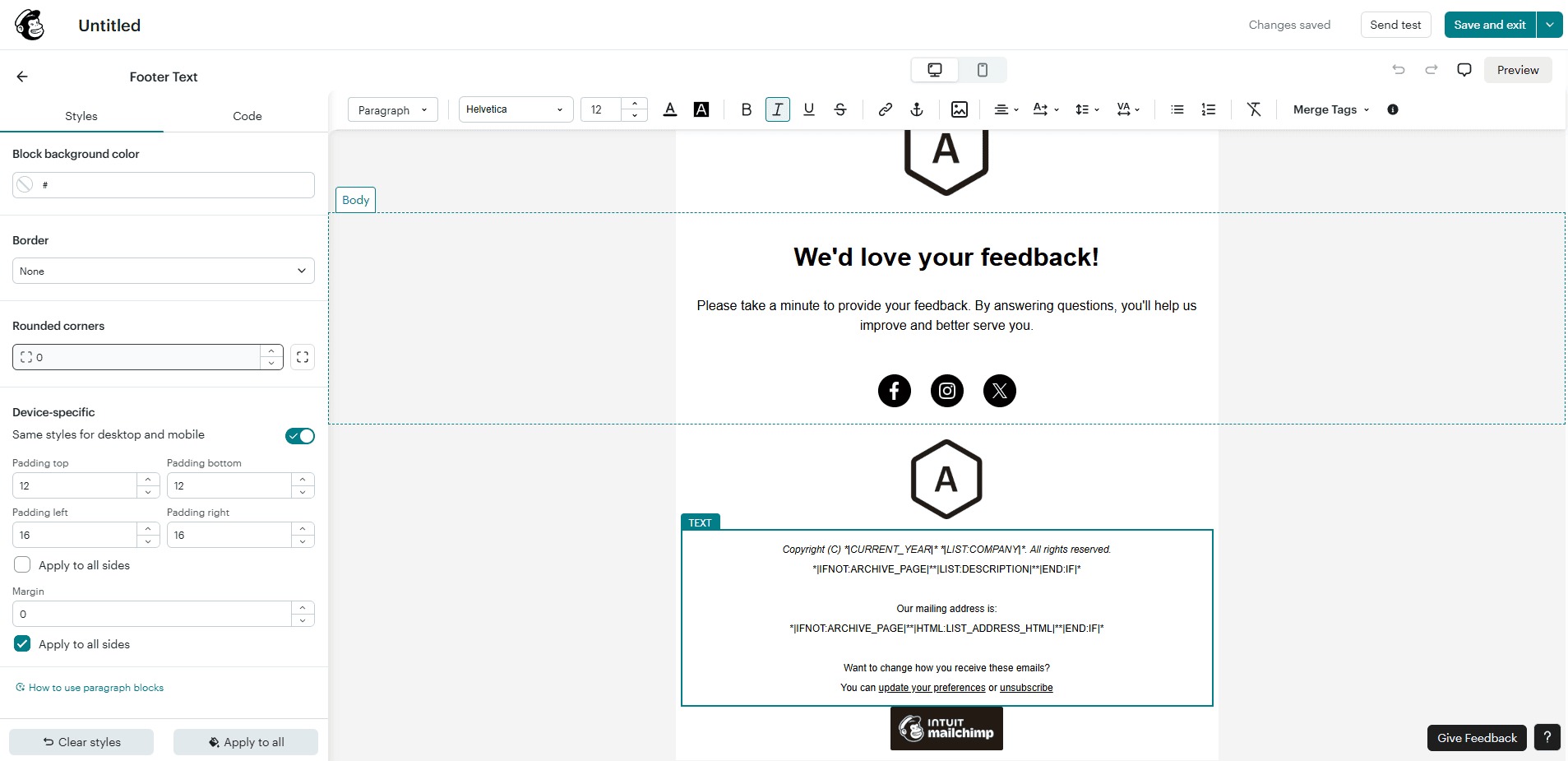
Mailchimp has the larger template library, more design flexibility and a more polished content studio. Omnisend’s editor is easy and its ecommerce blocks (product listings, discount codes) are handy, but there are fewer design options. For layout ideas you can use in either tool, see our newsletter design ideas.
Winner: Mailchimp.
Round 6: Integrations
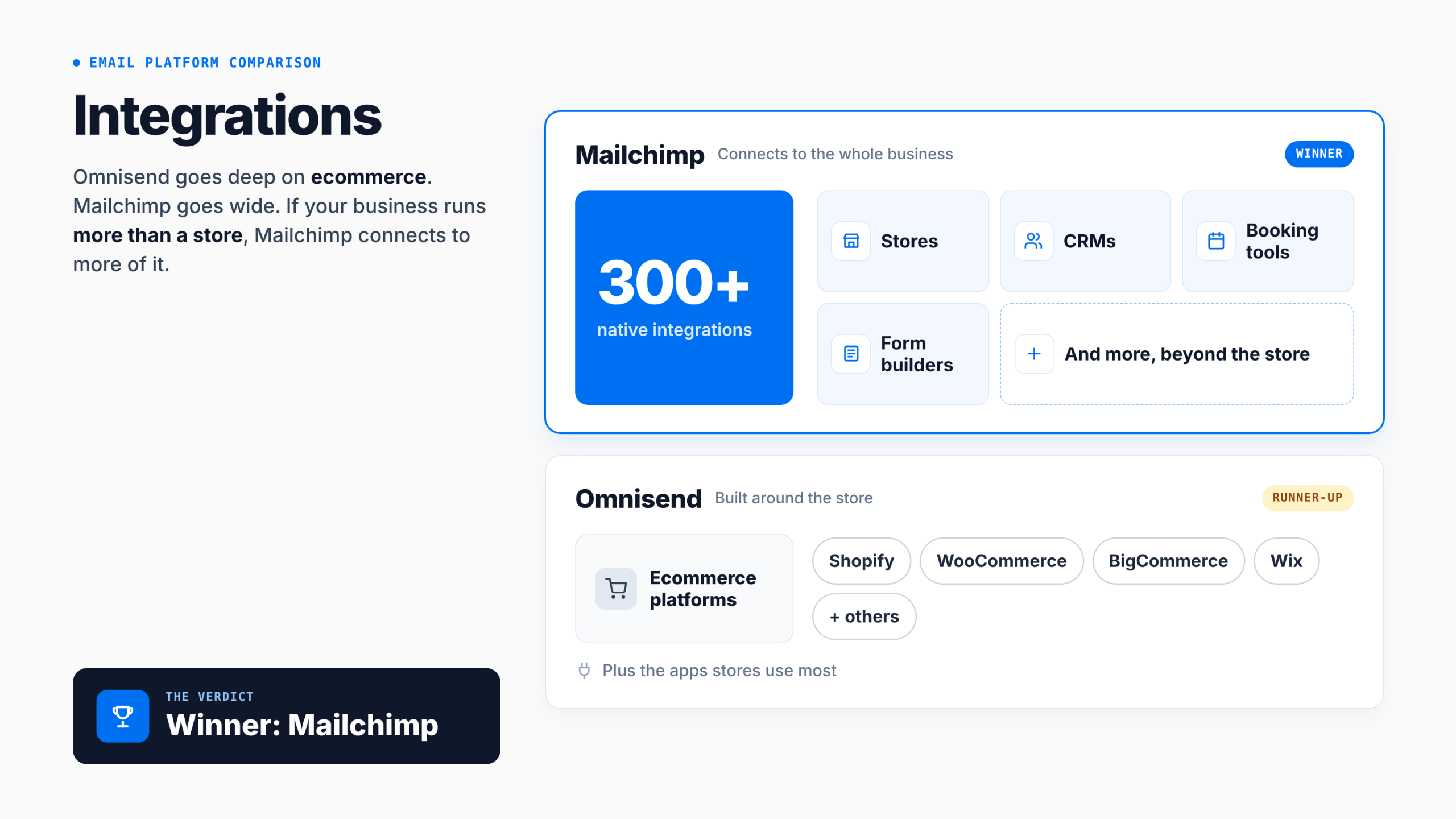
Mailchimp has 300+ native integrations covering stores, CRMs, booking tools, form builders and more. Omnisend focuses on ecommerce platforms (Shopify, WooCommerce, BigCommerce, Wix and others) and the apps stores use most.
If your business runs more than a store, Mailchimp connects to more of it.
Winner: Mailchimp.
Round 7: Support
Omnisend offers 24/7 live chat and email support on every plan, including free. Mailchimp gives free users email support for 30 days only. Essentials and Standard get 24/7 email and chat, and phone support starts on Premium at $350/month.
Winner: Omnisend.
Round 8: Beyond Ecommerce
If you’re not running an online store, Mailchimp is the more natural fit. It has surveys, landing pages, a website builder, social ads and broader reporting, and it’s used by service businesses, nonprofits and B2B teams. Omnisend’s features are almost all built around online stores.
Winner: Mailchimp.
Final Scoreboard: Omnisend 5, Mailchimp 3
- Omnisend wins: pricing for full automation, free plan, ecommerce automation, SMS and multichannel, support.
- Mailchimp wins: templates and editor, integrations, use beyond ecommerce.
A Simple Way to Decide
- You run an online store and want sales from automation: choose Omnisend.
- Your business isn’t mainly ecommerce, or your other tools rely on Mailchimp: choose Mailchimp.
- You’re a large store with lots of data: compare Omnisend with Klaviyo in our Omnisend vs Klaviyo guide.
- You’re on Shopify: see our roundup of the best email marketing apps for Shopify.
Whichever you pick, set up SPF, DKIM and DMARC for your sending domain. Gmail and Yahoo require it for bulk senders (Google’s guidelines, Yahoo’s best practices, dmarc.org). Ask for clear consent at checkout too: marketing emails to EU and UK customers need opt-in under GDPR and the ICO’s PECR rules. US sends must follow the CAN-SPAM Act. Our SPF, DKIM and DMARC setup guide walks through each record.
Omnisend Pros and Cons
✅Omnisend Pros:
- Prebuilt ecommerce workflows that are quick to launch
- Email, SMS and push in the same automation
- Free plan includes automation; 24/7 support on every plan
- Cheaper than Mailchimp Standard at 1,000–5,000 contacts
❌Omnisend Cons:
- Fewer integrations outside ecommerce
- Fewer design options than Mailchimp
- Costs rise quickly above 10,000 contacts
💰Pricing: Free (250 contacts); Standard $20 at 1,000, $81 at 5,000, $132 at 10,000; Pro from $59 (monthly billing).
Mailchimp Pros and Cons
✅Mailchimp Pros:
- 300+ integrations, the widest in the category
- Strong templates, editor and reporting
- Fits businesses beyond ecommerce
- Up to 200 automation flows on Standard
❌Mailchimp Cons:
- Free plan has no automation flows
- Essentials limits flows to 4 steps
- Phone support only on Premium ($350/month)
💰Pricing: Free (250 contacts); Essentials $26.50 at 1,500, $75 at 5,000; Standard $45, $100 and $135 (monthly billing).
Frequently Asked Questions
Is Omnisend better than Mailchimp?
Omnisend is better for online stores, and Mailchimp is better for general business marketing. Omnisend wins our comparison 5–3 on ecommerce automation, SMS, support and price for full automation. Mailchimp wins on templates, integrations and use beyond ecommerce.
Which is cheaper, Omnisend or Mailchimp?
Omnisend Standard is cheaper than Mailchimp Standard at 1,000 and 5,000 contacts ($20 vs $45 at about 1,000, and $81 vs $100 at 5,000). Mailchimp Essentials is cheaper at larger list sizes but limits automation.
Does Mailchimp work with Shopify?
Yes. Mailchimp has a Shopify app that syncs customers, orders and products. Omnisend’s Shopify integration is more focused on ecommerce flows.
Does Omnisend have a free plan?
Yes. Omnisend’s free plan covers 250 contacts and 500 emails a month, with prebuilt workflows and 24/7 support.
Can I switch from Mailchimp to Omnisend?
Yes. Export your audience from Mailchimp with tags and consent status, then import it into Omnisend or connect your store so customers sync automatically. Omnisend offers free migration help.
What are the alternatives to Omnisend and Mailchimp?
Klaviyo, MailerLite and Brevo are common alternatives. See our Omnisend alternatives and Mailchimp alternatives guides, plus our full Mailchimp review.
Final Verdict
Omnisend is the better choice for most online stores. Its prebuilt ecommerce flows, SMS, free-plan automation and 24/7 support give you more for less at 1,000–5,000 contacts. Mailchimp is the better fit if your business isn’t mainly ecommerce, or if you depend on its huge integration library and design tools. For a store-focused comparison with another big name, see Klaviyo vs Mailchimp.
Looking for a Simpler Alternative?
If you mainly send newsletters and promotions and want to keep costs down, Mailercloud is free for 1,000 contacts and 12,000 emails a month. Premium costs $10/month for 5,000 contacts with unlimited sends, automation and segmentation, and it connects to Shopify through Zapier. Omnisend Standard costs $81 and Mailchimp Standard $100 at the same size.
Mostly sending newsletters and promos? — try Mailercloud free
★★★★★ 4.5/5 on G2, Capterra & Trustpilot · Trusted by 35,000+ businesses
Free for 1,000 contacts · No credit card · $10/month for 5,000

An SEO expert with a focus on on-page optimization, technical SEO, and keyword research. Dedicated to helping businesses improve search rankings and grow their online presence through data-driven strategies.