Last updated: June 2026 · Tested by our editorial team using real subscriber lists and live campaigns
Klaviyo and Mailchimp are two of the most recognized names in email marketing, but they are built for different jobs. Klaviyo was designed from the ground up for ecommerce and revenue attribution. Mailchimp started as a general-purpose newsletter tool and grew into an all-in-one marketing platform for small businesses.
We ran the same store data, the same flows, and the same campaigns through both to see which one actually drives more value in 2026 — not from feature lists, but from daily use.
Below is our full 9-round breakdown with a declared winner each round and a running score, so you can follow the matchup as you read. If you are short on time, the Quick Answer and the final scoreboard have everything you need.
Quick Answer: Klaviyo wins for ecommerce and Mailchimp wins for general small-business email. Klaviyo takes our comparison 5–3 on the strength of deeper segmentation, revenue attribution, pre-built ecommerce flows, and native SMS. Mailchimp wins on ease of use, template variety, lower entry pricing, and a broader free plan for non-ecommerce users. If you run a Shopify or WooCommerce store and care about revenue per email, choose Klaviyo. If you want simple, affordable email marketing for a newsletter or service business, choose Mailchimp.
Table of Contents
Klaviyo vs Mailchimp: At a Glance
| Feature | Klaviyo | Mailchimp |
|---|---|---|
| Starting Price | $20/mo (501–1,000 contacts) | $13/mo (Essentials) |
| Free Plan | 250 contacts 500 email sends |
250 contacts 500 sends/mo |
| Best For | Ecommerce / DTC | General SMB / newsletters |
| Automation | Pre-built ecommerce flows | Customer Journey Builder |
| Segmentation | Behavioral + predictive | Behavioral + predictive (paid) |
| Revenue Attribution | ✓ Deep, per-flow | Basic (connected stores) |
| SMS Marketing | ✓ Native | Add-on / limited |
| Templates | ~100 | ~100, more polished |
| Support | Email + Chat (paid) | Email + Chat; phone $350+/mo |
Pricing verified 2026. Entry-level paid plans shown; both scale with contact count.
Round 1: Ease of Use and Onboarding
Winner: Mailchimp
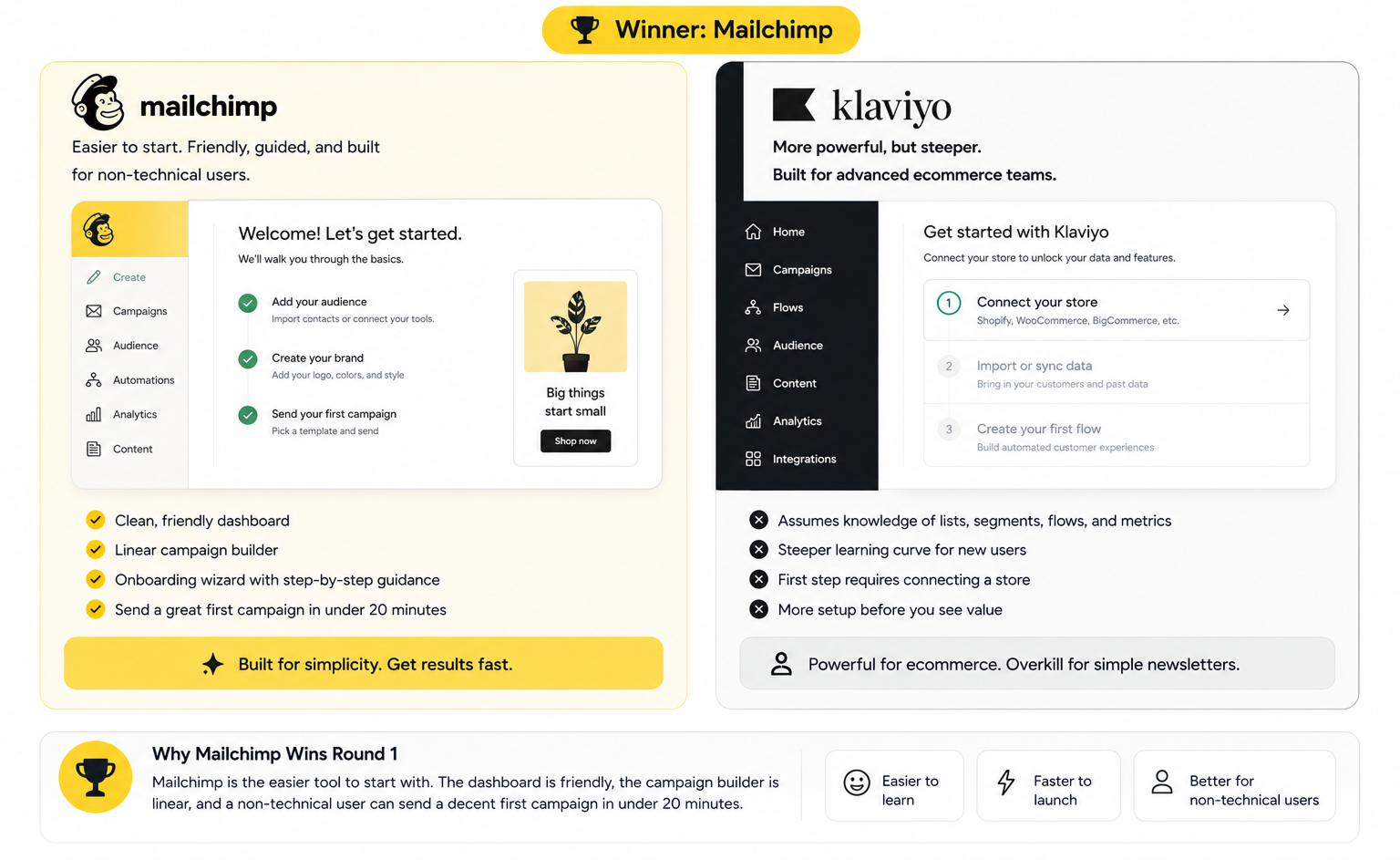
Mailchimp is the easier tool to start with. The dashboard is friendly, the campaign builder is linear, and a non-technical user can send a decent first campaign in under 20 minutes. Its onboarding wizard walks you through audience setup and branding without jargon.
Klaviyo is more powerful but steeper. The interface assumes you understand lists, segments, flows, and metrics, and the first-run experience pushes you toward connecting a store before anything feels useful. For ecommerce teams that is fine; for a solo newsletter it is overkill. Mailchimp takes the round on pure approachability.
Round 2: Email Editor and Templates
Winner: Mailchimp
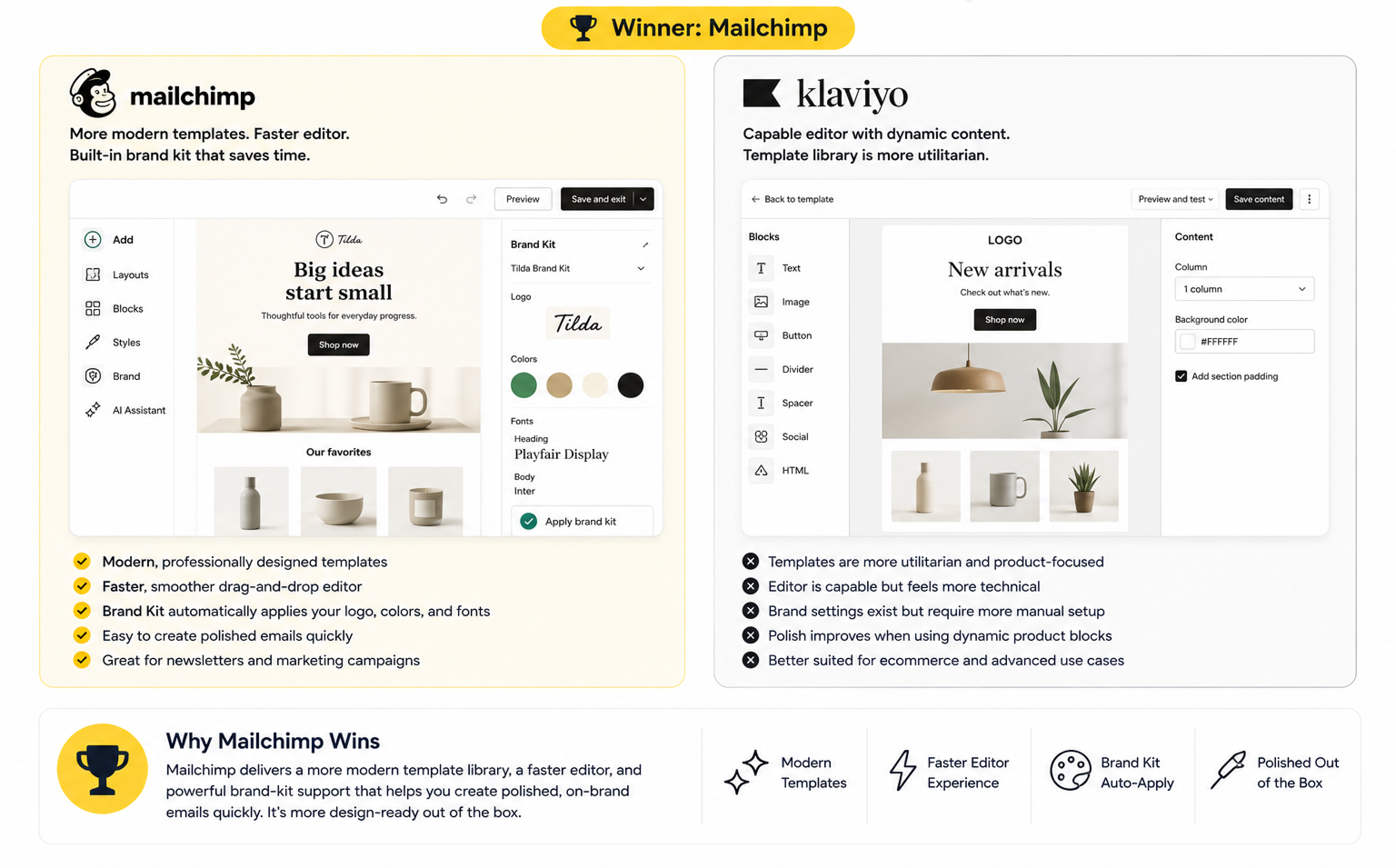
Both use drag-and-drop editors with comparable building blocks. Mailchimp’s templates feel more modern and its editor is faster to work in, with strong brand-kit support that pulls your logo, colors, and fonts automatically.
Klaviyo’s editor is capable and has improved, but its template gallery is more utilitarian and geared toward product-driven emails. For design polish out of the box, Mailchimp edges ahead. Klaviyo closes the gap once you are inserting dynamic product blocks, but on first impression Mailchimp wins.
Round 3: Automation and Flows
Winner: Klaviyo
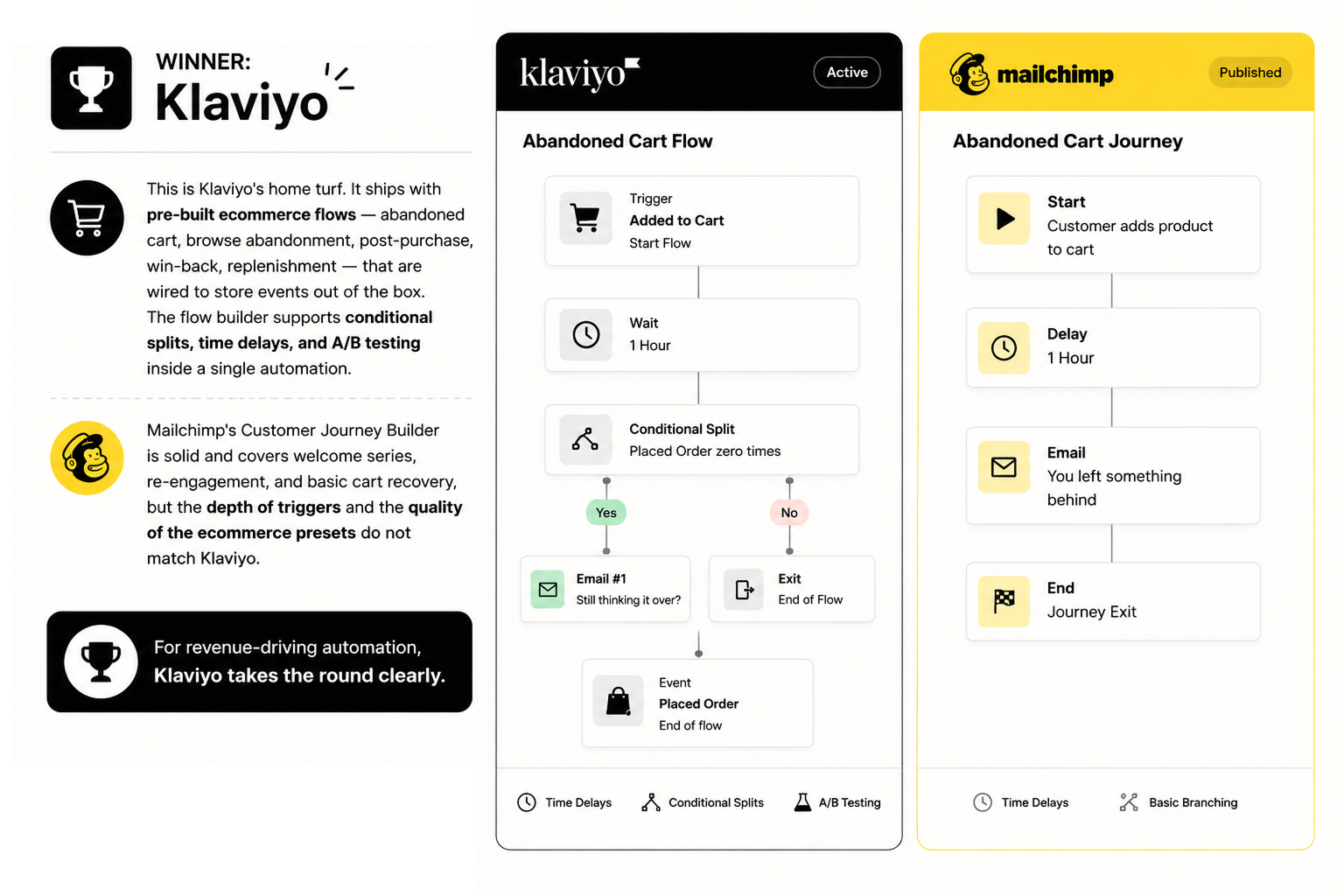
This is Klaviyo’s home turf. It ships with pre-built ecommerce flows — abandoned cart, browse abandonment, post-purchase, win-back, replenishment — that are wired to store events out of the box. The flow builder supports conditional splits, time delays, and A/B testing inside a single automation.
Mailchimp’s Customer Journey Builder is solid and covers welcome series, re-engagement, and basic cart recovery, but the depth of triggers and the quality of the ecommerce presets do not match Klaviyo. For revenue-driving automation, Klaviyo takes the round clearly.
Round 4: Segmentation and Personalization
Winner: Klaviyo
Klaviyo segments on every event it collects — opens, clicks, purchases, product views, predicted lifetime value, churn risk, and custom store properties. You can build a segment like ‘bought twice, viewed category X in 30 days, predicted to churn’ in a few clicks, and it updates in real time.
Mailchimp offers behavioral and predictive segmentation too, but the richest options sit on higher tiers and the event data is shallower unless you connect a store. Klaviyo’s data model is simply deeper, so it wins segmentation.
Round 5: Deliverability
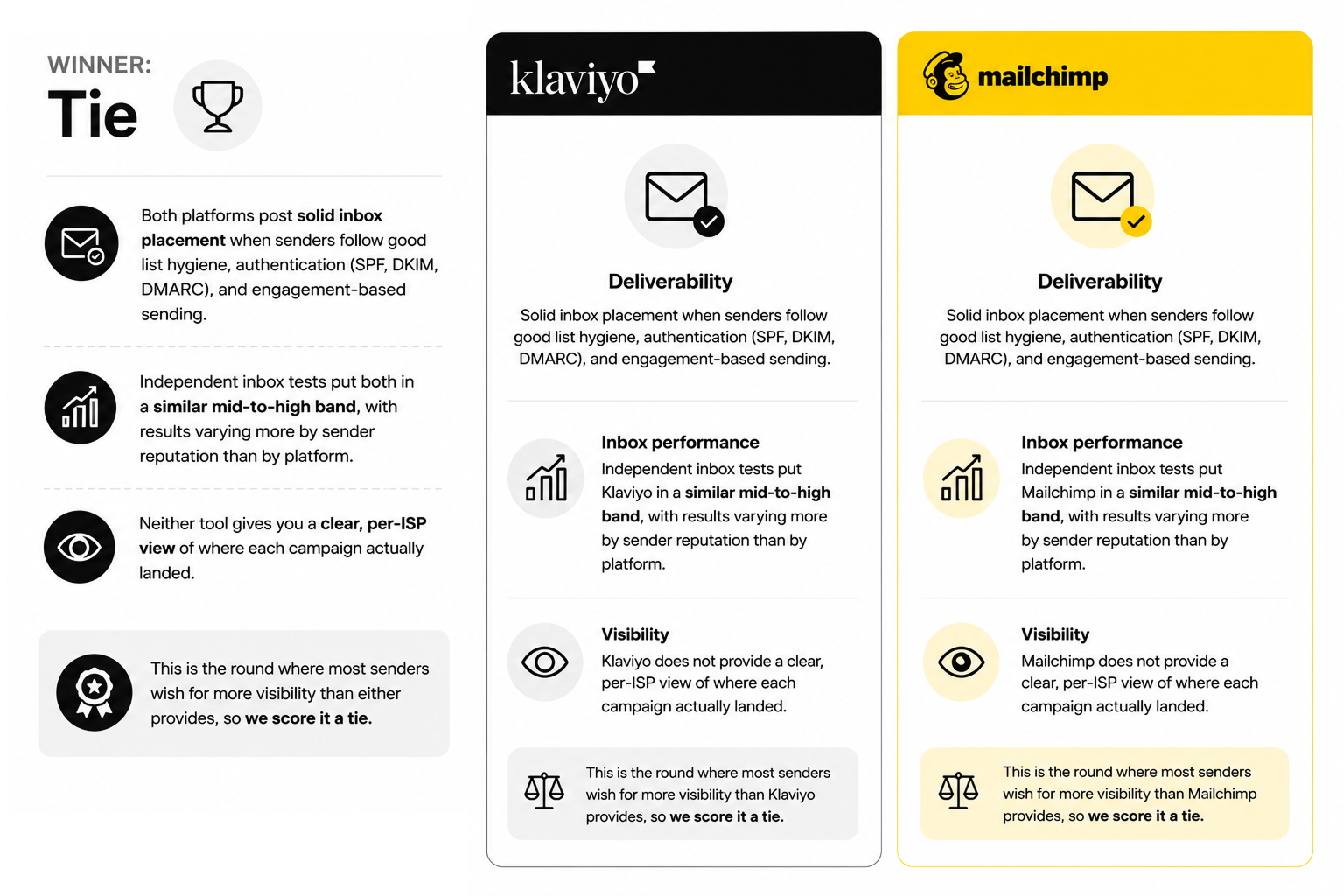
Winner: Tie
Both platforms post solid inbox placement when senders follow good list hygiene, authentication (SPF, DKIM, DMARC), and engagement-based sending. Independent inbox tests put both in a similar mid-to-high band, with results varying more by sender reputation than by platform.
Neither tool gives you a clear, per-ISP view of where each campaign actually landed. This is the round where most senders wish for more visibility than either provides, so we score it a tie.
Round 6: Reporting and Revenue Attribution
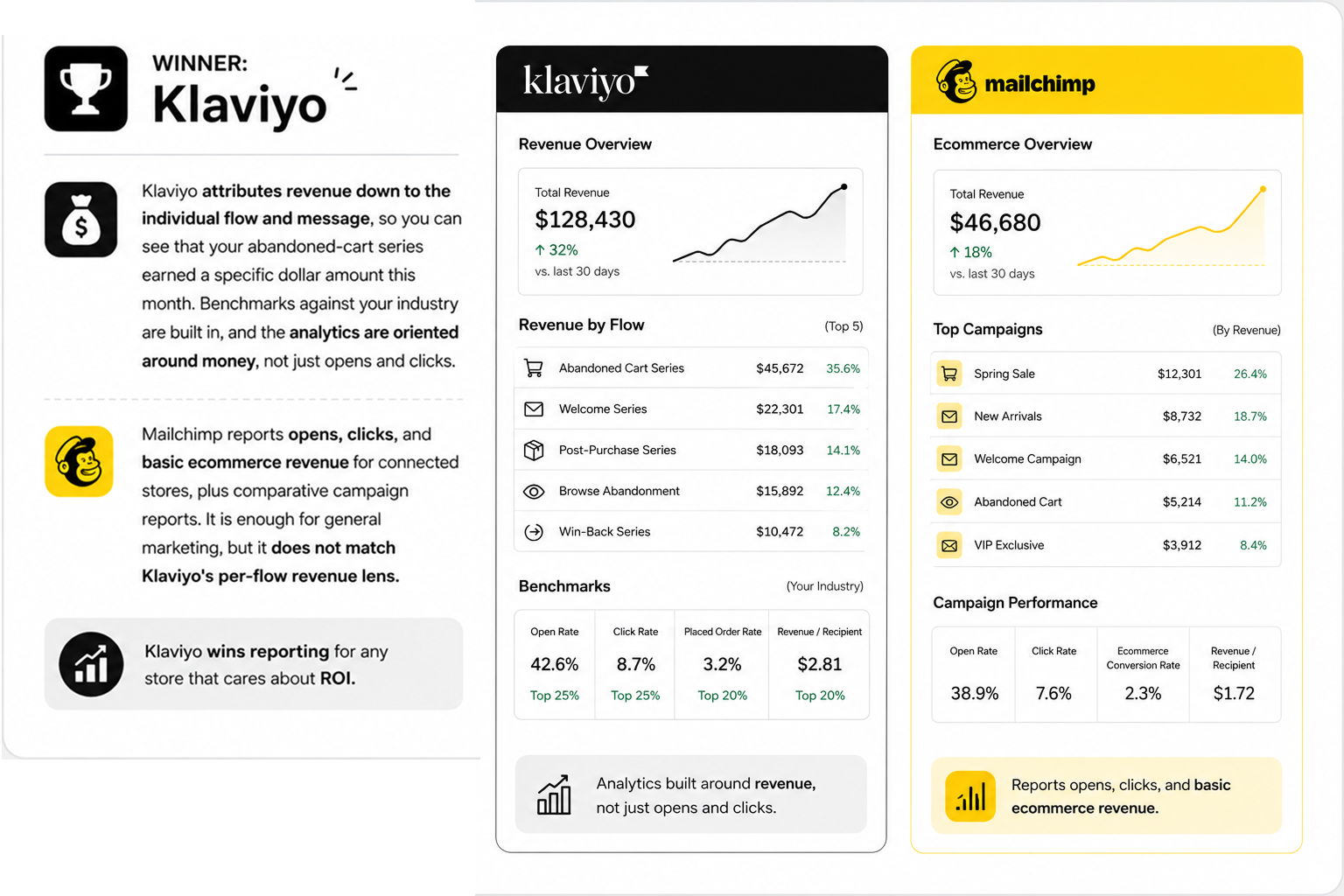
Winner: Klaviyo
Klaviyo attributes revenue down to the individual flow and message, so you can see that your abandoned-cart series earned a specific dollar amount this month. Benchmarks against your industry are built in, and the analytics are oriented around money, not just opens and clicks.
Mailchimp reports opens, clicks, and basic ecommerce revenue for connected stores, plus comparative campaign reports. It is enough for general marketing, but it does not match Klaviyo’s per-flow revenue lens. Klaviyo wins reporting for any store that cares about ROI.
Round 7: SMS and Multi-Channel
Winner: Klaviyo
Klaviyo has native SMS that lives in the same flows as email, so a cart-recovery sequence can send an email first and an SMS follow-up from one automation, with unified reporting and consent management.
Mailchimp’s SMS is more limited and feels bolted on by comparison. For brands that want true email-plus-SMS journeys, Klaviyo is the stronger multi-channel platform.
Round 8: Integrations and Ecommerce
Winner: Klaviyo
Klaviyo’s Shopify integration is among the deepest in the market, syncing products, orders, and customer events in near real time, with strong WooCommerce and BigCommerce support too. The whole product assumes a store is connected. For more options built around Shopify, see our roundup of email marketing apps for Shopify.
Mailchimp integrates with hundreds of apps and has a broad general-purpose marketplace, which is great for non-ecommerce use. But for store-native data depth, Klaviyo wins. Mailchimp’s edge is breadth across non-commerce tools.
Round 9: Pricing and Value
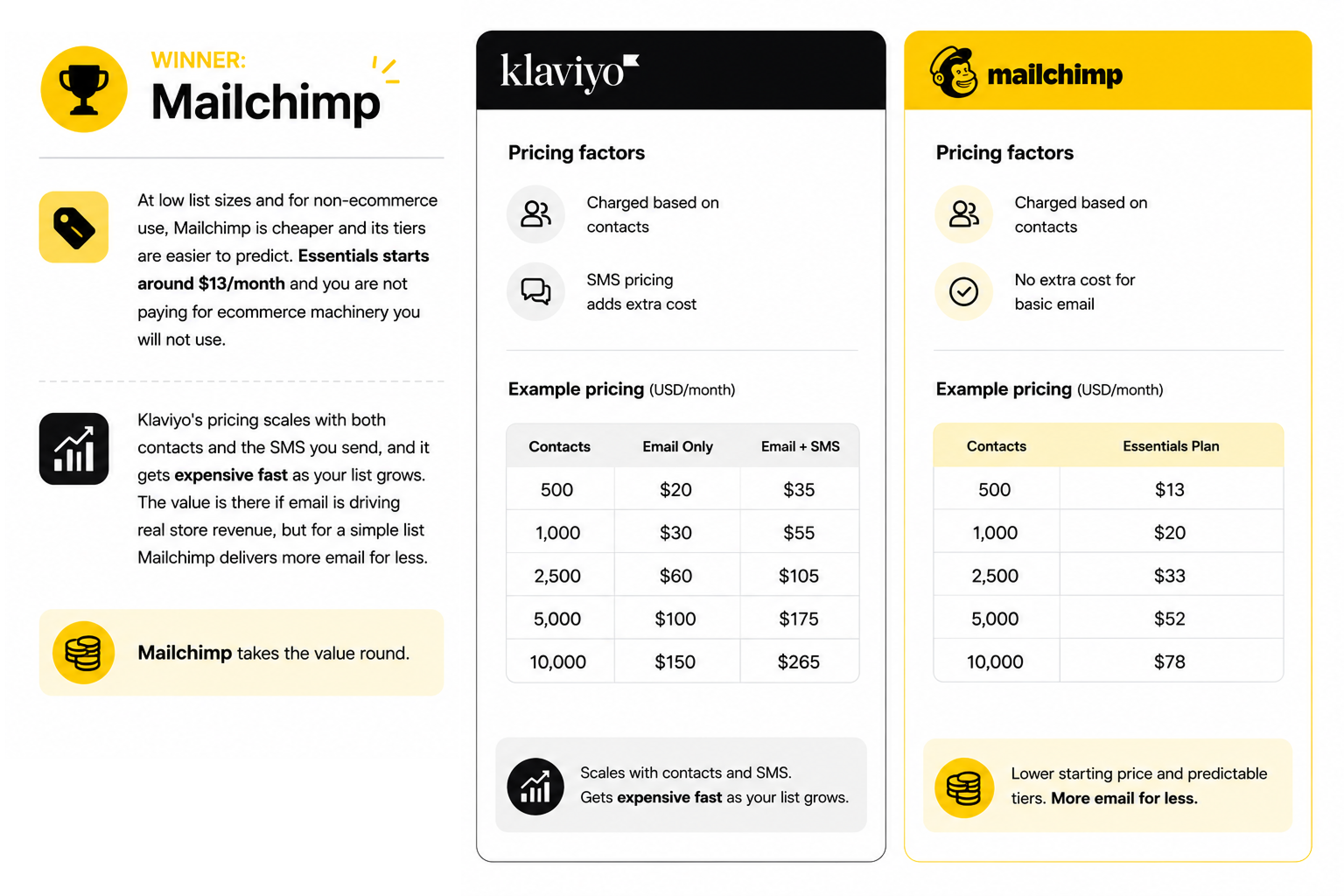
Winner: Mailchimp
At low list sizes and for non-ecommerce use, Mailchimp is cheaper and its tiers are easier to predict. Essentials starts around $13/month and you are not paying for ecommerce machinery you will not use. Our review of Mailchimp lists prices from 500 to 10,000 contacts.
Klaviyo’s pricing scales with both contacts and the SMS you send, and it gets expensive fast as your list grows. The value is there if email is driving real store revenue, but for a simple list Mailchimp delivers more email for less. Mailchimp takes the value round.
Final Scoreboard: Klaviyo 5, Mailchimp 3 (1 tie)
Klaviyo wins automation, segmentation, revenue reporting, SMS, and ecommerce integrations — the rounds that decide revenue for an online store. Mailchimp wins ease of use, templates, and pricing, and we scored deliverability a tie, for a 5–3 result.
The result tracks the intent: Klaviyo is the ecommerce revenue engine, Mailchimp is the approachable general-purpose marketer. Your store type matters more than the final score. If email is a revenue channel for your store, our guide to email marketing for ecommerce and our ranking of the best email marketing software in 2026 are worth a read.
Klaviyo Pros and Cons
Klaviyo
✓Pros:
- Best-in-class ecommerce flows (abandoned cart, browse, post-purchase, win-back)
- Deep behavioral and predictive segmentation that updates in real time
- Per-flow and per-message revenue attribution
- Native SMS inside the same automations as email
- Industry benchmarks built into reporting
- Near real-time Shopify, WooCommerce, and BigCommerce sync
✗Cons:
- Steep learning curve for non-ecommerce users
- Pricing scales quickly with contacts and SMS volume
- Overkill for simple newsletters or service businesses
- Template gallery is more utilitarian than Mailchimp’s
💰Pricing: Free up to 250 contacts / 500 email sends. Paid email starts around $20/month (501–1,000 contacts) and scales with list size; SMS is billed separately. Verified 2026.
Mailchimp Pros and Cons
Mailchimp
✓Pros:
- Easy to learn with a friendly campaign builder
- Polished, modern templates and strong brand-kit support
- Lower entry pricing for small or non-ecommerce lists
- Customer Journey Builder covers common automations
- Huge general-purpose integration marketplace
- Well-known brand with extensive documentation
✗Cons:
- Free plan reduced to 250 contacts / 500 sends in 2026
- Automation and segmentation depth trails Klaviyo for ecommerce
- Revenue attribution is basic
- Phone support only on $350+/month plans
- You pay for unsubscribed contacts on some plans
💰Pricing: Free plan: 250 contacts / 500 sends per month. Essentials starts around $13/month; Standard and Premium scale with contacts and features. Verified 2026.
Which Should You Choose?
Choose Klaviyo if:
- You run a Shopify, WooCommerce, or BigCommerce store and email is a revenue channel.
- You want pre-built, store-aware flows that recover carts and drive repeat purchases.
- You need deep segmentation on purchase and behavioral data.
- You want email and SMS in one automation with unified revenue reporting.
Choose Mailchimp if:
- You send newsletters or run a service business without a connected store.
- You want the fastest, friendliest setup with polished templates.
- You have a smaller list and want predictable, lower entry pricing.
- You value brand familiarity and a large general-purpose app marketplace.
Neither feels right?
Both tools in this comparison have real trade-offs — steep pricing as your list grows, features gated behind higher tiers, or paying for contacts who never open your emails. If your main job is email marketing and you want more value for the money, it is worth looking at a third option. For a wider view of the market, see our guide to the best email service providers.
Mailercloud starts at $7/month with a free plan covering 1,000 contacts and 12,000 emails/month — see our pricing. It includes an Inbox Tracker that shows exactly where your emails land across 15+ ISPs, plus AMP for Email, visual automation, A/B testing, segmentation, and 24/7 live chat on every plan, including free. The trade-off is a smaller integration library and lower brand recognition — but for pure email marketing value, it is hard to beat at the price.
How to Switch Between Klaviyo and Mailchimp
Switching between Klaviyo and Mailchimp follows the same steps in both directions. Export your contacts as a CSV from the source platform, including consent status and key custom fields, then import them into the new tool and map the fields during upload.
Reconnect your store integration (Shopify, WooCommerce, or BigCommerce) so product and order events flow in. Then rebuild your top three to five automations first — cart recovery, welcome, and post-purchase — since those drive most of the revenue. Recreate templates last; both tools accept custom HTML if you have coded designs.
FAQ
Is Klaviyo better than Mailchimp?
Klaviyo is better than Mailchimp for ecommerce, where its pre-built flows, revenue attribution, deep segmentation, and native SMS drive more sales per email. Mailchimp is better for general small-business email and newsletters, where ease of use, template polish, and lower entry pricing matter more. The right choice depends on whether you run an online store.
Is Klaviyo more expensive than Mailchimp?
Klaviyo is generally more expensive than Mailchimp as your list grows, because its pricing scales with contacts and SMS volume and it is built around ecommerce features. Mailchimp’s entry tiers are cheaper and more predictable for smaller or non-ecommerce lists. For a store driving revenue from email, Klaviyo’s cost can be justified by attributed sales.
Can I migrate from Mailchimp to Klaviyo?
Yes. Export your Mailchimp audience as a CSV with consent status, import it into Klaviyo, reconnect your store integration, and rebuild your key automations and segments. Klaviyo provides migration guides and the process typically takes a day or two for a standard store.
Does Mailchimp have abandoned cart emails?
Yes, Mailchimp supports abandoned cart automation for connected stores through its Customer Journey Builder, but the depth of ecommerce triggers and presets is narrower than Klaviyo’s purpose-built flows. For advanced cart and browse-abandonment sequences, Klaviyo offers more out of the box.
What is the main difference between Klaviyo and Mailchimp?
The main difference is focus. Klaviyo is an ecommerce marketing platform built around store data, revenue attribution, and SMS. Mailchimp is a general-purpose marketing tool built for ease of use across newsletters, service businesses, and light ecommerce. Klaviyo goes deeper for stores; Mailchimp is broader and simpler.
Is there a cheaper alternative to both Klaviyo and Mailchimp?
Yes. Several email marketing platforms offer comparable core features at lower price points. Mailercloud starts at $7/month with a free plan for 1,000 contacts and 12,000 emails per month, and MailerLite and Brevo also start cheaper than Klaviyo at scale. These are worth evaluating if email marketing value is your priority. You can also compare lower-cost options in our roundups of the best Klaviyo alternatives and Mailchimp alternatives.
Final Verdict
Klaviyo wins this matchup 5–3 and is the right call if you run an online store and want every email and SMS tied to revenue. Its flows, segmentation, and attribution are built for ecommerce growth.
Mailchimp is the better pick if you want approachable, affordable email for newsletters or a service business without store complexity. Match the tool to whether revenue runs through a cart — that decision matters more than the final score. See also our head-to-head Mailercloud vs Mailchimp comparison.

As a Marketing Director, I develop and implement marketing strategies, conduct market research, and manage a team of marketing professionals. With a successful track record of launching campaigns that drive revenue growth, I bring my marketing expertise to blog writing, creating engaging content that promotes the brand and its products/services.