
Last updated: April 2026 | Pricing verified April 18, 2026 | 14 min read
Mailchimp quietly ended its 15% recurring nonprofit discount in 2023. Now new nonprofits get a one-time 15% off and a single free month — and everyone who signed up before that quietly rolled onto full pricing. Combined with Mailchimp’s contact-based pricing (which counts unsubscribed contacts until you manually archive them) and the fact that its free plan caps at 1,000 contacts and 1,000 sends a month, a lot of nonprofits are asking the obvious question: what else is out there?
Quite a lot, it turns out. And several platforms still offer real, recurring nonprofit discounts that Mailchimp used to match.
The other nine alternatives below each have a strong case for a specific nonprofit use case — biggest discount, best free plan, best for fundraising events, best for donor CRM. We’ll cover each honestly, pros and cons. Looking at this from a different angle? We’ve also published a broader 10 best Mailchimp alternatives for 2026 comparison covering use cases beyond nonprofits.
Let’s dive in.
Quick Answer: The best Mailchimp alternative for nonprofits in 2026 is Mailercloud — it combines a generous free plan (1,000 contacts, 12,000 emails/month), transparent pricing starting at $7/month, and built-in donor-segmentation tools. Other strong nonprofit-friendly picks include Brevo (email + SMS for donor reminders), MailerLite (30% nonprofit discount), Constant Contact (up to 30% off for 501(c)(3)s + event management), EmailOctopus, Moosend, GetResponse (50% off annual + webinars), HubSpot (free CRM for donor management), Sender (2,500 free contacts), and Zoho Campaigns. Mailchimp ended its 15% recurring nonprofit discount in 2023 — this guide compares the 10 best replacements with honest pros and cons for every tool.
Related reading: Best Kit Alternatives.
Table of Contents
Why Nonprofits Are Leaving Mailchimp in 2026
The decision to move off Mailchimp usually comes down to a combination of these six points, not any single one:
- The recurring 15% nonprofit discount ended in 2023. Mailchimp now offers a one-time 15% off plus one free month, and only for brand-new accounts. Long-term nonprofit customers saw their real bill jump the moment the grandfathered discount expired.
- Contact-based pricing counts unsubscribed contacts. Until you manually archive them, unsubscribes still count toward your paid tier. Nonprofits running event-based lists can quietly pay for thousands of ghost contacts.
- Tier jumps are punishing. Going from 500 to 1,500 contacts on the Standard plan nearly doubles the monthly cost. For a nonprofit adding 30 email signups from an event, that’s a cliff rather than a ramp.
- Automation on the free plan is severely limited. Since 2022, free accounts get single-step automations only. Multi-step donor welcome sequences — the kind that actually move someone from first donation to recurring donor — require a paid plan.
- No native donation receipt features. Nonprofits end up hacking together tax-compliant receipts with conditional content blocks, or exporting to a separate donation platform.
- No nonprofit-specific segmentation. Mailchimp’s segmentation is capable, but it assumes an ecommerce mental model — spend, purchase frequency, cart value. Applying it to “first-time donor, recurring donor, lapsed donor, major gift candidate” takes configuration work that smaller platforms do for you out of the box.
These aren’t deal-breakers in isolation. Add them up, and a small development shop running Mailchimp at $79/month ends up asking whether it’s worth switching to a tool that costs a third as much, comes with a genuine nonprofit discount, and actually understands donor lifecycle. Pairing your email tool with the Best Social Media Tools for Nonprofits helps coordinate donor outreach across both channels.
See also: Getresponse alternatives.
What Nonprofits Actually Need from an Email Tool
Before we get to the alternatives, here’s the checklist we used to evaluate every tool below:
- A verified, recurring nonprofit discount. One-time promotional discounts don’t help year three of a five-year program. We only credit tools with ongoing nonprofit pricing.
- Donor segmentation beyond “opened last email.” Donation history, recency, frequency, amount, campaign source, event attendance. The fields nonprofits actually track.
- Donation receipt automation. Tax-compliant templates, receipt numbering, PDF attachments, donor contact card updates on receipt send.
- Fundraising campaign features. Event RSVPs, peer-to-peer emails, recurring donor upgrade prompts, end-of-year campaign templates, matching-gift reminder sequences.
- Strong deliverability for cold and semi-engaged donor lists. Nonprofit lists skew older (poor engagement signals) and include many recently-added event contacts (low historical engagement). Without authentication (SPF, DKIM, DMARC) set up properly, a high percentage of these emails land in Promotions or Spam.
- Pricing that doesn’t punish small nonprofits. A nonprofit that sends twice a month to 2,000 contacts should not pay the same as a B2B SaaS sending daily. Flat per-contact pricing is often worse than send-based pricing at this usage pattern.
Every tool below is evaluated against these six.
10 Best Mailchimp Alternatives for Nonprofits — At a Glance
Here’s how the ten alternatives compare on the numbers nonprofits care about most.
| Tool | Best For (Nonprofits) | Free Plan | Starting Price | Nonprofit Discount |
|---|---|---|---|---|
| Mailercloud#1 Pick | Best overall value for small-to-mid nonprofits | ✓ Yes 1,000 contacts / 12K emails |
$7/mo |
Contact sales
Low base price |
| Brevo | Email + SMS + WhatsApp for donors | ✓ Yes Unlimited / 300 emails/day |
$9/mo |
Custom (on request)
|
| MailerLite | Small nonprofits wanting clean UI | ✓ Yes 1,000 subs / 12K emails |
$10/mo |
30% off paid plans
|
| Constant Contact | Established 501(c)(3)s + events | ✗ No 60-day free trial |
$12/mo |
20% off 6 mo / 30% off 12 mo
|
| EmailOctopus | Tiny nonprofits on a budget | ✓ Yes 2,500 subs / 10K emails |
$9/mo |
Email for rate
|
| Moosend | Nonprofits scaling automation | ✗ No 30-day trial |
$9/mo |
25% off (verified NPO)
|
| GetResponse | Fundraising events + webinars | ✓ Yes 500 contacts / 2.5K emails |
$15/mo |
50% off annual plans
|
| HubSpot | Donor CRM + email in one | ✓ Yes 2,000 emails/mo + free CRM |
$20/mo |
Up to 40% (Nonprofit Program)
|
| Sender | Most generous free plan | ✓ Yes 2,500 subs / 15K emails |
$15/mo |
Case-by-case
|
| Zoho Campaigns | Nonprofits needing full suite | ✓ Yes 2,000 contacts / 6K emails |
$3/mo |
Up to 50% off Zoho One
|
Pricing verified April 18, 2026. All prices in USD. Nonprofit discounts typically require 501(c)(3) verification or equivalent. Contact each vendor for the most current terms.
Pricing verified April 18, 2026. Nonprofit discounts subject to vendor eligibility review (typically a 501(c)(3) determination letter).
1. Mailercloud — Best Overall for Nonprofits
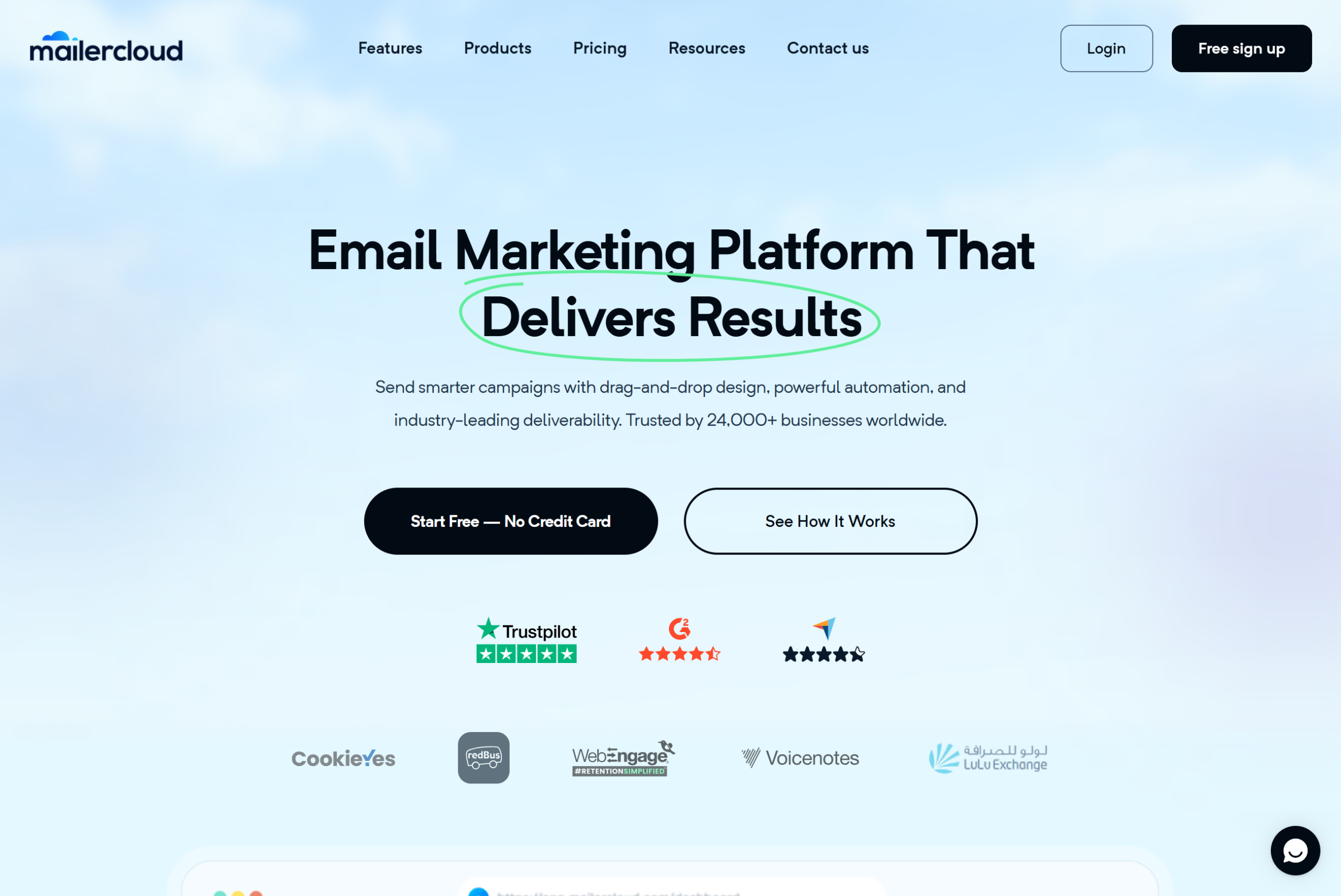
Mailercloud is the best overall Mailchimp alternative for nonprofits in 2026 because it gets three things right that most nonprofit-focused tools get wrong: it’s priced for small nonprofits (from $7/month), it ships with actual deliverability tooling, and its free plan is generous enough that most nonprofits under 1,000 contacts never need to pay.
The deliverability piece matters more than it sounds. Nonprofit lists tend to have weaker engagement signals than commercial lists (older subscribers, event contacts added months ago, donors who opted in for one campaign and then disengaged). That’s precisely the profile that trips spam filters at Gmail and Outlook. Mailercloud’s Inbox Tracker shows where your emails are actually landing — Primary, Promotions, or Spam — across Gmail, Outlook, Yahoo, and corporate gateways. That visibility alone is worth the monthly price for nonprofits that depend on donor opens.
Key features for nonprofits
- Free plan: 1,000 contacts and 12,000 emails per month (no credit card required)
- Inbox Tracker showing real placement per major inbox provider
- Guided SPF, DKIM, and DMARC setup — the three authentication standards nonprofit emails most often get wrong
- Visual automation builder with branching logic for donor welcome sequences, recurring donor upgrades, and lapsed donor reactivation
- Behavioural segmentation on every paid plan (open behaviour, click behaviour, donation amount via custom fields, event engagement)
- AMP for Email — interactive in-inbox experiences for event RSVPs and donation confirmations
- Built-in landing page and signup form builder for campaign pages without a web developer
- A/B testing on subject lines and content for fundraising appeals
- Transactional email via API + SMTP — same sender infrastructure for donation receipts and marketing emails
- Real-time analytics dashboard — per-campaign engagement, hourly open curves, country-level breakdowns
- 24/7 live chat and email support on every plan, including the free plan
- Predictable, transparent pricing — no auto-upgrade traps or surprise renewal increases
✅Pros for Nonprofits:
- Generous free plan: 1,000 contacts and 12,000 emails/month — enough for most small nonprofits to run year-round donor communications at zero cost
- Paid plans start at $7/month — nearly half the price of Mailchimp’s entry-level Essentials plan
- Unlimited automation workflows on every paid plan — build donor welcome series, lapsed-donor win-back, event reminders without hitting tier limits
- Inbox Tracker shows whether your donation appeals land in the inbox, Promotions tab, or spam across Gmail, Outlook, and Yahoo — critical when a single appeal drives the quarter’s fundraising
- Advanced donor segmentation: tag by donation amount, frequency, campaign, event attendance, or volunteer status
- Visual automation builder with branching logic — easy to map a full donor journey (signup → first donation → thank-you → one-year renewal)
- Built-in landing page and signup form builder — run fundraising campaigns without a separate tool
- A/B testing on subject lines and content for higher appeal open rates
- Strong deliverability infrastructure with real-time monitoring and dedicated IP options for larger nonprofits
- 24/7 live chat and email support on every plan — including free — so volunteer admins get help fast
- Predictable, transparent pricing — no surprise tier jumps when your donor list grows past arbitrary thresholds
- GDPR and CAN-SPAM compliance built in with double opt-in, preference centres, and one-click unsubscribe
❌Honest Cons:
- No donation-receipt templates out of the box — nonprofits either adapt a transactional template or pair Mailercloud with their donation platform (Donorbox, Givebutter, Stripe)
- Smaller third-party integration library than Mailchimp — integrates with Zapier, Stripe, WooCommerce, Shopify, but not directly with every nonprofit CRM
- Native event management features (RSVPs, ticketing) are not built in — use Eventbrite or similar and sync via Zapier
- No formal public “nonprofit discount” listed on the pricing page — but the base price is already low enough that most nonprofits pay less than they would on Mailchimp at full price; contact sales for a custom quote if you need one
💰Pricing: Free plan available (1,000 contacts, 12,000 emails/mo). Paid plans start at $7/month for 1,000 contacts with unlimited emails and unlimited automation. Start free →
💰 Pricing: Free plan (1,000 contacts, 12,000 emails/month). Paid plans start at $7/month. Pricing details →
👤 Best For: Small-to-mid nonprofits (50-10,000 contacts) that need reliable deliverability, honest pricing, and donor lifecycle automation without a six-figure marketing stack.
Verdict: If you’re on Mailchimp for nonprofits and the grandfathered discount went away, Mailercloud is the closest drop-in replacement at a third of the price. Start your free Mailercloud account →
2. Brevo (formerly Sendinblue)
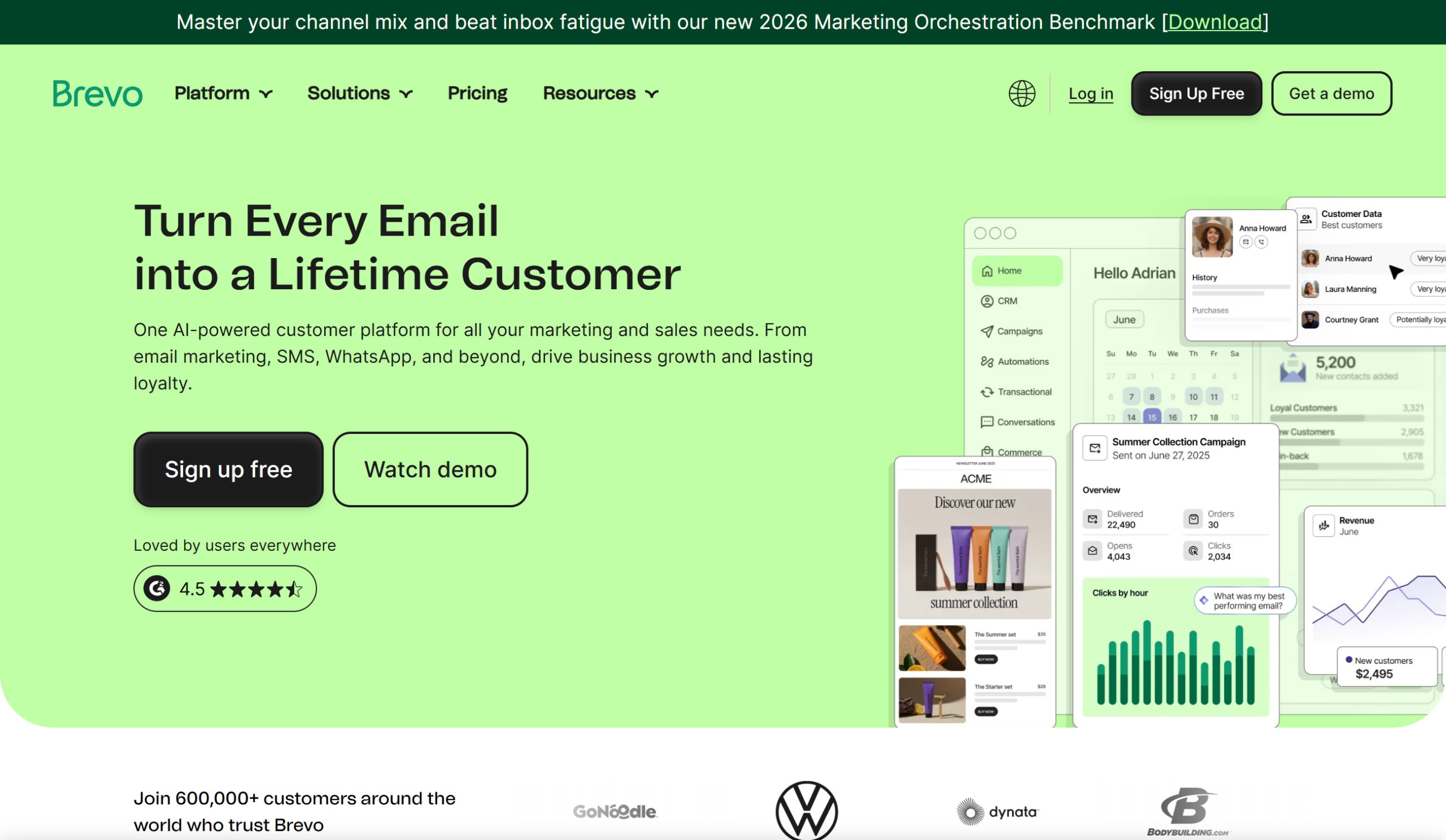
Brevo is the strongest Mailchimp alternative for nonprofits that send irregularly. Its pay-per-send pricing model (instead of Mailchimp’s pay-per-contact) means a nonprofit with 5,000 contacts sending twice a month pays less than one with 2,000 contacts sending daily. For fundraising programs with end-of-year spikes, that’s a real difference.
The other reason Brevo ranks well for nonprofits is its native SMS and WhatsApp channels. Donor reminder texts, event-day confirmations, and receipt notifications all happen inside the same platform — no Twilio side-contract required.
Key features for nonprofits
- Pay-per-send pricing (300 emails/day free; paid plans from $9/month for 5,000 emails)
- SMS and WhatsApp built in
- Nonprofit discount available via application (terms updated periodically — verify on Brevo’s nonprofit page)
- Visual automation builder with branching
- Built-in CRM with contact-level segmentation
Pros: Send-based pricing favours nonprofits with large but rarely-contacted lists. Multi-channel (email + SMS + WhatsApp). Strong transactional email offering.
Cons: Free plan limited to 300 sends/day (manageable for campaigns, restrictive for one-off event blasts). Nonprofit discount application process takes 5-10 business days. Interface feels denser than Mailercloud or MailerLite for first-time users.
💰 Pricing: Free forever for 300 emails/day. Paid plans from $9/month (5,000 emails). Starter plan unlocks scheduling.
👤 Best For: Nonprofits with large contact lists (5,000+) but irregular sending patterns, or programs that need SMS/WhatsApp alongside email.
3. MailerLite
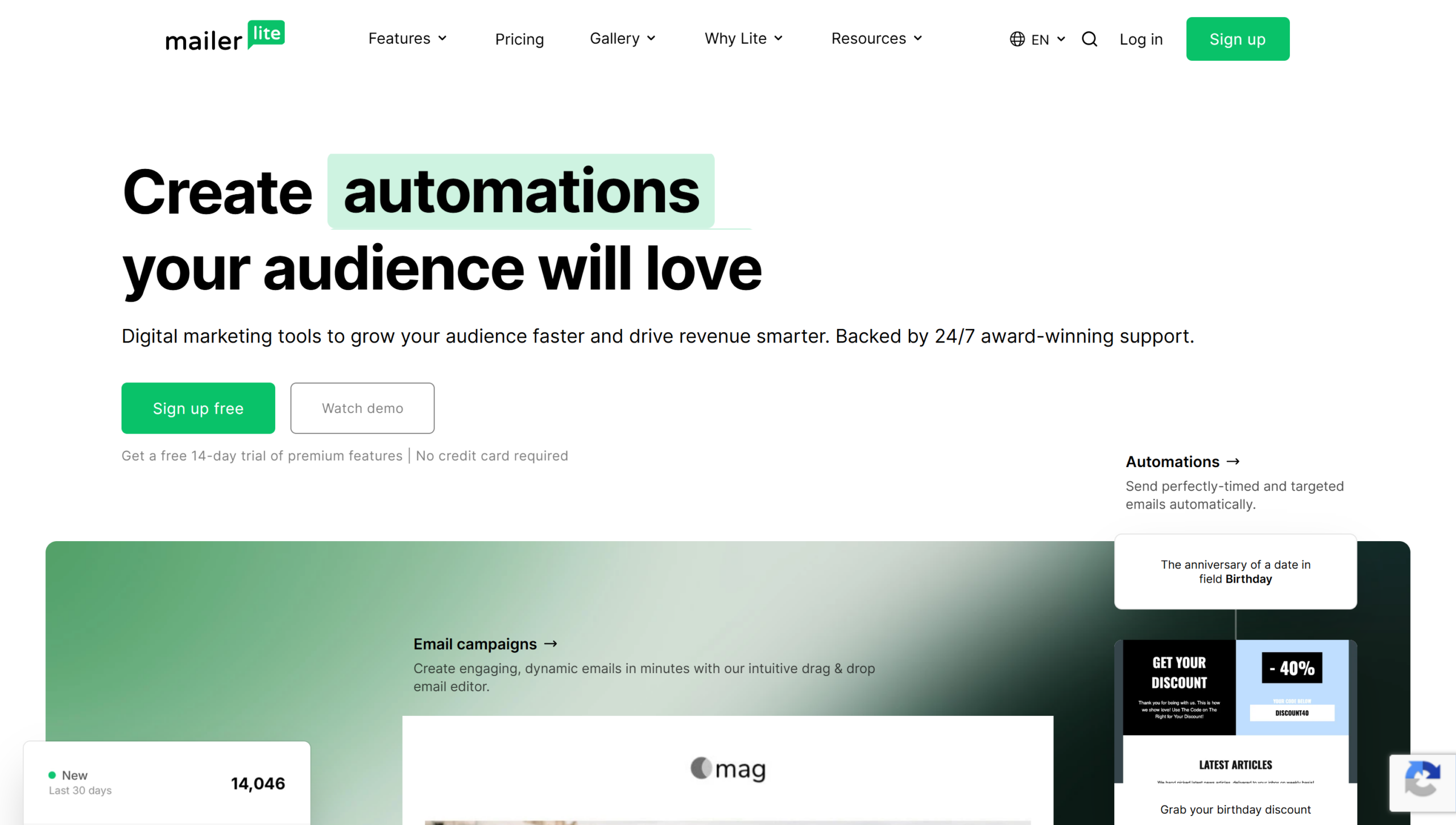
MailerLite is the clean, well-designed answer for small nonprofits that want email and basic automation without clutter. The interface is deliberately simplified compared to Mailchimp, and for volunteer-run nonprofit teams that rotate email duties, that simplicity is a feature, not a bug.
MailerLite offers a 30% nonprofit discount on paid plans (verified via application and 501(c)(3) status). Its Stripe integration also makes it one of the few tools where you can drop a donation button directly into an email without hacky workarounds.
Key features for nonprofits
- 30% nonprofit discount (on approval of 501(c)(3) documentation)
- Free plan: 1,000 subscribers, 12,000 emails/month
- Drag-and-drop builder with block-based email design
- Stripe-powered donation buttons inside emails
- Landing page builder and signup forms included
- A/B testing on subject lines and content
Pros: Genuine 30% recurring nonprofit discount. Extremely intuitive UI — ideal for volunteer teams. Donation button integration avoids separate donation platform friction.
Cons: Automation builder is less visual than Mailercloud’s or Brevo’s — linear flows can feel limiting for complex donor journeys. No native SMS. Reporting is less granular than Brevo or HubSpot.
💰 Pricing: Free for 1,000 subscribers. Paid plans from $10/month (1,000 subs, unlimited emails). Nonprofit discount brings this to ~$7/month.
👤 Best For: Small nonprofits (under 5,000 subscribers) where simplicity and a real nonprofit discount matter more than advanced automation.
4. Constant Contact
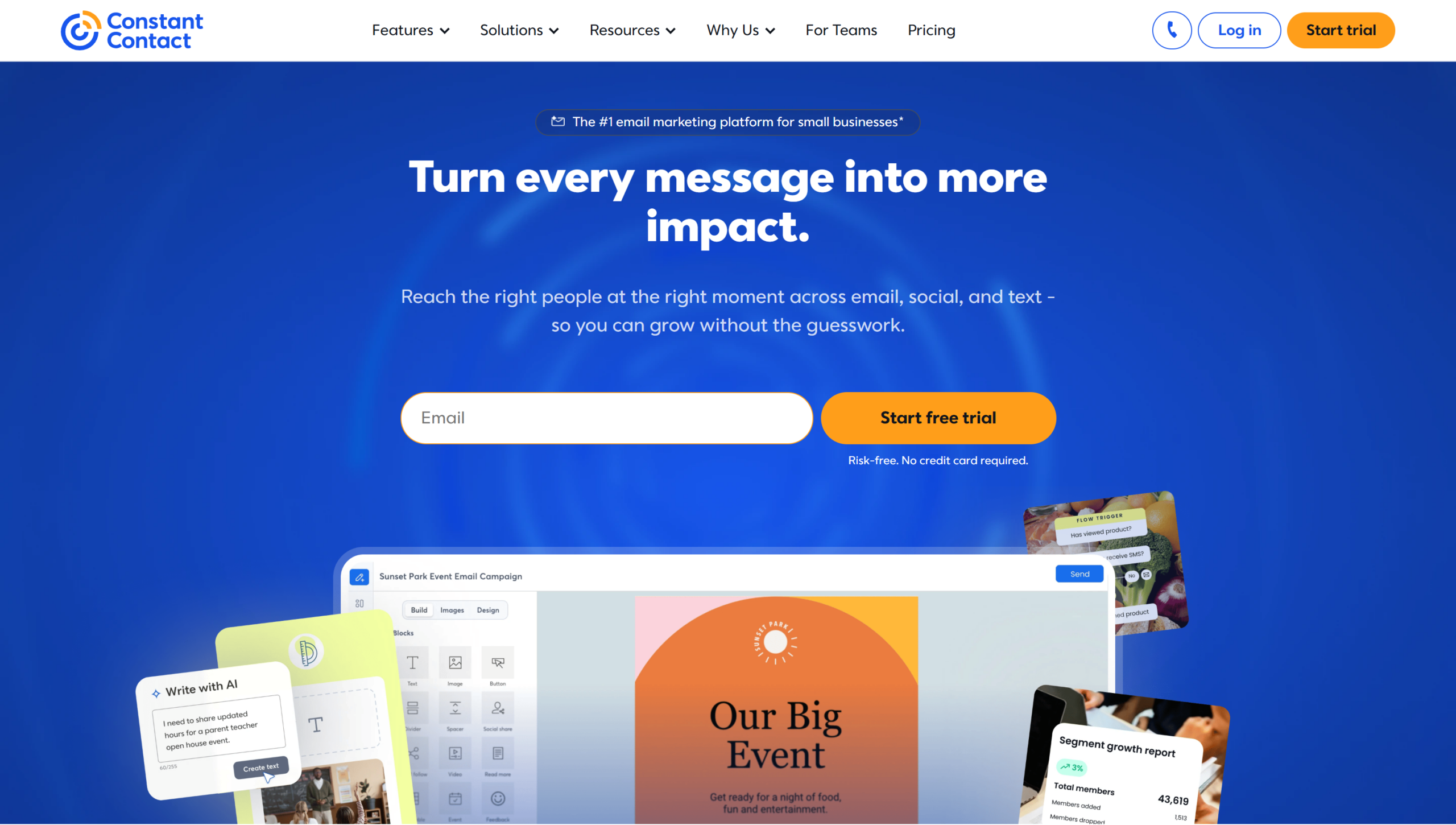
If Mailchimp is the generic default, Constant Contact is the nonprofit-sector default. It has spent years explicitly marketing to small nonprofits and ships with built-in event management that most competitors leave to separate tools. And it still offers a recurring nonprofit discount — 20% off for 6 months or 30% off annual prepayment for verified 501(c)(3) organisations.
The tradeoff is price point. Constant Contact is not cheap at list scale, and its editor is dated compared to Mailercloud or MailerLite. But for a nonprofit that values hand-holding support and needs event registration + email in one tool, it’s still a legitimate fit.
Key features for nonprofits
- 20% off 6 months / 30% off annual for verified nonprofits
- Built-in event RSVP and ticket management
- Survey and poll tools for post-event donor feedback
- Donation collection add-on
- Live person phone support (rare at this price tier)
Pros: Real, established nonprofit program with tenured support team. Event management is genuinely useful. Phone support included.
Cons: Expensive at scale — 5,000 contacts is roughly 2-3x Mailercloud pricing. Editor UX feels dated (the block editor is improving but template library still shows its age). Automation is less flexible than Brevo or ActiveCampaign. For more options, explore our roundup of Brevo alternatives.
💰 Pricing: Starts at $12/month (500 contacts); typical nonprofit at 5,000 contacts lands at $80-100/month after nonprofit discount.
👤 Best For: Mid-sized nonprofits (2,000-15,000 contacts) that run events regularly and value phone support over feature depth.
5. EmailOctopus
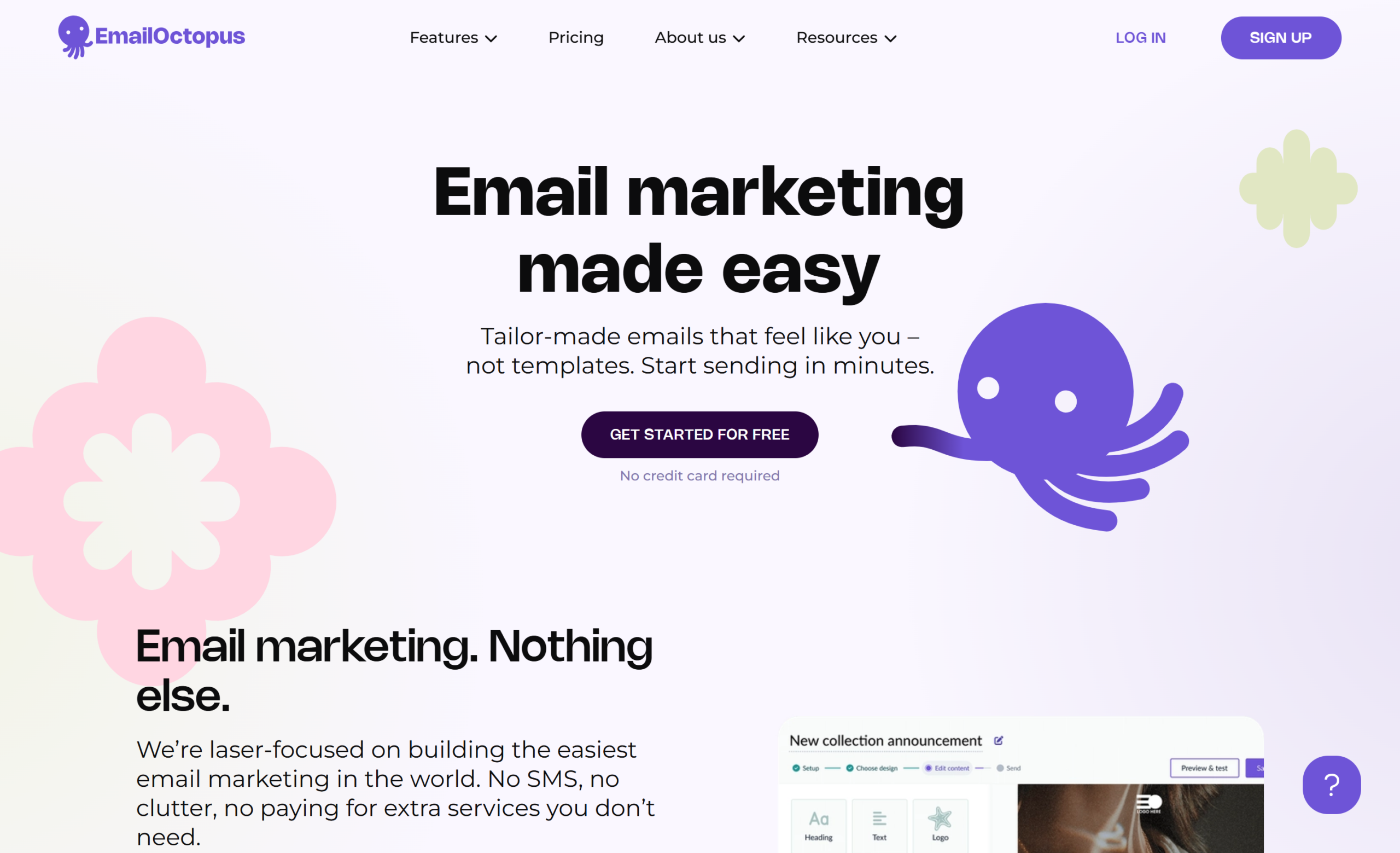
EmailOctopus is the cheapest legitimate paid option on this list. For tiny nonprofits (say, a neighborhood food bank with 800 subscribers) on a tight volunteer budget, EmailOctopus at roughly $8/month covers the basics: campaigns, simple automations, reasonable templates, and enough analytics to know what’s working.
It’s not built for advanced fundraising workflows. But it’s not trying to be. For nonprofits that just need a clean tool to replace Mailchimp at a lower price point and without the learning curve of HubSpot or Zoho, EmailOctopus fits. See how Mailercloud compares in our Mailercloud vs Mailchimp guide.
Key features for nonprofits
- Free plan: 2,500 subscribers / 10,000 emails per month
- Simple, beginner-friendly interface
- Basic time-delay automations
- Drag-and-drop email builder
- Integrates with Zapier for donation platform connections
Pros: Cheapest paid tier of any tool on this list. Generous free plan for under-2,500 subscribers. Very gentle learning curve.
Cons: No native donation features — everything routes through Zapier or manual imports. Automation builder is simplistic (no branching, limited triggers). No dedicated nonprofit discount program.
💰 Pricing: Free for 2,500 subscribers / 10,000 emails. Paid plans from $8/month.
👤 Best For: Very small nonprofits (under 2,500 subscribers) on a bare-bones budget that prioritise cost over feature depth.
6. Moosend
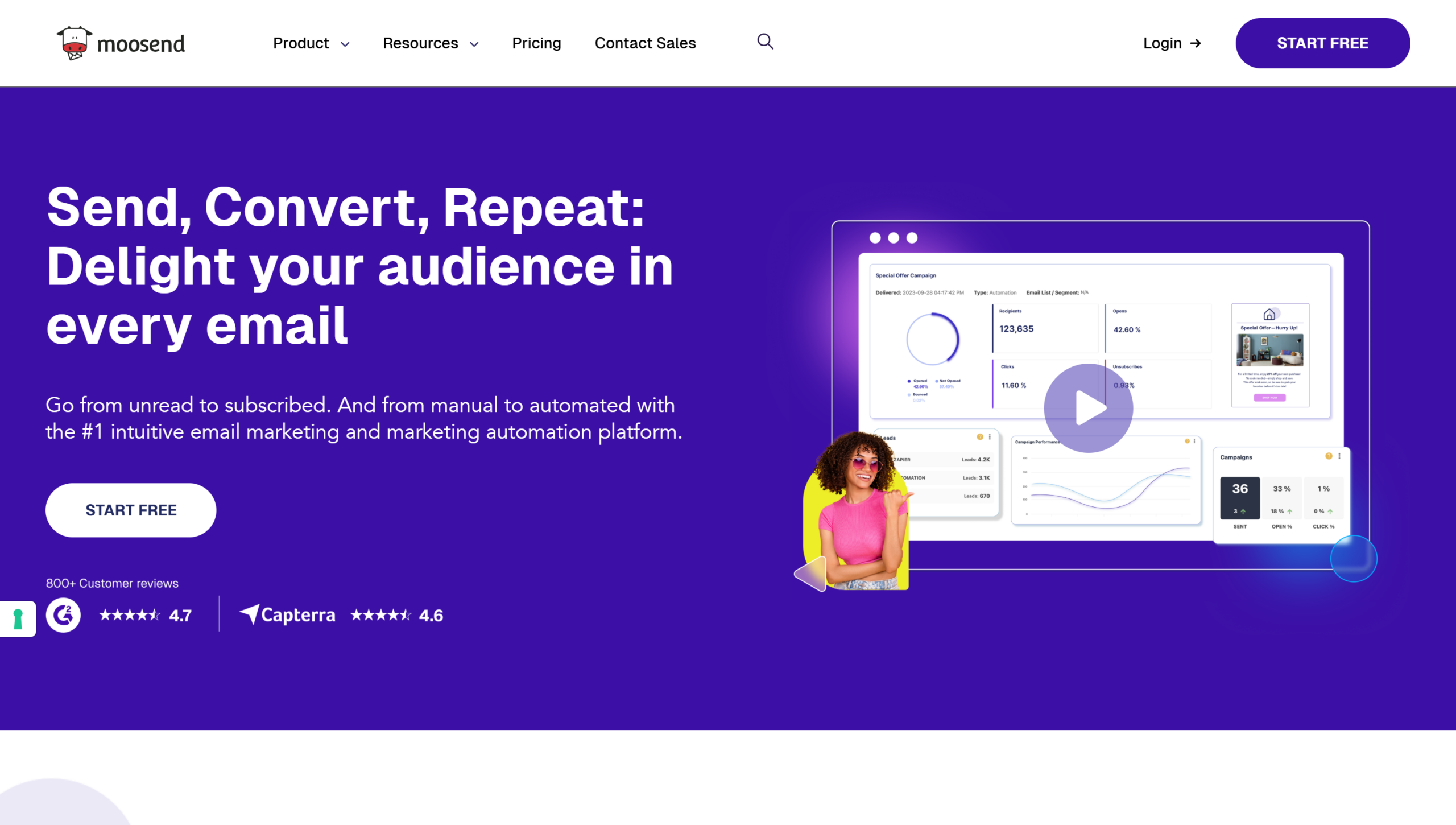
Moosend sits between EmailOctopus (simple) and Brevo (feature-dense). It has a strong drag-and-drop automation builder, AI-generated subject lines, and competitive pricing — but its visibility in the nonprofit space is lower than Constant Contact or GetResponse, and it does not currently publish a dedicated nonprofit discount program.
That said, for a nonprofit with a communications staff member who’s comfortable with mainstream marketing tools, Moosend’s automation workflows compete well with anyone.
Key features for nonprofits
- Visual automation builder with branching logic
- AI subject line and email copy suggestions
- Landing page and signup form builder
- A/B testing on subject lines, content, send times
- GDPR compliance tooling (relevant for nonprofits with EU donors)
Pros: Automation builder is one of the strongest on this list at its price point. AI tooling is surprisingly usable. GDPR features are a quiet win for nonprofits with any European donor base.
Cons: No standing nonprofit discount (one-off negotiations sometimes work, but don’t count on it). Email template library skews commercial/ecommerce rather than nonprofit. Support response times are slower than Mailercloud’s 24/7 chat.
💰 Pricing: From $9/month (500 contacts, unlimited emails).
👤 Best For: Nonprofits with a staff communications manager who wants strong automation at a moderate price and doesn’t need a nonprofit-specific discount.
7. GetResponse
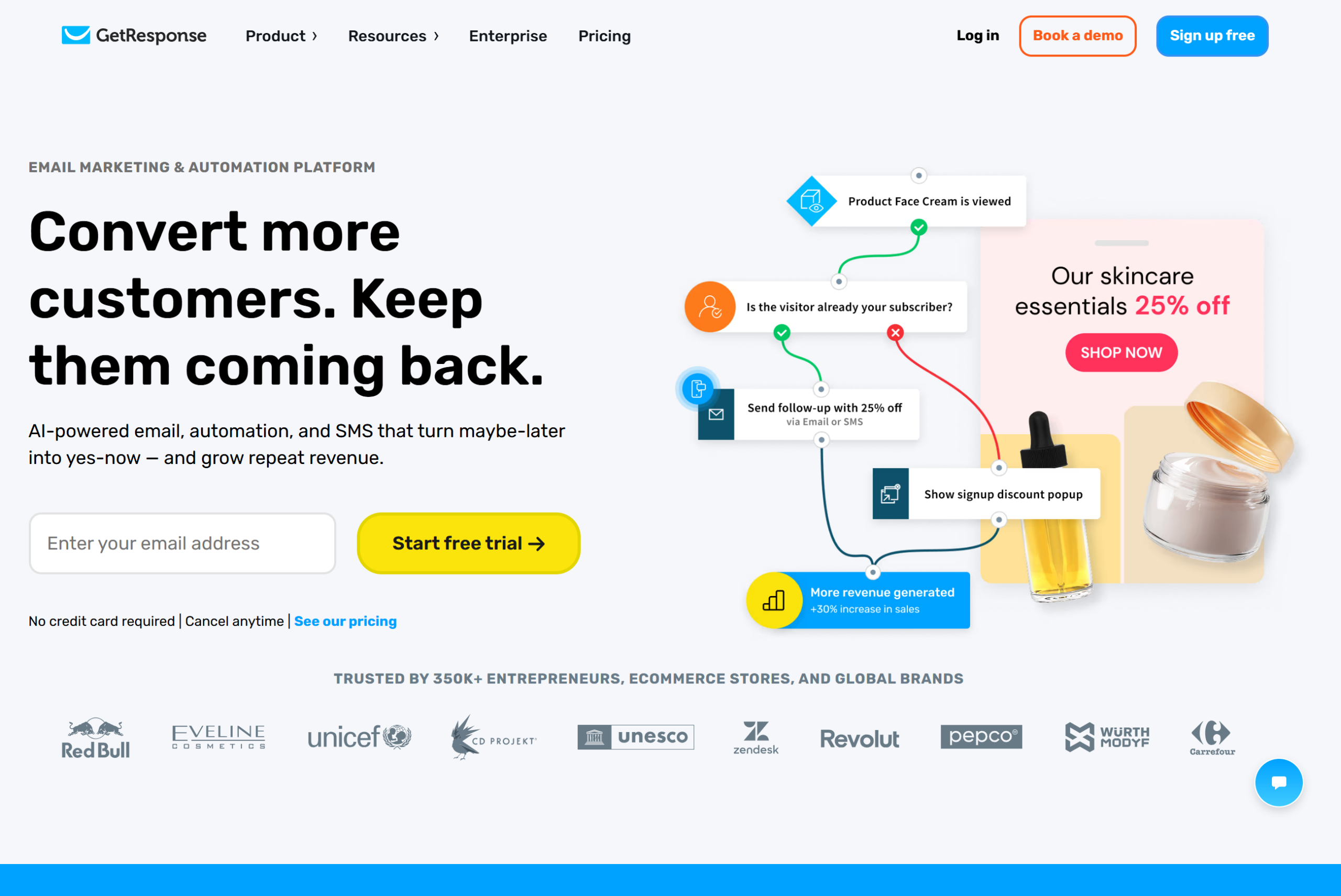
GetResponse offers one of the better nonprofit discounts on this list — up to 50% off annual plans for verified nonprofits. It also ships with built-in webinar tools, which matters more for nonprofits than most comparison articles acknowledge. Virtual fundraising events, donor briefings, and annual-report presentations all work well as webinars, and having email + webinars in one tool eliminates an entire vendor relationship.
Key features for nonprofits
- 50% nonprofit discount on annual plans (application required)
- Built-in webinars (up to 100 or 500 attendees depending on plan)
- Autoresponders and visual automation builder
- Landing page builder with conversion analytics
- Sales funnel templates (useful for recurring-giving programs)
Pros: Webinar integration is genuinely useful for fundraising events. 50% nonprofit discount is the largest recurring discount on this list. Funnel builder works well for recurring donor upgrade journeys.
Cons: Annual commitment required for the 50% discount (not monthly). Email deliverability can vary — historical reports show inconsistency compared to Mailercloud or MailerLite. Interface has a dated feel in places.
💰 Pricing: From $19/month before nonprofit discount (reduces to roughly $9.50 on annual). Webinar features require Marketing Automation plan ($59/month before discount).
👤 Best For: Nonprofits running regular virtual events, webinars, or fundraising campaigns that benefit from integrated video.
8. HubSpot
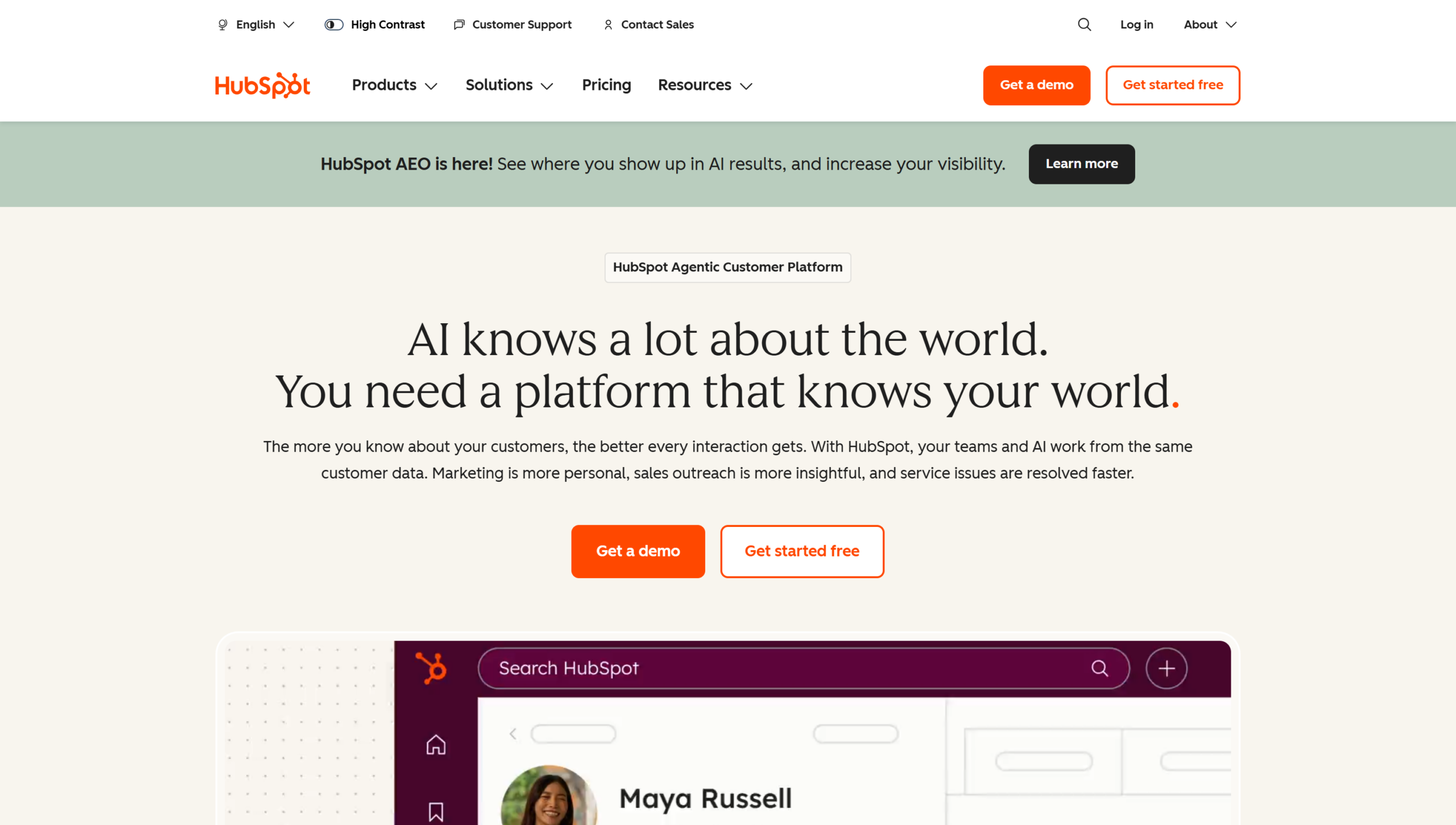
HubSpot is overkill for most small nonprofits. For mid-to-large nonprofits (20+ staff, dedicated development team, formalised donor stewardship) it might be a perfect fit — and HubSpot does run a legitimate nonprofit pricing program with significant discounts on its Marketing, Sales, and Service Hubs.
The underrated HubSpot play for smaller nonprofits: use the free CRM as a donor database (contact tracking, notes, task management, deal pipeline for major gifts), and connect it to a cheaper email tool like Mailercloud. You get a real donor CRM without the Marketing Hub license.
Key features for nonprofits
- Free CRM with 1 million contacts (genuinely free, no card required)
- Nonprofit discount program on Marketing Hub and Sales Hub
- Free tier includes 2,000 marketing emails/month, landing pages, forms
- Native integration with 1,500+ apps
- Reporting dashboards that handle development + program analytics
Pros: The free CRM alone is worth the setup time for any nonprofit that’s still tracking donors in a spreadsheet. Nonprofit discounts on paid tiers are real. Ecosystem is unmatched.
Cons: Full Marketing Hub is expensive even after nonprofit discount — roughly $250/month at the Professional tier. Steep learning curve for volunteer teams. Overkill for nonprofits under 5,000 contacts.
💰 Pricing: Free CRM (forever). Marketing Hub Starter from $20/month; Professional from $800/month list price (significantly reduced under nonprofit program).
👤 Best For: Mid-to-large nonprofits with a dedicated development or digital staff. Or smaller nonprofits that want a free donor CRM and will pair it with a cheaper email tool.
9. Sender
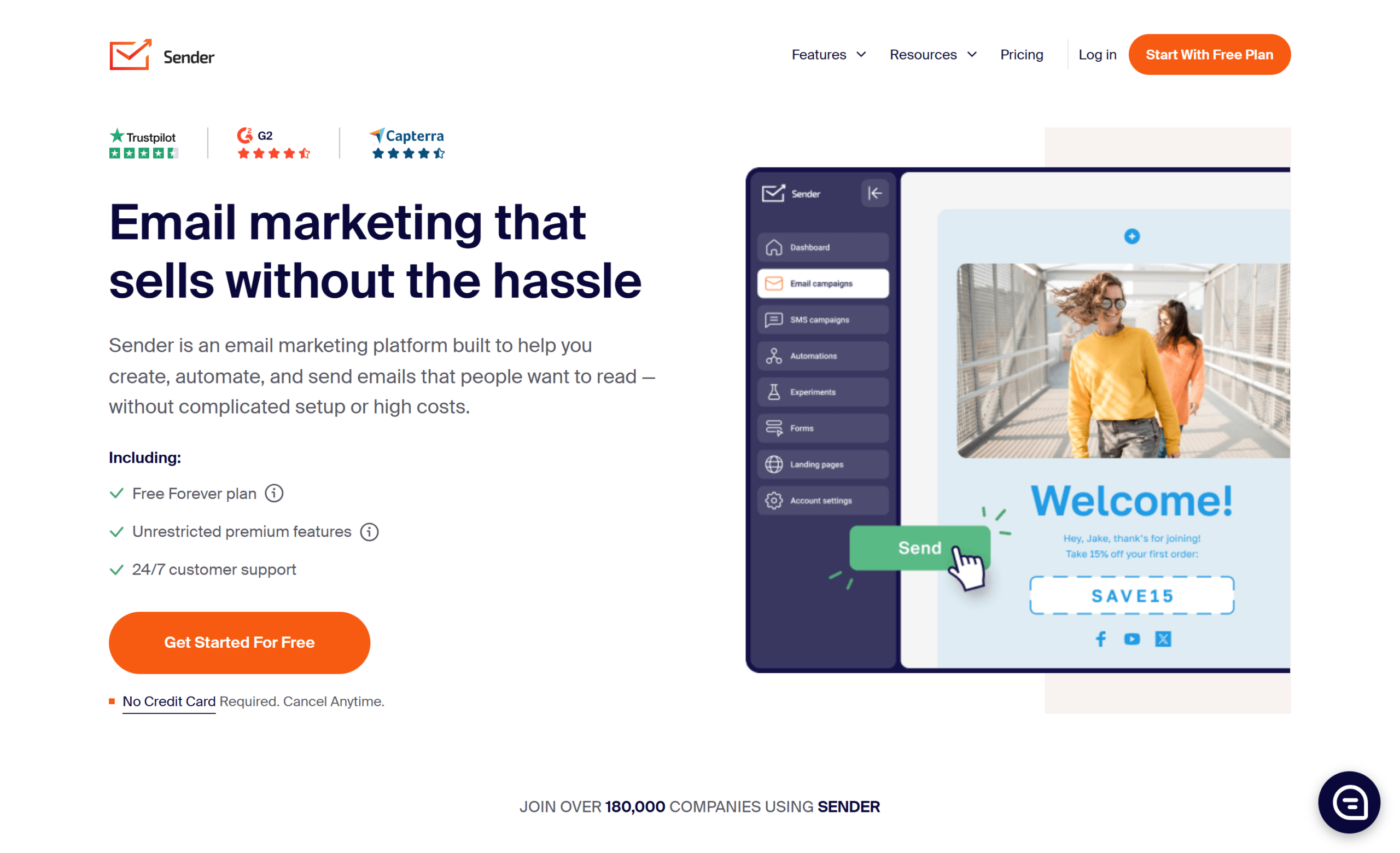
Sender has the most generous free plan on this list — 2,500 subscribers and 15,000 emails per month. For small nonprofits under that threshold, Sender is effectively free forever. The paid plans are also competitive, though they lack some of the deliverability tooling Mailercloud ships standard.
Key features for nonprofits
- Free plan: 2,500 subscribers / 15,000 emails per month
- Drag-and-drop email builder with mobile preview
- Automation workflows with triggers and delays
- SMS add-on (not free plan)
- Popups, subscription forms, and embedded forms
Pros: Best-in-class free plan for nonprofits. Simple enough for volunteer teams. Paid plans are competitive even without a dedicated nonprofit discount.
Cons: No dedicated nonprofit discount program (paid plan pricing is already competitive, so the impact is modest). No Inbox Tracker-style deliverability placement view. Support is email-only on lower tiers.
💰 Pricing: Free for 2,500 subscribers / 15,000 emails. Paid plans from $15/month.
👤 Best For: Very small nonprofits (under 2,500 subscribers) whose main need is a reliable free email tool and who don’t need advanced deliverability analytics.
10. Zoho Campaigns
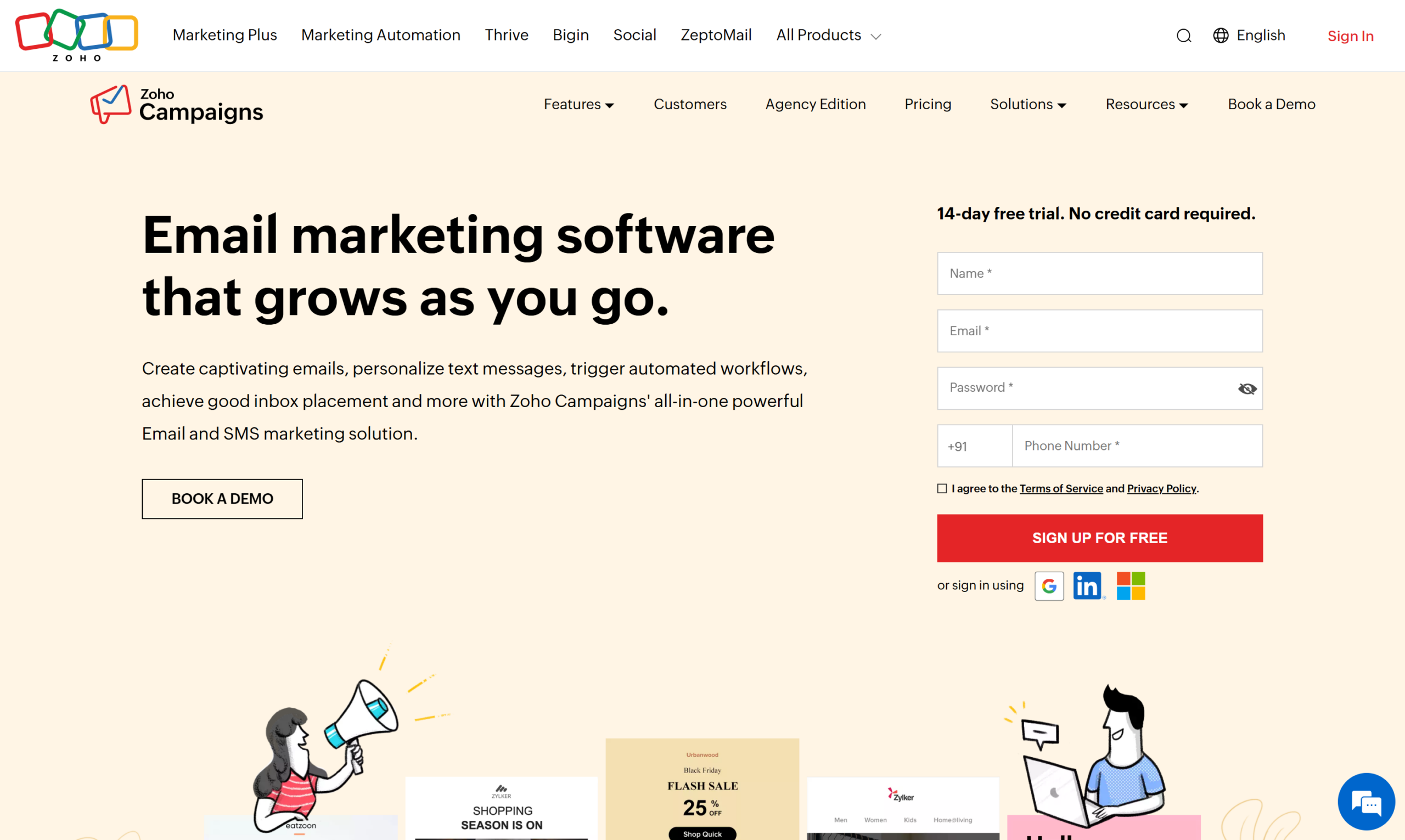
Zoho Campaigns is the right pick for nonprofits that already live inside the broader Zoho ecosystem — Zoho CRM for donor management, Zoho Books for accounting, Zoho Sign for donation agreements. Zoho One (the bundled suite) has one of the most generous nonprofit discount programs on the market, reaching 50% off the entire suite for qualifying organisations.
As a standalone email tool, Zoho Campaigns is capable but not best-in-class. Its strength is deep integration with Zoho CRM, which means donor fields (donation history, campaign source, event attendance) flow natively into email segmentation without a third-party sync.
Key features for nonprofits
- Up to 50% discount on Zoho One bundle (includes Zoho Campaigns, CRM, Forms, Surveys, and 40+ other apps)
- Native integration with Zoho CRM for donor-level segmentation
- Visual workflow builder with triggers, delays, branching
- A/B testing and advanced analytics
- Compliance tooling (GDPR, CAN-SPAM) built in
Pros: The Zoho One nonprofit discount on the full suite is the strongest bundled discount on the market. Integration with Zoho CRM is genuinely seamless. Good for nonprofits standardising on one vendor.
Cons: Only makes sense if you’re adopting (or already on) the Zoho ecosystem. Interface is functional but not polished. Email template library is smaller than mainstream competitors.
💰 Pricing: Zoho Campaigns standalone starts at $3/month (500 contacts). Zoho One nonprofit pricing varies by application.
👤 Best For: Nonprofits that want a full ecosystem (CRM + email + accounting + forms) on a single vendor with aggressive nonprofit discounts.
Free Mailchimp Alternatives for Nonprofits Worth Trying
If your budget is genuinely zero, these five free plans are the ones actually worth the sign-up time:
| Tool | Free Plan Limits | Standout For |
|---|---|---|
| Mailercloud | 1,000 contacts, 12,000 emails/month | Most feature-complete free plan (automation, Inbox Tracker, landing pages, AMP email) |
| Sender | 2,500 subscribers, 15,000 emails/month | Highest contact limit on a free plan |
| MailerLite | 1,000 subscribers, 12,000 emails/month | Cleanest UI, easiest onboarding |
| Brevo | Unlimited contacts, 300 emails/day | Best for large lists with infrequent sending |
| HubSpot | Free CRM + 2,000 marketing emails/month | Free CRM is the real value — pair it with any other email tool |
For most nonprofits, Mailercloud’s free plan is the best starting point because the feature ceiling is higher than competitors’ — you can test automation, segmentation, A/B testing, and deliverability tools on the free tier before committing to a paid plan. That’s much harder on Mailchimp’s free plan, which caps automations to single-step workflows.
How to Choose the Right Mailchimp Alternative for Your Nonprofit
- Best overall for small-to-mid nonprofits: Mailercloud — predictable pricing, strong deliverability, generous free tier
- Biggest recurring nonprofit discount: GetResponse (up to 50% off annual) or Constant Contact (30% off annual)
- Need SMS or WhatsApp alongside email: Brevo — multi-channel under one roof
- Tight budget, under 500 subscribers: EmailOctopus paid ($8/month) or Sender (free forever at 2,500 subs)
- Need donor CRM included: HubSpot Free CRM paired with any email tool, or Zoho Campaigns if standardising on Zoho
- Running recurring fundraising events: GetResponse (integrated webinars) or Constant Contact (event management)
- Ecommerce / product-side fundraising (merch, tickets): Mailercloud (transactional email API) or Brevo (pay-per-send)
Frequently Asked Questions
If you can’t decide, start with Mailercloud’s free plan. It’s the most feature-complete free tier on this list and gives you room to test donor automation and segmentation before paying anything. Comparing other tools too? We’ve also published deep-dive guides on Brevo alternatives and MailerLite alternatives for marketers shortlisting beyond Mailchimp.
What is the best Mailchimp alternative for nonprofits?
Mailercloud is the best overall Mailchimp alternative for nonprofits in 2026 — starting at $7/month with a free plan of 1,000 contacts and 12,000 emails per month. It ships with deliverability tooling (Inbox Tracker, guided SPF/DKIM/DMARC setup) and visual automation, which are the three areas where nonprofit email programs most often struggle. For nonprofits needing the largest recurring nonprofit discount specifically, GetResponse (50% off annual) and Constant Contact (30% off annual for verified 501(c)(3) organisations) are strong alternatives.
Does Mailchimp still offer a nonprofit discount?
Mailchimp ended its recurring 15% nonprofit discount in 2023. New nonprofit accounts now receive a one-time 15% off plus one free month — not recurring, and only available to brand-new accounts. Mailercloud offers transparent, everyday low pricing starting at $7/month, which works out to less than a discounted Mailchimp plan for most small-to-mid nonprofits. Constant Contact and GetResponse still offer recurring nonprofit discounts of 30% and 50% respectively on annual plans.
Is Mailchimp free for nonprofits?
Mailchimp’s free plan is available to nonprofits but limits accounts to 1,000 contacts and 1,000 emails per month. Mailercloud’s free plan allows 12 times the sends (12,000 emails per month) at the same 1,000-contact limit, and includes features Mailchimp’s free plan does not — multi-step automation, landing pages, and Inbox Tracker. For nonprofits serious about email, Mailercloud’s free plan is the more useful starting point.
What email marketing platforms offer the biggest nonprofit discount?
GetResponse offers the largest recurring nonprofit discount on this list at 50% off annual plans, followed by Constant Contact at 30% off annual and MailerLite at 30% off paid plans. Mailercloud does not offer a separate nonprofit discount because its standard pricing already starts at $7/month — lower than most competitors’ discounted nonprofit rates — but qualified nonprofits can contact Mailercloud support for case-by-case discount conversations on larger accounts.
What is the cheapest email marketing tool for small nonprofits?
For nonprofits with fewer than 2,500 subscribers, Sender’s free plan (2,500 subscribers, 15,000 emails per month) is the cheapest legitimate option at $0/month. Among paid options for small nonprofits, EmailOctopus starts at $8/month and Mailercloud at $7/month — both below the discounted Mailchimp nonprofit rate. For nonprofits above 2,500 subscribers, Mailercloud’s paid tiers offer the best price-to-feature ratio, particularly on the Inbox Tracker deliverability tool.
Can I migrate from Mailchimp to another tool easily?
Migration from Mailchimp to most alternatives — including Mailercloud — takes less than an hour for a typical nonprofit account. Export your contacts as a CSV from Mailchimp (Audience → Export Audience), upload to the new tool, recreate your signup forms, and rebuild any critical automations. Mailercloud’s support team offers free one-hour migration assistance for nonprofits, including mapping Mailchimp tags to Mailercloud segments.
Is Mailchimp still a good choice for nonprofits in 2026?
Mailchimp remains a capable email platform for nonprofits that are already heavily integrated with it and have budget to absorb the loss of the 15% recurring discount. For nonprofits starting fresh in 2026 — or re-evaluating their email stack — Mailercloud, Constant Contact, or GetResponse offer better value in almost every pricing tier. The case to stay with Mailchimp is migration inertia, not feature or pricing advantage.
Final Verdict — Why Mailercloud Is the Best Mailchimp Alternative for Nonprofits
Mailercloud wins as the default Mailchimp alternative for nonprofits because it addresses the five specific problems Mailchimp creates for this sector:
- Pricing is transparent and low from the start — no grandfathered discount to lose, no auto-upgrade traps, no contact-archive gotchas
- Free plan is 12x more generous on sends — 12,000 emails/month versus Mailchimp’s 1,000
- Deliverability tooling is built in — Inbox Tracker and guided authentication setup address the specific inbox-placement problem nonprofit lists tend to have
- Automation is available on free and paid plans — multi-step donor welcome sequences work without a premium upgrade
- 24/7 support on every plan — including the free plan, which matters for volunteer-run teams sending their first appeal at 9pm on a Friday
For nonprofits with under 10,000 contacts, switching to Mailercloud typically cuts monthly email cost by 40-60% versus a comparable Mailchimp plan, while gaining features (multi-step automation, deliverability analytics) that were previously locked behind higher Mailchimp tiers.
If you’re on Mailchimp and the price is creeping — or you’re setting up a new nonprofit and looking for a tool that will still be affordable in year three — Mailercloud is the first one to try.
Start your free Mailercloud account — 1,000 contacts, 12,000 emails/month, no credit card →

An SEO expert with a focus on on-page optimization, technical SEO, and keyword research. Dedicated to helping businesses improve search rankings and grow their online presence through data-driven strategies.