
Constant Contact has been around since 1995, but longevity doesn’t always mean it’s the best fit. With pricing that starts at $12/month for just 500 contacts and no free plan to speak of, many small businesses and marketers are looking for better options. In fact, over 2,100 people search for Constant Contact alternatives every month in the US alone.
Whether you’re frustrated by Constant Contact’s limited automation, its restrictive template editor, or the fact that prices climb steeply as your list grows, the good news is that the email marketing landscape has evolved dramatically. There are now powerful platforms that offer more features at lower prices — some with generous free plans that Constant Contact simply can’t match.
Further reading: Best Kit Alternatives.
We evaluated 10 email marketing platforms across deliverability, automation capabilities, ease of use, pricing transparency, and customer support. For a broader overview of the email landscape — including personal and business inbox providers — see our guide to the best email service providers. Here’s what we found after hands-on testing.
Table of Contents
Why Are People Looking for Constant Contact Alternatives?
Constant Contact was a pioneer in email marketing, but several pain points consistently push users toward competitors. The most common complaints center around three areas.
Pricing frustration is the top reason. Constant Contact’s Lite plan starts at $12/month for just 500 contacts, but the Standard plan jumps to $35/month, and the Premium plan hits $80/month. There’s no free plan at all — only a 14-day trial. Meanwhile, competitors like Brevo offer 300 emails/day for free, and MailerLite gives you a full-featured free tier for up to 1,000 subscribers.
Related guide: Best Mailchimp Alternatives for Nonprofits.
Limited automation is another major driver. While Constant Contact has added automation features over the years, they’re still basic compared to what ActiveCampaign, GetResponse, or even free tools like Mailercloud offer. If you’re specifically drawn to AMP-based interactive email automation — a format Constant Contact doesn’t support at all — see how tools in our Mailmodo alternatives guide handle this capability. Multi-step workflows, conditional branching, and behavioral triggers are either restricted to higher plans or missing entirely. If your core need is scale — sending to thousands of contacts without automation complexity — see our guide to the best bulk email sender platforms and what to look for. If GetResponse isn’t the right fit, see our GetResponse alternatives for 2026.
Template and design constraints round out the top three. The drag-and-drop editor feels dated compared to modern builders, and customization options are limited. Marketers who want pixel-perfect emails or AMP-powered interactive content often hit a wall.
For a deeper dive, see Best Omnisend Alternatives.
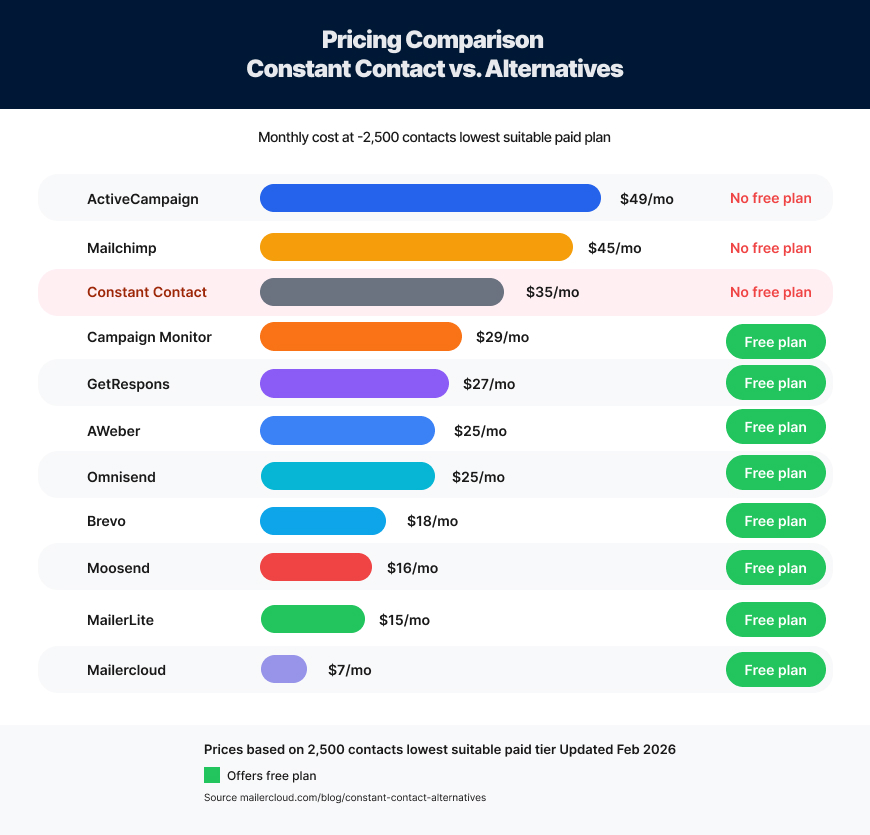
Constant Contact Competitors: How the Top 10 Compare
1. Mailercloud — Best Constant Contact Alternative for Overall Value
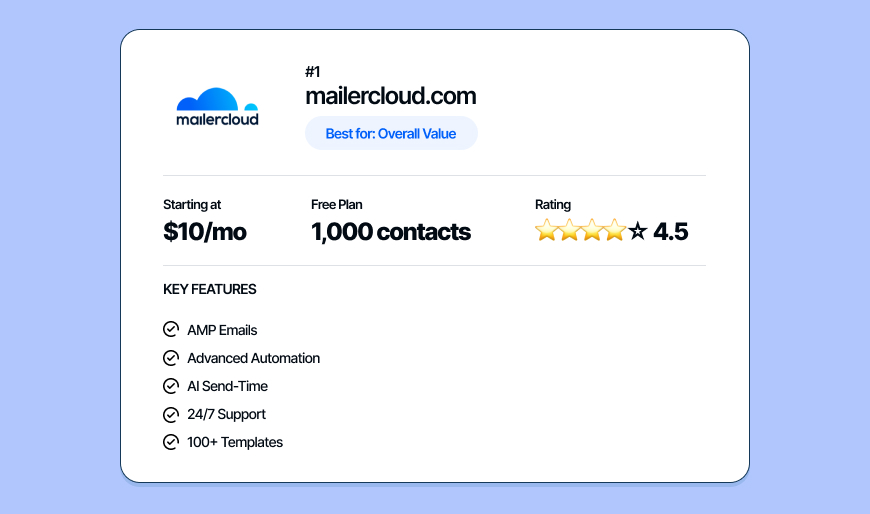
Mailercloud combines enterprise-grade deliverability with pricing that makes Constant Contact look expensive. It supports AMP emails out of the box, offers advanced automation workflows on every plan, and its drag-and-drop editor is genuinely intuitive. For businesses that need reliable email marketing without the inflated price tag, Mailercloud hits the sweet spot.
Learn more in our guide to Klaviyo alternatives.
Where Mailercloud particularly shines is deliverability. The platform uses AI-powered send-time optimization and built-in inbox placement monitoring to keep your emails out of the spam folder. Real users report open rates consistently above 25%, which is well above the industry average of 21%.
Key Features
- AMP Email Support — Create interactive emails with forms, carousels, and accordions directly inside the inbox
- Advanced Automation — Multi-step workflows with conditional branching, available even on lower-tier plans
- AI Send-Time Optimization — Automatically sends emails when each subscriber is most likely to open
- Real-Time Analytics — Track opens, clicks, bounces, and deliverability metrics in a live dashboard
- Drag-and-Drop Editor — Modern builder with 100+ templates and mobile-responsive designs
- List Segmentation — Segment by behavior, demographics, engagement level, and custom fields
| Pros | Cons |
|---|---|
|
✓ Free plan includes 1,000 contacts and 12,000 emails/month ✓ AMP email support (rare among competitors) ✓ Advanced automation on all plans ✓ Excellent deliverability rates ✓ 24/7 customer support via chat and email |
✗ Smaller integration marketplace than Mailchimp ✗ Less brand recognition than legacy platforms |
Pricing: Free plan up to 1,000 contacts (12,000 emails/month). Paid plans start at $10/month for 2,500 contacts. At 10,000 contacts: approximately $40/month. Significantly cheaper than Constant Contact at every tier.
Choose Mailercloud if you want the best balance of features, deliverability, and pricing — especially if AMP emails and advanced automation matter to you.
Skip it if you need 500+ native integrations or rely heavily on a specific third-party ecosystem.
2. Brevo (formerly Sendinblue) — Best Free Plan for High-Volume Senders
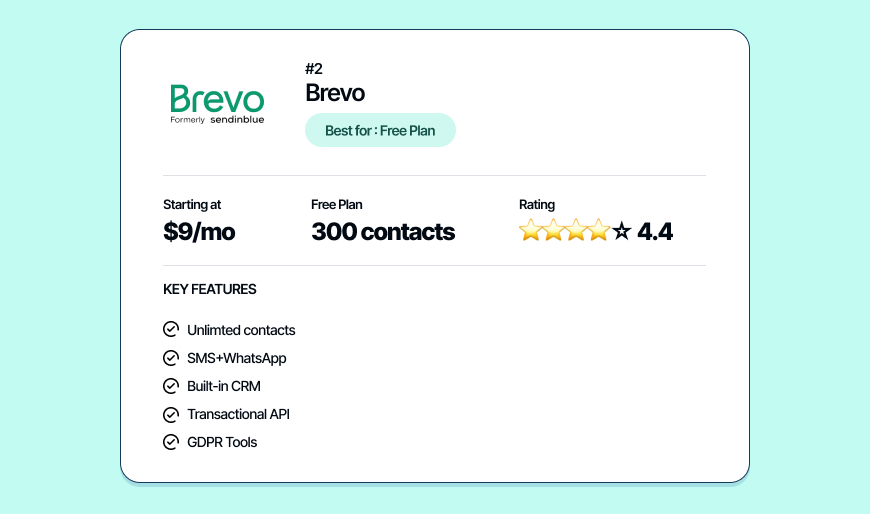
Brevo stands out with one of the most generous free tiers in email marketing: unlimited contacts with up to 300 emails per day. Unlike Constant Contact’s contact-based pricing, Brevo charges based on email volume, which can save serious money if you have a large list but don’t email frequently.
Beyond email, Brevo has evolved into a full CRM suite with SMS marketing, WhatsApp campaigns, live chat, and a built-in sales pipeline. It’s particularly popular among European businesses thanks to strong GDPR compliance tools and EU data hosting options.
Key Features
- Unlimited Contacts on every plan, including free
- Multi-Channel Marketing — Email, SMS, WhatsApp, and chat from one platform
- Built-in CRM — Sales pipeline and deal tracking included
- Marketing Automation — Visual workflow builder with behavioral triggers
- Transactional Emails — Dedicated transactional email API included
| Pros | Cons |
|---|---|
|
✓ Unlimited contacts on free plan (300 emails/day) ✓ Email-volume pricing saves money for large lists ✓ Multi-channel (SMS, WhatsApp, chat) ✓ Strong GDPR compliance tools |
✗ Brevo branding on free plan emails ✗ Email templates are more basic than competitors ✗ Automation limited to 2,000 contacts on free plan |
Pricing: Free plan with unlimited contacts, 300 emails/day. Starter plan from $9/month for 5,000 emails/month. Business plan from $18/month with advanced automation and A/B testing.
Choose Brevo if you have a large contact list but send infrequently, or if you want multi-channel marketing (email + SMS + WhatsApp) in one platform.
Skip it if you need best-in-class email templates or send high daily volumes on a tight budget.
3. MailerLite — Best Constant Contact Alternative for Beginners
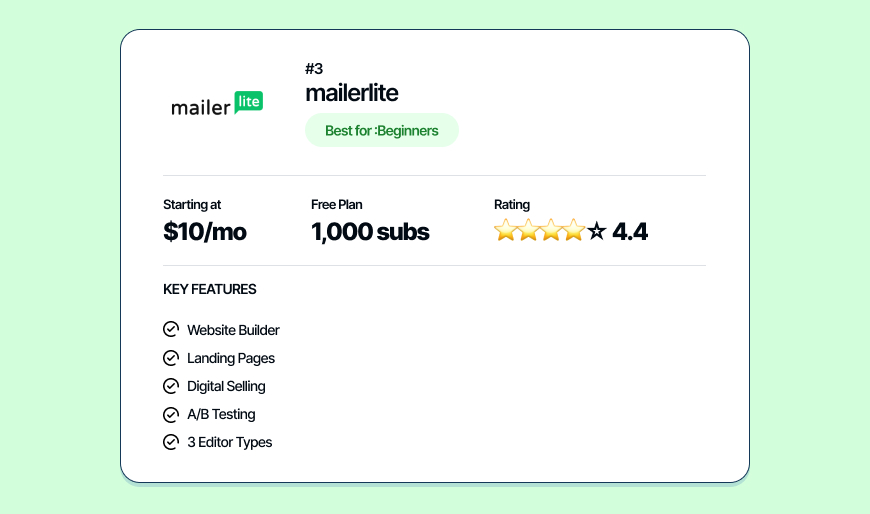
MailerLite is the platform people recommend when someone asks “what’s the easiest email marketing tool?” The interface is clean, the learning curve is gentle, and the free plan is genuinely useful with up to 1,000 subscribers and 12,000 monthly emails. It’s the anti-Constant Contact in many ways — simple where CC is cluttered, affordable where CC is expensive. (See our complete MailerLite alternatives guide for more details.)
Don’t mistake simplicity for weakness, though. MailerLite includes a website builder, landing page creator, and e-commerce selling tools alongside its core email features. For creators, bloggers, and small businesses, it often has everything you need in one place. For a deeper look at email strategy for smaller teams, see our complete small business email marketing playbook.
Key Features
- Intuitive Drag-and-Drop Editor — Three editor types: drag-and-drop, rich text, and HTML
- Website & Landing Page Builder — No need for a separate website tool
- Automation Workflows — Visual automation builder included on free plan
- Digital Product Selling — Sell downloads, subscriptions, and newsletters
- A/B Testing — Test subject lines, content, and send times
| Pros | Cons |
|---|---|
|
✓ Extremely user-friendly interface ✓ Free plan includes automation and landing pages ✓ Built-in website builder and e-commerce tools ✓ Excellent for creators and small businesses |
✗ Limited reporting on free plan ✗ No SMS or multi-channel marketing ✗ Approval process can delay account activation |
Pricing: Free plan up to 1,000 subscribers (12,000 emails/month). Growing Business plan from $10/month for 500 subscribers. Advanced plan from $20/month with enhanced automation and Facebook integration.
Choose MailerLite if you’re new to email marketing, value simplicity, or need a combined email + website solution on a budget.
Skip it if you need advanced segmentation, CRM features, or SMS marketing.
4. Mailchimp — Biggest Integration Ecosystem
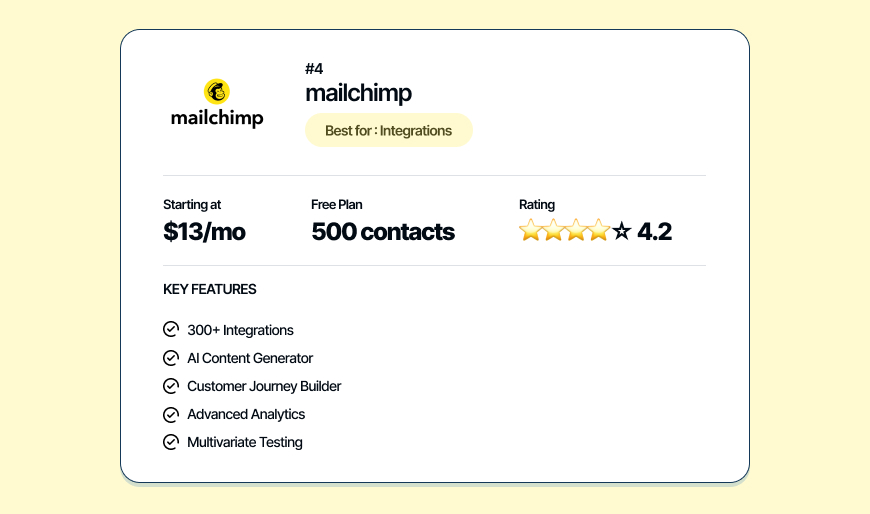
Mailchimp is the 800-pound gorilla of email marketing, and there’s a reason — it integrates with practically everything. With 300+ native integrations and broad third-party support through Zapier, Mailchimp connects to virtually any tech stack. If your workflow depends on connecting email to CRMs, e-commerce platforms, or custom tools, Mailchimp’s ecosystem is hard to beat.
That said, Mailchimp has become increasingly expensive since its Intuit acquisition. The free plan now caps at just 500 contacts with 1,000 monthly sends, and paid plans have steadily increased in price. For many small businesses, Mailchimp has gone from affordable starter tool to enterprise-priced platform. If Mailchimp is also on your radar and you want a dedicated comparison, see our full guide to the best Mailchimp alternatives for 2026.
Key Features
- 300+ Integrations — The largest native integration library in email marketing
- AI Content Generator — Generative AI tools for subject lines and email copy
- Customer Journey Builder — Visual automation with pre-built journey templates
- Advanced Analytics — Predictive demographics, purchase likelihood, and CLV estimates
- Multivariate Testing — Test up to 8 campaign variations simultaneously
| Pros | Cons |
|---|---|
|
✓ Unmatched integration ecosystem ✓ Powerful analytics and predictive features ✓ Strong brand recognition and community |
✗ Expensive — Standard plan starts at $20/mo for 500 contacts ✗ Free plan is very limited (500 contacts, 1,000 sends) ✗ Complex interface with a steep learning curve ✗ Charges for unsubscribed contacts |
Pricing: Free plan for 500 contacts (1,000 emails/month). Essentials from $13/month for 500 contacts. Standard from $20/month. Premium from $350/month. Prices increase sharply with contact count.
Choose Mailchimp if you need 300+ integrations or already rely on the Mailchimp/Intuit ecosystem.
Skip it if you’re price-sensitive or have a list over 2,500 contacts — costs escalate fast. If your list is newsletter-first rather than campaign-first, Beehiiv vs Mailchimp is the more relevant matchup.
5. Moosend — Most Affordable Paid Plan
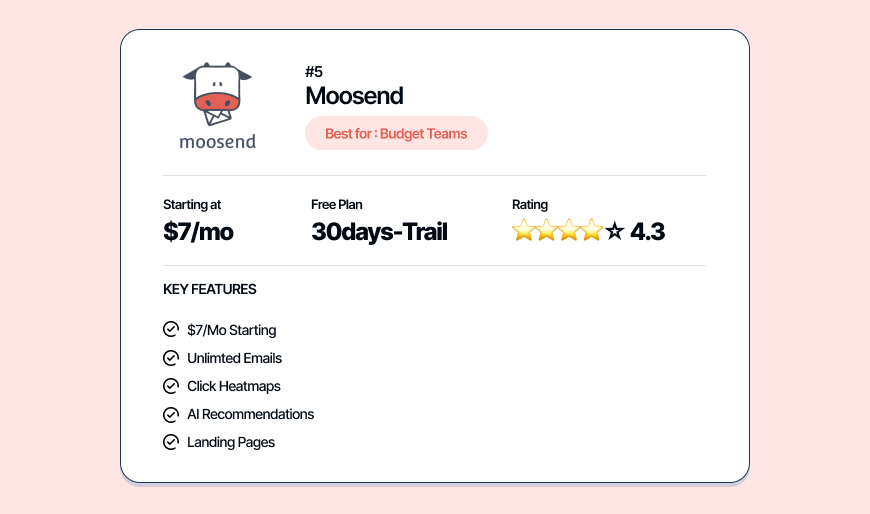
If budget is your primary concern, Moosend is hard to beat. At just $7/month for up to 500 subscribers with unlimited emails, it’s one of the cheapest paid email marketing platforms available. Despite the low price, Moosend doesn’t skimp on features — you get automation workflows, landing pages, and real-time analytics included.
Moosend was acquired by Sitecore in 2021, which has brought enterprise-level infrastructure to a small-business-friendly platform. The automation builder is surprisingly powerful for the price point, supporting conditional workflows, lead scoring, and weather-based personalization.
Key Features
- Automation Workflows — Pre-built recipes for cart abandonment, welcome series, and re-engagement
- Landing Page Builder — Create conversion-optimized pages without code
- Real-Time Analytics — Heatmaps for email click tracking
- Unlimited Emails — No sending limits on paid plans
- AI Product Recommendations — Dynamic content blocks for e-commerce
| Pros | Cons |
|---|---|
|
✓ Lowest starting price ($7/mo) ✓ Unlimited emails on all paid plans ✓ Solid automation for the price ✓ Email click heatmaps included |
✗ No permanent free plan (30-day trial only) ✗ Smaller template library than competitors ✗ Limited third-party integrations |
Pricing: 30-day free trial. Pro plan from $7/month for 500 subscribers (unlimited emails). Enterprise plan with custom pricing for dedicated IPs and priority support.
Choose Moosend if you want the absolute lowest cost with unlimited sending and decent automation.
Skip it if you need a free plan or rely on extensive third-party integrations.
6. Omnisend — Best Constant Contact Alternative for Ecommerce
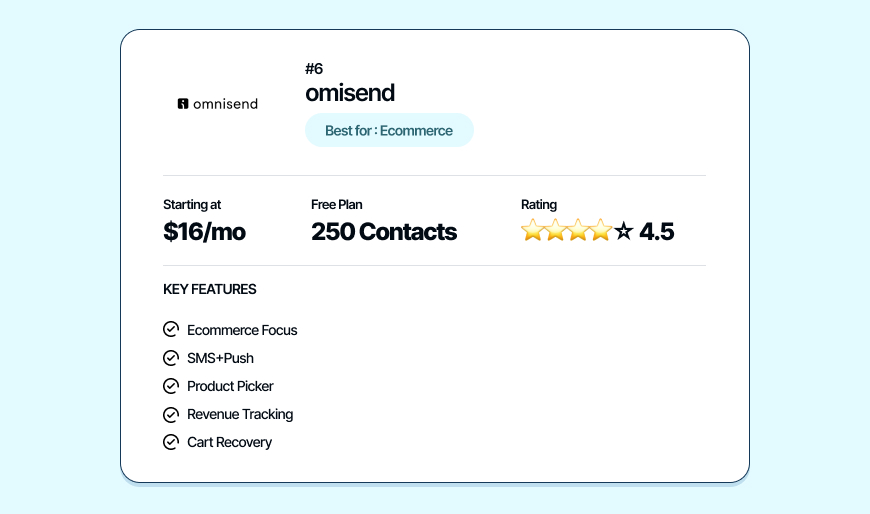
Omnisend was purpose-built for online stores, and it shows. Deep integrations with Shopify, WooCommerce, BigCommerce, and other e-commerce platforms mean you can trigger emails based on browsing behavior, cart contents, purchase history, and more. Add SMS and push notifications into the same workflow, and you have a true omnichannel marketing platform.
The pre-built automation workflows are a standout — cart abandonment, browse abandonment, order confirmation, cross-sell, and win-back sequences work right out of the box. For e-commerce brands that find Constant Contact’s automation too basic, Omnisend is a significant upgrade.
Key Features
- E-commerce Automations — Pre-built workflows for cart abandonment, welcome series, and post-purchase
- SMS + Push Notifications — Omnichannel messaging from one platform
- Product Picker — Pull products directly from your store into emails
- Campaign Booster — Automatically resend to non-openers with a new subject line
- Revenue Attribution — Track exactly how much revenue each email generates
| Pros | Cons |
|---|---|
|
✓ Best-in-class e-commerce integrations ✓ SMS and push notifications included ✓ Revenue attribution for every campaign ✓ Free plan with 250 contacts and 500 emails/month |
✗ Not ideal for non-ecommerce businesses ✗ Higher starting price than some competitors ✗ Limited free plan (250 contacts) |
Pricing: Free plan for 250 contacts (500 emails/month). Standard from $16/month for 500 contacts (6,000 emails/month). Pro from $59/month with unlimited emails and SMS credits.
Choose Omnisend if you run an online store and want email + SMS + push in one platform with revenue tracking.
Skip it if you’re not in e-commerce — you’ll be paying for features you won’t use.
7. GetResponse — Best for Automation + Webinars
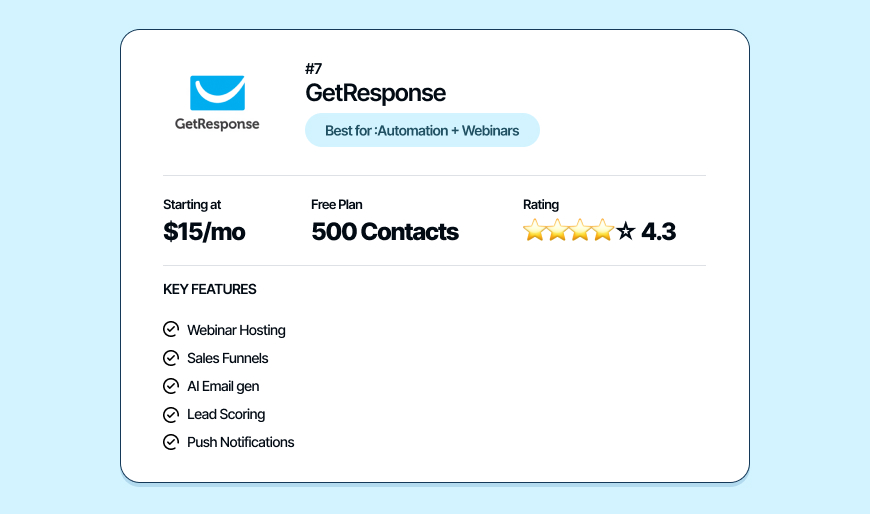
GetResponse is unique among Constant Contact alternatives because it bundles webinar hosting into its marketing platform. If you use webinars for lead generation, product demos, or customer education, having everything in one tool eliminates the need for separate webinar software. The automation builder is also one of the most capable in this price range.
Beyond webinars, GetResponse offers conversion funnels (pre-built marketing funnels), a website builder, and AI-powered email generation. It’s evolved from a simple email tool into a comprehensive marketing platform that covers the full customer journey.
Key Features
- Built-in Webinar Hosting — Host webinars for up to 1,000 attendees (no separate tool needed)
- Conversion Funnels — Pre-built sales funnels with landing pages, emails, and payment processing
- Advanced Automation — Visual builder with scoring, tagging, and conditional logic
- AI Email Generator — Create email copy and subject lines with GPT-powered AI
- Web Push Notifications — Browser notifications alongside email campaigns
| Pros | Cons |
|---|---|
|
✓ Webinar hosting included (unique feature) ✓ Powerful automation with lead scoring ✓ Conversion funnels streamline marketing ✓ Free plan for up to 500 contacts |
✗ Interface can feel overwhelming at first ✗ Webinars only on Marketing Automation plan and above ✗ Deliverability reports could be more detailed |
Pricing: Free plan for 500 contacts (2,500 newsletters/month). Email Marketing from $15.60/month for 1,000 contacts. Marketing Automation from $48.40/month (includes webinars). E-commerce from $97.60/month. Automation pricing varies widely across the category — see the full comparison of what 12 platforms include at each tier.
Choose GetResponse if webinars are part of your marketing strategy or you need built-in sales funnels alongside email.
Skip it if you just need simple email campaigns — you’d be paying for features you won’t use.
8. AWeber — Best Customer Support Among Constant Contact Competitors
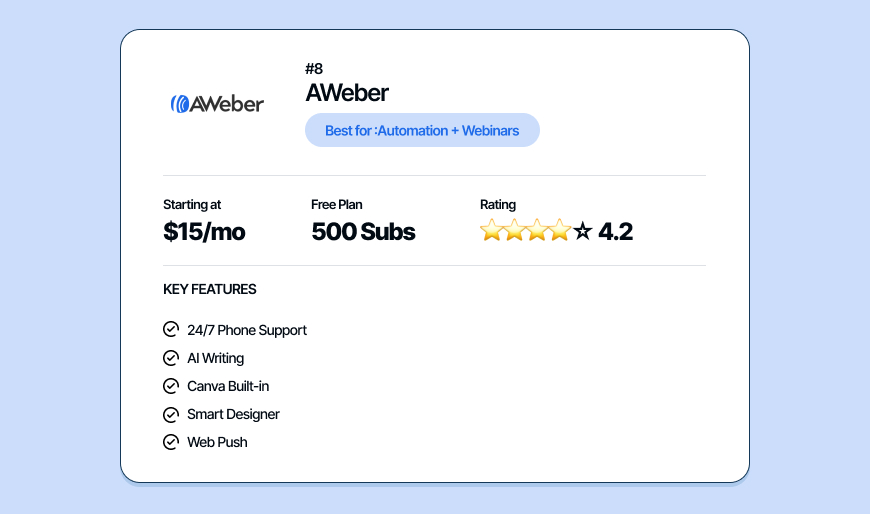
AWeber has been in the email marketing game since 1998 and has built a reputation for exceptional customer support. If you’re the type of user who values being able to call a real person or get a quick live chat response, AWeber consistently delivers. They offer 24/7 support via phone, live chat, and email on all plans — including the free tier.
Feature-wise, AWeber covers the fundamentals well. The drag-and-drop builder is straightforward, and their AI writing assistant can help generate subject lines and email copy. The autoresponder system is simple but effective for drip campaigns and welcome sequences.
Key Features
- 24/7 Phone & Live Chat Support — Available on all plans, including free
- AI Writing Assistant — Generate email copy, subject lines, and landing page text
- Canva Integration — Design graphics directly within the email editor
- Smart Designer — Auto-generates branded email templates from your website
- Web Push Notifications — Browser notifications alongside email
| Pros | Cons |
|---|---|
|
✓ Best-in-class customer support (24/7 phone, chat, email) ✓ Free plan for up to 500 subscribers ✓ Simple, reliable platform ✓ Strong deliverability track record |
✗ Automation is basic compared to competitors ✗ Templates feel dated ✗ Pricing gets expensive at scale |
Pricing: Free plan for 500 subscribers (3,000 emails/month, AWeber branding). Lite from $15/month for unlimited subscribers. Plus from $30/month. Unlimited from $899/month.
Choose AWeber if customer support is your top priority and you want a reliable, no-surprises email platform.
Skip it if you need advanced automation workflows or modern template designs. Our AWeber vs Mailchimp breakdown scores the two veterans round by round.
9. ActiveCampaign — Best Advanced Automation for B2B
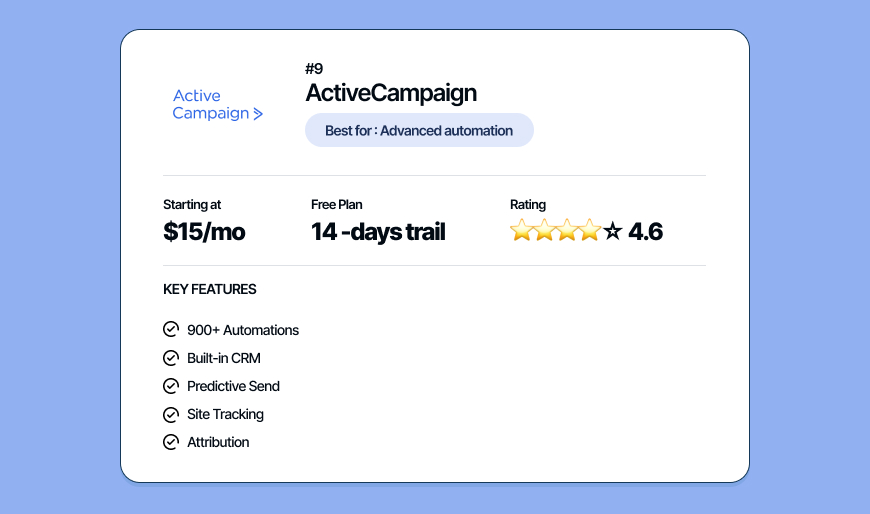
ActiveCampaign is the tool marketers graduate to when they’ve outgrown basic email platforms. Its automation builder is arguably the most powerful in the industry, supporting complex multi-step workflows with conditional logic, split actions, goal tracking, and predictive content. If your marketing strategy relies on sophisticated automation, ActiveCampaign is the gold standard.
The built-in CRM software solution makes ActiveCampaign particularly strong for B2B companies. Lead scoring, pipeline management, deal tracking, and sales automation are all integrated with the email marketing features. It’s not the cheapest option, but for teams that need marketing automation depth, it’s worth every penny.
Key Features
- Industry-Leading Automation — 900+ automation recipes with conditional logic, splits, and goals
- Built-in CRM — Sales pipeline, deal tracking, and lead scoring
- Predictive Sending — Machine learning optimizes send times per contact
- Site Tracking — Trigger automations based on website behavior
- Attribution Reporting — See which touchpoints drive conversions
| Pros | Cons |
|---|---|
|
✓ Most powerful automation builder available ✓ Integrated CRM with sales automation ✓ 900+ pre-built automation recipes ✓ Excellent deliverability |
✗ No free plan (14-day trial only) ✗ Steeper learning curve ✗ Gets expensive quickly ($79/mo at 2,500 contacts on Plus plan) |
Pricing: 14-day free trial. Starter from $15/month for 1,000 contacts. Plus from $49/month (includes CRM). Professional from $79/month. Enterprise from $145/month.
Choose ActiveCampaign if you need enterprise-grade automation and CRM in one platform, especially for B2B marketing.
Skip it if you’re just sending newsletters — you’d be paying for automation power you don’t need.
10. Campaign Monitor — Best Email Design Experience
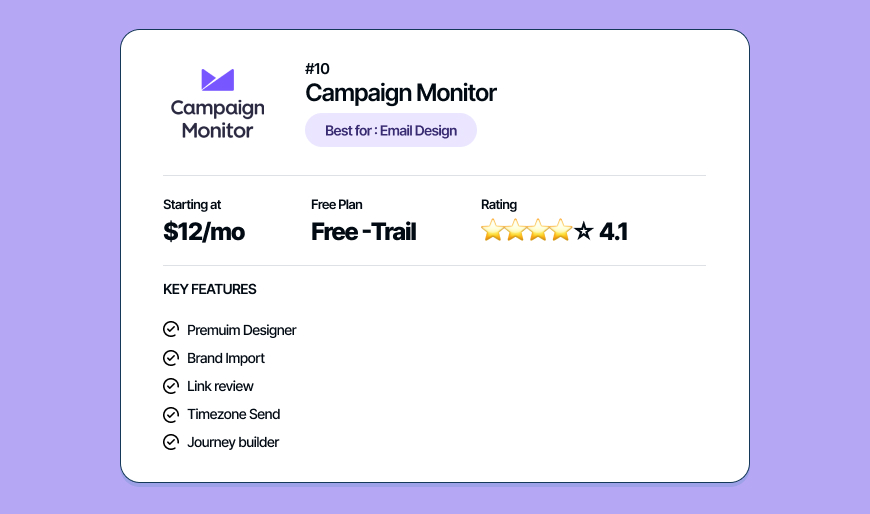
Campaign Monitor has earned a loyal following among design-conscious brands, and for good reason. Its email builder produces some of the most polished, on-brand emails in the industry. The template library is curated for quality over quantity, and the drag-and-drop editor offers fine-grained design control that other platforms can’t match.
Where Campaign Monitor falls short is pricing and automation. The Basic plan has limited features, and the Premier plan at $159/month feels steep compared to what competitors offer. But if email design quality is your top priority, Campaign Monitor delivers a premium experience. If that rules it out, see our list of the best Campaign Monitor alternatives.
Key Features
- Premium Email Builder — The most design-focused editor in email marketing
- Branded Templates — Auto-import brand colors, fonts, and logos from your website
- Link Review — Automatically checks all links before sending
- Timezone Sending — Deliver emails at the optimal local time for each recipient
- Visual Journey Designer — Drag-and-drop automation builder
| Pros | Cons |
|---|---|
|
✓ Best-in-class email design tools ✓ Auto-branded templates from your website ✓ Link review catches broken links before send ✓ Clean, intuitive interface |
✗ Expensive compared to alternatives ✗ Basic plan severely limits features ✗ No free plan (only a free trial with 5 subscribers) ✗ Automation is limited on lower tiers |
Pricing: Free trial (5 subscribers only). Lite from $12/month for 500 contacts (2,500 emails). Essentials from $29/month (unlimited emails). Premier from $159/month (advanced segments, phone support).
Choose Campaign Monitor if email design quality and brand consistency are your top priorities.
Skip it if you’re budget-conscious or need advanced automation at a reasonable price.
How We Tested These Constant Contact Alternatives
We evaluated each platform across six criteria: deliverability (inbox placement rates), automation depth (workflow complexity and triggers), ease of use (time from signup to first campaign sent), pricing fairness (cost at 500, 2,500, and 10,000 contacts), template quality (design flexibility and mobile responsiveness), and support responsiveness (average response time across channels). We created test accounts on each platform, sent test campaigns, and built automation workflows to provide recommendations grounded in actual usage rather than spec-sheet comparisons.
How to Switch from Constant Contact (5 Steps)
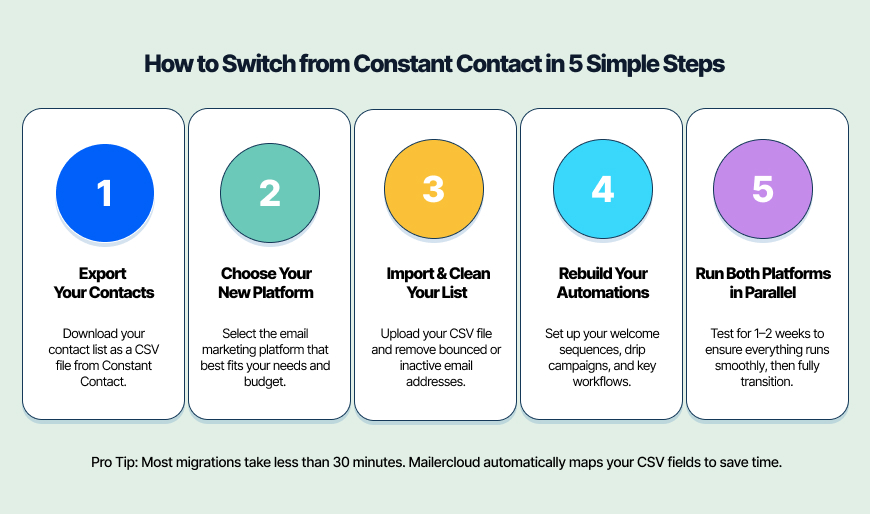
Step 1: Export your contacts. In Constant Contact, go to Contacts → Export. Download your full contact list as a CSV file. Make sure to include all custom fields, tags, and engagement data.
Step 2: Choose your new platform. Use the comparison table above to pick the best fit. Consider your primary use case (e-commerce, newsletters, B2B automation) and budget.
Step 3: Import and clean your list. Upload the CSV to your new platform. Most tools will automatically map standard fields (name, email). Take this opportunity to remove bounced addresses and unengaged contacts — a clean list improves deliverability from day one.
Step 4: Recreate your key automations. Set up your welcome series, drip campaigns, and any triggered emails in the new platform. Most alternatives offer pre-built templates that make this faster than starting from scratch.
Step 5: Run both platforms in parallel for 2 weeks. Send your next campaign from both Constant Contact and the new tool (to different segments). Compare deliverability, open rates, and click rates. Once you’re confident, cancel Constant Contact and go all-in. See how Mailercloud compares in our Mailercloud vs Constant Contact guide.
Frequently Asked Questions
- What is the best free alternative to Constant Contact?
Mailercloud and MailerLite both offer strong free plans with up to 1,000 contacts and 12,000 monthly emails. For larger contact lists, Brevo’s free plan allows unlimited contacts with 300 emails per day. Each has different strengths: Mailercloud excels in deliverability and AMP emails, MailerLite in ease of use, and Brevo in multi-channel marketing.
- Is Constant Contact worth the price in 2026?
For most small businesses, Constant Contact’s pricing is hard to justify. At $35/month for the Standard plan (2,500 contacts), you can get comparable or better features from Mailercloud ($10/month), MailerLite ($10/month), or Moosend ($7/month). Constant Contact’s strength is its event marketing tools and established brand, but for pure email marketing, more affordable alternatives have caught up or surpassed it.
- How does Constant Contact compare to Mailchimp?
Both are legacy email marketing platforms that have become increasingly expensive. Mailchimp has a larger integration ecosystem (300+ native integrations vs. Constant Contact’s 200+), while Constant Contact has better event marketing features. However, both are more expensive than newer alternatives like Mailercloud and MailerLite that offer similar or superior features at lower price points. If you’re comparing these two directly, see our in-depth Constant Contact vs Mailchimp comparison.
- Can I migrate my contacts from Constant Contact for free?
Yes. Constant Contact allows you to export your full contact list as a CSV at any time. Every platform on this list supports CSV imports for free. The migration process typically takes 15–30 minutes, and most tools will automatically map standard fields like name, email, and phone number.
- Which Constant Contact alternative has the best deliverability?
Based on our testing, Mailercloud and ActiveCampaign consistently deliver the highest inbox placement rates. Both use dedicated IP options, authentication protocols (SPF, DKIM, DMARC), and proactive list hygiene tools. AWeber also has a strong deliverability track record built over 25+ years of operation.
- What is the cheapest alternative to Constant Contact?
Moosend is the cheapest paid option at $7/month for 500 subscribers with unlimited emails. For free plans, Brevo offers the most generous free tier with unlimited contacts (300 emails/day), while Mailercloud and MailerLite both offer 1,000 contacts for free. All are significantly cheaper than Constant Contact’s starting price of $12/month for just 500 contacts.
- Which Constant Contact competitor is best for e-commerce?
Omnisend is the clear winner for e-commerce businesses. It offers deep integrations with Shopify, WooCommerce, and BigCommerce, along with pre-built automation workflows for cart abandonment, browse abandonment, and post-purchase sequences. It also includes SMS and push notifications in the same platform, making it a true omnichannel solution for online stores. For a deeper dive into the flows that drive ecommerce revenue, see our ecommerce email flows.

Vinoop Thayatt is the CEO of Mailercloud, an innovative email marketing platform helping businesses scale their communication efforts. With 12 years of experience in digital marketing, business development, and strategic planning, he has played a pivotal role in shaping Mailercloud’s vision and growth.