
Last updated: July 2026 | Pricing verified on July 29, 2026 | 18 min read
MailerLite’s free plan now caps at 250 subscribers and 2,500 emails a month — and if you cross that limit, sending stops entirely until you upgrade or delete contacts. Paid plans start at $12/month on Comfort and $25/month on Power, and they auto-charge you the moment your list crosses into the next tier. Add a dated automation builder that still lacks conditional splits, and it’s no surprise people are searching for something better.
Learn more in our guide to MailerLite vs Mailchimp.
We tested 12 email marketing platforms against MailerLite across five criteria: pricing, deliverability, automation depth, ease of use, and support. The short version? Mailercloud is the best MailerLite alternative in 2026 — it starts at $7/month, keeps a 1,000-contact free plan, and includes Inbox Tracker and AMP Email support that MailerLite doesn’t match.
See also: Convertkit alternatives.
Here’s the full breakdown.
Quick Answer: Mailercloud is the best MailerLite alternative in 2026 — starting at $7/month with a 1,000-contact free plan (double MailerLite’s current 250-contact cap). The other top 11 alternatives include Brevo, Mailchimp, ActiveCampaign, Kit (ConvertKit), Omnisend, GetResponse, HubSpot, Moosend, EngageBay, Constant Contact, and Sender. Mailercloud wins on deliverability (Inbox Tracker shows real-time inbox placement), interactive emails (AMP support), and pricing transparency — no auto-upgrades or hidden send caps (see our HubSpot vs Mailchimp). For a direct face-off between two of them, see ActiveCampaign vs HubSpot, compared.
Table of Contents
Why People Are Leaving MailerLite in 2026
MailerLite built its reputation on simplicity and a free plan. But several recent changes have pushed users to look elsewhere:
- Free plan capped at 250 subscribers. MailerLite’s free tier allows 250 subscribers and 2,500 emails/month — down from the 1,000 subscribers it used to offer. Cross the limit and campaigns and automations are locked until you upgrade
- Pricing climbs fast. Comfort starts at $12/month and Power at $25/month, but both are tiered by subscriber count. Cross a tier and MailerLite raises your limit and charges your card for the next band without asking. Comfort also caps sending at 10× your tier ceiling, so a 1,000-subscriber plan stops at 10,000 emails a month
- Basic automation. The free plan allows just 3 active automations with a 5-step limit. Comfort raises that to 50 automations and 100 steps, but multiple automation triggers are locked to Power at $25/month. If you need branching logic, lead scoring, or multi-channel triggers, you’ll hit a wall
- Limited segmentation. You can segment by basic fields and activity, but behavioral triggers, purchase-based targeting, and dynamic segments are either missing or restricted to higher plans
- Deliverability concerns. Multiple users on G2 and Reddit report emails landing in spam or promotions tabs even with proper SPF/DKIM authentication — particularly on the free plan using shared IPs
- No AMP Email support. Interactive email content (in-email forms, carousels, accordions) isn’t available. For marketers pushing engagement beyond static newsletters, this is a gap
If any of these sound familiar, the alternatives below address them directly.
How We Ranked These Alternatives
We evaluated each platform against five criteria, weighted by what matters most to marketers switching from MailerLite:
- Pricing transparency and value — what you actually pay at 1K, 5K, and 10K contacts, including hidden fee
- Deliverability and inbox placement — infrastructure quality, authentication support, IP reputatio
- Automation and segmentation depth — workflow complexity, conditional logic, behavioral trigger
- Ease of use — how quickly a MailerLite user can get productiv
- Support and onboarding — response times, availability, and channel option
We cross-referenced user reviews from G2, Capterra, and Reddit, verified pricing on each platform’s official site, and tested core features where possible.
At-a-Glance Comparison
| Tool | Best For | Free Plan | Starting Price | Standout Feature |
|---|---|---|---|---|
| Mailercloud#1 Pick | Best overall value | Yes 1,000 contacts |
$7/mo |
Inbox Tracker
AMP Emails
|
| Brevo | Email + SMS + CRM | Yes 300 emails/day |
$9/mo | Multi-channel |
| Mailchimp | Integrations & brand | Yes 500 contacts |
$13/mo | 300+ integrations |
| ActiveCampaign | Advanced automation | No 14-day trial |
$15/mo | 800+ automation recipes |
| Kit (ConvertKit) | Creators & bloggers | Yes 10,000 subs |
$15/mo | Creator commerce |
| Omnisend | Ecommerce stores | Yes 250 contacts |
$16/mo | Ecommerce flows |
| GetResponse | Webinars & funnels | Yes 500 contacts |
$15.58/mo | Built-in webinars |
| HubSpot | Full CRM suite | Yes Limited email |
$20/mo | CRM + marketing |
| Moosend | Budget automation | No 30-day trial |
$9/mo | Cheap automation |
| EngageBay | All-in-one SMB | Yes 250 contacts |
$13.79/mo | Marketing + Sales + Support |
| SendPulse | Email + chatbot + CRM combo | Yes 15,000 emails/month |
$10/mo | Automation flow builder |
| Constant Contact | Nonprofits & events | No 60-day trial |
$12/mo | Event management |
| Sender | Best free plan | Yes 2,500 contacts |
$10/mo | Generous free tier |
Pricing verified May 2026. Entry-level paid plans shown. Free plan limits vary by tool.
1. Mailercloud — Best Overall MailerLite Alternative
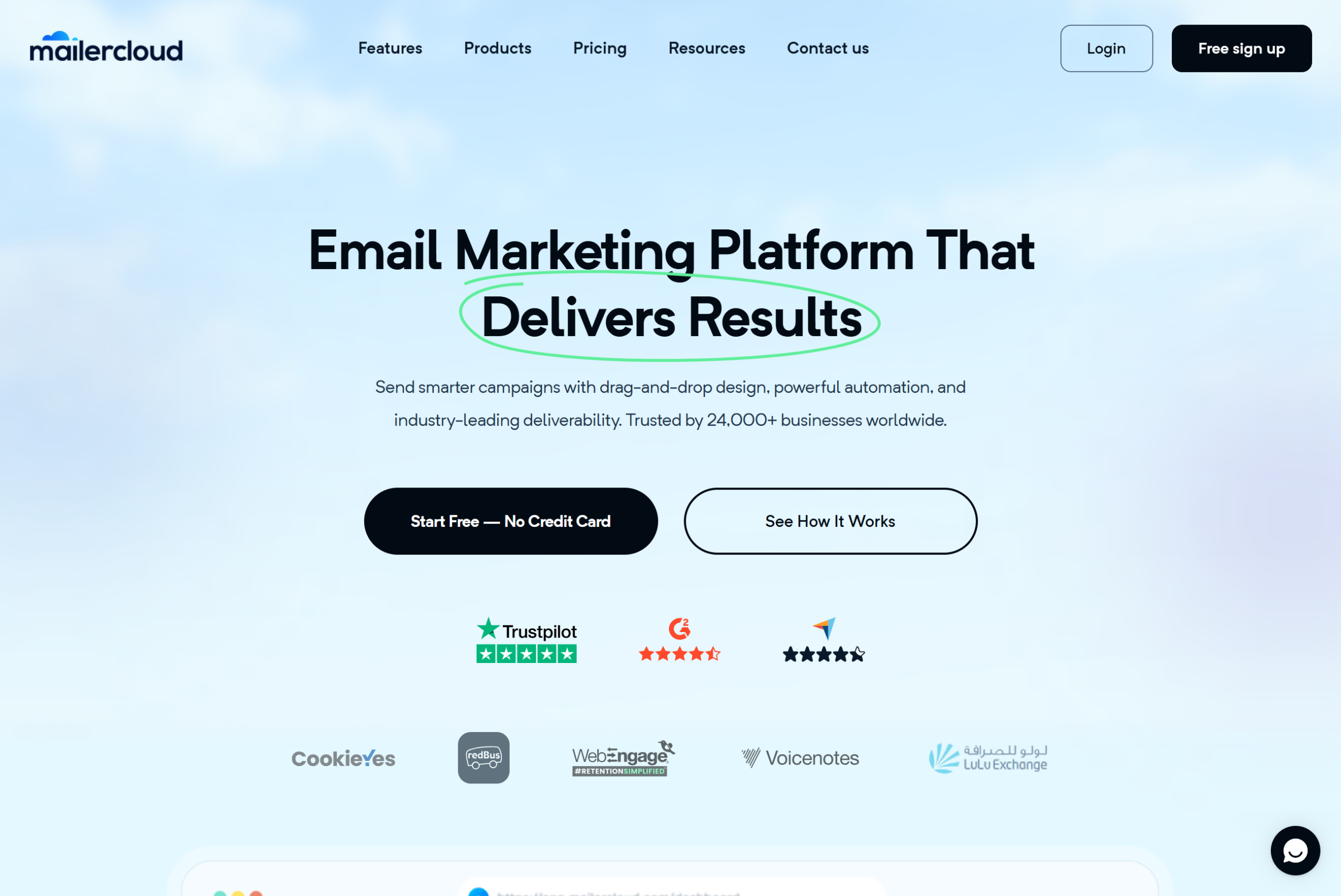
Mailercloud matches MailerLite’s simplicity but goes further where it counts: deliverability tracking, interactive emails, and pricing that stays predictable as you grow. Where MailerLite starts at $12/month on Comfort and auto-charges you as your list grows, Mailercloud starts at $7/month with no send-volume auto-upgrades or hidden caps.
Further reading: best Getresponse alternatives.
The standout difference is Inbox Tracker — a built-in tool that shows exactly where your emails land across Gmail, Outlook, Yahoo, and other major ISPs. MailerLite doesn’t offer this. You’re left guessing whether emails hit inbox, promotions, or spam. With Mailercloud, you see it in real time and can adjust before your next send. Mailercloud senders on the Standard plan achieved an average 94.3% inbox placement across Gmail, Outlook, and Yahoo — measured via Inbox Tracker across the user base in Q1 2026.
See also: Best Mailchimp Alternatives for Nonprofits.
Mailercloud also supports AMP for Email — interactive, app-like experiences right inside the inbox. Think embedded surveys, live product carousels, and in-email forms that submit without opening a browser. MailerLite doesn’t support AMP at all.
Further reading: best Omnisend alternatives.
Key Features
- Free plan: 1,000 contacts, 12,000 emails/month — no credit card, no time limi
- Inbox Tracker: real-time inbox vs. spam placement across 15+ ISP
- AMP Email support for interactive inbox experience
- Visual automation builder with conditional branching and trigger
- Drag-and-drop email editor with 100+ responsive template
- Built-in landing page and webform builde
- Advanced segmentation by behavior, demographics, and engagemen
- A/B testing for subject lines and conten
- Dedicated IP pools available on higher plan
- SPF, DKIM, and DMARC alignment built i
- Real-time campaign analytics with geo and device breakdow
- 24/7 live chat and email support on every plan, including fre
✓Pros:
- Free plan: 1,000 contacts and 12,000 emails/month — double MailerLite’s current free tier
- Starts at $7/month — cheapest full-featured option on this list
- Inbox Tracker shows exactly where emails land (inbox, spam, promotions) across 15+ ISPs
- AMP for Email support for interactive, app-like inbox experiences
- Visual automation with conditional branching and advanced triggers
- Drag-and-drop editor with 100+ responsive templates
- Built-in landing page and signup form builder
- Advanced segmentation by behavior, demographics, and engagement
- A/B testing for subject lines and content
- SPF, DKIM, and DMARC alignment built in
- Real-time analytics with geo and device breakdown
- 24/7 live chat and email support on every plan, including free
✗Cons:
- Smaller third-party integration library compared to Mailchimp or HubSpot
- Native SMS marketing is still in development (roadmap item)
- Lower brand recognition in the US market compared to Mailchimp
💰Pricing: Free plan available (1,000 contacts, 12,000 emails/month). Paid plans start at $7/month with no ecommerce transaction fees.
Pricing: Free plan available (1,000 contacts, 12,000 emails/month). Paid plans start at $7/month. No ecommerce transaction fees.
Best For: Small to mid-size businesses that want modern email features, strong deliverability, and transparent pricing without MailerLite’s limitations.
Verdict: Mailercloud gives you everything MailerLite does — plus Inbox Tracker, AMP Emails, and 24/7 support — at a lower starting price. If you’re outgrowing MailerLite, this is the most logical upgrade. Start your free Mailercloud account (no credit card needed) →
2. Brevo — Best for Email + SMS on a Budget
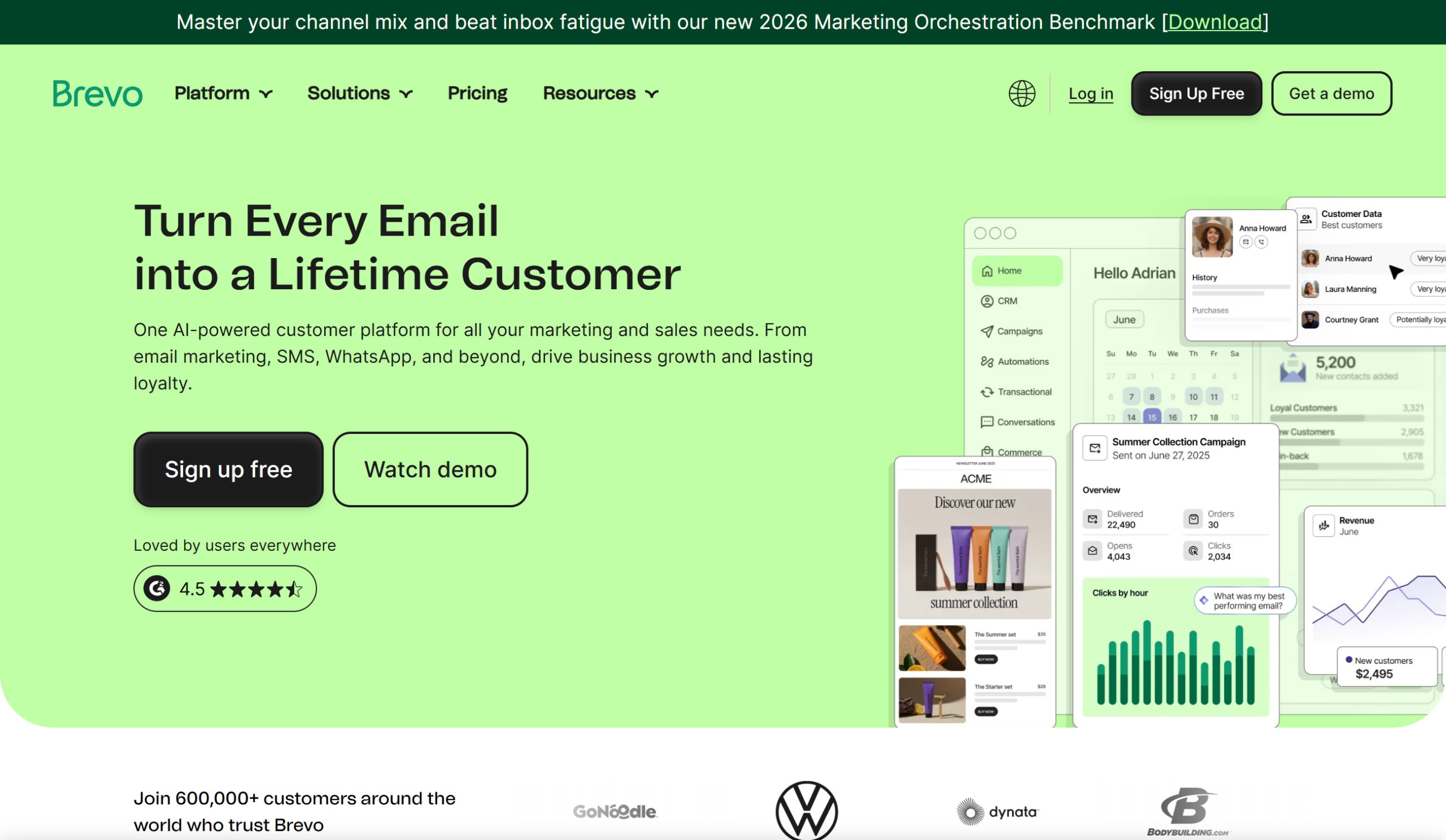
Brevo (formerly Sendinblue) charges by emails sent, not contacts stored. That pricing model alone makes it attractive for businesses with large lists but moderate send frequency — exactly the opposite of MailerLite’s contact-based billing.
Further reading: best Activecampaign alternatives.
The platform bundles email, SMS, WhatsApp, and a basic CRM into one dashboard. The free plan allows unlimited contacts with a 300 emails/day cap. For teams that need multi-channel outreach without juggling multiple tools, Brevo consolidates well.
For a deeper dive, see Best Klaviyo Alternatives.
Key Features
- Unlimited contacts on every plan, including fre
- Email + SMS + WhatsApp marketing in one platfor
- Visual automation workflows with event-based trigger
- Built-in CRM with deal pipeline trackin
- Transactional email API for order confirmations and receipt
✓Pros:
- Unlimited contacts on every plan, including free — MailerLite charges per contact
- Email + SMS + WhatsApp marketing in one platform
- Built-in CRM with deal pipeline tracking
- Transactional email API included
- Pricing based on emails sent, not contacts stored
✗Cons:
- Free plan limited to 300 emails/day (not per month)
- Email editor has a steeper learning curve than MailerLite’s
- Advanced automation locked behind $65/month Business plan
- Deliverability can be inconsistent on shared IPs
💰Pricing: Free plan (unlimited contacts, 300 emails/day). Paid plans start at $9/month for 5,000 emails.
Pricing: Free plan (unlimited contacts, 300 emails/day). Paid plans start at $9/month for 5,000 emails. (Brevo Pricing, accessed May 2026)
Best For: Businesses that want email + SMS + CRM in one tool without paying per contact.
3. Mailchimp — Best Brand Recognition and Integration Ecosystem
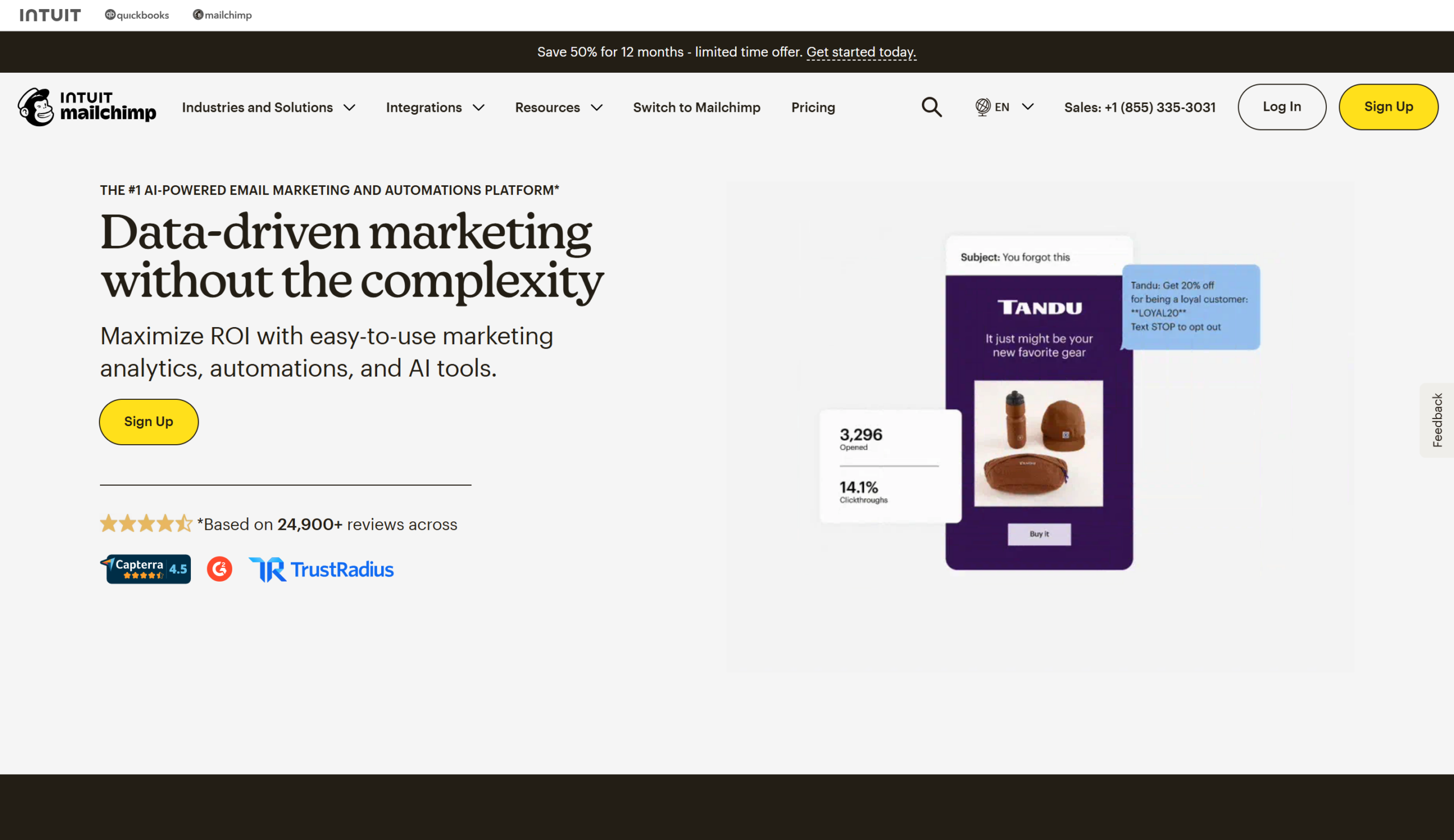
Mailchimp remains the most recognized name in email marketing, with 300+ integrations and a polished interface. But recognition comes at a cost: the free plan now caps at 500 contacts and 1,000 sends/month, and paid plans start at $13/month — nearly double Mailercloud’s entry price.
Further reading: best Brevo alternatives.
Where Mailchimp shines is its integration library and AI-powered content suggestions. If your stack depends on niche third-party tools, Mailchimp likely connects to them.
Key Features
- 300+ native integrations with ecommerce, CRM, and CMS platform
- AI-powered subject line and content recommendation
- Predictive segmentation and customer journey builde
- Multivariate testing (up to 8 variables on Premium
- Social media posting and ad management built i
✓Pros:
- 300+ native integrations — largest ecosystem on this list
- AI-powered content and subject line recommendations
- Predictive segmentation and customer journey builder
- Multivariate testing with up to 8 variables (Premium)
- Strong brand recognition and established infrastructure
✗Cons:
- Free plan cut to 500 contacts and 1,000 sends/month
- Starting price of $13/month — nearly double Mailercloud
- Charges for unsubscribed contacts on your list
- Advanced automation requires Standard plan ($20+/month)
💰Pricing: Free plan (500 contacts, 1,000 sends/month). Standard plan starts at $13/month.
Pricing: Free plan (500 contacts, 1,000 sends/month). Standard plan starts at $13/month. (Mailchimp Pricing, accessed May 2026)
Best For: Established businesses that need extensive third-party integrations and don’t mind paying more for brand familiarity.
4. ActiveCampaign — Best for Advanced Automation and CRM
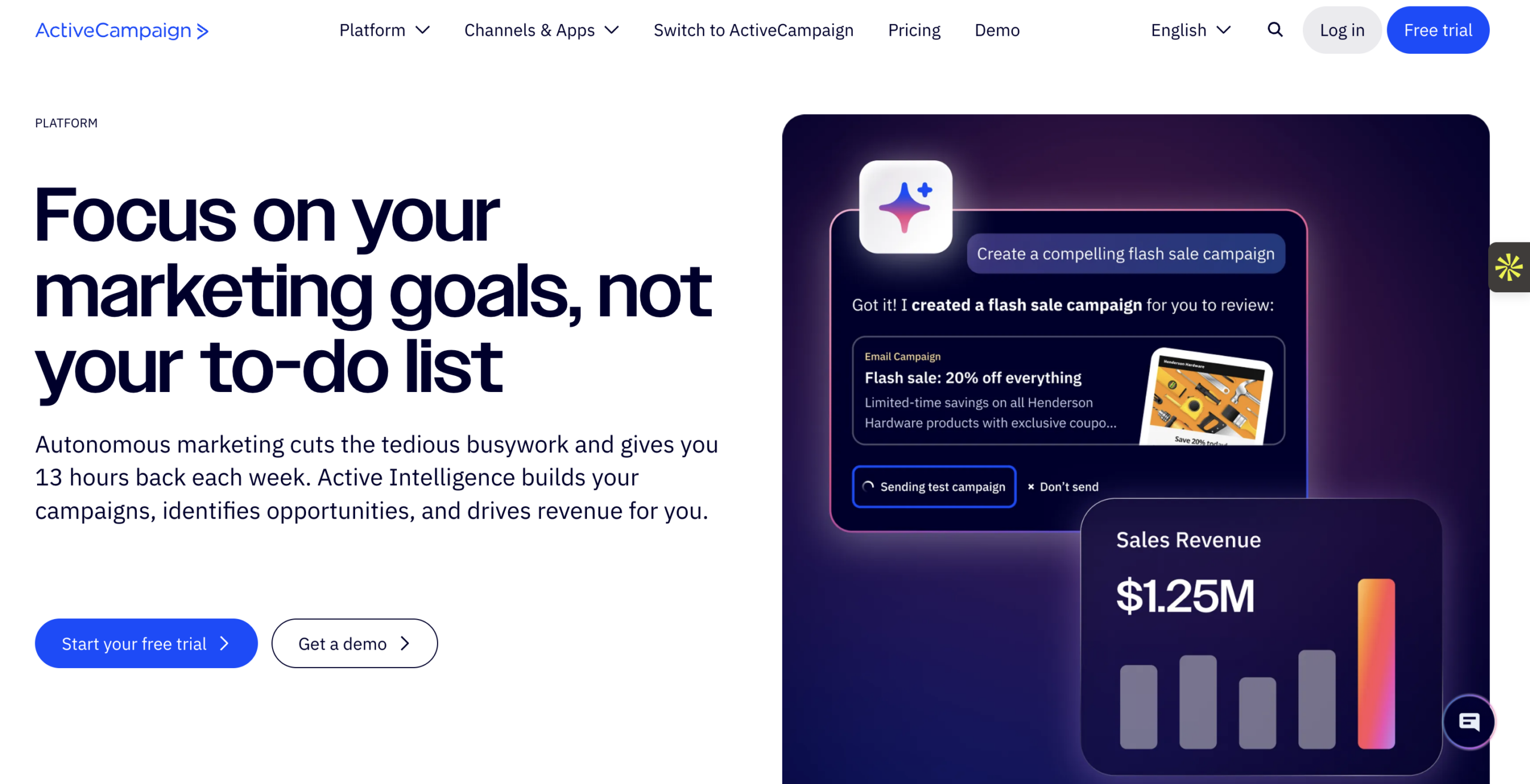
ActiveCampaign is the automation specialist. Its visual workflow builder supports conditional logic, if/else branching, lead scoring, site tracking, and CRM pipeline management — features MailerLite simply doesn’t offer. The trade-off: there’s no free plan, and the learning curve is steeper.
Key Features
- Visual automation with 800+ pre-built recipe
- Built-in CRM with deal tracking and sales automatio
- Site and event tracking for behavioral trigger
- Lead scoring with predictive win probabilit
- 950+ integrations via native and Zapier connection
✓Pros:
- Most advanced automation builder on this list — 800+ pre-built recipes
- Built-in CRM with deal tracking and sales automation
- Site and event tracking for behavioral triggers
- Lead scoring with predictive win probability
- 950+ integrations via native and Zapier
✗Cons:
- No free plan — only a 14-day trial
- Starts at $15/month — more than double Mailercloud’s entry price
- Steeper learning curve for non-technical users
- Pricing scales aggressively above 10,000 contacts
💰Pricing: No free plan (14-day trial). Starter plan starts at $15/month for 1,000 contacts.
Pricing: No free plan. Starter plan starts at $15/month for 1,000 contacts. (ActiveCampaign Pricing, accessed May 2026)
Best For: B2B and SaaS teams that need deep automation, lead scoring, and CRM in one platform.
5. Kit (formerly ConvertKit) — Best for Content Creators

Kit is built for creators who sell digital products, courses, and paid newsletters. Its tag-based subscriber management is simpler than MailerLite’s list-based system, and the free plan covers up to 10,000 subscribers — the most generous in this list. Our Mailchimp vs ConvertKit guide shows how Kit fares against the biggest name in email.
Key Features
- Tag-based subscriber management (no separate lists
- Visual automation for email sequences and funnel
- Built-in commerce: sell digital products and paid subscription
- Creator Network for cross-promotion with other creator
- Free plan: 10,000 subscribers with limited send
✓Pros:
- Most generous free plan: 10,000 subscribers
- Tag-based management is simpler than list-based systems
- Built-in commerce for digital products and paid newsletters
- Creator Network for cross-promotion
- Clean, minimal interface designed for writers and creators
✗Cons:
- Limited email design options — text-focused templates only
- No AMP Email or interactive content support
- Automation limited on free plan
- Not suited for ecommerce or B2B marketing
💰Pricing: Free plan (10,000 subscribers, limited features). Creator plan starts at $15/month.
Pricing: Free plan (10,000 subscribers, limited features). Creator plan starts at $15/month. (Kit Pricing, accessed May 2026)
Best For: Bloggers, YouTubers, and solo creators who monetize their audience through digital products.
6. Omnisend — Best for Ecommerce Stores
Omnisend is purpose-built for ecommerce. Pre-built workflows for cart abandonment, browse abandonment, order follow-ups, and win-back campaigns work out of the box with Shopify, WooCommerce, and BigCommerce. MailerLite doesn’t offer this level of ecommerce-specific automation.
Key Features
- Pre-built ecommerce workflows (cart recovery, post-purchase, win-back
- Email + SMS + web push in a single campaig
- Dynamic product recommendations in email
- Deep Shopify, WooCommerce, and BigCommerce integration
- Revenue attribution per campaign and automatio
✓Pros:
- Purpose-built ecommerce workflows (cart recovery, post-purchase, win-back)
- Email + SMS + web push in a single campaign
- Revenue attribution per campaign and automation
- Deep Shopify, WooCommerce, and BigCommerce integrations
- Dynamic product recommendations in emails
✗Cons:
- Free plan limited to 250 contacts and 500 emails/month
- Not suitable for non-ecommerce businesses
- Fewer general marketing features than Mailercloud or Brevo
- SMS credits cost extra on all plans
💰Pricing: Free plan (250 contacts, 500 emails/month). Standard plan starts at $16/month.
Pricing: Free plan (250 contacts, 500 emails/month). Standard plan starts at $16/month. (Omnisend Pricing, accessed May 2026)
Best For: Online stores that want email + SMS automation with built-in revenue tracking.
7. GetResponse — Best for Webinars and Funnels
GetResponse bundles email marketing with webinar hosting, sales funnels, and landing pages — a combination no other tool on this list matches. If your marketing strategy relies on webinars to generate leads, GetResponse eliminates the need for a separate webinar platform.
Key Features
- Built-in webinar hosting (up to 1,000 live attendees
- Conversion funnel builder for lead generation and sale
- AI-powered email generator and subject line scorin
- Landing pages with A/B testin
- Paid newsletter monetization tool
✓Pros:
- Built-in webinar hosting — unique among email platforms
- Conversion funnel builder for lead gen and sales
- AI-powered email generator and subject line scoring
- Landing pages with A/B testing on all plans
- Paid newsletter monetization tools
✗Cons:
- Free plan limited to 500 contacts with restricted features
- Paid plans start at $15.58/month — higher than Mailercloud
- Interface feels cluttered with too many features
- Webinar feature only available on higher-tier plans
💰Pricing: Free plan (500 contacts, limited features). Email Marketing plan starts at $15.58/month.
Pricing: Free plan (500 contacts, limited features). Email Marketing plan starts at $15.58/month. (GetResponse Pricing, accessed May 2026)
Best For: Marketers and coaches who use webinars as a core lead-generation channel.
8. HubSpot Marketing Hub — Best Full CRM + Email Suite
HubSpot is overkill if you just need email marketing. But if you want email, CRM, sales pipelines, customer service, and marketing automation under one roof, it’s hard to beat. The free CRM is excellent; the email marketing features improve dramatically on paid plans starting at $20/month.
Key Features
- Full CRM with contact management, deals, and tasks — fre
- Email marketing with personalization tokens and smart conten
- Marketing automation with revenue attributio
- Landing pages, forms, and ad managemen
- Detailed reporting dashboards with ROI trackin
✓Pros:
- Full CRM with contact management, deals, and tasks — free
- Marketing automation with revenue attribution
- Deep reporting dashboards with ROI tracking
- Landing pages, forms, and ad management included
- Excellent ecosystem for sales + marketing alignment
✗Cons:
- Marketing Hub starts at $20/month — expensive for email-only needs
- Pricing jumps dramatically at Professional tier ($890/month)
- Overkill complexity for simple email marketing
- Free email tools are very limited
💰Pricing: Free CRM with basic email. Marketing Hub Starter at $20/month for 1,000 contacts.
Pricing: Free CRM with basic email. Marketing Hub Starter at $20/month for 1,000 contacts. (HubSpot Pricing, accessed May 2026)
Best For: Growing businesses that want a unified CRM, sales, and marketing platform — and have the budget for it.
9. Moosend — Best Budget Alternative with Automation
Moosend packs automation features into a $9/month starting price — making it one of the cheapest platforms that still offers workflow builders, conditional logic, and custom triggers. The interface is clean and the template library is solid, though not as large as Mailchimp’s or Mailercloud’s.
Key Features
- Visual automation with conditional workflow
- 80+ responsive email template
- Real-time analytics and heatmap
- Landing pages and subscription forms include
- Ecommerce integrations with product recommendation
✓Pros:
- Strong automation at a low $9/month entry price
- Visual workflow builder with conditional logic
- Real-time analytics and email heatmaps
- Landing pages and forms included on all plans
- Ecommerce integrations with product recommendations
✗Cons:
- No free plan — only a 30-day trial
- Template library (~80) is smaller than competitors
- Limited integrations compared to Mailchimp or HubSpot
- Owned by Sitecore — future pricing direction uncertain
💰Pricing: No free plan (30-day trial). Pro plan starts at $9/month for 500 subscribers.
Pricing: No free plan (30-day free trial). Pro plan starts at $9/month for 500 subscribers. (Moosend Pricing, accessed May 2026)
Best For: Budget-conscious businesses that still want workflow automation at a low price.
10. EngageBay — Best All-in-One for Small Teams
EngageBay bundles marketing, sales, and support tools at a price point that undercuts HubSpot significantly. The free plan covers 250 contacts with email marketing, CRM, and a helpdesk — making it a solid choice for small teams that want everything in one place.
Key Features
- Marketing automation + CRM + helpdesk in one platfor
- Visual workflow builder with multi-step sequence
- Landing pages, forms, and pop-up
- Deal pipeline management with task automatio
- Live chat and ticketing system include
✓Pros:
- Marketing + sales + support in one platform at SMB pricing
- Free plan covers 250 contacts with CRM and helpdesk
- Visual automation workflows with multi-step sequences
- Landing pages, forms, and pop-ups included
- Live chat and ticketing system on all plans
✗Cons:
- Email templates feel outdated compared to newer platforms
- Deliverability tracking is basic — no inbox placement data
- Automation builder is less intuitive than ActiveCampaign’s
- Limited third-party integrations
💰Pricing: Free plan (250 contacts). Basic plan starts at $13.79/month.
Pricing: Free plan (250 contacts). Basic plan starts at $13.79/month. (EngageBay Pricing, accessed May 2026)
Best For: Small teams that want marketing + sales + support tools without HubSpot’s price tag.
11. SendPulse — Best for Email and Chatbot combo + a Free Built-In CRM
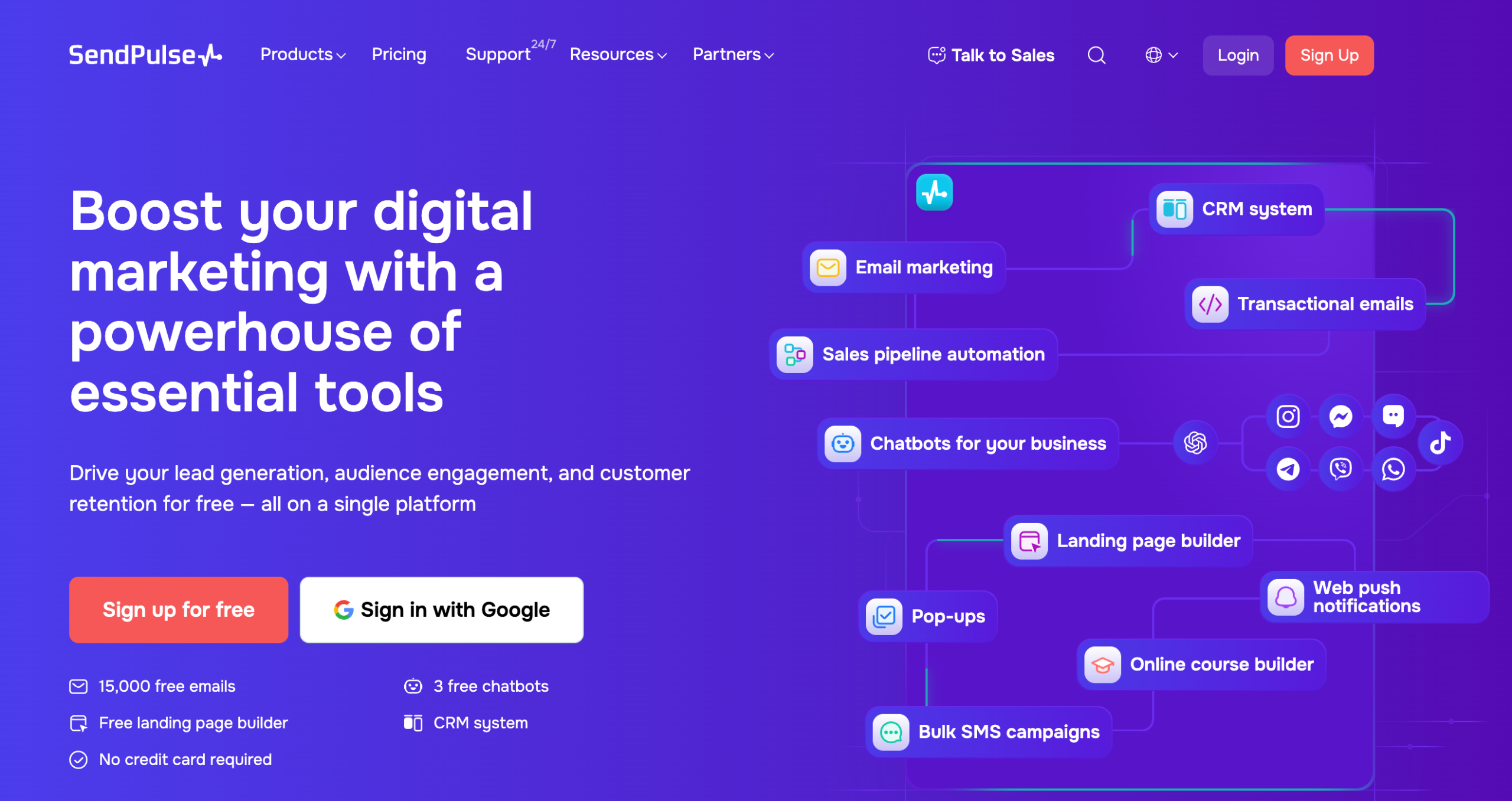
SendPulse pairs its email marketing platform with a genuinely free CRM system, so contacts, deal pipelines, and campaign history live in the same workspace instead of a separate tool you have to bolt on. Where MailerLite keeps automation and contact management purely to email, SendPulse ties email, SMS and chatbots (WhatsApp, Instagram, Facebook, Telegram, TikTok, Viber), and sales pipelines into one connected system.
Key Features
- Free CRM system with automated pipelines, deal cards, and full customer interaction history
- Email marketing with a drag-and-drop builder, 140+ templates, and flow-based automation
- Automated abandoned-cart, order-update, feedback, and win-back campaigns tied to CRM deals
- Chatbots for WhatsApp, Instagram, Facebook, Telegram, TikTok, and Viber, connected to the same contact records
- Payment links, invoices, and document templates generated directly from CRM deals
✓Pros:
- Free-forever plan includes both email marketing and the full CRM system, no credit card required
- Official WhatsApp Business API provider for WhatsApp campaigns
- Marketing, sales, and support run on one connected platform rather than separate tools
- Automated pipelines pull in leads and orders from carts, forms, pop-ups, and chatbots automatically
- Built-in support for repeat purchases, upsells, and cross-sells through automated post-purchase flows
✗Cons:
- Free plan caps out at 500 subscribers, smaller than some competitors on this list
- CRM depth is aimed at SMB workflows rather than enterprise-scale sales operations
💰Pricing: Free plan (up to 500 subscribers, 15,000 emails/month, full CRM included, no credit card required). Standard plan starts at $9.60/month (billed annually, up to 500 subscribers).
subscribers).
Pricing: Free plan (500 subscribers, 15,000 emails/month, CRM included). Standard plan starts at $9.60/month billed annually. (SendPulse Pricing, accessed September 2026)
Best For: Scaling businesses and online stores that want email marketing and a CRM working together out of the box with an option to add chatbots or SMS campaigns.
12. Constant Contact — Best for Nonprofits and Event Marketing
Constant Contact has been around since 1995 and shows it — the interface feels dated compared to newer tools. But its strength is event management, donation tools, and nonprofit discounts that competitors don’t match. If you run events or rely on fundraising, it’s worth a look. If you’re comparing these two directly, see our in-depth Constant Contact vs Mailchimp comparison.
Key Features
- Built-in event management with RSVP trackin
- Social media posting and ad managemen
- Survey and poll tools built into emai
- Nonprofit discounts (up to 30% off
- 300+ integrations with ecommerce and CRM tool
✓Pros:
- Built-in event management with RSVP tracking
- Nonprofit discounts up to 30%
- Social media posting and ad management
- Survey and poll tools built into email
- 300+ integrations with ecommerce and CRM
✗Cons:
- No free plan — only a 60-day trial
- Interface feels dated compared to modern alternatives
- Starting price of $12/month for basic features
- Automation limited to email-only (no SMS or push)
💰Pricing: No free plan (60-day trial). Lite plan starts at $12/month for 500 contacts.
Pricing: No free plan (60-day free trial). Lite plan starts at $12/month for 500 contacts. (Constant Contact Pricing, accessed May 2026)
Best For: Nonprofits, community organizations, and event-driven businesses.
13. Sender — Best Free Plan for Beginners
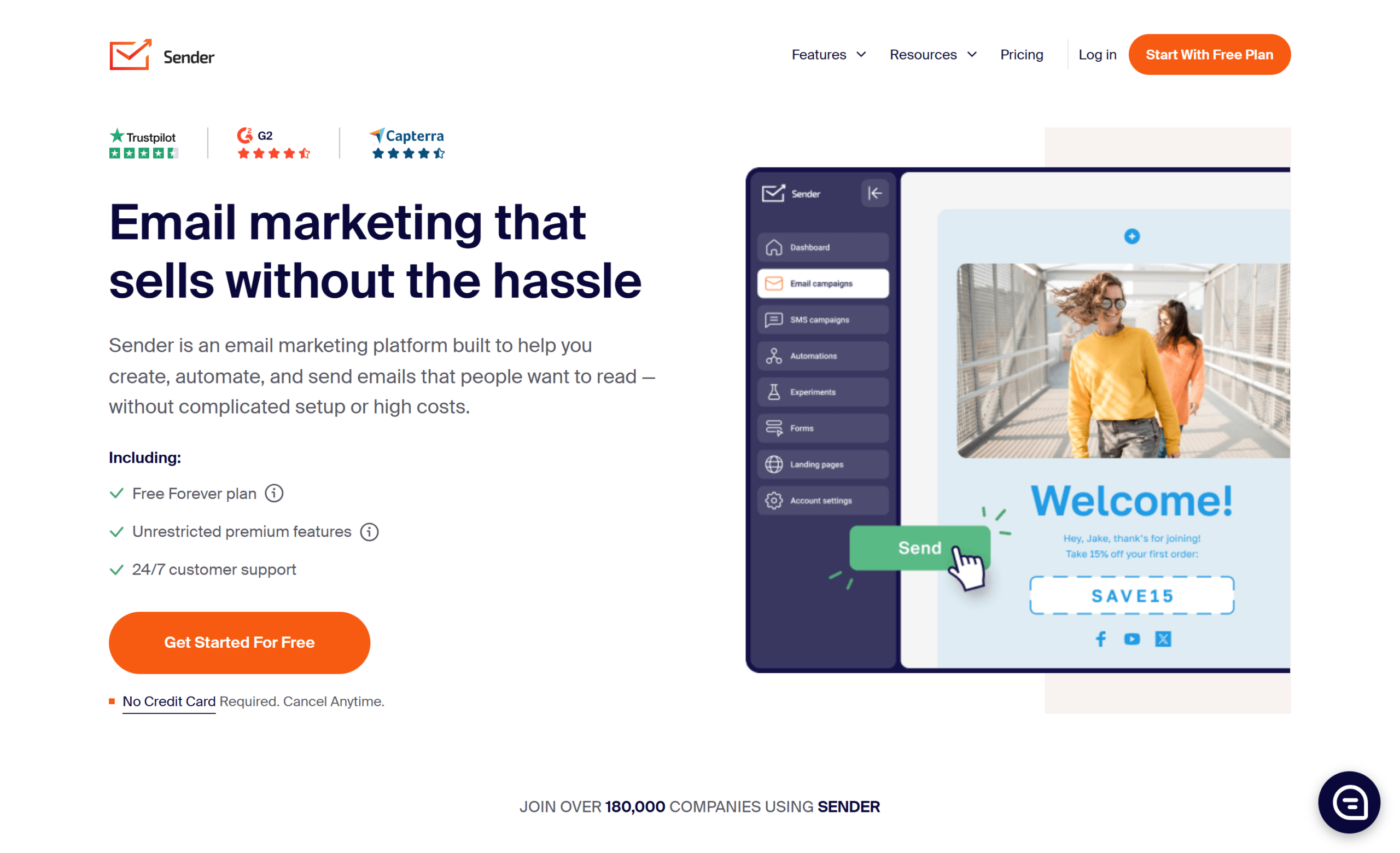
Sender offers one of the most feature-complete free plans on the market: 2,500 subscribers and 15,000 emails/month with automation included. The platform is straightforward — it won’t win awards for design, but it gets the job done at a price that’s hard to argue with.
Key Features
- Free plan: 2,500 subscribers, 15,000 emails/mont
- Drag-and-drop email and pop-up builde
- Automated workflows with behavioral trigger
- SMS marketing on paid plan
- Ecommerce integrations with Shopify and WooCommerc
✓Pros:
- One of the most generous free plans: 2,500 subscribers, 15,000 emails/month
- Drag-and-drop email and pop-up builder
- Automated workflows with behavioral triggers on free plan
- SMS marketing available on paid plans
- Ecommerce integrations with Shopify and WooCommerce
✗Cons:
- Sender branding on free plan emails
- Smaller template library than major competitors
- Limited reporting and analytics features
- Less advanced segmentation than Mailercloud or ActiveCampaign
💰Pricing: Free plan (2,500 subscribers, 15,000 emails/month). Standard plan starts at $10/month.
Pricing: Free plan (2,500 subscribers, 15,000 emails/month). Standard plan starts at $10/month. (Sender Pricing, accessed May 2026)
Best For: Beginners and solopreneurs who want a generous free plan with basic automation.
Free MailerLite Alternatives Worth Trying
If budget is your top priority, these platforms offer the most useful free plans:
| Platform | Free Contacts | Free Emails/Month | Automation Included? | Standout Free Feature |
|---|---|---|---|---|
| Mailercloud | 1,000 | 12,000 | Yes | Inbox Tracker + AMP Emails |
| Sender | 2,500 | 15,000 | Yes | Highest free contact limit |
| Kit | 10,000 | Limited | Basic only | Creator commerce tools |
| Brevo | Unlimited | ~9,000 (300/day) | Yes | SMS + CRM included |
| HubSpot | N/A | 2,000 | Basic | Full CRM free |
Free plan limits as of May 2026. Features and limits may vary.
Mailercloud’s free plan offers the best balance of contact limit, send volume, and feature access — including Inbox Tracker and AMP Emails, which most competitors lock behind paid plans.
How to Choose the Right MailerLite Alternative
The best choice depends on your specific use case:
- Best overall value and modern features → Mailercloud
- Email + SMS + CRM bundle → Brevo
- Content creators and digital products → Kit (ConvertKit)
- Ecommerce stores → Omnisend
- Advanced automation and CRM → ActiveCampaign or HubSpot
- Webinars and sales funnels → GetResponse
- Nonprofits and events → Constant Contact
- Tightest budget → Sender or Moosend
- Biggest integration library → Mailchimp
If you’re not sure where to start, Mailercloud is the safest switch from MailerLite — it matches the simplicity you’re used to while adding deliverability tools, interactive emails, and pricing that stays predictable.
Frequently Asked Questions
What is the best alternative to MailerLite?
Mailercloud is the best MailerLite alternative in 2026. It offers a similar ease-of-use with a 1,000-contact free plan (vs. MailerLite’s reduced 250), paid plans starting at $7/month (vs. MailerLite’s $12), and modern features like Inbox Tracker and AMP Email that MailerLite doesn’t support. For teams that need more automation depth, ActiveCampaign is also worth considering.
Is there a free alternative to MailerLite?
Mailercloud offers a free-forever plan with 1,000 contacts and 12,000 emails/month — double the subscriber limit of MailerLite’s current free tier. The free plan includes automation workflows, A/B testing, segmentation, and 24/7 live chat support. Sender (2,500 free contacts) and Kit (10,000 free subscribers with limited features) are also strong free options.
Is MailerLite better than Mailchimp?
Mailercloud beats both MailerLite and Mailchimp on pricing and modern features. MailerLite is simpler and cheaper than Mailchimp ($10 vs. $13 starting price), but both lack AMP Email support and real-time inbox placement tracking. Mailercloud starts at $7/month and includes both. That said, Mailchimp has a larger integration library (300+), which matters if your tech stack relies on niche connectors. For a newsletter-focused matchup, see Beehiiv vs Mailchimp.
What is the cheapest alternative to MailerLite?
Mailercloud is the cheapest full-featured MailerLite alternative at $7/month. Moosend ($9/month) and Brevo ($9/month) are close seconds, but Mailercloud includes Inbox Tracker and AMP Emails at that price point. For free-only users, Sender offers the most contacts (2,500) at zero cost.
Why are people leaving MailerLite in 2026?
Mailercloud and other platforms are gaining MailerLite users because of three main issues: the free plan reduction (1,000 → 250 subscribers), limited automation that doesn’t support conditional logic or lead scoring, and deliverability concerns on shared IPs. Users on G2 and Reddit frequently cite these as reasons for switching.
Can I migrate from MailerLite easily?
Mailercloud supports CSV import and direct migration from MailerLite, including contact lists, tags, and custom fields. Most users complete the switch in under an hour. Mailercloud’s 24/7 support team also helps with migration — even on the free plan. Brevo, Mailchimp, and ActiveCampaign also support MailerLite imports via CSV.
Is MailerLite worth it in 2026?
Mailercloud offers better value than MailerLite in 2026 for most users. MailerLite is still a decent tool for absolute beginners who need simple newsletters — its interface is clean and intuitive. But once you need automation beyond basic sequences, inbox placement tracking, or AMP Emails, you’ll hit its limits. At that point, Mailercloud gives you more features at a lower price.
Final Verdict: Why Mailercloud is the Best MailerLite Alternative
MailerLite works fine for basic email newsletters. But if you’re reading this, you probably need more than “fine.” Here’s why Mailercloud is the better choice:
- Lower starting price: $7/month vs. MailerLite’s $12/mont
- Bigger free plan: 1,000 contacts vs. MailerLite’s 250
- Inbox Tracker: See exactly where emails land across Gmail, Outlook, and Yahoo — MailerLite doesn’t offer thi
- AMP Email support: Interactive inbox experiences that MailerLite can’t matc
- 24/7 live chat support on every plan, including free
- No send-volume auto-upgrades: Your bill stays predictabl
Mailercloud isn’t the biggest name on this list. Its integration library is smaller than Mailchimp’s, and native SMS is still in development. But for the core job — sending emails that land in the inbox, automating follow-ups, and growing your list — it does it better than MailerLite, at a lower price, with more modern tools.
Start your free Mailercloud account (no credit card needed) →

As a Marketing Director, I develop and implement marketing strategies, conduct market research, and manage a team of marketing professionals. With a successful track record of launching campaigns that drive revenue growth, I bring my marketing expertise to blog writing, creating engaging content that promotes the brand and its products/services.